
OPPO

Search documents
Omdia:2025年中国大陆智能手机市场微幅下滑1%,华为时隔五年重夺第一
Canalys· 2026-01-15 09:17
Core Viewpoint - The Chinese smartphone market is projected to see a slight decline in shipments in 2025, with a total of 282.3 million units, down 1% from the previous year. Huawei leads the market with a 17% share, followed closely by Vivo and Apple, while the overall market dynamics are influenced by government subsidy policies and product differentiation strategies [2][6][9]. Market Performance - In 2025, Huawei's shipments reached 46.8 million units, maintaining a 17% market share, while Vivo and Apple followed closely with 46.0 million and 45.9 million units, respectively. Xiaomi and OPPO rounded out the top five with shipments of 43.7 million and 42.8 million units [9]. - The fourth quarter of 2025 saw a total shipment of 76.4 million units, a year-on-year decline of 1%. Apple led this quarter with 16.5 million units, capturing a 22% market share, while Vivo and OPPO showed improved performance compared to the previous year [2][9]. Strategic Insights - Apple has successfully increased its shipments through a differentiated product strategy, particularly with the iPhone 17 series, which has been well-received by consumers. The company has maintained competitive pricing for its base models, enhancing its product mix [4]. - Huawei is investing heavily in its HarmonyOS ecosystem, committing 1 billion RMB to support innovation in AI and the operating system, while Xiaomi is strategically timing the release of its flagship model to stay competitive [4][6]. Future Outlook - Analysts predict that rising costs will pose significant challenges for smartphone manufacturers in both China and globally in 2026. The increasing prices of storage components will require companies to balance cost distribution, pricing competitiveness, and hardware upgrades [8]. - Despite cost pressures, manufacturers are expected to continue investing in long-term value areas such as channel upgrades, AI, and cross-device ecosystem experiences, indicating that 2026 could still be a year of value growth and product innovation in the Chinese market [8].



Omdia:2025年第四季度,全球智能手机市场增长4%,苹果连续三年蝉联市场首位
Canalys· 2026-01-15 09:17
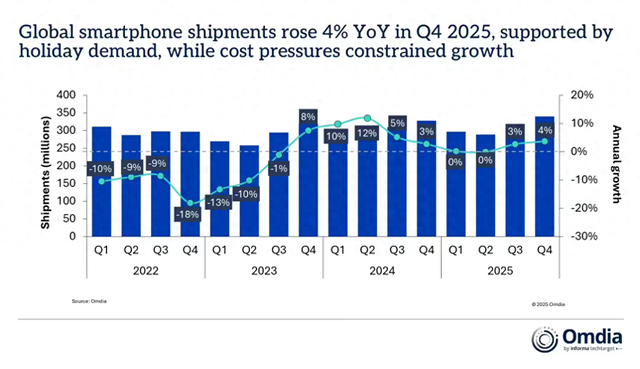
Core Insights - The global smartphone market is expected to grow by 4% year-on-year in Q4 2025, driven by seasonal demand recovery and improved inventory management, despite some manufacturers facing rising component costs [1][2] - Apple leads the market with a 25% share, benefiting from strong demand for the iPhone 17 series, achieving record quarterly shipments and maintaining its position as the largest smartphone manufacturer for three consecutive years [1][5] - Samsung ranks second with an 18% market share, primarily due to strong sales of models priced under $300, particularly the Galaxy A17 series [1] - Xiaomi remains in third place with an 11% market share, although it faced shipment challenges in key markets during Q4 [1][2] - Vivo achieved an 8% market share, bolstered by its leading position in the Indian market, while OPPO returned to growth, re-entering the global top five [1][2] Market Performance - In 2025, global smartphone shipments are projected to grow by 2% year-on-year, reaching 1.25 billion units, reflecting a steady market recovery, although performance varies significantly across regions [2] - The first half of 2025 showed weak performance, while the second half benefited from strong demand in emerging markets and positive responses to flagship model launches [2] - Rising memory costs and supply constraints have begun to impact the market, limiting shipment potential in Q4 [2] Manufacturer Strategies - Rising cost pressures are reshaping manufacturers' strategies for 2026, with increased semiconductor costs and a slowing replacement cycle expected to affect shipment momentum [8] - Manufacturers are optimizing configurations and aligning new product launch strategies more closely with component supply, while leveraging channels such as trade-in programs and ecosystem bundling to support higher price points [8] - The trend towards greater scale and supply-side leverage is evident, as seen with realme's integration into OPPO, reflecting manufacturers' efforts to maintain competitiveness amid rising costs [8][6] Supply Chain Challenges - DRAM supply tightness is creating significant supply pressures in the smartphone industry, expected to be a key factor influencing market trends in 2026 [5][6] - All manufacturers are competing fiercely for supply, emphasizing long-term partnerships, leveraging scale advantages to secure capacity, and focusing on core suppliers [6] - The situation is particularly challenging for manufacturers reliant on entry-level smartphones, as these models are highly price-sensitive and memory and storage costs constitute a larger share of total material costs [6]


Omdia 报告:2025Q4 全球手机出货量出炉,苹果、三星、小米稳居前三
Huan Qiu Wang· 2026-01-15 07:17
【环球网科技综合报道】1月15日消息,市场调查机构 Omdia 发布报告显示,2025 年全球智能手机出货 量达 12.5 亿台,同比增长 2%,呈现 "前低后高" 的复苏态势。其中第四季度表现尤为亮眼,全球出货 量同比增长 4%,苹果、三星、小米等头部品牌格局稳定,行业在结构调整中迈向高质量发展。 在 2025 年第四季度全球智能手机市场份额排名中,苹果以 25% 的占比创下该季度历史新高,凭借 iPhone 17 系列的强劲需求及旧款机型的持续热销,连续第三年蝉联年度全球销量冠军。具体来看,基 础款 iPhone 17 采用 "存储升级不加价" 的亲民策略,销量超出市场预期;主打超薄设计的 iPhone Air 则 进一步提升了高端产品线的市场吸引力,成为苹果业绩增长的重要支撑。Omdia 首席分析师 Sanyam Chaurasia 表示,产品矩阵的精准布局的用户需求的深度契合,推动苹果实现了出货量的历史性突破。 来源:环球网 安卓阵营中,三星以 18% 的市场份额位居第四季度第二,其增长动力主要来自 300 美元以下的中低端 市场,Galaxy A17 系列的 4G 和 5G 机型凭借高性价比深受消费 ...
雷军又要直播、荣耀持续预热、vivo要发布、OPPO售新机
Sou Hu Cai Jing· 2026-01-15 06:02
Group 1 - Major discussions in the industry revolve around smartphone market reports for Q4 2025 and the entire year, emphasizing the need to focus on future developments [1] Group 2 - Lei Jun announced an unexpected live stream to discuss the new Xiaomi SU7, indicating that the vehicle is in its final stages and will have test models available for public experience [3] - Honor is promoting the Magic8 Pro Air, which aims to redefine lightweight flagship standards with a high energy density of 917Wh/L and a battery capacity of 5500mAh, set to launch on January 19 [6] Group 3 - iQOO is set to unveil the Z11 Turbo, with the only remaining uncertainty being its pricing amidst rising memory costs, while Vivo is also promoting the Y500i long-lasting version [8] - OPPO has launched the A6c, focusing on long battery life and durability, targeting offline sales channels [8]

广东制造爆款频出,董明珠们点赞“广货行天下”
Sou Hu Cai Jing· 2026-01-15 04:43
Core Viewpoint - The article emphasizes the importance of quality in both consumer and corporate life, highlighting the robust quality awareness ingrained in Guangdong's manufacturing culture [1]. Industry Overview - Guangdong produces one out of every three smartphones sold globally, with the Greater Bay Area's smart home appliance industry accounting for approximately 30% of the global market [2]. - By November 2025, Guangdong's home appliance exports are expected to represent nearly half of the national total [2]. Historical Context - The "Four Great Kings" of Guangdong, which include traditional products like "Pearl River Water, Guangdong Grain, Lingnan Clothing, and Cantonese Home Appliances," have evolved significantly since the 1980s [3]. Current Industry Developments - "Pearl River Water" now symbolizes Guangdong's extensive trade logistics, with cross-border e-commerce import and export volume increasing 66 times over nine years, holding over one-third of the national market share [4]. - The food industry in Guangdong aims to exceed 1.5 trillion yuan in output value by 2027, with Cantonese mooncakes accounting for 75% of national production and 90% of exports [4]. - Guangdong's clothing and home appliance sectors are innovating in smart wearables and smart home technologies, with 40% of global smartphones and 70% of consumer drones labeled as "Made in Guangdong" [5]. Ecosystem and Supply Chain - Guangdong's manufacturing ecosystem is characterized by deep collaboration and a complete industrial chain, enabling rapid product development and delivery [8]. - In the textile and apparel sector, a micro-ecosystem in Guangzhou allows for clothing production from design to delivery in as little as one day [8]. - The consumer electronics sector benefits from a "one-hour industrial circle" around Dongguan, facilitating efficient assembly of over 95% of smartphone components [8]. Innovation and Technology - The article discusses a transformation in Guangdong's manufacturing driven by AI and user experience, with companies like Gree and Skyworth leading the charge in smart technology integration [12][13]. - The shift in mindset from "what I can produce" to "how I can serve your needs" is highlighted as a key factor in enhancing product offerings [13]. Market Expansion Initiatives - The "Guangdong Goods Going Global" initiative aims to enhance market access for over 6,000 enterprises across various sectors, supported by major e-commerce platforms [15]. - The initiative employs a model of "government support, platform assistance, and enterprise participation," promoting products through cultural integration [15]. Future Outlook - Experts suggest that Guangdong's manufacturing must enhance its brand image and focus on high-value products to compete globally [20][22]. - The importance of leveraging traditional Lingnan culture for creative inspiration in product development is emphasized, alongside the need for technological innovation [22].

龙旗科技港股上市:AI端领军者,智能ODM迎爆发增长
Xin Lang Cai Jing· 2026-01-15 04:23
Core Viewpoint - Shanghai Longqi Technology Co., Ltd. (stock code: 09611.HK) has officially launched its IPO in Hong Kong, planning to issue 52.26 million H-shares with a maximum price of HKD 31.00 per share, aiming to capitalize on the booming demand in the AI sector for performance growth and valuation enhancement [3][5]. Company Overview - Established in 2004, Longqi Technology has evolved into a leading ODM service provider for smart products, offering a comprehensive range of services from product research and design to manufacturing and support [3][5]. - The company has a global presence with R&D centers in Shanghai, Shenzhen, and Huizhou, and production bases in Huizhou, Nanchang, Vietnam, and India, along with branches in the US, South Korea, Japan, Singapore, and Hong Kong [3][5]. Market Position - Longqi Technology holds a 22.4% market share, ranking as the second-largest consumer electronics ODM globally and the largest smartphone ODM with a 32.6% market share [5][14]. - The company has established long-term partnerships with major brands like Xiaomi, Samsung, Lenovo, and OPPO, with several collaborative models exceeding 10 million units in shipments [5][15]. Business Model - The company employs a "1+2+X" framework, focusing on smartphones as the core, personal computing and automotive electronics as key growth areas, and emerging consumer electronics like tablets and wearables [5][7]. - In 2024, smartphone revenue reached RMB 36.13 billion, accounting for 77.9% of total revenue, while AIoT revenue surged by 122% year-on-year to RMB 5.57 billion, representing 12.0% of total revenue [7][8]. Financial Performance - Revenue grew from RMB 29.34 billion in 2022 to RMB 46.38 billion in 2024, with a compound annual growth rate (CAGR) of 25.7% [8][9]. - Net profit improved from RMB 5.6 billion in 2022 to RMB 5.1 billion in the first nine months of 2025, reflecting a 20.9% year-on-year increase [8][9]. Competitive Advantages - Longqi Technology invests heavily in R&D, with cumulative expenditures of RMB 7.23 billion from 2022 to the first nine months of 2025, focusing on wireless communication, audio, display, optics, and AI applications [11]. - The company has established a robust global supply chain and production capabilities, enhancing its competitive edge in responding to market demands and fluctuations in raw material prices [11][12]. Industry Outlook - The global ODM market for consumer electronics is expected to grow, with a forecasted increase in shipment volumes from 2.11 billion units in 2024 to 2.49 billion units by 2029, driven by AI technology integration [12][13]. - The automotive electronics market is projected to expand from RMB 2.5 trillion in 2024 to RMB 3.3 trillion by 2029, indicating significant growth opportunities for ODM manufacturers [13][14]. Future Growth Potential - Longqi Technology is well-positioned to benefit from the AI-driven demand surge in smartphones and other smart products, with expectations of substantial revenue growth in AIoT, AI PCs, and automotive electronics [15][16]. - The company anticipates achieving a net profit of RMB 6.85 billion in 2025, representing a 29.4% year-on-year increase, with further growth projected for 2026 and 2027 [16].
手机市场混战下的新变数:规模与利润之间的博弈,华为、苹果成最大赢家
Tai Mei Ti A P P· 2026-01-15 03:57
Group 1 - In 2025, global smartphone shipments reached 1.26 billion units, marking a 1.9% year-over-year growth, while the Chinese market saw a decline of 0.6% with shipments of approximately 285 million units [2][9][10] - Apple and Samsung maintained their leadership in the high-end market, with Apple achieving a market share of 19.7% and Samsung at 19.1%, both showing significant year-over-year growth [6][7] - Huawei regained the top position in the Chinese market with a market share of 16.4%, despite a slight decline in shipments compared to 2024 [9][10] Group 2 - Apple's iPhone 17 series significantly boosted its performance, leading to a record-breaking market share in China, with a 21.5% year-over-year increase in Q4 shipments [5][6] - Samsung achieved a remarkable 7.9% growth in 2025, the highest among the top five brands, driven by the popularity of its Galaxy A series [7][8] - The smartphone market is expected to face challenges in 2026 due to rising storage costs and changing consumer demands, with predictions of a potential decline in shipments [12][14] Group 3 - The competitive landscape is shifting towards high-end products, with brands focusing on premium offerings to counteract market pressures [16][17] - Xiaomi experienced a mixed performance, benefiting from government subsidies but facing significant declines in Q4, highlighting the volatility in the market [11] - The ongoing shortage of storage chips is anticipated to impact production costs and pricing strategies, leading to adjustments in product specifications and offerings [13][14]
扎克伯格亲手杀死元宇宙
3 6 Ke· 2026-01-15 03:39
Core Insights - The article discusses Meta's strategic shift from a focus on the metaverse to AI-powered smart glasses, marking a significant change in direction for the company [3][4][9] Group 1: Meta's Strategic Shift - Meta announced a 10% workforce reduction in its Reality Labs division, affecting approximately 1,500 employees, as part of a broader strategy to cut the metaverse budget by 30% and redirect resources to AI smart glasses [3][5][9] - The company has incurred a cumulative operating loss of $73 billion in its Reality Labs division over the past four years, highlighting the financial burden of its previous metaverse ambitions [5][6] - Meta's new focus is on AI and mixed reality (MR) technologies, moving away from the immersive VR experiences that characterized its earlier strategy [9][12] Group 2: Market Trends and Comparisons - The article contrasts Meta's approach with Apple's, noting that while Apple continues to prioritize high-end display technology in its Vision Pro, Meta is betting on AI integration in lightweight glasses [14][16] - The rise of AI glasses in the market is seen as a response to user preferences for practical applications rather than immersive virtual experiences, with Meta's new strategy aligning with this trend [9][20] - Chinese tech companies are also adapting to the changing landscape, focusing on practical applications of technology rather than the speculative aspects of the metaverse [17][20] Group 3: Future Implications - The article suggests that AI glasses may soon reach a pivotal moment akin to the iPhone's launch, with advancements in Micro-LED technology and solid-state batteries expected to enhance functionality [21] - New interaction methods, such as voice and gesture controls, are anticipated to replace traditional touch interfaces as the technology evolves [21] - The concept of a pervasive, invisible metaverse is introduced, where augmented reality information seamlessly integrates into daily life without requiring dedicated applications [21][22]


智谱CEO谈DeepSeek冲击;字节正研发新一代豆包AI耳机;携程回应涉嫌垄断被立案调查;传一加手机CEO刘作虎遭通缉...
Sou Hu Cai Jing· 2026-01-15 02:24
Group 1 - The Chinese government has extended the personal income tax refund policy for home purchases until December 31, 2027, which aims to stimulate the real estate market by allowing tax refunds based on the sale and purchase amounts of properties [3][3][3] - The U.S. State Department announced a suspension of visa processing for 75 countries, effective January 21, as part of a reevaluation of screening and review processes [3][3][3] - The U.S. has imposed a 25% tariff on certain imported semiconductors and related products, effective January 15, as part of its trade policy [4][4][4] Group 2 - OpenAI has signed a three-year agreement with Cerebras to procure up to 750 megawatts of computing power, with the total deal exceeding $10 billion, focusing on AI chip technology [7][8][8] - Skild AI has completed a $1.4 billion financing round, raising its valuation to over $14 billion, with participation from major investors including SoftBank and Nvidia [25][25] - Proxima, an AI biotechnology company, has secured $80 million in seed funding, led by DCVC, to advance its research and development efforts [26][26][26] Group 3 - The Chinese smartphone market is projected to see Huawei regain the top position by 2025, with an estimated total shipment of 285 million units, reflecting a slight decline of 0.6% year-on-year [22][22][22] - The private equity firm, Huanfang Quantitative, reported a 56.6% average return in 2025, with assets under management exceeding 70 billion yuan, making it one of the leading quantitative hedge funds in China [6][6][6] - Ctrip is under investigation for alleged monopolistic practices, with the company stating it will cooperate fully with regulatory authorities [13][13][13]

隔夜夜盘市场走势:资讯早间报-20260115
Guan Tong Qi Huo· 2026-01-15 02:06
1. Report Industry Investment Rating No information provided in the content. 2. Core Viewpoints of the Report - The precious metal market had a strong performance on January 14th with spot silver rising over 7% and hitting a record - high of $93 per ounce, and spot gold reaching a new high of $4643 per ounce [4][52]. - The international precious metal futures generally closed higher, and most London base metals also closed up, while the oil market had slight increases [5][6]. - There were various macro - level policy announcements, including central bank operations, tax policies, and industry - specific regulations [9]. - Different sectors in the financial and commodity markets had their own trends and developments, influenced by factors such as geopolitical risks, economic data, and policy changes [32][47][52]. 3. Summary by Relevant Catalogs Overnight Night - Market Trends - Precious metals: Spot silver rose over 7% and hit $93/ounce, spot gold reached $4643/ounce; COMEX gold futures rose 0.76% to $4633.90/ounce, COMEX silver futures rose 7.93% to $93.19/ounce [4][5]. - Base metals: Most London base metals closed up, with LME tin rising 9.03% to $54000/ton, LME nickel rising 6.24% to $18785/ton, etc., while LME aluminum fell 0.25% to $3189.5/ton [5]. - Oil: WTI crude oil rose 0.15% to $61.02/barrel, Brent crude rose 0.08% to $65.52/barrel [6]. Important News Macro News - The central bank will conduct a 900 - billion - yuan 6 - month repurchase operation on January 15th [9]. - The government extended the individual income tax refund policy for home - swapping from January 1, 2026, to December 31, 2027 [9]. - Three departments regulated the new - energy vehicle industry to resist price wars [9]. - China's 2025 foreign trade volume reached 45.47 trillion yuan, with exports growing 6.1% and imports growing 0.5% [10]. - US November retail sales and PPI were higher than expected [11]. - A Fed official said there was no need for a rate cut in January but there might be room later [11]. Energy and Chemical Futures - Qinghai Wucai's soda ash plant reduced production by 30% for about a week [14]. - UAE's Fujairah Port's refined oil inventory rose 4.2% to 19.769 million barrels, while light distillate inventory fell 6.5% [14]. - China's methanol port inventory decreased by 96,900 tons to 1.4403 million tons [14]. - The "ghost fleet" sought Russian ship flags after the US seized Venezuelan oil - trading ships [15]. - China's December crude and refined oil imports had different trends [15]. - Iran's oil exports had record - breaking growth in the past 14 months [15]. - OPEC maintained the 2026 global economic growth forecast at 3.1% and predicted 3.2% for 2027; Russia's 2025 crude output decreased 0.7% [16]. - US crude exports increased by 43,000 barrels/day, commercial crude inventory increased 0.81%, and domestic production decreased by 58,000 barrels/day [18]. Metal Futures - Guangzhou Futures Exchange announced trading fees and order quantity rules for lithium carbonate and polysilicon futures [20]. - Some tin smelters were preparing for delivery, and warehouse receipts were expected to increase [21]. - Indonesia might approve 260 million tons of nickel ore and 60,000 tons of tin production quotas in 2026 [21]. - Sichuan Tianli will conduct production line maintenance, reducing lithium iron phosphate output [21]. - Two clients in lithium carbonate futures were restricted from opening positions for 3 months [21]. Black - Series Futures - HeSteel Group's January 2026 silicon - manganese inquiry price was 5850 yuan/ton, and the purchase volume was 17,000 tons [24]. - Mongolia's December 2025 coal exports increased 16.83% month - on - month and 71.31% year - on - year [24]. - HeSteel got the first steel export license in Hebei after 16 years [24]. - National building materials production, inventory, and demand data showed certain trends as of January 14th [25]. - China's December imports of iron ore and coal increased compared to November [25]. Agricultural Product Futures - Indonesia cancelled the plan to increase the mandatory biodiesel blend ratio to 50% and will raise the CPO export levy from 10% to 12.5% in March [27]. - China's December soybean imports were 8.044 million tons [29]. - US private exporters reported sales of 334,000 tons of soybeans to China and 136,000 tons of corn to South Korea [30]. Financial Markets Finance - On January 14th, A - shares had a volatile day with a turnover close to 4 trillion yuan; different indices had different performances [32]. - Hong Kong's Hang Seng Index rose 0.56%, with net southbound funds buying nearly HK$2.9 billion [32]. - Regulatory authorities issued three - aspect requirements for fund dividends [32]. - On Wednesday, the single - day turnover of domestic ETFs exceeded 700 billion yuan, and the scale of stock - type and cross - border ETFs reached new highs [33]. - Insurance funds' long - term investment pilot got new capital [34]. - A - share GEO concept stocks were active, but some companies clarified their non - involvement [34]. - Zhejiang Securities Regulatory Bureau investigated Sunflower's restructuring plan, and the company terminated the major asset - restructuring [34]. - Shanghai Stock Exchange regulated abnormal trading behaviors in Guosheng Technology [35]. - Baidu considered upgrading its secondary listing in Hong Kong to a dual - primary listing [35]. Industry - Three departments regulated the new - energy vehicle industry to build a fair market order [36]. - In 2025, China's auto production and sales exceeded 34 million, with new - energy vehicles exceeding 16 million, and 2026 sales were expected to grow [36][37]. - The 2026 work meeting of the new - energy vehicle industry emphasized technological breakthroughs and market expansion [37]. - The sixth - batch high - value medical consumables procurement results were announced [37]. - Shanghai launched an action plan for autonomous driving [37]. - In 2025, Huawei regained the top position in China's smartphone market [37]. - The Chinese lunar - year commemorative coins and notes had a hot reservation, and notes had a premium in the secondary market [38]. - The US government will impose a 25% tariff on some semiconductor products from January 15th [39]. - Warren Buffett warned about the risks of AI [39]. Overseas - The Fed's Beige Book showed that most districts had economic growth [41]. - The US urged citizens to leave Iran and withdrew some military personnel; Iran was on high alert [41]. - The US will suspend visa processing for 75 countries from January 21st [41]. - The US Supreme Court did not rule on Trump's tariff policy [42]. - Denmark, the US, and Greenland will discuss Greenland's future [42]. - Some Fed officials had different views on interest - rate cuts [42]. - NASA planned a manned lunar - orbiting mission no earlier than February 6th [42]. - US November PPI and retail sales data were higher than expected [44]. - US December existing - home sales reached the highest level since February 2023 [44]. - Japanese Prime Minister announced the dissolution of the House of Representatives and an early election [44]. - The Bank of Japan will discuss market operations and may continue to raise interest rates [44]. - South Korea's 2025 semiconductor exports reached a record high [45]. - India was considering a proposal for battery - storage system component localization [45]. International Stock Markets - US stocks fell, with the Dow down 0.09%, S&P 500 down 0.53%, and Nasdaq down 1% [47]. - European stocks had mixed results, with Germany's DAX down 0.53% and the UK's FTSE 100 up 0.46% [47]. - Asian - Pacific stocks had mixed performances, with Japan's Nikkei 225 up 1.48% and South Korea's KOSPI up 0.65% [47]. - Market regulators investigated Ctrip for suspected monopoly, and its stock prices fell [48]. - Citigroup's Q4 revenue rose 2.1% to $19.87 billion [49]. - Bank of America's Q4 revenue rose 7% to $28.37 billion [50]. - Czechoslovak Group planned an IPO worth €750 million in Amsterdam [51]. Commodities - Precious metals had a strong rally, and industrial metals like copper and tin also strengthened [52]. - International precious metal futures closed higher, supported by geopolitical and economic factors [52]. - London base metals mostly closed up [52]. - Oil prices rose slightly due to Iran - related supply concerns [53]. - Tungsten prices continued to be strong in 2026 [53]. - OPEC maintained the 2026 oil demand growth forecast and predicted 2027 growth [53]. Bonds - China's bond market had a mixed performance, with the central bank conducting repurchase operations [55]. - Japan's government bonds were sold off due to election - related fiscal concerns [55]. - US Treasury yields fell across the board [55]. Foreign Exchange - The on - shore RMB against the US dollar rose 31 points, and the RMB central parity rate was depreciated [56]. - The US dollar index fell 0.11%, and most non - US currencies rose [56]. - Japan's finance minister warned about exchange - rate fluctuations, and the yen rebounded [56]. - South Korea's central bank will discuss excess foreign - exchange reserves with commercial banks [58]. Upcoming Economic Data and Events - Economic data release schedule includes UK, German, US, etc., data from 2025 [60]. - Event schedule includes central bank operations, company press conferences, and Fed officials' speeches [62].