香港交易所

Search documents
港交所将于1月19日推出新股票期权类别
Xin Lang Cai Jing· 2026-01-09 04:45
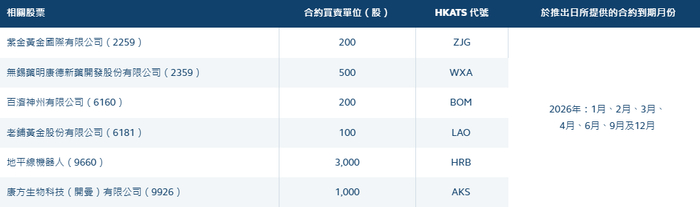
Group 1 - The Hong Kong Stock Exchange (HKEX) announced the launch of six new stock option categories on January 19, aimed at expanding the stock options market and providing investors with more choices [1] - The average daily trading volume in the HKEX derivatives market reached 1,662,751 contracts last year, marking a 7% year-on-year increase and setting a new record [1] - Stock options, including monthly and weekly expiry contracts, were among the most actively traded products, with an average daily trading volume of 879,831 contracts last year, which is a 22% year-on-year increase and also a record high [1] Group 2 - The new stock options include contracts for companies such as Anjin Huangjin Guo Yi Limited (2259), Wuxi Zhenming Kangde New Town Development Co., Ltd. (2359), and others, with varying contract sizes and expiry months [2] - Specific contract sizes for the new options range from 100 shares to 3,000 shares, catering to different investor needs [2] - The introduction of these new options is expected to enhance liquidity and trading opportunities in the stock options market [2]


新财观|COP30峰会释信号:内地与香港协同引领绿色资金新流向
Xin Hua Cai Jing· 2026-01-09 03:13
Global Climate Governance - The current global climate funding gap is significant, with developing countries needing approximately $215 billion to $387 billion annually for adaptation, while public funding only reaches $23 billion to $30 billion, less than one-tenth of the required amount [2] - Disagreements between developed and developing countries regarding funding responsibilities and technology transfer remain unresolved, complicating climate financing mechanisms [2] COP30 Key Outcomes and Funding Mechanism Breakthroughs - COP30 achieved structural progress in several areas, despite ongoing disagreements on fossil fuel issues, establishing new directions for global climate governance [3] - A significant breakthrough in climate funding mechanisms was reached, with an agreement to triple global climate adaptation funding by 2035 and a new "Tropical Forest Forever Fund" initiated by Brazil, aiming for a target size of $125 billion [4] - The establishment of the "Belém Action Mechanism" (BAM) marks the first inclusion of "just transition" in the UNFCCC framework, providing institutional support for affected industries and communities during energy transitions [5] - COP30 initiated the transition of global carbon markets from rule-making to infrastructure connectivity, promoting technical cooperation among countries on carbon market standards [6][7] China's Green Finance Strategy - China announced a new Nationally Determined Contribution (NDC) target, committing to reduce total greenhouse gas emissions by 7% to 10% by 2035, enhancing transparency and demonstrating responsibility in global climate governance [8] - The green finance system in China is maturing, with a multi-layered policy framework established since 2016, leading to a significant increase in green loans and investments in energy transition and ecological protection [9] - The green bond market in China is expanding, with cumulative issuance exceeding 4 trillion yuan, primarily funding clean energy and green infrastructure projects [10] Hong Kong's Role in Green Finance - Hong Kong is positioning itself as an international green finance hub, with significant growth in green and sustainable debt issuance, reaching approximately $84.4 billion in 2024 [18] - The regulatory framework for green finance in Hong Kong is advancing, with the introduction of a sustainable finance classification directory and enhanced disclosure requirements for listed companies [16][25] - Hong Kong is leveraging its offshore RMB center advantage to attract international investments in green bonds, enhancing the appeal of "green RMB" products [17][18] Collaboration Between Mainland China and Hong Kong - The collaboration between Mainland China and Hong Kong in green finance is evolving towards a three-tiered integration of products, standards, and platforms [20] - The mutual accessibility of green financial products, including green bonds and transition finance, is expected to enhance cross-border capital flows [21] - Joint efforts in standardization and information disclosure are underway, with both regions working towards a unified green finance classification system [24][25] - Infrastructure connectivity is being established to facilitate cross-border green capital movement, addressing challenges in regulatory recognition and environmental impact verification [26][27]
智通ADR统计 | 1月9日





智通财经网· 2026-01-08 22:22
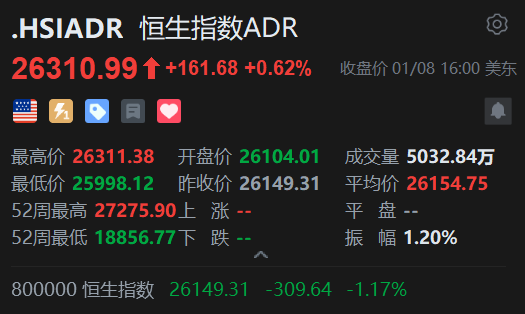
Market Overview - The Hang Seng Index (HSI) closed at 26,310.99, up by 161.68 points or 0.62% as of January 8, 16:00 Eastern Time [1] - The index reached a high of 26,311.38 and a low of 25,998.12 during the trading session, with a trading volume of 50.328 million shares [1] Major Blue-Chip Stocks Performance - HSBC Holdings closed at HKD 125.439, up by 0.92% compared to the Hong Kong close [2] - Tencent Holdings closed at HKD 615.197, down by 0.13% compared to the Hong Kong close [2] Stock Price Movements - Tencent Holdings: Latest price HKD 616.000, down by HKD 8.500 or 1.36%, with an ADR price of 615.197, reflecting a decrease of 0.13% [3] - Alibaba Group: Latest price HKD 142.600, down by HKD 3.300 or 2.26%, with an ADR price of 150.458, reflecting an increase of 5.51% [3] - HSBC Holdings: Latest price HKD 124.300, down by HKD 2.900 or 2.28%, with an ADR price of 125.439, reflecting an increase of 0.92% [3] - Other notable movements include Meituan-W down by 3.35% and JD.com down by 2.02% [3]
【窩輪透視】港交所窩輪2日漲27%!原來是這兩個指標在發力
Ge Long Hui· 2026-01-08 21:27
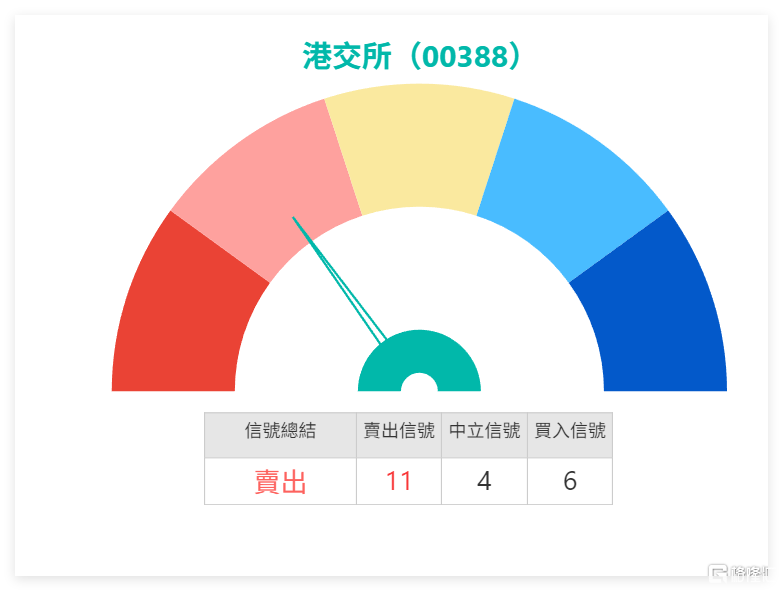
Core Viewpoint - The Hong Kong Stock Exchange (HKEX) is currently experiencing a technical analysis phase with support levels at 415 HKD and 405 HKD, and resistance levels at 438 HKD and 456 HKD, indicating a potential upward movement probability of 52% [1][3]. Technical Analysis - The recent performance of HKEX shows a relatively strong trend compared to the Hang Seng Index, with the stock price stabilizing around 430 HKD, above the upper band of the Bollinger Bands [3]. - The short-term resistance level is identified at approximately 438 HKD, and if this level is breached, there is potential for the stock to rise to 440 HKD [3]. - Current technical signals indicate a predominance of "sell" signals, with 11 sell signals compared to 6 buy signals, suggesting a cautious outlook for short-term movements [3]. Derivative Products Performance - Following a phase of price increase on January 5, 2026, related warrants (窩輪) showed significant reactions, with UBS bull certificates (64102) rising by 27%, Societe Generale bull certificates (57689) by 24%, and Morgan Stanley call warrants (22028) by 23% within two days, highlighting the leverage effect of these products [3][5]. - The key factors influencing the price movements of warrants include the proximity of the exercise price to the underlying stock price and changes in implied volatility, which affects market expectations of future volatility [5][6]. Investment Recommendations - For investors holding HKEX-related warrants, it is advisable to set profit-taking levels, such as placing a stop-loss slightly below recent highs for Societe Generale bull certificates (69254) to avoid profit erosion [6]. - New investors are cautioned against chasing high-priced warrants that have already seen significant increases, such as UBS bull certificates (64102), and are encouraged to consider alternatives like Societe Generale bull certificates (69254) and Morgan Stanley call warrants (22028) due to their lower premium and higher leverage [6]. - For those with a bearish outlook on HKEX's short-term performance, Societe Generale bear certificates (69592) are recommended, as they offer the lowest premium and a high leverage of 19.1, allowing for better capitalizing on potential declines [6]. Selected Products Overview - A summary of selected products related to HKEX includes: - Morgan Stanley call warrant (22028) with a leverage of 13 - UBS call warrant (23422) with a leverage of 9.4 - Societe Generale bear certificate (69592) with a leverage of 19.1 [7].
香港交易所(0388.HK)25年业绩前瞻:多重利好兑现高增长 交投延续看三支撑
Ge Long Hui· 2026-01-08 21:17
Core Viewpoint - The Hong Kong stock market is expected to see significant trading activity in 2025, driven by macroeconomic recovery, favorable policies, industrial upgrades, and improved global liquidity, leading to high growth in Hong Kong Stock Exchange's performance [1] Market Overview - As of December 2025, the market capitalization of the Hong Kong securities market was HKD 47.39 trillion, a decrease of 1.26% quarter-on-quarter but an increase of 34.18% year-on-year [1] - The average daily trading amount (ADT) for 2025 reached HKD 249.82 billion, up 90.28% year-on-year, with Q4 ADT at HKD 229.81 billion, reflecting a 22.97% increase year-on-year but a 19.75% decrease quarter-on-quarter [1][2] Southbound Capital Inflow - In 2025, southbound capital saw a net inflow of HKD 1.301455 trillion, a year-on-year increase of 74.92%, with quarterly inflows of HKD 411.33 billion, HKD 272.86 billion, HKD 399.99 billion, and HKD 217.28 billion respectively [2] - The influx of southbound capital has significantly boosted trading activity in the Hong Kong stock market [2] IPO Market - In 2025, there were 117 new listings, an increase of 47 compared to the previous year, with total IPO fundraising amounting to HKD 285.81 billion, a year-on-year increase of 224.24% [2] - The increase in IPO fundraising was largely driven by major A-share companies listing in Hong Kong, contributing to 49.02% of the total IPO fundraising [2] Derivatives and Commodity Market - In 2025, the average daily trading volume of futures and options reached 1.663 million contracts, a year-on-year increase of 7.1% [3] - The average daily trading volume of metal contracts on the LME was 757,000 lots, reflecting a 14.0% year-on-year increase [3] Interest Rate Impact - Following the Federal Reserve's interest rate cuts, the HIBOR rate has seen a slight decline, with the 6-month HIBOR dropping from 4.17% at the beginning of 2025 to 2.99% [4] - The decline in interest rates is expected to enhance trading activity in the Hong Kong stock market, which may offset some negative impacts on investment income [4] Earnings Forecast - Revenue forecasts for 2025, 2026, and 2027 are projected to increase by 26.53%, 2.70%, and 3.84% respectively, reaching HKD 28.31 billion, HKD 29.07 billion, and HKD 30.19 billion [5] - Net profit forecasts for the same years are expected to rise by 38.49%, 6.22%, and 4.01% respectively, reaching HKD 17.60 billion, HKD 18.69 billion, and HKD 19.44 billion [5] Market Dynamics - The ongoing liquidity support from the Federal Reserve's monetary policy shift is expected to benefit the Hong Kong stock market [6] - The continuous inflow of southbound capital is anticipated to maintain high trading activity levels [6] - The valuation advantage of the Hong Kong stock market remains, with the Hang Seng Index's PE-TTM at approximately 11.96 times, compared to the 17.00 times of the CSI 300 [6] Long-term Outlook - The Hong Kong Stock Exchange is expected to benefit from increased trading activity and valuation uplift, with a target price of HKD 520 per share, maintaining a "buy" rating [7]
1月7日【港股Podcast】恆指、港交所、兗礦能源、友邦保險、中移動、阿里
Ge Long Hui· 2026-01-08 20:15
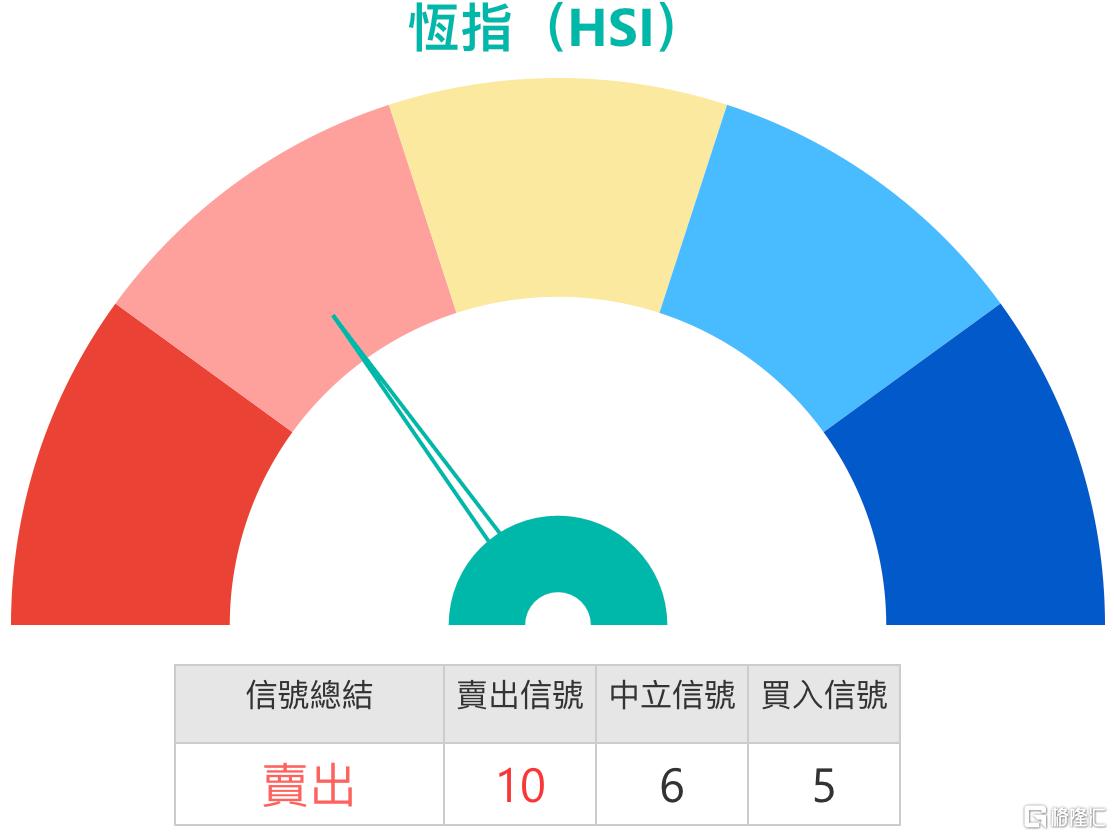
Group 1: Hang Seng Index (HSI) - Bullish investors continue to expect the index to rise to 27,000 points, maintaining their positions in bull certificates with a redemption price of 25,854 points [1][2] - Bearish investors believe the recent small rebound has ended and anticipate a decline of 300-400 points, holding bear certificates with a redemption price of 27,300 points [1][2] - Current technical signals show a predominance of sell signals, with 10 sell signals compared to 5 buy signals, indicating a potentially less optimistic short-term market outlook [2][4] Group 2: Hong Kong Exchanges and Clearing (00388.HK) - The stock price of Hong Kong Exchanges is showing a relatively strong performance, currently trading around 430 HKD, with a potential resistance level at 438 HKD [5] - If the stock can break through the 438 HKD resistance, there is a possibility of reaching 440 HKD [5] - Technical signals indicate a majority of sell signals, with 11 sell signals and 6 buy signals, suggesting a cautious short-term outlook [5][6] Group 3: Yancoal Energy (01171.HK) - Yancoal Energy's stock price has shown strong upward movement, with a significant increase in trading volume [11] - The short-term resistance level is around 11.2 HKD, and if this level is surpassed, the stock could rise to 11.5 HKD [11] - Current technical signals are neutral, indicating no clear direction in the stock's movement [11][15] Group 4: AIA Group (01299.HK) - AIA's stock price has remained relatively stable, with a slight decline, and is currently consolidating at high levels [16] - The resistance level is approximately 89.1 HKD, and if surpassed, the stock could potentially reach 90 HKD or higher [16] - The technical signals are predominantly sell signals, with 10 sell signals and 6 neutral signals, indicating a cautious approach for investors [16][21] Group 5: China Mobile (00941.HK) - China Mobile's stock has experienced increased volatility, currently trading around 81.3 HKD, with a support level at 78.2 HKD [21][22] - If the stock falls below 78.2 HKD, it may decline further to around 74.9 HKD [21][22] - The technical signals are primarily buy signals, with 5 buy signals and 5 sell signals, suggesting some support for bullish positions [22][25] Group 6: Alibaba Group (09988.HK) - Alibaba's stock has seen a notable decline, with increased trading volume during the market downturn [26] - The support level is around 142 HKD, and if breached, the stock could drop to 140 HKD or lower [26] - Although the technical signals indicate a majority buy signals, caution is advised due to the proximity of the redemption price to the support level [26][30]

证券2026年展望-投资中国优质券商正当时
2026-01-08 02:07
Summary of Key Points from the Conference Call Industry Overview - The conference call discusses the Chinese securities industry, highlighting the growth opportunities for domestic brokers due to deepening capital market reforms, increased foreign investment, and rising demand for prime brokerage services [1][2]. Core Insights and Arguments - **Growth Projections**: The profitability growth rate for Chinese brokers is expected to reach 12% in 2026, supported by policies such as the normalization of IPO issuances and the expansion of derivatives [1][5]. - **Regulatory Environment**: The regulatory focus on supporting strong firms while limiting weaker ones is leading to accelerated industry consolidation, improving the performance structure of leading brokers [1][4]. - **Investment Value Changes**: Historically low investment value in the securities sector is changing due to reduced competition, improved performance stability, and a shift towards risk-neutral strategies [4][10]. - **Market Dynamics**: The demand for direct financing is increasing due to economic transformation, with a notable rise in M&A and debt restructuring activities [2][19]. Investment Opportunities - **Short-term Opportunities**: Key investment lines for 2026 include: 1. Increased activity in the primary market driven by normalized A-share IPOs. 2. Brokers with strong sales and trading capabilities benefiting from stable returns generated by institutional investors. 3. Companies with strong international business growth, particularly those leading in cross-border operations [6][22]. - **Wealth Management Trends**: The shift in resident wealth towards financial assets presents opportunities for brokers to enhance their wealth management services, focusing on differentiated offerings for retail clients [8][9]. Important but Overlooked Content - **Long-term Investment Value**: The long-term investment value of the securities sector is expected to improve as the industry structure becomes more balanced and competitive pressures decrease [10][14]. - **Regulatory Changes**: The ongoing regulatory reforms are expected to enhance the growth potential and valuation framework for brokers, particularly in attracting long-term foreign capital [19][20]. - **Valuation Metrics**: Current valuations for the securities sector are low, providing a safety net for future growth, with A-share and Hong Kong brokers trading at 1.5x and 0.98x PB levels, respectively [20]. Conclusion - The Chinese securities industry is poised for significant growth driven by regulatory support, market demand, and evolving investment strategies. Key players are expected to capitalize on these trends, enhancing their market positions and profitability in the coming years [21][22].
智通ADR统计 | 1月8日



智通财经网· 2026-01-07 22:21
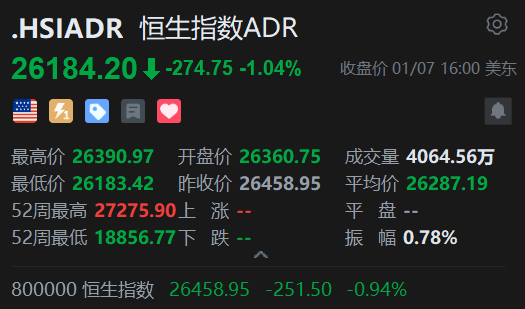
Market Overview - The Hang Seng Index (HSI) closed at 26,184.20, down by 274.75 points or 1.04% from the previous close of 26,458.95 [1] - The index reached a high of 26,390.97 and a low of 26,183.42 during the trading session, with an average price of 26,287.19 [1] Major Blue-Chip Stocks Performance - HSBC Holdings closed at 124.996 HKD, down 1.73% from the previous close [2] - Tencent Holdings closed at 619.762 HKD, down 0.76% from the previous close [2] - Alibaba Group (W) saw a decline of 3.25%, closing at 145.900 HKD [3] - Other notable declines include: - Xiaomi Group (W) down 1.55% to 38.160 HKD [3] - NetEase (S) down 2.88% to 222.600 HKD [3] - Meituan (W) down 1.51% to 104.500 HKD [3] ADR Performance - Tencent's ADR closed at 619.762, reflecting a decrease of 0.76% compared to its Hong Kong stock price [3] - HSBC's ADR was at 124.996, down 1.73% from its Hong Kong counterpart [3] - Alibaba's ADR closed at 142.841, down 2.10% compared to its Hong Kong price [3]
万亿外资巨头,加仓!
Zhong Guo Ji Jin Bao· 2026-01-07 13:52
Group 1 - BlackRock increased its holdings in Haier Smart Home, WuXi Biologics, Midea Group, and Bank of China on January 2, 2026 [1][3] - The shareholding percentage of WuXi Biologics increased from 5.32% to 6.14%, Midea Group from 5.15% to 6.75%, Bank of China from 5.98% to 6.11%, and Haier Smart Home from 7.72% to 8.34% [3] - Previously, on December 29, 2025, BlackRock had reduced its holdings in Midea Group from 7.03% to 5.16% and in Bank of China from 6.07% [3] Group 2 - Goldman Sachs released a report predicting that China's GDP growth in 2026 will exceed market expectations, recommending an overweight position in Chinese stocks [4][5] - The report anticipates a continuation of the bull market in Chinese stocks, with annual growth rates of 15% to 20% in 2026 and 2027, supported by earnings growth and valuation re-rating [5] - UBS Wealth Management expressed optimism for the Chinese market, highlighting advanced manufacturing and technological self-reliance as new growth engines, with a projected 37% earnings growth for the Hang Seng Tech Index in 2026 [5]



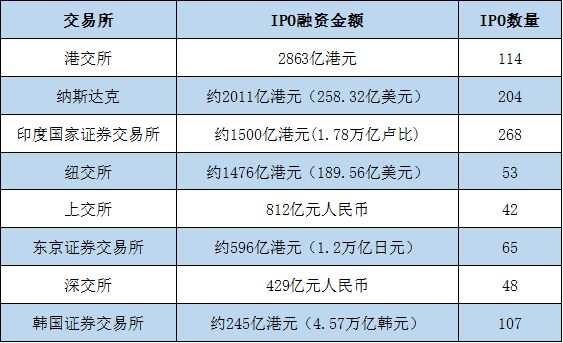
2025全球IPO榜:港交所第一,印度“意外”上榜
Zheng Quan Shi Bao Wang· 2026-01-07 12:19
Group 1 - The global IPO market showed significant recovery in 2025, with Hong Kong Stock Exchange returning to the top position globally, hosting 114 IPOs and raising 286.3 billion HKD [1][2] - The largest IPO globally was Medline, which raised approximately 62 billion USD on NASDAQ, surpassing the Indian National Stock Exchange, which ranked second with 268 listings and a total fundraising of 1.78 trillion INR [2][4] - The top ten IPOs in 2025 were diverse in industry, including sectors such as biomedicine, security, and finance, with Hong Kong Stock Exchange accounting for four of these IPOs [3][6] Group 2 - Medline's IPO on December 17, 2025, marked a significant milestone, with a first-day market valuation exceeding 54 billion USD, providing substantial returns to its private equity backers [4][5] - Verisure, a Swedish security company, also had a notable IPO, raising approximately 36 billion EUR and achieving a first-day increase of 21%, marking it as the largest IPO in Europe since 2022 [4][5] - Predictions for 2026 indicate a potential wave of large IPOs, particularly from major US exchanges, with estimates of 200 to 230 companies going public and raising between 40 to 60 billion USD [7][8] Group 3 - Hong Kong is expected to maintain competitiveness in the IPO market, with forecasts suggesting around 150 new listings in 2026, raising between 320 to 350 billion HKD, driven by technology, consumer, and green economy sectors [8] - The competition between US and Hong Kong capital markets is anticipated to intensify, with both markets expected to see significant IPO activity [8]