Arm Holdings plc

Search documents
Stocks Finish Sharply Higher as Tech Stocks Soar
Yahoo Finance· 2025-11-24 21:35
The markets will look to this week’s economic news for direction. On Tuesday, Sep retail sales are expected to climb +0.4% m/m and +0.3% m/m ex-autos. Also, Sep PPI is expected to remain unchanged from Aug at +2.6% y/y, and Sep core PPI is expected to ease to +2.7% y/y from +2.8% y/y in Aug. In addition, The Conference Board’s Nov consumer confidence index is expected to fall by 1.2 points to 93.4. Finally, on Tuesday, Oct pending home sales are expected to climb +0.1% m/m. Wednesday brings weekly initial u ...
今夜,暴涨!
中国基金报· 2025-11-24 16:14
Group 1 - The core viewpoint of the article highlights a significant rise in technology stocks, particularly in the U.S. markets, with the Nasdaq index surging nearly 2% [2][3] - Major semiconductor companies like AMD and Micron, along with tech giants such as Tesla and Alphabet, saw substantial stock price increases, contributing to the overall market rally [3] - The market sentiment is largely influenced by rising expectations for a potential interest rate cut by the Federal Reserve, with the probability of a cut next month reaching nearly 80% [4][5] Group 2 - The article notes that the Boston Fed President Susan Collins does not see an urgent need for rate cuts, while New York Fed President John Williams indicated that there may be reasons for a cut in the near term [5] - Analysts express that the current economic data is subject to various interpretations due to delays in official data releases, complicating the economic outlook [7] - Chinese stocks also performed well, with the China concept stock index rising approximately 2.5%, and Xiaomi's ADR increasing over 4% following a significant share buyback by its founder Lei Jun [7][8]






4 top takeaways from MIT’s 2025 CFO Summit
Yahoo Finance· 2025-11-24 13:19
Core Insights - CFOs are facing a plethora of new AI tools that promise to enhance workflows, but they must critically assess the actual capabilities of these tools and their fit within finance [2][3][4] - The role of CFOs is evolving as they navigate risks and changes brought about by AI, regulatory shifts, and economic challenges, requiring a new approach to team management and risk assessment [4][6][7] - The increasing frequency of "black swan" events necessitates agile scenario planning and a focus on supply chain management, which has become a critical topic in boardrooms [20][21] AI Integration in Finance - CFOs need to differentiate between automation and true AI capabilities, as many tools currently available are more about automation than genuine AI [2][3] - Understanding the probabilistic nature of AI models, such as large language models, is crucial for CFOs to determine where to place trust in these technologies [8] Skills and Talent Management - Strong analytical, interpretative, and storytelling skills are becoming increasingly important for CFOs and their teams, as AI can handle routine tasks but human skills are essential for strategic decision-making [9][12] - The ability to communicate financial results effectively to various stakeholders is a key skill for CFOs, requiring tailored narratives for different audiences [14] Evolving CFO Roles - The role of CFO is expanding to include operational responsibilities, with many CFOs also taking on titles such as COO or president, reflecting a broader scope of influence in business strategy [15][16] - Successful CFOs emphasize the importance of delegation and developing talent within their teams to manage the dual responsibilities of finance and operations effectively [18] Navigating Risks and Uncertainties - The rise of black swan events has made it essential for CFOs to prepare for unexpected challenges and to incorporate flexible forecasting methods into their planning [19][20] - Supply chain management has gained prominence in discussions among CFOs, highlighting its critical role in navigating current economic uncertainties [20]
美媒:英伟达也技穷了?华尔街陷入分裂,AI泡沫破裂进入倒计时?
Sou Hu Cai Jing· 2025-11-24 09:24
Core Insights - Nvidia's recent earnings report, which initially caused a surge in stock price, ultimately led to a decline, indicating a shift in market sentiment and expectations [3][4] - The market's threshold for "good news" has significantly increased, with investors questioning sustainability and profitability despite Nvidia's strong performance [5][6] Market Sentiment - Wall Street is experiencing a divide between optimistic and skeptical investors, with the former viewing recent pullbacks as a temporary adjustment in a bull market [6][7] - Skeptics are concerned about high valuations and systemic risks associated with "circular financing," where major companies invest in startups that in turn purchase services from them, creating a false sense of prosperity [7][9] Financial Data - Major tech companies like Microsoft, Amazon, Meta, and Alphabet contribute over 40% of Nvidia's revenue and plan to increase capital expenditures by 34% to a total of $440 billion in the next 12 months [9] - Despite Nvidia's optimistic guidance, concerns arise regarding the ability of these companies to convert high spending on GPUs into sustainable profits [9][10] Stock Performance - CoreWeave Inc. has seen a 46% drop in stock price, while Oracle's shares fell by 24%, marking the largest monthly decline since the 2001 internet bubble burst [11][12] - The semiconductor sector is also under pressure, with related indices dropping 11% in November and popular stocks like AMD and Arm experiencing declines over 20% [16] Future Outlook - The AI investment cycle is still perceived as in its early stages, but the era of easy capital and storytelling to attract investment may be coming to an end [17][18] - Investors are urged to seek clear paths to return on investment, as the current environment is fraught with uncertainty and potential volatility [18]

Raymond:投资主题从周期转向AI,这些美股芯片股仍有大幅上涨空间
智通财经网· 2025-11-24 03:52
Core Viewpoint - The investment bank Raymond believes that semiconductor stocks, including Nvidia (NVDA.US), AMD (AMD), and Intel (INTC.US), have significant upside potential, with a focus on the dominance of artificial intelligence in the market [1][2] Semiconductor Industry Ratings - Raymond has reinstated its ratings for the semiconductor industry, giving "Outperform" ratings to AMD and Broadcom (AVGO.US), "Market Perform" ratings to ARM (ARM.US), Astera Labs (ALAB.US), and Intel, and "Strong Buy" ratings to Marvell Technology (MRVL.US) and Nvidia [1] - The analysts emphasize that the AI theme has become dominant, overshadowing trading strategies based on semiconductor market cycles [1] Nvidia's Position - Nvidia is highlighted as a leader in the AI sector and is considered a "core holding" for investors due to its strong competitive advantages and mature software stack developed over a decade [1] - The company benefits from robust community support and a full-stack system approach [1] Marvell Technology Insights - Marvell Technology faces skepticism as a custom chip supplier, but analysts believe it has the necessary advantages through its dedicated integrated circuit business and optical division [1] - Currently, data center products account for approximately 75% of sales, with expectations for continued growth in the custom integrated circuit and data center optical digital signal processor markets [1] - Management aims to capture about 20% of the market share in the data center custom integrated circuit sector by 2028, valued at over $8 billion [1] Broadcom's Market Potential - Broadcom is expected to expand its market share in the AI sector as large enterprises seek customized alternatives to general-purpose processors [1] AMD's Competitive Edge - AMD is seen as a strong competitor to Nvidia in the graphics processing market, with expectations for growth in accelerators and AI rack systems [2] - The company is projected to produce 1.9 million MI350 chips and 9.15 million MI450 chips by fiscal year 2027, indicating potential market share expansion in servers and personal computers [2] ARM's Strategic Focus - ARM is concentrating on expanding into the data center sector and exploring AI-related opportunities, including in-house chip development [2] - Data center sales have approached 20% of total sales over the past two years, increasing the company's engagement with hyperscale operators [2] Astera Labs' Market Position - Astera Labs is recognized as a leading supplier in the retimer market, focusing on high-speed connectivity services with its PCIe5 and PCIe6 products [2] - The significant increase in computational intensity has driven demand for the company's core high-speed interconnect technology [2] Intel's Stock Recovery - Intel's stock has seen a notable recovery due to various events, including investments from the U.S. government, Nvidia, and SoftBank, although its fundamentals still require improvement [2] - The stock is trading significantly above historical averages, with overall assessments indicating its fair value is close to the current price [2]
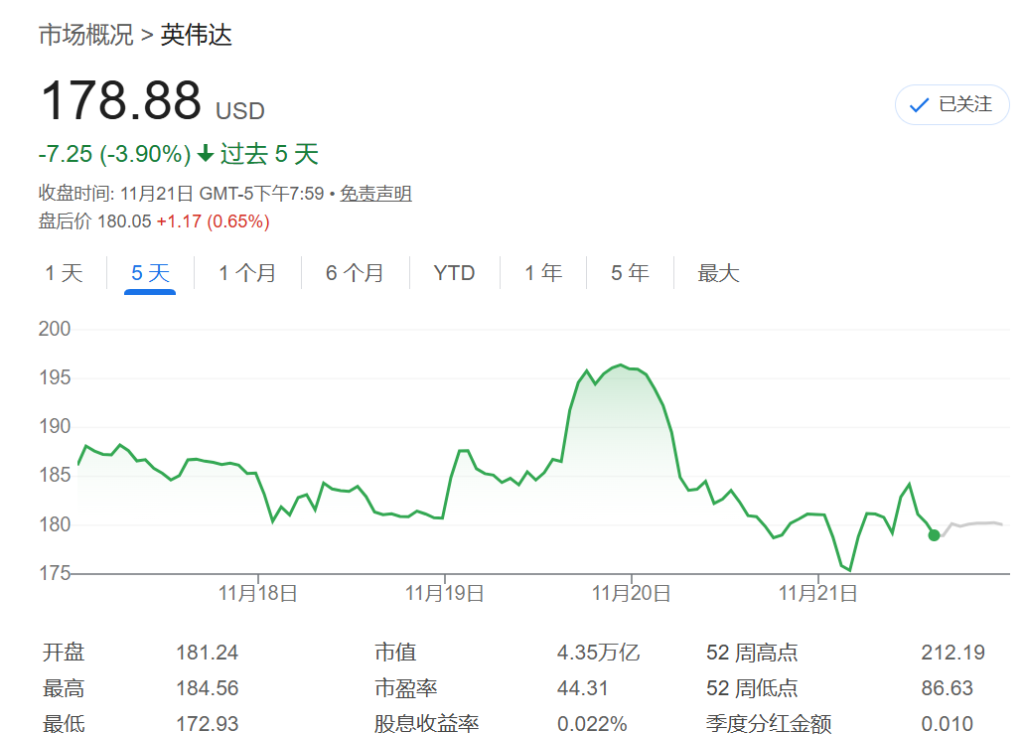
英伟达救不了AI股,市场想看到什么?
美股IPO· 2025-11-24 03:41
Core Viewpoint - Nvidia's strong earnings report failed to boost the AI sector and instead deepened market anxiety, shifting investor focus from capital expenditure to return on investment (ROI) [1][2][9] Market Reaction - Nvidia's stock initially rose over 5% after its earnings report but reversed to close down 3.2%, reflecting a broader market trend where the S&P 500 and Nasdaq 100 also experienced declines [2] - The AI ecosystem is under pressure, with a chip-related stock index dropping 11% in November, marking its worst month since 2022, and companies like AMD and Arm seeing declines over 20% [4] Company-Specific Performance - Meta's stock has fallen 21% since its earnings report on October 29 due to concerns over aggressive capital spending, while Microsoft's stock dropped 13% for similar reasons [4] - Companies with weaker balance sheets, such as CoreWeave and Oracle, faced significant stock price declines of over 40% and 29%, respectively, potentially marking Oracle's largest monthly drop since 2001 [4][7] Diverging Opinions on AI Outlook - There is a clear divide in market sentiment regarding the future of AI, with skeptics fearing that high valuations driven by a few AI stocks are unsustainable, especially as companies may resort to debt to maintain spending [8] - Optimists view recent market corrections as healthy adjustments, believing that major tech players will continue to invest in AI without signs of slowing down [8] Shift in Investor Focus - Investors are increasingly questioning the ROI of substantial capital expenditures, seeking evidence of faster growth and higher profitability from companies providing AI software and services [9][10] - Nvidia's strong performance has not alleviated concerns regarding its major clients, including Microsoft, Amazon, Meta, and Alphabet, which are expected to increase their combined capital expenditures by 34% to $440 billion over the next 12 months [10] Future Volatility - The consensus among investors is that the path forward for AI trading will be bumpier, influenced by macroeconomic uncertainties and differing views on the progress of the AI revolution [11]

英伟达独强难支,AI股何去何从?
Jin Shi Shu Ju· 2025-11-24 03:26
Core Insights - The initial positive reaction to Nvidia's earnings report did not alleviate investor concerns about the AI stock bubble, leading to significant market volatility [1] - The market is currently divided into two camps: skeptics who warn of bubble risks and optimists who see potential for long-term growth [2] Group 1: Skeptics' Concerns - Skeptics are worried that the market valuations are reaching unreasonable levels as investors chase a few AI-related stocks [3] - There are concerns about the sustainability of the massive capital investments made by companies to remain competitive, especially as they begin to incur debt [3] - The cyclical nature of these financing arrangements could pose systemic risks, where the weakness of one company could drag down the entire AI-related sector [3] Group 2: Optimists' Perspective - Optimists view the recent pullback in AI stocks as a healthy correction, indicating that greater growth is on the horizon [4] - Major tech companies like Microsoft, Amazon, Meta Platforms, and Alphabet are expected to continue investing heavily in AI, with a projected 34% increase in capital expenditures to $440 billion over the next 12 months [4] - There is a belief that the AI investment cycle is just beginning, supported by strong industry demand and a favorable regulatory environment [4] Group 3: Nvidia's Role and Market Reactions - Nvidia's performance was anticipated due to prior disclosures from its major clients, which account for over 40% of its sales [5] - Despite Nvidia's strong earnings, other semiconductor stocks have faced significant declines, with the chip-related stock index dropping 11% in November, marking the worst monthly performance since 2022 [5] - Concerns about the sustainability of AI spending have led to sharp declines in stocks of companies like AMD and ARM, with losses exceeding 20% [5] Group 4: Investment Return Concerns - Investors are increasingly questioning the return on investment (ROI) for AI-related expenditures, which is critical for future growth and profitability [6] - The need for clarity on ROI is seen as essential for reviving interest in AI investments, with expectations that it may take one or two more quarters to see relevant evidence [6] - Nvidia's earnings report may have temporarily alleviated immediate concerns about AI investment sustainability, but doubts about large spending companies remain [6] Group 5: Market Volatility and Consensus - The divergence in investor perspectives contributes to ongoing volatility in the AI market, with macroeconomic uncertainties and differing views on the AI revolution's development stage [8] - The collapse of the cryptocurrency market is also seen as a factor contributing to the observed volatility [8]
Wedbush:AI及高性能计算领域内存供应持续紧张
智通财经网· 2025-11-24 02:12
Group 1: Memory Market Insights - High demand for memory, particularly Flash Memory and DRAM, is expected to continue driving prices upward [1] - Memory supply remains tight, with NAND experiencing a sharp price increase similar to DRAM starting in October, often seeing double-digit percentage hikes [1] - Major players in the DRAM market include SK Hynix, Samsung, and Micron Technology, while leading NAND manufacturers are Samsung, SK Hynix, Western Digital, Intel, and Micron Technology [1] Group 2: Quantum Computing and Supercomputing Trends - There is a growing interest in quantum computing within the commercial sector, with companies like IBM, Fujitsu, D-Wave, IonQ, and others being highlighted [2] - The latest list of the world's 500 most powerful supercomputers saw 45 new entrants, but none made it into the top ten, although this is expected to change with new projects from the U.S. Department of Energy [2] - NVIDIA remains the leading supplier for supercomputing systems, occupying 30 GPU slots and 6 CPU slots, while Intel secured 25 CPU slots and AMD obtained 18 slots (14 CPUs and 4 GPUs) [2]

英伟达财报难消市场疑虑 AI赛道陷”泡沫论“ 与 ”早期论“激辩
Zhi Tong Cai Jing· 2025-11-24 00:13
Core Viewpoint - The explosive earnings report from Nvidia did not alleviate investor concerns about a potential AI stock bubble, leading to a divided market sentiment regarding the current state of AI trading [1][5]. Group 1: Market Sentiment - Skeptics worry that the market valuations of AI-related growth stocks have soared to dangerous levels, with concerns about the sustainability of the massive investments required to maintain competitive positions [1][3]. - Optimists view the recent pullback in AI stocks as a healthy adjustment before further gains, believing that major tech companies will continue to invest in AI development without signs of slowing down [1][2]. - Market volatility was highlighted after Nvidia's earnings report, with initial gains followed by a significant drop, reflecting uncertainty among investors regarding future profitability and energy demands [2][5]. Group 2: Financial Performance and Projections - Nvidia's strong earnings report was anticipated due to prior disclosures of spending plans from major clients like Microsoft, Amazon, Meta, and Alphabet, which collectively account for over 40% of Nvidia's sales [3]. - These major clients are expected to increase their capital expenditures by 34% over the next 12 months, reaching $440 billion [3]. - Despite Nvidia's solid performance, other semiconductor companies have faced challenges, with the semiconductor index down 11% in November, marking the worst monthly performance since 2022 [3][5]. Group 3: Investment Returns and Concerns - Investors are increasingly questioning the return on investment (ROI) for AI software and services, with the timing of when substantial investments will translate into growth and profitability being a critical issue [4][5]. - Concerns about the sustainability of large capital expenditures have led to significant stock price declines for companies like Meta and Microsoft, with declines of 21% and 13% respectively since their earnings reports [5]. - Companies with weaker balance sheets, such as CoreWeave and Oracle, have experienced even more severe stock price drops, indicating heightened scrutiny on their financial health [5]. Group 4: Broader Economic Context - The macroeconomic uncertainty and differing views on the stage of the AI revolution contribute to the observed market volatility, compounded by the collapse of cryptocurrency markets [6].




英伟达救不了AI股,市场想看到什么?
Hua Er Jie Jian Wen· 2025-11-24 00:07
Core Insights - Despite Nvidia's strong earnings report, market anxiety persists, leading to a significant stock price reversal and a broader market decline [1] - The AI ecosystem is under pressure, with a notable drop in chip-related stocks and significant declines in companies heavily investing in AI, such as Meta and Microsoft [5][9] Market Reactions - Nvidia's stock initially rose over 5% following its earnings report but closed down 3.2%, reflecting a volatile market response [1] - A chip-related stock index fell by 11% in November, marking its worst month since 2022, with AMD and Arm experiencing declines over 20% [5] Investor Sentiment - Investors are increasingly questioning the sustainability of capital expenditures and the return on investment (ROI) from AI investments [2][10] - Concerns are growing that high valuations in the AI sector may not be justified, with fears of a potential bubble [9] Company Performance - Meta's stock has dropped 21% since its earnings report due to investor concerns over aggressive capital spending plans, while Microsoft's stock has fallen 13% for similar reasons [5] - Companies with weaker balance sheets, such as CoreWeave and Oracle, have faced even steeper declines, with CoreWeave's stock plummeting over 40% [5][8] Future Outlook - There is a divide in market sentiment regarding the future of AI investments, with some investors viewing recent corrections as healthy, while others fear unsustainable spending [9][11] - The focus is shifting from capital expenditures to the need for clear evidence of ROI, which is critical for restoring momentum in AI investments [10]