上海钢联

Search documents
开年已涨33%!锡价创历史新高
Shang Hai Zheng Quan Bao· 2026-01-15 04:58
Core Viewpoint - The strong performance of tin prices is driven by supply disruptions and increasing demand from sectors such as consumer electronics, automotive electronics, and AI, leading to a significant rise in trading activity and market interest [1][3][4]. Group 1: Price Performance - As of January 15, the main tin contract on the Shanghai Futures Exchange reached a record high of 443,400 CNY per ton, marking a year-to-date increase of 33.5% [1][3]. - The London Metal Exchange (LME) tin contract also saw a year-to-date increase of approximately 33% [3]. Group 2: Supply Disruptions - Recent natural disasters, such as landslides in the North Kivu province of the Democratic Republic of Congo, have raised concerns about potential disruptions in tin mining and transportation, further fueling market sentiment [3][4]. - The market is also reacting to the slower-than-expected recovery of tin production in Myanmar, despite some analysts predicting an acceleration in recovery by late January [4]. Group 3: Demand Drivers - Tin is increasingly recognized as a "technology metal" and "computing metal," with significant applications in solder for electronics, solar cells, and electric vehicles, contributing to rising demand [1][6]. - The International Tin Association reports that over half of the tin produced is used for soldering, a trend expected to continue in the next decade [6]. Group 4: Future Demand Projections - The demand for tin solder is projected to grow at a compound annual growth rate (CAGR) of 7% from 2024 to 2030, driven by advancements in AI, smart devices, and the electrification of vehicles [7]. - Overall global tin demand is expected to grow at a CAGR of 4.3% during the same period [7]. Group 5: Supply Constraints - The global static reserve-to-production ratio for tin is only 16 years, indicating a scarcity of this metal [7]. - Major tin-producing countries, including China, Indonesia, Myanmar, Peru, and Brazil, are facing various challenges that limit supply, such as resource depletion and regulatory changes [7][8]. - The International Tin Association warns that the lack of investment in new mines over the past two decades could lead to significant supply challenges in the future [8].
固态电池产业化提速,电池ETF嘉实(562880)有望持续受益
Xin Lang Cai Jing· 2026-01-14 06:44
Group 1 - The China Securities Battery Theme Index decreased by 0.01% as of January 14, 2026, with leading stocks such as Fulin Precision rising by 9.84% and Shuneng Electric falling [1] - The price of battery-grade lithium carbonate reported by Shanghai Steel Union increased by 2,050 yuan/ton to 165,900 yuan/ton compared to the previous day's closing price [1] - The inter-ministerial joint meeting on the development of energy-saving and new energy vehicles emphasized enhancing the self-controllable capabilities of the supply chain and accelerating breakthroughs in solid-state batteries and advanced autonomous driving technologies [1] Group 2 - As of December 31, 2025, the top ten weighted stocks in the China Securities Battery Theme Index include CATL, Sungrow Power, and others, accounting for a total of 51.77% of the index [2] - The Battery ETF by Harvest (562880) closely tracks the China Securities Battery Theme Index, providing a convenient tool for investing in the battery theme sector [2] Group 3 - Investors without stock accounts can also access battery industry investment opportunities through the Battery ETF linked fund (016567) [3]
上海钢联股价涨5.93%,南方基金旗下1只基金位居十大流通股东,持有233.09万股浮盈赚取393.93万元
Xin Lang Cai Jing· 2026-01-14 02:44
Group 1 - Shanghai Steel Union's stock price increased by 5.93% to 30.20 CNY per share, with a trading volume of 278 million CNY and a turnover rate of 3.06%, resulting in a total market capitalization of 9.625 billion CNY [1] - The company, established on April 30, 2000, and listed on June 8, 2011, primarily engages in B2B e-commerce services related to the steel, energy, mining, and non-ferrous metals industries [1] - The revenue composition of Shanghai Steel Union includes 97.29% from supply chain services, 1.56% from consignment services, 0.66% from data subscription services, 0.19% from business promotion services, 0.12% from conference training services, 0.11% from other services, 0.07% from research consulting services, and 0.01% from other supplementary services [1] Group 2 - Southern Fund's Southern CSI 1000 ETF (512100) is among the top ten circulating shareholders of Shanghai Steel Union, having reduced its holdings by 17,900 shares to 2.3309 million shares, representing 0.76% of the circulating shares [2] - The Southern CSI 1000 ETF has a current scale of 76.63 billion CNY, with a year-to-date return of 8.02%, ranking 1352 out of 5520 in its category, and a one-year return of 49.62%, ranking 1555 out of 4203 [2] - The fund manager, Cui Lei, has been in position for 7 years and 70 days, managing assets totaling 122.76 billion CNY, with the best fund return during the tenure being 234.52% and the worst being -15.93% [3]

印尼镍矿拟减产引发市场震荡 产能优势难挡库存高压
2 1 Shi Ji Jing Ji Bao Dao· 2026-01-13 02:11
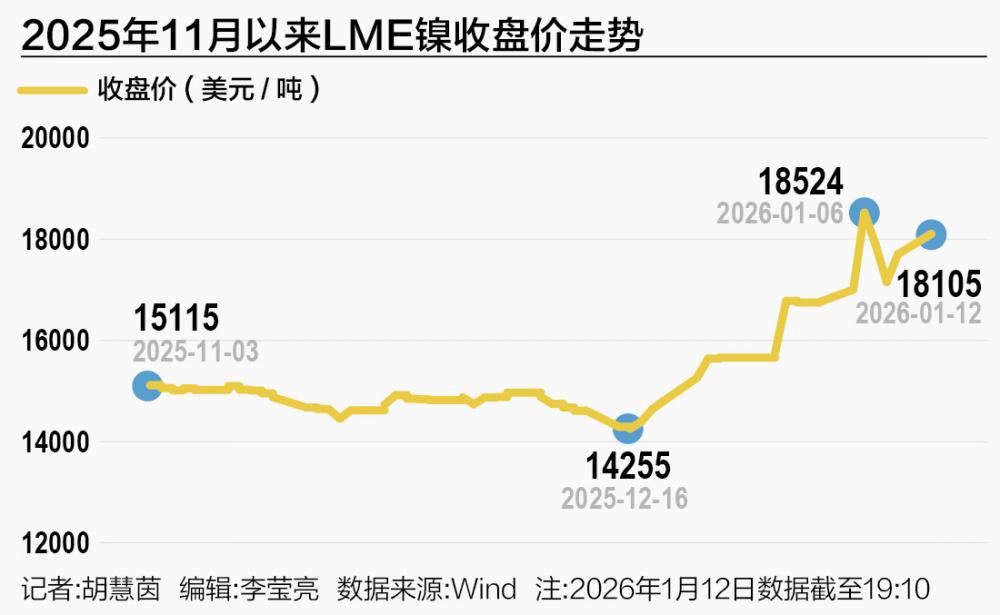
Core Viewpoint - Nickel prices have surged significantly since mid-December 2022, driven by supply concerns from Indonesia and increased investment in China's metal market, although signs of a cooling trend are emerging [1][3][4]. Group 1: Price Movements - On January 6, 2023, nickel futures prices rose by 10.5%, nearing $18,800 per ton, marking the largest single-day increase since late 2022 [1]. - As of January 12, 2023, nickel futures prices fell to $17,703 per ton, reflecting a cumulative increase of 5.6% since the beginning of the year [1]. - The recent nickel price surge has been accompanied by a decline in prices, with LME nickel dropping to $18,059 per ton and Shanghai nickel at ¥143,760 per ton by January 12, 2023 [3]. Group 2: Supply Dynamics - Indonesia controls nearly 70% of global nickel production and plans to cut production quotas by approximately 34% to 250 million tons by 2026 [4][8]. - The Indonesian government is also adjusting the pricing formula for nickel and imposing taxes on cobalt, which is expected to increase production costs [4][9]. - Analysts suggest that Indonesia's shift from production expansion to active regulation aims to stabilize prices and address supply concerns [4][9]. Group 3: Market Sentiment and Future Outlook - The current market sentiment indicates limited downside potential for nickel prices, with predictions suggesting an average price of $15,250 per ton by 2026 if no significant production cuts are implemented [1][11]. - Despite the recent price volatility, analysts believe that the oversupply situation in the nickel market has not been resolved, with expectations of a surplus of 350,000 to 400,000 tons by 2026 [11]. - The demand side remains weak, particularly in the stainless steel sector, which has been a significant consumer of nickel [10][11]. Group 4: Strategic Considerations - Indonesia's nickel industry policies are evolving, focusing on maximizing resource value and stabilizing prices rather than merely expanding production [7][9]. - The country aims to enhance its influence in the global nickel market through coordinated policies among nickel-exporting nations, akin to an "OPEC for nickel" [8]. - The long-term strategy includes developing downstream industries, particularly in electric vehicle production, to increase the added value of nickel resources [8][9].

镍价飙涨创近三年高位
2 1 Shi Ji Jing Ji Bao Dao· 2026-01-12 23:42
Core Viewpoint - Nickel prices have surged since mid-December 2022, driven by supply concerns from Indonesia and a large-scale investment boom in China's metal market. However, signs of a cooling trend have emerged, with prices dropping from a peak of nearly $18,800 per ton to $17,703 per ton by January 12, 2023, reflecting a 5.6% increase since the beginning of the year [1][2][3]. Group 1: Price Movements and Market Dynamics - On January 6, 2023, nickel futures prices on the London Metal Exchange (LME) rose by 10.5%, marking the largest single-day increase since late 2022 [1][2]. - As of January 12, 2023, LME nickel was priced at $18,059 per ton, while Shanghai nickel futures were at 143,760 yuan per ton, showing a nearly 7.7% increase since the start of the year [2][3]. - The recent surge in nickel prices contrasts with the performance of other metals like copper and aluminum, which have reached new highs, indicating a divergence in market trends [1][3]. Group 2: Supply Concerns and Indonesian Policy - Indonesia controls approximately 70% of global nickel production and has announced plans to reduce production quotas by 34% to about 250 million tons by 2026 to better match supply and demand [2][3][4]. - The Indonesian government is also adjusting the pricing formula for nickel and imposing taxes on by-products like cobalt, which could increase production costs and tighten supply [3][4]. - Analysts suggest that Indonesia's shift from expansion to active regulation and price support is a strategic move to address concerns about future supply shortages [3][4]. Group 3: Investment Trends and Market Sentiment - The recent volatility in nickel prices has been fueled by a comprehensive investment boom in the Chinese metal market, with significant trading volumes observed in nickel and other metals [4][5]. - Investor behavior in the precious metals market has shifted towards a "buying the dip" strategy, although recent declines in nickel prices may indicate a potential retreat from this trend [4][5]. - The overall sentiment in the market remains cautious, with expectations of a potential oversupply of nickel persisting, despite temporary price increases [22][23]. Group 4: Future Outlook and Challenges - Analysts predict that unless Indonesia implements strict production controls and demand experiences a significant rebound, nickel prices may struggle to maintain high levels, with forecasts suggesting an average price of $15,250 per ton by 2026 [1][3][22]. - The demand for nickel is primarily driven by the stainless steel and battery sectors, but current market conditions indicate a weakening demand, particularly in the stainless steel industry [21][22]. - The potential for structural changes in nickel demand exists, but large-scale substitutions are unlikely due to fixed nickel content in stainless steel and the established preferences for battery technologies [23][24].
美联储1月或暂停降息 黄金站上4600美元再创新高
Xin Lang Cai Jing· 2026-01-12 12:51
Group 1 - The core point of the article indicates that the U.S. labor market is showing signs of "weak growth and low unemployment," which has led to a decrease in expectations for the Federal Reserve to cut interest rates in January 2026 [2][3] - In December 2025, the U.S. non-farm employment increased by 50,000, which was below the market expectation of 70,000, while the unemployment rate unexpectedly dropped to 4.4%, lower than the anticipated 4.5% [2] - Analysts suggest that the current economic data and the potential for a change in the Federal Reserve's leadership in 2026 may influence future monetary policy decisions [3][6] Group 2 - Following the release of the non-farm data, gold prices strengthened, with COMEX gold futures rising by 1.29% to $4,518.4 per ounce on January 9, 2026, and continuing to reach historical highs above $4,600 per ounce [3][4] - Factors influencing the rise in gold prices include high geopolitical risks, increasing U.S. fiscal risks, and strong demand from global central banks for gold [4][5] - The World Gold Council reported that gold performed exceptionally well in 2025, continuously setting historical records, and forecasts a potential price increase of 15% to 30% in 2026 [7]
印尼拟减产引发镍市震荡 下游雄心遭遇需求和替代化双重挑战
2 1 Shi Ji Jing Ji Bao Dao· 2026-01-10 01:39
Core Viewpoint - Nickel prices have surged significantly since mid-December 2022, driven by supply concerns from Indonesia and increased investment in China's metal market, although signs of a cooling trend are emerging [1][2][4] Group 1: Price Movements - On January 6, 2023, nickel futures prices on the London Metal Exchange surged by 10.5%, nearing $18,800 per ton, marking the largest single-day increase since late 2022 [1] - As of January 9, 2023, nickel futures prices fell to $17,155 per ton, reflecting a cumulative increase of 3.3% since the beginning of the year [1] - The Shanghai nickel futures contract reached a peak of 147,720 yuan per ton, with a significant increase of nearly 24,000 yuan per ton from its December 2022 low [2] Group 2: Supply Dynamics - Indonesia controls approximately 70% of global nickel production and plans to reduce its production quota by 34% to about 250 million tons by 2026 [3][5] - The Indonesian government is also adjusting the pricing formula for nickel and imposing taxes on by-products like cobalt, which could increase production costs [3][5] - Analysts suggest that Indonesia's shift from production expansion to active regulation aims to stabilize prices and address supply concerns [3][6] Group 3: Market Sentiment and Demand - The recent surge in nickel prices is partly attributed to a broader investment boom in the Chinese metal market, with trading volumes for nickel and other metals increasing significantly [4] - Despite the recent price increases, there are concerns about ongoing weak demand in the stainless steel and battery sectors, which could limit future growth [7][9] - The market anticipates that unless there is a substantial and sustained reduction in supply or a significant recovery in demand, nickel prices may not remain elevated [8][9] Group 4: Future Outlook - Analysts predict that if Indonesia strictly implements its production quota, nickel prices may stabilize at higher levels in the short term, but long-term supply overhang remains a concern [9] - The potential for structural substitution in nickel usage is limited, as changes in demand are primarily driven by cost and performance requirements rather than price fluctuations [9]
上海钢联涨2.11%,成交额1.87亿元,主力资金净流出366.30万元
Xin Lang Cai Jing· 2026-01-09 03:13
Group 1 - The core viewpoint of the news is that Shanghai Steel Union's stock has shown a positive performance with a 5.81% increase since the beginning of the year and a significant rise in net profit despite a decrease in revenue [2][3] - As of January 9, Shanghai Steel Union's stock price increased by 2.11% to 26.58 CNY per share, with a total market capitalization of 8.472 billion CNY [1] - The company primarily operates in B2B e-commerce services related to steel, energy, mining, and non-ferrous metals, with supply chain services accounting for 97.29% of its revenue [2] Group 2 - For the period from January to September 2025, Shanghai Steel Union reported a revenue of 57.318 billion CNY, a year-on-year decrease of 10.65%, while net profit attributable to shareholders increased by 31.78% to 1.68 billion CNY [2] - The company has distributed a total of 1.51 billion CNY in dividends since its A-share listing, with 63.136 million CNY distributed in the last three years [3] - As of September 30, 2025, the number of shareholders increased by 3.49% to 37,200, while the average circulating shares per person decreased by 3.34% to 8,238 shares [2]
开年即冲刺 全力保交付 订单“催更” 锂电企业扩产马不停蹄
Zhong Guo Zheng Quan Bao· 2026-01-08 22:01
Core Viewpoint - The lithium battery industry is experiencing a significant investment boom, driven by increasing demand for energy storage and stable growth in power battery installations, leading to a tight supply-demand balance in 2026 [4][6]. Group 1: Company Expansion Plans - Longpan Technology plans to invest up to 2 billion yuan to build a new production base for 240,000 tons of high-pressure lithium iron phosphate annually, as existing capacity cannot meet customer demand [1][2]. - In addition to Longpan Technology, several companies, including Fulin Precision, Dongfang Zirconium, and Xinzhou Bang, have announced investment plans for lithium battery projects, continuing the expansion trend from 2025 [1][2]. - Longpan Technology has previously raised funds to build projects with capacities of 110,000 tons and 85,000 tons of high-performance phosphate-based cathode materials, with ongoing capacity expansion efforts [2]. Group 2: Industry Investment Trends - Since 2025, over 282 investment projects in the lithium battery industry chain have been announced in China, with a total investment exceeding 820 billion yuan, marking a year-on-year increase of over 74% [2]. - The investment trend is not only domestic but also expanding internationally, with companies like Xinzhou Bang planning to invest approximately 260 million USD in a lithium-ion battery materials project in Saudi Arabia [3]. Group 3: Market Dynamics - The surge in lithium battery investments is attributed to multiple factors, including the explosive growth in energy storage demand, steady increases in power battery installations, and rapid technological advancements [4][5]. - The industry has transitioned from a state of oversupply to a tight balance since mid-2025, with expectations of continued investment momentum into 2026 due to strong demand growth [6][7]. - Companies are increasingly adopting a rational approach to expansion, focusing on "order capacity" to avoid blind investments and ensure sustainable growth [6][7].



复星系再拓资本版图
Xin Lang Cai Jing· 2026-01-08 16:56
Group 1 - Fosun International's subsidiary, Shanghai Yiyao Technology Co., Ltd., has initiated the IPO process, aiming to expand its capital footprint in the A-share market [1][3] - Fosun has developed into an innovative global family consumption industry group over 30 years, focusing on a happiness ecosystem centered around health, happiness, and wealth [1][4] - Currently, Fosun controls six A-share listed companies and four Hong Kong-listed companies, with four of the A-share companies having a market capitalization exceeding 100 billion [1][5] Group 2 - The performance of Fosun's listed companies shows significant divergence, with six companies reporting a decline in net profit, reflecting operational pressures in certain sectors [1][8] - Shanghai Yiyao Technology, established in July 2018, aims to provide high-tech solutions across various intelligent manufacturing sectors, including automotive and food automation [3][4] - Fosun's total assets exceeded 796.5 billion as of December 31, 2024, with a global presence in over 35 countries and regions [4][6] Group 3 - The latest financial reports indicate that among the six A-share companies, Shanghai Steel Union and Fosun Pharma reported net profit growth, while others like Yuyuan and Hainan Mining experienced declines [8][9] - Fosun's strategic focus is shifting from diversified expansion to deepening its core sectors, particularly in health and intelligent manufacturing, to optimize cash flow and enhance capital efficiency [7][8]