中复神鹰

Search documents
成交额超2000万元,化工行业ETF易方达(516570)连续13天净流入
Xin Lang Cai Jing· 2026-02-04 04:47
Core Viewpoint - The chemical industry ETF, E Fund (516570), has shown mixed performance with a slight decline of 0.46% recently, while the underlying index, the China Petroleum Industry Index (H11057), has also seen a minor drop of 0.16% as of February 4, 2026 [1]. Group 1: Index Performance - As of February 4, 2026, the China Petroleum Industry Index (H11057) decreased by 0.16% [1]. - The leading stocks in the index included China Petroleum, which rose by 3.02%, and Shanghai Petrochemical, which increased by 1.63% [1]. - The worst performers were Guangdong Hongda, which fell by 4.17%, and Zhongfu Shenying, which dropped by 2.11% [1]. Group 2: ETF Performance - The E Fund chemical industry ETF (516570) had a recent price of 1.09 yuan, with a two-week cumulative increase of 0.55%, ranking it in the top half of comparable funds [1]. - The ETF recorded a turnover rate of 1.84% during the trading session, with a total transaction volume of 29.4586 million yuan [1]. - The ETF's total assets reached 1.595 billion yuan, marking a one-year high [1]. Group 3: Fund Flows - Over the past 13 days, the E Fund chemical industry ETF has experienced continuous net inflows, with a peak single-day inflow of 391 million yuan, totaling 1.371 billion yuan in net inflows [1]. - The average daily net inflow for the ETF was 105 million yuan [1]. Group 4: Top Holdings - As of January 30, 2026, the top ten weighted stocks in the China Petroleum Industry Index accounted for 55.71% of the index, including Wanhua Chemical and China Petroleum [2].
碳纤维背板龙头光大同创,签约中复神鹰和机器人公司
DT新材料· 2026-02-03 16:05
【DT新材料】 获悉, 2月3日, 光大同创 发布公告, 北京中科慧灵机器人技术有限公司 日前与 公司 及 迪洛斯人工智能科技 正式签署《人形机器人 及具身智能领域合作框架协议》。 三方将围绕人 形机器人最关键的"骨骼"与"皮肤"——结构件与外观件的轻量化新 材料展开定向研发,并通过"技术—产能"的深度绑定机制,为中科慧 灵CASBOT灵宝系列人形机器人的工程化与规模化交付夯实基础。 根据协议,双方将摒弃传统简单采买模式,直接进入联合研发阶段, 围绕中科慧灵下一代人形机器人在关节高动态响应及"中间加固超薄空心腔体"等 高难度结构需求, 协同开展碳纤维及先进复合材料的微观结构设计与工艺参数寻优,力图在材料物理极限内实现性能突破,提升机器人本体的抗冲击 性、可靠性与能效比。 资料显示, 光大同创 成立于2012年3月20日,于2023年4月18日登陆创业板。公司 拥有多家子公司,厦门奔方材料、苏州领新智能等从事 碳纤维复合 材料生产以及碳纤维背板加工相关业务。 公司是消费电子防护及功能件领域的头部企业之一 。率先实现消费电子级碳纤维的量产,良品率达95%,成本较日本东丽低20%,在轻量化材料领域 构建了坚实的技术 ...


东华大学启动纺织新材料学科先导项目
Zhong Guo Hua Gong Bao· 2026-02-03 06:18
Group 1 - The project focuses on the research of new textile materials, targeting three main research directions: high-performance fibers and composite materials, bio-based and recycled fiber materials, and smart fibers and flexible devices [1] - The initiative aims to promote interdisciplinary integration in textiles, establishing a comprehensive education system that combines cutting-edge guidance, inter-school collaboration, and industry-education integration [1] - The project seeks to cultivate emerging interdisciplinary fields such as "Textiles + Mechanics," "Textiles + Biology," and "Textiles + Intelligence," emphasizing the high-performance, green, and intelligent development of textile materials [1] Group 2 - Representatives from various task teams reported on project advancement strategies, key pathways, expected outcomes, and existing progress during the meeting [2] - Collaboration with industry partners was highlighted, focusing on themes such as industry-education integration, collaborative innovation, and results transformation [2] - Expert consultants provided high praise for the project and offered suggestions on enhancing cross-school and cross-disciplinary mechanisms, promoting collaborative innovation between academia and industry, and developing high-level innovation platforms [2]
深度|商业航天新材料全景图:新材料企业的机遇与投资逻辑(附20+报告)
材料汇· 2026-02-02 14:42
Core Viewpoint - The global commercial aerospace market is experiencing unprecedented growth, with projections indicating a market size of $75-125 billion in 2024 and expected to reach $140 billion in 2025. China's commercial aerospace market is particularly rapid, projected to reach 2.3 trillion RMB in 2024, a year-on-year growth of 22.9%, and expected to exceed 2.8 trillion RMB in 2025. Material technology is becoming a core factor determining the competitiveness of commercial aerospace companies [1]. Group 1: Material Demand Characteristics - The demand for materials in commercial aerospace differs significantly from traditional aerospace, focusing on lightweight materials to reduce launch costs, with savings of approximately 20,000-30,000 RMB per kilogram of payload. The core logic for material selection is "lightweight equals increased energy, temperature resistance equals increased efficiency, and reliability equals cost" [1]. - Breakthroughs in reusable technology require materials to withstand over 100 uses and extreme temperature ranges from -270°C to 3000°C, as well as complex space environments [1]. Group 2: Overview of Key New Materials - A total of 128 new materials have been identified as critical for commercial aerospace applications, including aluminum-lithium alloys, titanium alloys, stainless steel, high-temperature alloys, and various composite materials [3][4]. - Key materials such as carbon fiber composites are highlighted for their strength-to-weight ratio, with T700 grade carbon fiber being used in less critical components and T1100 grade for primary load-bearing structures [9][11]. Group 3: Carbon Fiber Composites - Carbon fiber composites (CFRP) are essential in commercial aerospace, accounting for 15%-20% of the manufacturing cost of medium-sized reusable rockets, with values exceeding 20 million RMB per unit. In satellite manufacturing, CFRP costs represent 12%-15% of total manufacturing costs for low Earth orbit satellites [10][11]. - The domestic market for carbon fiber is dominated by companies like Zhongjian Technology and Guangwei Composites, with a significant market share in high-strength carbon fiber applications [12][13]. Group 4: Stainless Steel as a Core Material - Stainless steel is recognized for its low cost, high temperature resistance, and strength, making it a key material for reusable rocket technology. It is used in major structural components like rocket bodies and fuel tanks, aligning with the commercial aerospace principle of "reliability equals cost" [15][16]. - The main grades of stainless steel used can withstand temperatures up to 1400°C and maintain structural stability across a wide temperature range, significantly reducing manufacturing costs compared to advanced materials like titanium alloys [15][16]. Group 5: High-Temperature Materials and Refractory Metals - High-temperature materials are critical for rocket engine technology, directly influencing thrust, efficiency, and reusability. Materials such as ceramic matrix composites and nickel-based superalloys are essential for components exposed to extreme temperatures [19][20][25]. - The domestic production of high-temperature alloys, such as GH4169, has reached over 95% localization, indicating a strong domestic supply chain for aerospace applications [26].




中英经贸合作新范本:阿斯利康千亿投资引领跨国药企在华发展步伐
2 1 Shi Ji Jing Ji Bao Dao· 2026-01-31 10:26
Core Viewpoint - AstraZeneca plans to invest over 100 billion RMB (approximately 15 billion USD) in China by 2030, marking its largest strategic investment since entering the market in 1993, aimed at expanding its pharmaceutical production and R&D footprint [2][4] Group 1: Investment Details - The investment will cover the entire value chain from drug discovery, clinical development to manufacturing, enhancing AstraZeneca's capabilities in cell therapy and antibody-drug conjugates [4][5] - The investment will significantly deepen AstraZeneca's R&D presence in China, linking over 500 clinical hospitals with its global strategic R&D centers in Beijing and Shanghai [4][5] - AstraZeneca's collaboration with CSPC Pharmaceutical Group could reach up to 18.5 billion USD (approximately 128.5 billion RMB), with an initial payment of 1.2 billion USD (approximately 8.4 billion RMB) [3][5] Group 2: Market Dynamics - China's pharmaceutical market is undergoing structural changes, with a record 76 innovative drugs approved by the National Medical Products Administration in 2025, indicating a trend towards diversified innovative therapies [3][6] - Approximately one-third of global licensing transactions are related to Chinese biopharmaceutical companies, with over 30% of clinical trials in cutting-edge fields like cell therapy and ADCs occurring in China [3][6] Group 3: Strategic Partnerships - AstraZeneca has formed partnerships with leading biotech companies in China, aiming to leverage local innovations and enhance global supply chains [5][6] - The company has engaged in 17 licensing collaborations with 15 Chinese partners since 2023, with contract values exceeding 10 billion USD in 2025 alone [5][6] Group 4: Innovation and Development - The investment aligns with China's "Healthy China 2030" initiative, focusing on improving disease prevention, early screening, and accessibility of innovative drugs [10][12] - AstraZeneca's R&D pipeline in China has grown significantly, with over 200 projects, and is expected to yield around 20 new drug approvals by 2030 [7][9] Group 5: Industry Impact - AstraZeneca's investment reflects the ongoing opening of the Chinese pharmaceutical market, supported by favorable policies and reforms that enhance the R&D environment [7][10] - The company has invested in 31 Chinese innovative enterprises through its medical industry fund, facilitating 17 global licensing collaborations worth over 13.7 billion USD [9][10]

日本6000米vs中国10909米!中国凭啥有下五洋捉鳖的自信与野心?深海新材料才是大国底气
材料汇· 2026-01-30 15:28
Core Viewpoint - Japan's deep-sea rare earth mining initiative claims to have concentrations 20-30 times higher than China's land resources, with over 16 million tons of total rare earths, while China has already established advanced deep-sea mining capabilities and technologies [6][8]. Group 1: National Strategy Perspective - The deep sea is a strategic area for resource security, technological competition, and geopolitical maneuvering, marking China's transition from a maritime power to a maritime strong power [11]. - The demand for critical minerals like rare earths, cobalt, and nickel is expected to grow exponentially, with the International Energy Agency predicting a 3.5-fold increase by 2050 under net-zero scenarios [12]. - The deep sea is a global mineral reserve, with the International Seabed Authority reporting approximately 50 trillion tons of polymetallic nodules, making it essential for future high-end industries [14]. Group 2: Technological Competition - Deep-sea exploration is a complex system engineering challenge, comparable to space exploration, requiring advanced interdisciplinary capabilities [15]. - The synergy between deep-sea and space technologies enhances national technological strength, with deep-sea mining supporting high-end manufacturing sectors like aerospace and semiconductors [16]. Group 3: Geopolitical Competition - Countries like the US, Germany, and India are increasingly investing in deep-sea exploration, with the market expected to reach $500 billion by 2030 [17]. - Japan's mining activities in the disputed South Bird Island area raise legal questions regarding its exclusive economic zone, while China is building its discourse power through legitimate international cooperation [17]. Group 4: Challenges in Deep Sea - The extreme environment at 10,000 meters poses significant challenges, including high pressure, temperature variations, corrosive conditions, and complex terrain [18][20]. - China is addressing these challenges through a comprehensive technology system focused on material innovation and equipment development [23]. Group 5: Rise of Hidden Champions - China has transitioned from reliance on imports for deep-sea materials and equipment to achieving self-sufficiency and even surpassing some foreign technologies [25]. - Key materials include pressure-resistant materials, corrosion-resistant alloys, buoyancy materials, sealing materials, and functional protective materials, all of which are crucial for deep-sea operations [54]. Group 6: Key Materials and Innovations - Pressure-resistant materials like titanium alloys have seen significant advancements, with domestic production achieving high performance and reliability [28][33]. - Corrosion-resistant alloys developed in China have demonstrated superior performance in extreme environments, significantly extending the lifespan of deep-sea mining equipment [38]. - Innovations in buoyancy materials have led to lightweight, high-strength composites that maintain performance under deep-sea conditions, reducing costs compared to imported alternatives [45]. - Sealing materials have evolved to include shape memory alloys and high-performance plastics, enhancing the reliability of deep-sea equipment [48].

化工“双碳”:政策擎双碳,化工领方向
Guolian Minsheng Securities· 2026-01-30 12:49
Investment Rating - The report maintains a positive investment rating for the chemical industry, highlighting the potential benefits from the "dual carbon" policy implementation [5]. Core Insights - The "dual carbon" policy is expected to significantly impact the chemical industry, with a focus on carbon emissions control becoming a rigid constraint during the 14th Five-Year Plan period [6][14]. - The report identifies that the attention towards "dual carbon" from provincial leaders has increased by 137% since September 2025, indicating a shift in focus towards carbon emissions as a critical performance metric [7][18]. - The chemical industry is anticipated to undergo structural changes, with high carbon intensity sectors facing supply constraints, while low-carbon leaders are expected to benefit from the transition [8][30]. Summary by Sections 1. "14th Five-Year Plan": Carbon Peak Closing Battle - Local carbon assessments may treat carbon emissions as an equally important rigid constraint [15]. - High carbon intensity sectors such as ammonia fertilizer, coal chemical, and chlorine-alkali are likely to face capacity constraints first [29][30]. 2. Petrochemical "Dual Carbon" Opportunities - The petrochemical sector is expected to undergo a transformation driven by the "dual carbon" goals, with a focus on optimizing supply and demand structures [38]. - Refining sector dynamics are shifting towards improved supply-demand balance due to stringent approval processes for new projects and the elimination of high-energy-consuming capacities [38]. 3. Basic Chemical "Dual Carbon" Opportunities - Coal chemical industry is projected to stabilize supply under carbon limits, driving quality improvements in the sector [3.1]. - Carbon fiber and fluorochemical sectors are expected to benefit from process optimization and green transitions [3.2][3.3]. 4. Investment Recommendations - The report suggests focusing on three categories of leading companies: 1. Integrated leaders in the oil chemical sector with scale and efficiency advantages [8]. 2. Coal chemical leaders with advanced processes and low emissions [8]. 3. High-quality firms in fluorochemical and carbon fiber sectors that align with "dual carbon" goals [8].


化学纤维板块1月30日跌1.66%,华峰化学领跌,主力资金净流出3.88亿元
Zheng Xing Xing Ye Ri Bao· 2026-01-30 08:54
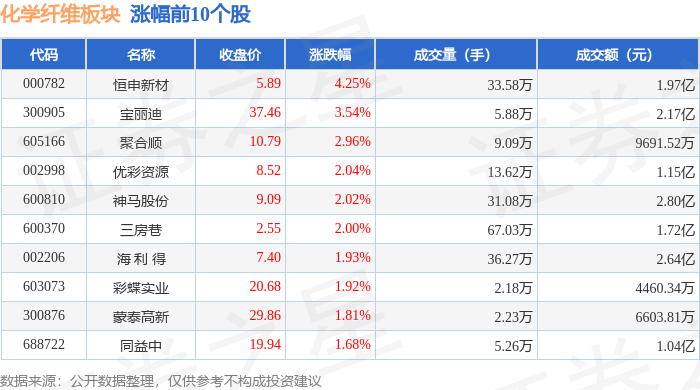
Market Overview - The chemical fiber sector experienced a decline of 1.66% on January 30, with Huafeng Chemical leading the drop [1] - The Shanghai Composite Index closed at 4117.95, down 0.96%, while the Shenzhen Component Index closed at 14205.89, down 0.66% [1] Stock Performance - Notable gainers in the chemical fiber sector included: - Hengshen New Materials (Code: 000782) with a closing price of 5.89, up 4.25% and a trading volume of 335,800 shares, totaling 197 million yuan [1] - Baolidi (Code: 300905) closed at 37.46, up 3.54% with a trading volume of 58,800 shares, totaling 217 million yuan [1] - Major decliners included: - Huafeng Chemical (Code: 002064) closed at 12.88, down 5.85% with a trading volume of 774,500 shares, totaling 26.67 million yuan [2] - Xinxiang Chemical Fiber (Code: 000949) closed at 7.27, down 3.84% with a trading volume of 985,300 shares, totaling 716 million yuan [2] Capital Flow - The chemical fiber sector saw a net outflow of 388 million yuan from main funds, while retail investors contributed a net inflow of 420 million yuan [2] - The capital flow for specific stocks showed: - Hengshen New Materials had a main fund net outflow of 12.99 million yuan, with retail inflow of 1.70 million yuan [3] - Sanfangxiang (Code: 600370) had a main fund net inflow of 7.65 million yuan, while retail outflow was 0.37 million yuan [3]


万亿级市场!低空经济,迈向场景化应用元年
Xin Lang Cai Jing· 2026-01-29 03:47
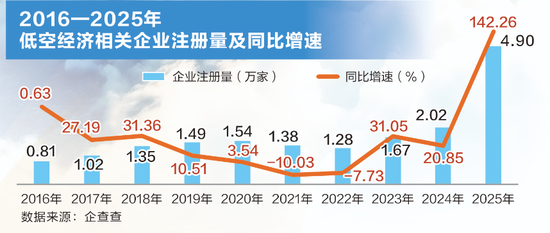
Core Insights - The low-altitude economy is projected to reach a market size of 1.5 trillion yuan by 2025 and 3.5 trillion yuan by 2035, becoming a core track for cultivating new productive forces and emerging industries [4][26] - The year 2026 is seen as a pivotal year for the low-altitude economy, marking the transition from concept validation to scenario application [2][24] - The Chinese government has elevated the low-altitude economy to a strategic emerging industry, with multiple policies and frameworks established to support its development [6][28] Market Potential - The low-altitude economy market in China surpassed 500 billion yuan in 2023, reaching 505.95 billion yuan, with a projected growth of 32.5% to 670.25 billion yuan in 2024 [4][26] - The number of registered low-altitude economy-related enterprises increased significantly, with a forecast of 49,000 registrations by 2025, marking a year-on-year growth of 142.26% [2][24] Policy Support - The low-altitude economy was included in national planning for the first time in February 2021, and it has been recognized as a strategic emerging industry in subsequent government reports [6][28] - The establishment of the Low Altitude Economy Development Department by the National Development and Reform Commission aims to coordinate the advancement of the low-altitude economy [6][28] Industry Structure - The low-altitude economy industry is concentrated in three major economic zones: the Greater Bay Area, Yangtze River Delta, and Beijing-Tianjin-Hebei, which together form the leading tier of development [7][29] - As of January 2023, there were approximately 163,000 active low-altitude economy-related enterprises in China, with significant concentrations in East and South China [7][29] Technological Advancements - The low-altitude economy has developed a complete industrial chain encompassing low-altitude manufacturing, operation, infrastructure, and information services [10][32] - China leads globally in drone research and design, with over 77,000 drone R&D companies, including major players like DJI [10][32] Investment Trends - Investment in the low-altitude economy is on the rise, with 143 financing events recorded in the first half of 2025, a 120% increase year-on-year [15][37] - The stock market has seen significant interest, with 17 concept stocks doubling in price since 2024, indicating strong investor confidence [15][37] Application Scenarios - The low-altitude logistics market is expected to grow rapidly, with projections of reaching 120 to 150 billion yuan by 2025 and 450 to 605 billion yuan by 2035 [11][33] - Companies like WanFeng Aviation are developing comprehensive applications for fixed-wing aircraft, eVTOL, and drones, covering various transportation scenarios [12][34] Challenges Ahead - The low-altitude economy faces challenges in infrastructure development, regulatory frameworks, and technological breakthroughs, which are essential for scaling operations [40][41] - Key issues include the reliance on imported components, high operational costs, and the need for a stable business model to ensure sustainable growth [40][41]
多家上市公司,预计扭亏
Sou Hu Cai Jing· 2026-01-28 16:27
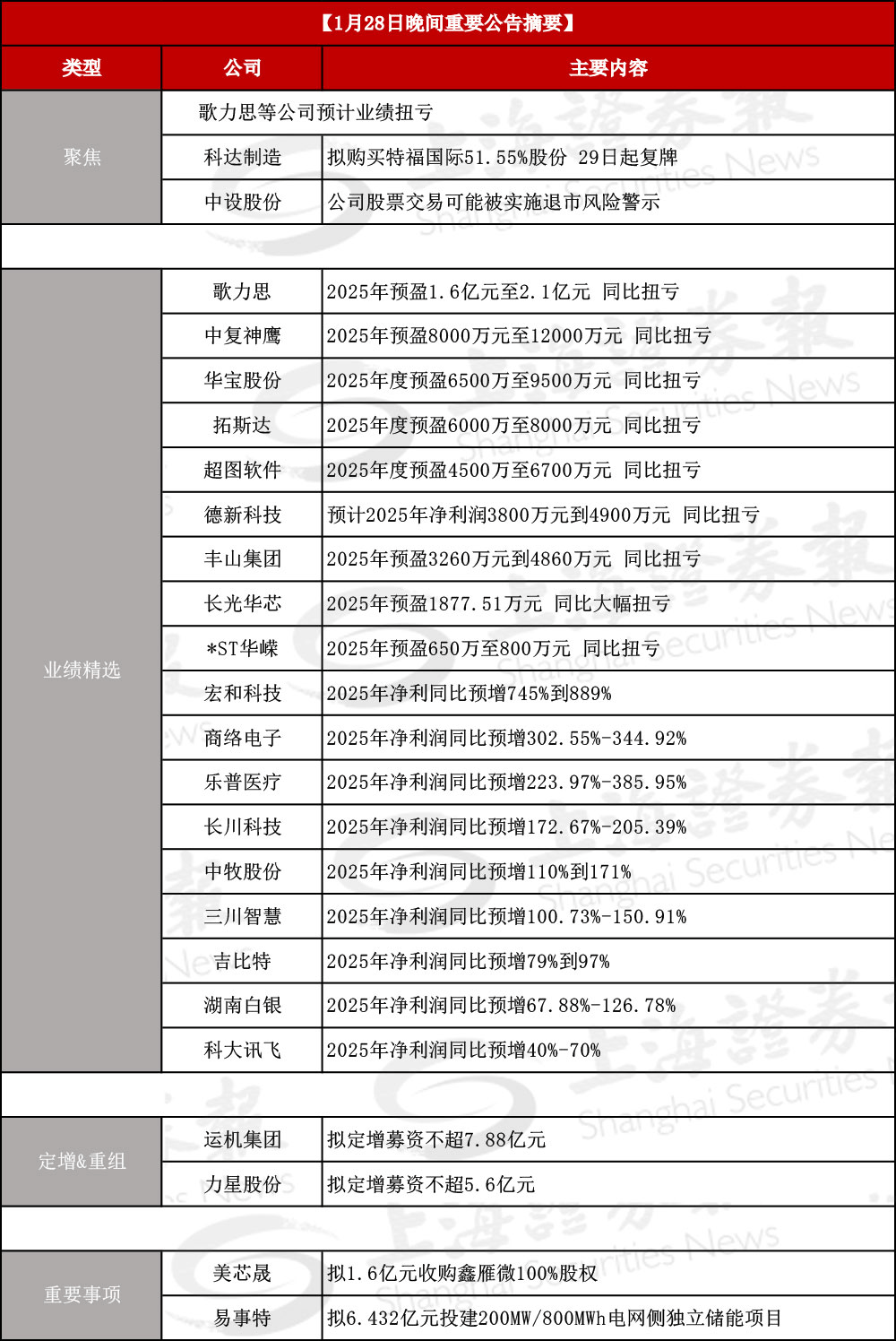
Group 1: Earnings Forecasts - Several companies, including Ge Li Si, Zhong Fu Shen Ying, and Hua Bao, are expected to turn losses into profits in 2025, with Ge Li Si projecting a net profit of 16 million to 21 million yuan, and Zhong Fu Shen Ying estimating a profit of 8 million to 12 million yuan [2][3][4] - Hua Bao is forecasting a net profit of 6.5 million to 9.5 million yuan, recovering from a loss of 29.6 million yuan in the previous year [3] - Tuo Si Da anticipates a profit of 6 million to 8 million yuan, compared to a loss of 24.5 million yuan last year, driven by strategic product focus and cost control [4] Group 2: Significant Increases in Profit - Hong He Technology expects a net profit increase of 745% to 889%, projecting 192.7 million to 225.5 million yuan for 2025 [11] - Shang Luo Electronics forecasts a profit of 285 million to 315 million yuan, representing a growth of 302.55% to 344.92% [12] - Le Pu Medical anticipates a profit of 800 million to 1.2 billion yuan, a significant increase of 223.97% to 385.95% compared to the previous year [12] Group 3: Strategic Transactions - Keda Manufacturing plans to acquire 51.55% of Tefu International, with the transaction expected to enhance its overseas building materials business [8][9] - Mei Xin Sheng intends to acquire 100% of Xin Yan Wei for 16 million yuan, which will help expand its magnetic sensing product line [23] - Yun Ji Group and Li Xing Co. are both planning to raise funds through private placements, with amounts not exceeding 788 million yuan and 560 million yuan respectively [22] Group 4: Risk Warnings - Zhong She Co. may face delisting risk due to projected negative net profits and revenue below 300 million yuan [10] Group 5: Other Notable Earnings Projections - Long Guang Hua Xin expects a net profit of approximately 18.78 million yuan, a significant increase from the previous year [6] - Ji Bi Te forecasts a profit of 169 million to 186 million yuan, an increase of 79% to 97% [17] - Hunan Bai Yin anticipates a profit of 285 million to 385 million yuan, reflecting a growth of 67.88% to 126.78% [17]