Scale AI

Search documents
Meta天价收购Manus!扎克伯格砸钱抢智能体,AI赛道硝烟再起
Sou Hu Cai Jing· 2026-01-04 05:36
Core Insights - Meta's acquisition of the AI startup Manus for billions is a strategic move to strengthen its position in the global AI competition, reflecting the company's urgency to enhance its AI capabilities and commercialize them effectively [1][3][13] Meta's AI Anxiety and Strategic Shift - Meta is perceived to be lagging behind competitors like OpenAI and Google in the AI race, despite having a strong AI research division and the open-source Llama model series [3] - The company has prioritized AI over its previous focus on the metaverse, establishing the Meta Super Intelligence Lab and acquiring 49% of Scale AI for $14 billion to bolster its AI development [3] Technical, Product, and Commercial Support - The acquisition of Manus is not just about obtaining an AI chat tool; it represents a critical integration of technology, product, and commercialization, which Meta currently lacks [5] - Manus is a general-purpose AI agent capable of executing complex tasks autonomously, marking a significant advancement from traditional chatbots [7] Commercialization Potential - Manus has demonstrated its effectiveness by serving millions of users and processing over 147 trillion tokens since its launch in March 2025, achieving an annual recurring revenue of over $100 million within just eight months [7] - The subscription model for small and medium enterprises provides Meta with a high-growth revenue stream, alleviating investor concerns regarding the return on its substantial AI investments [9] Strategic Objectives of the Acquisition - The acquisition aims to secure a leading position in the emerging agent-driven AI landscape, which is seen as the next disruptive direction following large language models [11] - By integrating Manus's capabilities into its existing platforms like Facebook, Instagram, and WhatsApp, Meta can enhance user engagement and open new revenue streams in enterprise services [11] Talent Acquisition and Future Implications - The founder of Manus, Xiao Hong, will join Meta as a vice president, bringing valuable product thinking and commercialization experience to the company [11] - This acquisition signals a pivotal shift in the AI industry towards practical applications, positioning Meta to compete more effectively against giants like Google and Microsoft [13]


吴恩达定调AI工业时代,马斯克痛批疯狂,5.2万亿基建引爆人才战
Sou Hu Cai Jing· 2026-01-03 11:37
哈喽,大家好,今天小睿这篇科技深评,就来拆解AI圈年度最劲爆大戏:小扎带汤上门挖顶尖人才, 马斯克怒批"疯狂",吴恩达最新报告揭露这场亿级人才战背后的行业变局! 2025年末,AI学术泰斗、谷歌大脑联合创始人吴恩达在社交媒体发布公开信及年度总结长文,掷地有 声地将2025年定义为"AI工业时代的黎明"。 这份被行业视为"AI发展风向标"的报告中,AI人才争夺战被列为四大核心关键词之首,而Meta首席执 行官扎克伯格亲自煲汤挖人、马斯克痛批天价薪酬的戏剧性场景,正是这场"亿级战争"的真实写照。 随着全球科技巨头纷纷入局,AI人才的市场价值被推向历史巅峰,背后更是牵扯着万亿级基建投入与 技术革命的深层逻辑。 这场席卷全球的AI人才争夺战,由Meta在2025年7月正式点燃。 当时扎克伯格宣布成立"Meta超级智能实验室",为招募顶尖人才开出高达数亿美元的四年期薪酬方案, 其中流动现金补偿远超行业常规的股票期权,彻底颠覆了科技行业的人才定价体系。 为了说服目标人选,扎克伯格亲自登门拜访,甚至带上自制的汤品,成功将Scale AI首席执行官汪滔及 其核心团队、OpenAI推理模型研究员韦杰森等大牛纳入麾下。 更令人震 ...
别了,大模型;你好,Agent:读懂Meta收购Manus的范式转移
创业邦· 2026-01-03 10:22
Core Viewpoint - Meta's acquisition of Manus for billions of dollars highlights the shifting landscape of AI, emphasizing the need for practical applications over mere conversational capabilities [7][14][20]. Group 1: Manus's Journey and Team - Manus, founded in Wuhan and developed in Beijing, has transitioned to a Singapore-based company, showcasing a modern narrative of Chinese tech talent navigating geopolitical challenges [7][18]. - The core team of Manus, led by founder Xiao Hong and chief scientist Peak Ji, is characterized by exceptional engineering skills and insights into user behavior, rather than traditional academic AI backgrounds [8][10]. - Peak Ji's philosophy of "orthogonality" emphasizes building applications that leverage existing models rather than competing directly with them, leading to innovative solutions in AI [12]. Group 2: Technological Innovations - Manus distinguishes itself from traditional chatbots by developing an "Agent" capable of performing complex tasks, such as market research and data analysis, rather than just engaging in conversation [16]. - The company has created a virtual operating system that enhances AI capabilities, addressing limitations in memory and operational accuracy, which has proven to be a significant engineering success [16]. Group 3: Geopolitical and Economic Challenges - The decision to relocate Manus's headquarters to Singapore and lay off Chinese staff reflects the harsh realities of geopolitical tensions, particularly regarding access to critical technology and funding [18][19]. - Manus's shift away from China is driven by the need for advanced computing power and capital, which are increasingly restricted for Chinese companies due to U.S. export controls [19]. Group 4: Implications for the Chinese AI Industry - The acquisition of Manus by Meta signifies a loss for the Chinese AI sector, as talented engineers are compelled to contribute to foreign companies due to local constraints [22]. - Manus's success illustrates the potential of Chinese engineers to innovate independently, yet the current environment hampers the growth of local ecosystems and market opportunities [22][25].
LeCun 手撕 Meta:Llama 4 造假,小扎直接废掉整个 AI 团队,锐评 28 岁新上司:不懂研究还瞎指挥
AI前线· 2026-01-03 07:56
Core Viewpoint - Yann LeCun, a Turing Award winner and former chief scientist at Meta, has officially announced his departure to pursue entrepreneurial ventures, revealing significant issues within Meta's AI operations, including manipulated benchmark results and a loss of trust in the AI team by CEO Mark Zuckerberg [2][5]. Group 1: Manipulation of Benchmark Results - LeCun disclosed that the benchmark results for Llama 4 were manipulated, with engineers using different model variants to optimize scores rather than presenting true capabilities [4]. - The launch of Llama 4 in April 2025 was marked by impressive benchmark scores but faced criticism for its actual performance, corroborating LeCun's claims of "data cheating" [4][10]. Group 2: Management and Team Dynamics - Following the Llama 4 incident, Zuckerberg reportedly lost trust in the AI team, leading to the marginalization of the entire generative AI team, with many employees leaving or planning to leave [5][6]. - Meta's response included a $15 billion investment in acquiring a significant stake in Scale AI and hiring its young CEO, Alexandr Wang, to lead a new research department [5][7]. Group 3: Leadership and Strategic Direction - LeCun criticized Wang's appointment, highlighting a troubling reversal of hierarchy where a less experienced individual would oversee a leading AI researcher [8]. - The fundamental disagreement between LeCun and Wang centers on the strategic direction of Meta's AI efforts, with LeCun advocating for a different approach than the current focus on scaling language models [9][10]. Group 4: Limitations of Current AI Models - LeCun has consistently argued that large language models have significant limitations and that true AI potential requires alternative approaches [10][11]. - He presented a new model architecture called Joint Embedding Predictive Architecture (JEPA), which aims to address the shortcomings of existing technologies by training systems on video and spatial data to develop a better understanding of physical principles [13][14]. Group 5: Future Predictions - LeCun anticipates that a prototype of the new architecture could be ready within 12 months, with broader applications expected in several years [14]. - He predicts that AI with animal-level intelligence could be achieved in five to seven years, while human-level intelligence may take a decade [14].

Meta为何花10亿美金收购这家中国AI应用公司?
首席商业评论· 2026-01-03 05:02
Core Viewpoint - The acquisition of Manus by Meta for over $2 billion signals a significant shift in the AI landscape, highlighting Manus's rapid growth and potential as a leading AI application despite initial skepticism about its technology [4][10][18]. Group 1: Manus's Journey and Technology - Manus transformed from a controversial startup to a leading AI application, showcasing capabilities like automatic resume processing and candidate evaluation [5][6]. - The company claims to be the "world's first general-purpose AI agent," drawing comparisons to other successful AI products [5]. - Despite criticism regarding its technology being easily replicable, Manus demonstrated strong market traction with a monthly subscription model ranging from $20 to $200 [8][18]. Group 2: Financial Performance and Market Position - Manus achieved an Annual Recurring Revenue (ARR) of $125 million within just nine months, setting a record in the SaaS industry [10]. - It is one of only eight consumer AI companies globally with an ARR exceeding $100 million, indicating its rarity and value in the market [10]. - The acquisition by Meta marks one of the largest in the company's history, emphasizing the strategic importance of Manus in Meta's transition to an AI platform [11][12]. Group 3: Strategic Implications for Meta and the Industry - Meta's acquisition aims to integrate Manus's capabilities into its broader social and enterprise services, moving from a social network to an AI platform [12][13]. - The high valuation of Manus is expected to positively impact other AI agent companies, potentially reshaping market valuations [13]. - The competitive landscape in Silicon Valley is intensifying, with companies like OpenAI and Google also vying for talent and technology in the AI space [12][20].
不演了,图灵奖得主刚离职就曝 Meta 黑幕,还阴阳 28 岁上司:没经验还想管我?
3 6 Ke· 2026-01-03 04:25
Core Insights - Yann LeCun, a Turing Award winner and former chief scientist at Meta, admitted that the test results of Meta's Llama 4 model were "slightly manipulated," indicating that different models were used for different tests to achieve better scores [1][3]. Group 1: Llama 4 Model Controversy - The Llama 4 series, released in April last year, claimed to achieve leading scores in various tests, with Llama 4 Maverick reaching second place in the LMSYS Chatbot Arena with a score of 1417, becoming the fourth model to surpass 1400 points [3]. - Researchers soon discovered discrepancies in Meta's official charts, revealing that the model used for testing was an "experimental version optimized for dialogue scenarios," specifically tailored for leaderboard performance [3]. - Following the introduction of a "style control" feature in the Arena, Llama 4 Maverick's ranking dropped from second to fifth, raising further questions about the integrity of the results [3]. Group 2: Community Reaction and Criticism - The open-source community expressed disappointment over the leaderboard manipulation, with users on Reddit's r/LocalLLaMA forum humorously suggesting a name change to "LocalGemma" due to the perceived failure of Llama 4 [4]. - Critics within the open-source community condemned Meta's actions as contradictory to the open-source spirit, arguing that the company sought to gain community support while simultaneously undermining its own models [4]. Group 3: Internal Dynamics at Meta - LeCun revealed that Meta's leadership, particularly Mark Zuckerberg, exerted immense pressure on the generative AI team to accelerate development, leading to communication breakdowns [7]. - Zuckerberg's disappointment with Llama 4's performance resulted in a loss of confidence in the project, marginalizing the entire generative AI organization and prompting many team members to leave [8]. - Meta's investment of $14 billion in data labeling company Scale AI and the appointment of its young CEO, Alexandr Wang, as head of the new AI initiative raised concerns about the lack of research experience in leadership [8][10]. Group 4: LeCun's Departure and Future Plans - LeCun's decision to leave Meta stemmed from increasing political difficulties within the company, despite Zuckerberg's support for his research [11]. - He expressed concerns about the influence of new hires on the direction of research, stating that many within Meta were misled by the hype surrounding large language models [11]. - LeCun has founded a new company, Advanced Machine Intelligence (AMI) Labs, with plans to raise €500 million and achieve a valuation of €3 billion, positioning himself as executive chairman to focus on research [13].
「辍学创业」的风再次席卷硅谷,但真正的变量从来不是学位
机器之心· 2026-01-02 03:12
Core Viewpoint - The trend of "dropping out to start a business" is gaining traction in Silicon Valley, with many founders emphasizing their dropout status as a positive credential in the venture capital community [3][4]. Group 1: The Trend of Dropping Out - More founders at Y Combinator's Demo Day are highlighting their dropout experiences, indicating that this has become a badge of honor reflecting their commitment to entrepreneurship [4]. - The urgency to capitalize on the AI startup boom is driving some students to abandon their studies, believing that a degree may hinder their chances of securing funding [5]. - Some investors express skepticism about the extreme dropout trend, suggesting that the value of a college network and brand remains significant, even for those who do not graduate [7]. Group 2: Perspectives on Age and Experience - While many young founders are dropping out, some investors prefer older founders who possess wisdom gained from experience and setbacks, viewing this as a more valuable trait [8]. - Despite the trend, many leading AI entrepreneurs still choose to complete their education, indicating that a degree can still hold value in the industry [9]. Group 3: The Nature of Dropping Out - The concept of "dropping out" has evolved; many who drop out continue to engage in their entrepreneurial pursuits in resource-rich environments [10]. - Ultimately, success is determined by the founder's ability to leverage the right resources and networks at the right time, rather than merely holding a degree [12].

华人掌舵Meta AI的格局,已经初步形成了
虎嗅APP· 2026-01-01 09:29
Core Insights - The article discusses the significant changes in Meta's AI strategy and organizational structure, particularly highlighting the rise of Chinese talent in leadership positions within the company [5][8][30]. Group 1: Organizational Changes - Meta's AI strategy has undergone a major transformation, with multiple reorganizations throughout the year, including the acquisition of a 49% stake in Scale AI for approximately $14 billion [11]. - The new AI structure at Meta has established the Meta Super Intelligence Lab (MSL) as the core, with Alexandr Wang as the Chief AI Officer, overseeing various departments including TBD, which focuses on developing large language models [15][16]. - The departure of Yang Likun, the former Chief Scientist, marks a significant shift in leadership, as he was a long-time figure in Meta's AI landscape [17][22]. Group 2: Talent Acquisition - Meta has aggressively recruited over 50 AI researchers and engineers from competitors like OpenAI, Google, and Apple, with a notable proportion being of Chinese descent [18][19]. - The company has reportedly offered salaries exceeding $100 million, with specific cases like Ruoming Pang, who was offered up to $200 million [18][19]. - Shengjia Zhao, a prominent figure in Meta's AI structure, has quickly risen to a high-ranking position, reflecting the company's focus on retaining top talent [20][21]. Group 3: Acquisition of Manus - The acquisition of Manus, an AI agent company, is seen as a strategic move for Meta, allowing the startup to operate within Meta's ecosystem while maintaining its agility [26][29]. - The founder of Manus, Xiao Hong, is transitioning from an entrepreneur to a high-level executive at Meta, indicating a shift in his professional identity [27][30]. - The integration of Manus into Meta's AI operations is expected to enhance the company's capabilities in the competitive AI agent market [29].

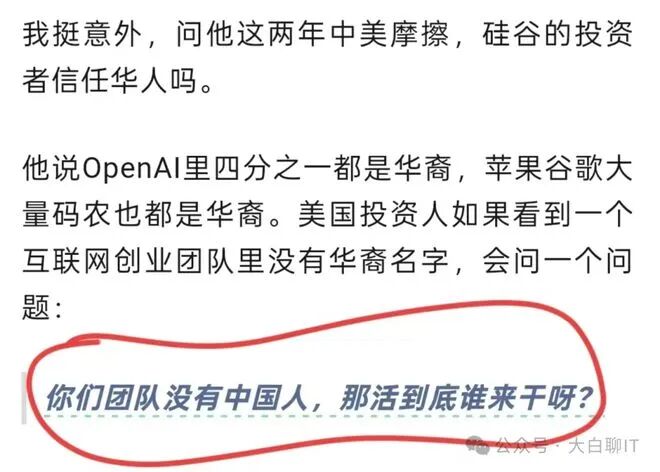
“团队没有华人,那活到底谁来干呀?”硅谷投资人发出灵魂质问,从Meta收购Manus和xAI、OpenAI团队成员聊起
Xin Lang Cai Jing· 2025-12-31 23:39
Core Insights - The question posed by a Silicon Valley investor about the absence of Chinese engineers highlights the critical role they play in the AI industry, indicating that they have become essential to the sector's success [1][2]. Group 1: Importance of Chinese Engineers - Chinese engineers represent a significant portion of top AI talent in the U.S., with 38% of elite AI professionals having graduated from Chinese universities, surpassing those trained domestically [2]. - In Meta's Super Intelligence Lab, 7 out of 11 core researchers are from China, and over 40% of xAI's founding team is Chinese [2]. - The recent acquisition of Manus by Meta for over $2 billion underscores the value placed on Chinese teams, as the company aims to enhance its capabilities in enterprise AI solutions [4]. Group 2: Key Figures and Events - Alexandr Wang, a Chinese entrepreneur and founder of Scale AI, was brought on board by Meta after the company invested $14.8 billion for a 49% stake in Scale AI, highlighting the strategic importance of Chinese talent [4][6]. - Following Wang's appointment as Chief AI Officer at Meta, significant internal changes occurred, including the departure of Yann LeCun, indicating a shift towards a strategy focused on competitive product models [9][11]. - The incident involving Chinese engineer Li Xuechen at xAI, who attempted to take proprietary code to OpenAI, illustrates the high stakes and competitive nature of retaining Chinese talent in the AI sector [12][15]. Group 3: Broader Implications - The competitive landscape in Silicon Valley is increasingly characterized by a reliance on Chinese engineers, with their skills being viewed as indispensable for AI advancements [22]. - The discussions surrounding the value of Chinese engineers reflect broader concerns about talent retention in China's tech sector, as many top talents are being lured away by lucrative offers from Silicon Valley [22].
Meta just bought one of the fastest-growing AI startups you've probably never heard of
Fastcompany· 2025-12-31 14:27
Core Insights - Meta has acquired Manus, a Singapore-based AI startup with Chinese roots, for over $2 billion to enhance its AI capabilities [2][3] - The acquisition is part of Meta's strategy to catch up in the competitive AI landscape, following a significant investment of $14.3 billion in AI training data startup Scale AI earlier this year [3][5] - Manus will continue to operate independently under Meta, with a focus on integrating its AI technology into Meta's suite of products [4][6] Company Strategy - Meta's shift towards AI comes after a pivot from its initial focus on the metaverse, with plans to invest $600 billion in U.S. AI tech and infrastructure by 2028 [5] - The acquisition of Manus is expected to bolster Meta's AI product offerings across platforms like Facebook, Instagram, and WhatsApp [3][8] Operational Changes - Following the acquisition, Meta plans to wind down Manus's operations in China and relocate remaining employees, ensuring no access to first-party user data from Meta's existing products [7][9] - Manus's CEO expressed that joining Meta will allow the company to build on a stronger foundation without altering its operational structure [4]