三星

Search documents
中国软件技术发展洞察和趋势预测研究报告2026
极客邦科技· 2026-02-05 07:26
Investment Rating - The report does not explicitly state an investment rating for the industry Core Insights - The artificial intelligence (AI) sector continues to dominate investment, accounting for 88.1% of total financing in the technology field in 2025, an increase of 5.3 percentage points from 2024 [21] - The humanoid robot sector has emerged as a significant area of investment, capturing 16.8% of the total technology financing [28] - The report highlights the rapid evolution of AI technologies, particularly in reasoning models and multimodal models, which are reshaping the landscape of AI applications [36][38] Summary by Sections 2025 Technology Market Review - In 2025, the technology sector saw a total financing of 738.4 billion yuan across 644 events, with AI leading the way [21] - Key developments included the rise of humanoid robots and advancements in AI models, such as the release of various reasoning models by major companies [19][36] 2026 Technology Trend Outlook - The report anticipates continued growth in AI and humanoid robotics, with significant investments expected in these areas [28] - The integration of AI into various applications is expected to accelerate, driven by advancements in multimodal models and reasoning capabilities [36][38] Financing Events and Trends - The AI sector experienced 212 financing events exceeding 100 million yuan, representing 88.7% of all such events in the technology field [29] - The report notes a shift towards more substantial financing rounds, with seed and A rounds making up 67.7% of total financing events [31] Key Companies and Innovations - Notable companies in the AI sector include Zhiyuan AI, Minimax, and Yuzhi Technology, which have raised significant funds in recent rounds [32] - The report highlights the emergence of new technologies and models, such as DeepSeek and various multimodal models, which are expected to drive future growth [36][38]
全球手机季度收入创历史新高!均价首破400美元!
Sou Hu Cai Jing· 2026-02-05 06:32
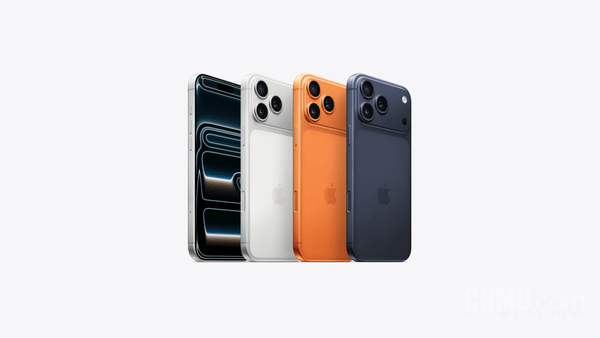
【CNMO科技消息】2月5日,据Counterpoint Research发布的《Market Monitor Service》报告,2025年第 四季度,全球智能手机市场收入同比增长13%,达到1430亿美元(约合人民币9930亿元),创单季度历 史新高。同时,手机平均售价(ASP)同比增长8%,首次在单季度内突破400美元(约合人民币2777 元)。 据CNMO了解,2025年第四季度,苹果出货量和收入均创历史新高,分别同比增长14%和23%。三星则 以11%的市场份额继续保持全球第二大收入贡献者地位,2025年第四季度收入同比增长12%;同期,其 出货量同比增长17%,为前五大品牌中最高。 Counterpoint Research指出,苹果的增长主要由iPhone 17系列驱动,受益于换机超级周期。同时,各区 域ASP的整体提升也带来了更强劲的收入增长,Pro版机型的占比提升尤为明显。苹果在美国、中国等 多个地区的收入均创下新纪录。 2025年第四季度,小米收入同比下降9%,出货量同比下降11%,主要受到供应受限以及元器件成本上 升对其入门级和中端产品组合的冲击;OPPO的收入和ASP分别同比增长23 ...


全球智能手机单季度平均售价首次突破400美元关口
Feng Huang Wang· 2026-02-05 06:22
Core Insights - The global smartphone market revenue is projected to grow by 13% year-on-year in Q4 2025, reaching a record high of $143 billion [1] - The average selling price (ASP) of smartphones increased by 8% year-on-year, surpassing $400 for the first time in a single quarter, driven by a trend towards higher-end devices and rising BOM costs [1] - Smartphone shipment volume grew by 5% year-on-year, indicating a market growth driven by "value expansion" rather than "scale expansion" [1] Company Performance - Apple experienced the fastest revenue growth among the top five brands, with a 23% year-on-year increase, primarily due to the performance of the iPhone 17 series, achieving a revenue market share of 59% [1] - Samsung's shipment volume grew by 17% year-on-year, the fastest among the top five brands, supported by strong performance of the Galaxy A series across various regions, with a revenue growth of 12% [1] - Xiaomi's revenue declined by 9% year-on-year, and shipment volume decreased by 11%, impacted by supply constraints and rising component costs affecting its entry-level and mid-range product lineup [1] - OPPO's revenue and ASP grew by 23% and 6% year-on-year, respectively, marking the second-fastest growth among the top five brands [1] - Vivo's revenue also increased by 6% year-on-year, supported by strong performance in the Chinese and Indian markets [2]

【买卖芯片找老王】260205 华邦/美光/三星/海力士/TI/英飞凌
芯世相· 2026-02-05 06:16
算笔账 一批十万的呆料压在库存 每月仓储费➕资金成本至少5k 放半年就亏3万 有料单不知道怎么推广? 芯片超人已经 累计服务2.2万用户 ,打折清库存,最快半天完成交易! 找不到,卖不掉,价格还想再好 点 ,都可以来找我们! 优势物料,特价出售 品牌 型号 年份 数量 华邦 W25Q40CLWI 22+ 30K 美光 MT41K128M16JT-125 IT:K 两年内 30K SAMSUNG/三星 K4B4G1646E-BCNBO00 25/23+ 10K | SAMSUNG/三星 | K4B4G1646E-BYMA | 23+ | 10K | | --- | --- | --- | --- | | SAMSUNG/三星 | K4A4G165WF-BCTD000 | 25+ | 10K | | SAMSUNG/三星 | K4A8G165WC-BCTD000 | 25+ | 10K | | SAMSUNG/三星 | K4A8G165WG-BCWEO00 | 25+ | 10K | | KIOXIA/铠侠 | THGBMTG5D1LBAIL | 25+ | 10K | | SAMSUNG/三星 | KLM4G1 ...

中国智能家电市场趋势洞察
益普索· 2026-02-05 05:35
Investment Rating - The report does not explicitly provide an investment rating for the smart home appliance industry Core Insights - The Chinese home appliance market is transitioning from scale expansion to quality upgrades, with a focus on deep competition driven by changing demand structures [3] - The Z generation, accounting for nearly 20% of the population and contributing about 40% of consumption, is driving a shift in consumer logic towards emotional value, personalization, and aesthetic appeal [4] - Consumers are moving from "external display" to "internal experience," emphasizing the need for brands to innovate based on local user demands [5] - Companies must build a forward-looking insight system to identify future opportunities through macro and micro trend research [5] - The focus on sustainable growth and core competitiveness is essential, guiding product innovation, brand communication, and marketing strategies [6] Market Trends - The market is experiencing a "micro-segmentation" wave, moving away from universal products to innovative categories that match the evolving lifestyle and spatial needs of consumers [9][19] - The design philosophy is shifting from "highlighting presence" to "small and refined," maximizing functional value through technology stacking in limited spaces [10][62] - Aesthetic integration is becoming crucial, with appliances designed to blend seamlessly into home environments, transforming them into art pieces rather than mere functional devices [11][35] - The importance of aesthetics is highlighted, with 84% of consumers considering appearance when purchasing appliances, and 69% willing to pay more for high-quality designs [36] Consumer Behavior - Consumers are increasingly prioritizing emotional value and personalized experiences over mere functionality, with 88% considering functionality as a key purchasing factor [12][86] - The demand for "zero-maintenance" solutions is rising, with users seeking appliances that require minimal effort and provide seamless integration into their lives [13][99] - Health has become a core value in appliance offerings, with consumers looking for products that enhance both physical and mental well-being [15][111] Product Innovation - The trend towards multi-functional products is replacing standalone devices, with integrated solutions becoming mainstream [75][81] - The report emphasizes the need for appliances to provide not just utility but also emotional and sensory experiences, bridging the gap between product functionality and user lifestyle [86][92] - The shift towards proactive health management solutions is evident, with consumers willing to invest in appliances that offer comprehensive health benefits [113][116] Future Outlook - The report suggests that brands must adapt to the evolving consumer landscape by offering personalized, aesthetically pleasing, and health-oriented products [18][126] - The integration of AI and smart technology is expected to enhance user experiences, with a focus on seamless, intuitive interactions [135][140] - The future of home appliances lies in creating ecosystems that connect various devices, providing a cohesive and intelligent living environment [138][139]
AI空调卷疯了:格力、美的、海尔集体押注,核心价值是「省钱省电」?
3 6 Ke· 2026-02-05 04:13
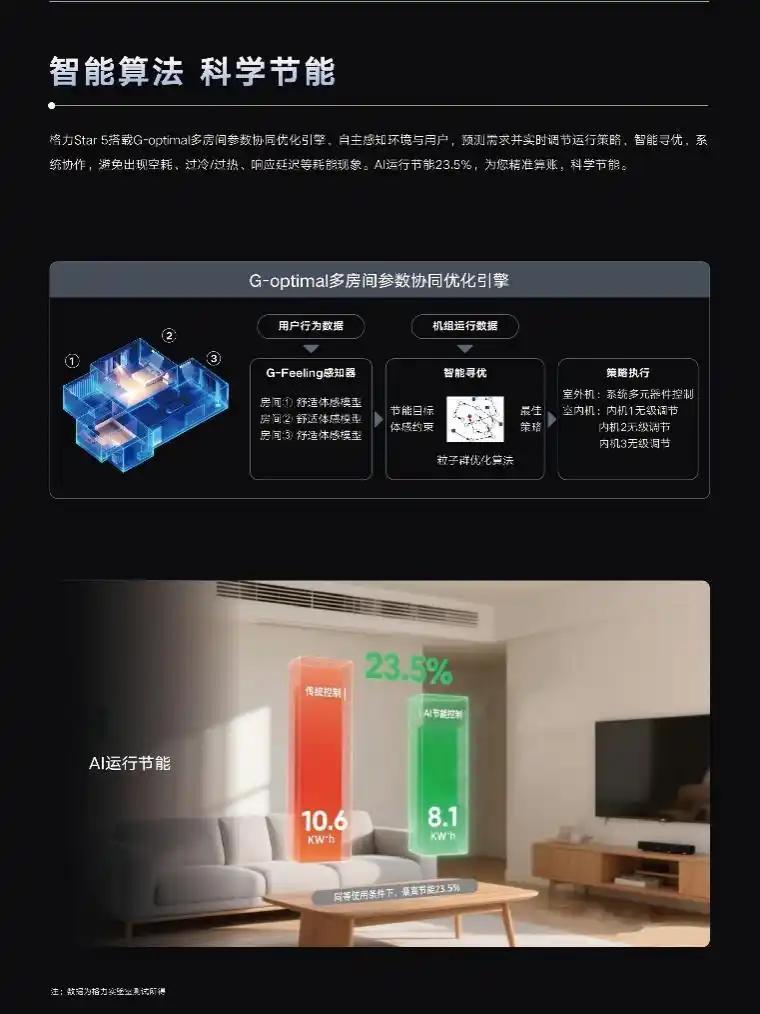
Core Viewpoint - The air conditioning industry is rapidly evolving with the integration of AI technology, moving from traditional cooling and heating systems to more intelligent solutions that focus on user comfort and energy efficiency [1][3][12]. Group 1: AI Integration in Air Conditioning - AI air conditioners, such as Gree's Star 5 AI, aim to enhance user experience by maintaining optimal comfort levels rather than just achieving set temperatures [3][4]. - Traditional air conditioning systems often waste energy and respond slowly to changes in user needs, while AI systems optimize energy use and adjust dynamically based on real-time conditions [4][6]. - Gree's Star 5 AI claims to achieve energy savings of up to 23.5% under ideal conditions, although actual performance may vary based on individual household factors [6][12]. Group 2: Competitive Landscape - Major appliance manufacturers, including Gree, Midea, and Haier, are heavily investing in AI technology, indicating a shift in the market towards algorithm-driven air conditioning solutions [12][15]. - The introduction of AI in air conditioning is expected to create a competitive divide, favoring companies with established data and technology capabilities, while smaller firms may struggle to keep up [16]. - As the market for household air conditioning approaches saturation, consumers are likely to prioritize smart features over cost when upgrading their systems [16].



2025年全球平板市场继续复苏:联想增速最快高达36.2%
Ge Long Hui· 2026-02-05 04:06
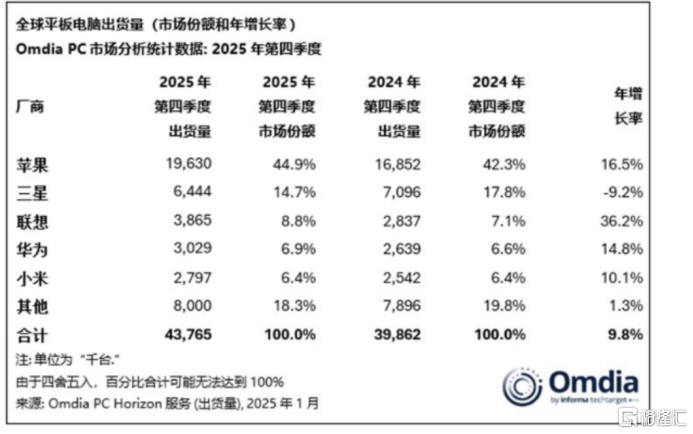
Core Viewpoint - The global tablet market is expected to see a year-on-year shipment growth of 9.8% in 2025, reaching 162 million units, with Apple and Samsung maintaining the top two positions, collectively holding about 55% market share [1]. Group 1: Market Performance - In Q4 2025, global tablet shipments reached 43.765 million units, supported by strong performance from Apple's iPad Air and iPad Pro series, which saw shipments of 19.63 million units, a year-on-year increase of 16.5%, capturing a market share of 42.3% [2]. - Samsung's shipments amounted to 6.44 million units in Q4 2025, reflecting a year-on-year decline of 9.2%, yet it maintained a market share of 17.8%, leading over Huawei, Xiaomi, and Lenovo [3]. - Lenovo exhibited the fastest growth among major manufacturers, with shipments of 3.865 million units, a year-on-year increase of 36.2%, achieving a market share of 7.1% [5]. Group 2: Market Dynamics - Lenovo's rapid growth is attributed to proactive inventory strategies implemented before price increases in memory components [6]. - The tablet market in 2025 achieved its highest annual shipment volume since the pandemic-driven demand peak in 2020, bolstered by seasonal holiday demand and preemptive stocking by manufacturers in anticipation of memory supply constraints [6]. - Manufacturers are advised to carefully balance competitiveness and profitability, as potential disruptions in the memory market could affect supply availability and increase prices, with growth opportunities becoming more limited, primarily focused on high-end models in developed markets and education demand in emerging markets [6].

高通电话会全文&详解:AI数据中心“抽干”DRAM产能,内存短缺将决定今年手机市场规模
美股IPO· 2026-02-05 04:02
Core Viewpoint - Qualcomm issued a severe warning for Q2, indicating that the competition for HBM capacity in AI data centers is impacting traditional DRAM supply, leading to significant shortages and forcing smartphone manufacturers to cut orders, with Q2 mobile chip revenue guidance reduced to $6 billion. The CEO emphasized that the overall mobile market size for the fiscal year will directly depend on memory supply availability [1][5][8]. Group 1: Financial Performance - Qualcomm achieved record revenue of $12.3 billion in Q1 of fiscal 2026, with a non-GAAP EPS of $3.50. The QCT (chip business) revenue reached a record $10.6 billion, and automotive revenue grew 15% year-over-year to $1.1 billion, also a historical high [5][28]. - The QCT mobile revenue reached a record $7.8 billion, driven by strong performance from flagship smartphones [38]. - Qualcomm returned $3.6 billion to shareholders, including $2.6 billion in stock buybacks and $949 million in dividends [39]. Group 2: Memory Supply Issues - The memory crisis is attributed to HBM taking precedence over DRAM, leading to industry-wide shortages and price increases that may define the overall mobile industry scale for the fiscal year [6][7][28]. - Qualcomm's CFO noted that several smartphone OEMs are adopting a cautious approach, reducing chip inventory to align with scaled-back production plans due to memory supply constraints [7][39]. - The CEO stated that the entire fiscal year's mobile market size will be determined by memory availability, despite strong end-user demand [8][28]. Group 3: Market Position and Strategy - Qualcomm maintains a solid position in the high-end market, expecting to retain approximately 75% market share for Samsung's upcoming flagship devices [10][12]. - The introduction of ByteDance's AI smartphone is seen as a significant milestone towards "AI-native smartphones," indicating a shift in market dynamics [11][12]. - High-end and ultra-high-end market demand has exceeded expectations, with OEMs likely prioritizing high-margin models in a constrained memory environment [12][28]. Group 4: Diversification and Future Growth - Qualcomm's automotive business is projected to accelerate with an estimated growth rate exceeding 35% in Q2, supported by a long-term supply agreement with Volkswagen Group [13][39]. - In the PC sector, Qualcomm is advancing the Windows on ARM ecosystem, with the Snapdragon X2 Plus platform launched and 150 Snapdragon-powered PCs expected to enter commercial use this year [15][30]. - Qualcomm is making significant strides in the robotics sector, launching the Dragonwing IQ10 series chips aimed at accelerating the commercialization of home, industrial, and humanoid robots [16][33]. Group 5: Data Center Ambitions - Qualcomm reiterated its ambitions in the data center market, focusing on providing specialized inference chips for disaggregated data centers, with substantial revenue expected to materialize by 2027 [18][20]. - The company is executing a dual-line strategy with CPUs based on Oryon and RISC-V architectures, bolstered by the acquisition of Ventana Microsystems [19][34]. - Recent industry developments validate Qualcomm's view that specialized and energy-efficient AI platforms are crucial as inference becomes a key growth driver for data centers [20][34].


「非洲手机之王」传音即将退位?利润腰斩,50元手机扛不住存储涨价
3 6 Ke· 2026-02-05 03:57
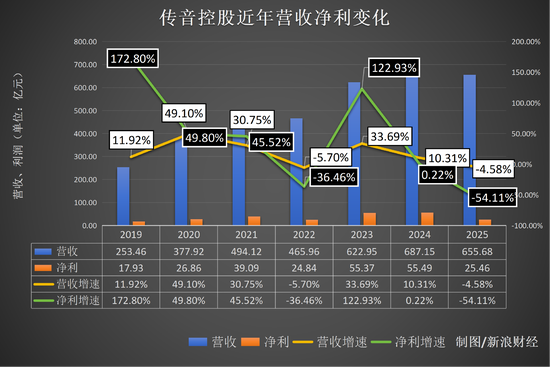
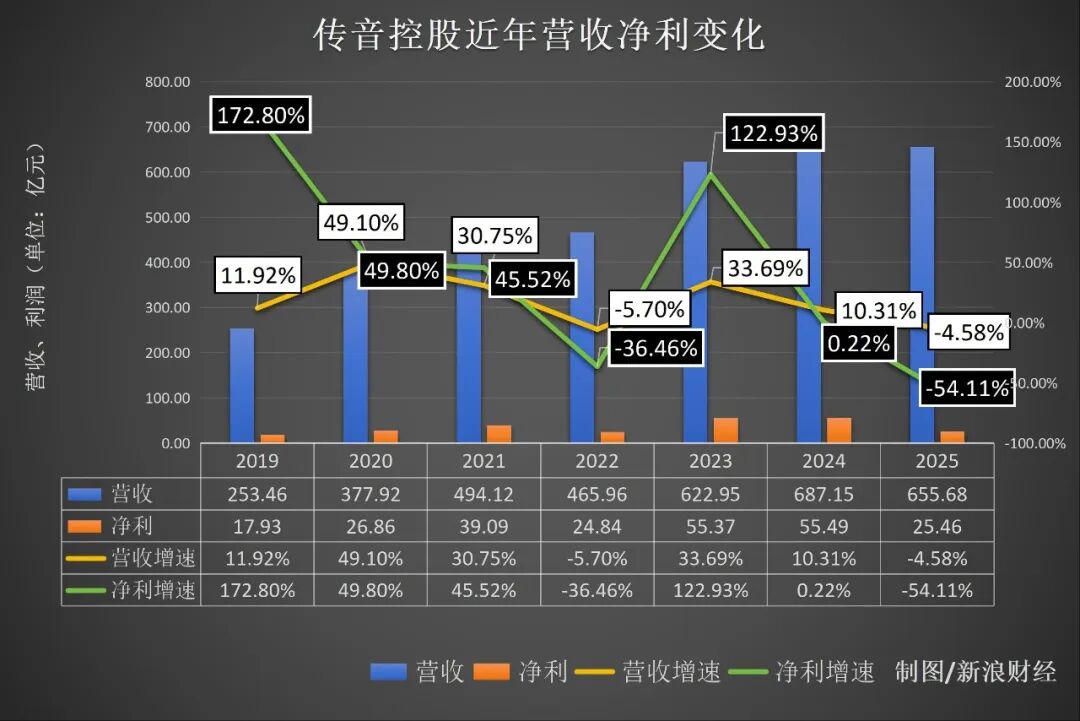
Core Viewpoint - Transsion Holdings is expected to experience a decline in both revenue and net profit in 2025, with net profit projected to be halved, marking the worst performance since its IPO in 2019 [1][2][4]. Financial Performance - The company forecasts a revenue of approximately 65.568 billion yuan for 2025, a decrease of about 31.47 billion yuan or 4.58% year-on-year [2]. - The net profit attributable to shareholders is expected to be around 2.546 billion yuan, down by approximately 30.03 billion yuan or 54.11% year-on-year [2][4]. - In the first half of 2025, Transsion reported a revenue of 29.077 billion yuan, a decline of 15.86% compared to the same period last year, with net profit dropping by 57.48% [5]. Market Competition - Transsion's market share remains the largest in Africa, but competition is intensifying, particularly from Xiaomi and Honor, which have shown growth rates of 34% and 158% respectively [1][8]. - The global smartphone market is experiencing sluggish growth, with a projected increase of only 2% in 2025, leading to increased pressure on low-cost manufacturers like Transsion [8]. Cost and Supply Chain Issues - The company attributes its poor performance to rising storage prices, which have significantly impacted product costs and gross margins [4][6]. - The global storage market has seen prices increase by over 40% due to high demand from AI data centers, further straining the cost structure for smartphone manufacturers [7][8]. Diversification Efforts - To mitigate risks, Transsion is exploring new business areas such as mobility and energy storage, although these segments currently contribute only 8.8% to total revenue [10][12]. - The company has established multiple brands and is attempting to expand into electric vehicles and energy storage products, but these initiatives have yet to generate significant revenue [10][12].

“非洲手机之王”传音即将退位? 利润腰斩!
Xin Lang Ke Ji· 2026-02-05 02:46
Core Viewpoint - Transsion Holdings is expected to experience a decline in both revenue and net profit in 2025, with net profit projected to be halved, marking the worst performance since its listing [1][4][2]. Financial Performance - The company anticipates a revenue of approximately 65.568 billion yuan in 2025, a decrease of about 31.47 billion yuan or 4.58% year-on-year [2]. - The net profit is expected to be around 2.546 billion yuan, down by approximately 30.03 billion yuan or 54.11% compared to the previous year [2][4]. Market Competition - Transsion's market share is under pressure due to intensified competition in key markets like Africa and South Asia, with competitors such as Xiaomi and Honor showing significant growth rates of 34% and 158% respectively [1][7]. - Despite maintaining the largest market share in Africa, Transsion's growth rate of 25% is being outpaced by its competitors [7]. Cost and Pricing Issues - The company cites rising storage prices as a significant factor affecting its cost and gross margin, with the average price of its smartphones being only 332.1 yuan and feature phones at 50.1 yuan [1][8]. - The global storage market has seen prices increase by over 40%, impacting the overall cost structure for smartphone manufacturers [6][7]. Diversification Efforts - To mitigate risks, Transsion is exploring new business areas such as mobility and energy storage, although these new ventures currently contribute only about 8.8% to total revenue [11][13]. - The company has established a mobility division and is expanding into electric two-wheelers and energy storage products, but these initiatives have yet to significantly impact overall revenue [11][12]. Historical Context - Since its listing on the Sci-Tech Innovation Board in 2019, Transsion had previously maintained strong growth until a decline in 2022, attributed to global macroeconomic factors and increased R&D expenses [4][5]. - The current forecast for 2025 represents a continuation of this downward trend, with net profit expected to be the lowest since the company's IPO [4][5].