
小米汽车

Search documents
中国汽车市场,分水岭已至
Hu Xiu· 2025-09-03 00:31
Core Insights - The competition among new energy vehicle manufacturers in China has intensified, with monthly sales data revealing significant shifts in market positions and performance [1][78]. Group 1: Sales Performance - Leap Motor and Xpeng are currently the most likely to achieve their annual sales targets [2]. - NIO and Li Auto have swapped positions in monthly sales, with NIO delivering 31,305 units in August, surpassing Li Auto's 28,529 units for the first time in 34 months [5]. - The sales of Xiaomi vehicles are estimated to be less than half of their annual target, depending on production capacity [3]. - Other brands like Lantu, Avita, and Hongmeng Zhixing have completion rates below 40% [4][11]. Group 2: Market Dynamics - The competition is becoming more intense, with Leap Motor achieving 57,066 units sold, marking its sixth consecutive month at the top, while Xpeng reached a historical high of 37,709 units [10]. - The introduction of new large pure electric SUVs has directly impacted the sales performance of NIO and Li Auto [6]. - The launch of the Lido L90 by NIO, priced under 200,000 yuan, significantly contributed to its sales growth [8]. Group 3: Strategic Insights - The shift in sales positions reflects a broader strategic competition between different technological routes in the Chinese EV industry [17]. - NIO's all-in approach on pure electric vehicles and its investment in battery swap networks is beginning to show returns, as evidenced by the strong demand for the Lido L90 [21][24]. - Li Auto's reliance on range-extended technology is facing challenges as market competition intensifies, indicating a need for diversification in technology strategies [25][27]. Group 4: Supply Chain and Production - The supply chain has become a critical factor in the survival of new energy vehicle companies, with companies like Leap Motor and Xpeng excelling in supply chain management [32][47]. - Leap Motor's focus on in-house development of key technologies has allowed for better cost control and reduced dependency on external suppliers [33][34]. - Xpeng's strategy of collaboration, such as its partnership with Didi for the MONA series, has enabled it to quickly penetrate the market [38][41]. Group 5: Challenges and Future Outlook - The performance of Huawei's HarmonyOS in the automotive sector has declined, highlighting the challenges of relying solely on ecosystem partnerships [51][63]. - Xiaomi's reliance on contract manufacturing has led to production bottlenecks, affecting its ability to meet demand [66][68]. - The industry is transitioning from a focus on volume to a focus on delivery, production capacity, and cost management, with upcoming Q3 financial reports likely to trigger a new round of valuation differentiation [79][80].


京沪楼市8月成交量回升,A股融资余额创历史新高 | 财经日日评
吴晓波频道· 2025-09-03 00:30
Group 1: Internet Industry Performance - In the first seven months, the revenue of large-scale internet enterprises in China exceeded 1.1 trillion yuan, reaching 11,352 billion yuan, with a year-on-year growth of 3.5%, an increase of 0.4 percentage points compared to the first half of the year [2] - The profit for the same period was 938.8 billion yuan, showing a year-on-year decline of 1.8%, but the decline rate narrowed significantly by 6.5 percentage points compared to the first half of the year [2] - The top five regions in terms of internet business revenue were Beijing, Guangdong, Shanghai, Zhejiang, and Guizhou, accounting for 84.6% of the national internet business revenue [2] Group 2: Logistics Industry Trends - The logistics industry prosperity index for August recorded 50.9%, an increase of 0.4 percentage points from the previous month, indicating a clear expansion [4] - The business volume index and new order index have both been in the expansion range for six and seven consecutive months, respectively [4] - The recovery in logistics demand is supported by high growth in high-end manufacturing and the release of consumer demand due to policy support [4][5] Group 3: Real Estate Market Dynamics - In August, Shanghai's second-hand housing transactions reached 19,912 units, a month-on-month increase of 2.76% and a year-on-year increase of 11.34%, marking the highest level for the same period since 2021 [6] - The new policies in Beijing and Shanghai have positively impacted the real estate market, contributing to a recovery in both new and second-hand housing markets [6][7] - The confidence of real estate companies in land acquisition has increased due to the sales recovery of quality projects in core urban areas [7] Group 4: New Energy Vehicle Market - New energy vehicle manufacturers such as Leap Motor, Xpeng Motors, and NIO achieved record high delivery volumes in August, with Leap Motor delivering 57,100 units, a year-on-year increase of 88% [10] - The overall growth rate of the new energy vehicle market is slowing, despite the strong performance of individual companies [11] Group 5: E-commerce Expansion - JD.com has made a voluntary public acquisition offer for CECONOMY, valuing the transaction at approximately 22 billion euros, equivalent to over 180 billion yuan [12] - JD.com's strategy focuses on local e-commerce expansion in overseas markets, contrasting with other platforms that rely on cross-border e-commerce [13] Group 6: A-share Market Financing - The total financing balance of A-shares reached a historical high of 2.28 trillion yuan, with the Shanghai Stock Exchange reporting a balance of 1.16 trillion yuan and the Shenzhen Stock Exchange reporting 1.11 trillion yuan [14] - The increase in financing balance is attributed to high daily trading volumes, with average daily trading around 2.5 trillion yuan [14][15]


新造车8月成绩单:零跑继续领跑
Bei Jing Shang Bao· 2025-09-02 16:30
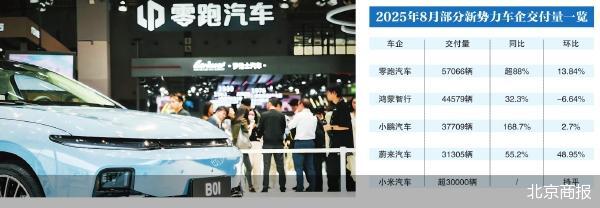
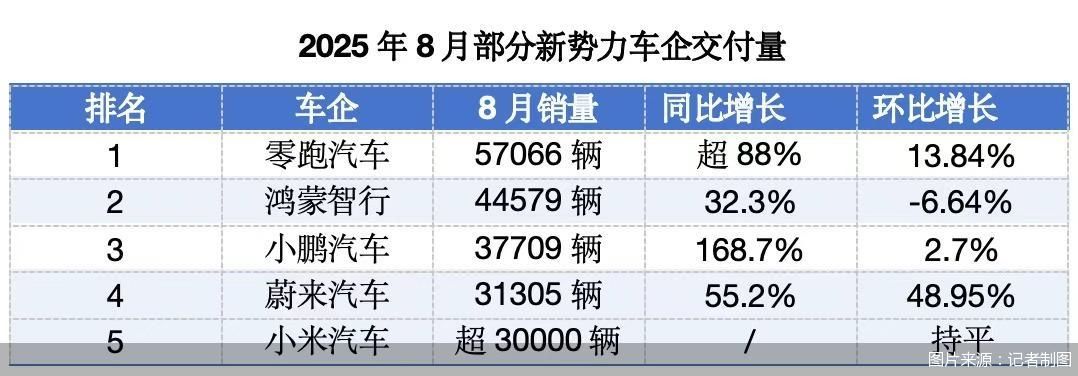
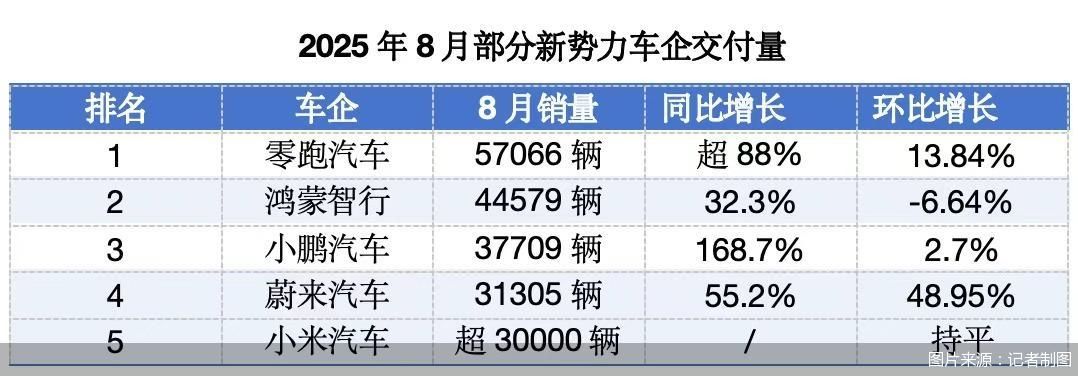
Core Viewpoint - The new energy vehicle market continues to thrive, with new force car manufacturers achieving impressive delivery numbers, although the industry remains unstable due to product homogeneity and the need for differentiation in order to boost sales [1][3][8]. Group 1: Delivery Performance - Leap Motor leads the new force car manufacturers with 57,100 new car deliveries in August, a year-on-year increase of over 88%, and a total of 328,900 deliveries in the first eight months, up 136.4% [3][4]. - Hongmeng Zhixing delivered 44,600 new cars in August, with a cumulative delivery surpassing 900,000, while Xiaopeng Motors delivered 37,700 new cars, marking a year-on-year growth of 168.7% [3][4]. - NIO reversed its sales stagnation with 31,300 new car deliveries in August, a year-on-year increase of 55.2%, while Li Auto's deliveries fell below 30,000 for the first time in three months, totaling 28,500 [4][5]. Group 2: Market Dynamics - The overall sales situation in August indicates that cost-effectiveness and technological capabilities are key drivers for the growth of new force car manufacturers [5][7]. - The new car effect was significant in August, with several new models like Leap B01 and Xiaopeng P7 receiving substantial market attention upon launch [5][6]. - The penetration rate of new energy passenger vehicles reached 56.7% in August, with retail sales of approximately 1.1 million units [7]. Group 3: Industry Challenges and Strategies - New force car manufacturers face challenges such as insufficient production capacity and tight cash flow, necessitating a shift towards flexible production and diversified product strategies [8]. - There is a noted issue of product homogeneity among new force car manufacturers, with a call for differentiation focusing on vehicle stability and safety as key competitive factors [8].
车企8月交付成绩单:零跑、小鹏、蔚来交付创新高
Bei Jing Shang Bao· 2025-09-02 14:11
Core Insights - The new energy vehicle (NEV) market in China continues to thrive, with significant growth in delivery volumes among new car manufacturers, particularly Li Auto, Xiaopeng Motors, and NIO [3][4][9] - The competitive landscape remains unstable, with a noted trend of product homogeneity among new energy vehicle manufacturers, necessitating differentiation to boost sales [3][12][13] Delivery Performance - Leap Motor led the market in August with 57,066 units delivered, marking a year-on-year increase of over 88% and a month-on-month increase of 13.84% [4][5] - Other notable performances include: - Hongmeng Zhixing: 44,579 units, a year-on-year increase of 32.3% but a month-on-month decrease of 6.64% [5][7] - Xiaopeng Motors: 37,709 units, a year-on-year increase of 168.7% and a month-on-month increase of 2.7% [5][7] - NIO: 31,305 units, a year-on-year increase of 55.2% and a month-on-month increase of 48.95% [5][7] - Xiaomi Motors: over 30,000 units, achieving this milestone for the second time since its launch [7] Market Trends - The overall sales of narrow passenger vehicles reached approximately 1.94 million units in August, with a year-on-year growth of 2.0% and a month-on-month growth of 6.2% [12] - The penetration rate of narrow new energy passenger vehicles is estimated at 56.7%, with sales expected to reach 1.1 million units [12] New Model Impact - The introduction of new models has significantly influenced sales, with vehicles like Leap B01, Xiaopeng new P7, and NIO's L90 receiving considerable market attention [9][11] - Leap B01 achieved over 20,000 pre-orders within a month of its launch, while Xiaopeng's new P7 saw over 10,000 pre-orders within 7 minutes [11] Industry Challenges - New energy vehicle manufacturers face challenges such as insufficient production capacity and tight cash flow, necessitating flexible production strategies and diversified product offerings [13] - The industry is experiencing a shift in consumer demand from novelty to value, emphasizing the importance of cost-effectiveness and technological capabilities [12][13]
8月销量大洗牌:“零问鹏”前三,理想下跌、蔚来回归
凤凰网财经· 2025-09-02 12:57
Core Viewpoint - The new energy vehicle market is experiencing significant shifts in delivery rankings, indicating that the competition landscape is far from settled, with various brands showing fluctuating performance in August [2][3][31]. Group 1: August Delivery Rankings - The top three brands in August are still "Zero, Question, and Peng," with Li Auto dropping to sixth place [4][10]. - Leap Motor achieved a record delivery of 57,066 units, marking an 88.3% year-on-year increase [4]. - A notable shift occurred in the second tier, with NIO rising to fourth place with 31,305 units delivered, while Li Auto fell to sixth with 28,529 units, reflecting a competitive reshuffle [6][19]. Group 2: Brand Performance Insights - Leap Motor's success is attributed to its diverse product range and practical marketing strategy, allowing it to maintain resilience amid market fluctuations [12]. - Aion's performance contrasts with Deep Blue, as Aion saw a 23.5% decline in deliveries, while Deep Blue experienced a 40.3% increase [7]. - NIO's rise is largely due to the success of the L90 model, which offers competitive pricing and timely deliveries, while the brand faces challenges in adjusting its pricing strategy for existing models [20][25]. Group 3: Challenges and Opportunities - Xiaomi's entry into the market is marked by delivery challenges, with over 400,000 unfulfilled orders as of July, necessitating a focus on production capacity to avoid potential customer dissatisfaction [25][26]. - Li Auto's recent decline in sales is linked to the transition of its L series products and the underperformance of the i8 model, with hopes pinned on the upcoming i6 model to regain market confidence [27][29]. - The upcoming launch of new models in September, including the Li i6 and NIO's new ES8, is expected to significantly impact the competitive landscape and brand rankings [35][36].
新造车8月销量出炉:零跑继续领跑,蔚来创新高
Bei Jing Shang Bao· 2025-09-02 10:28
Core Viewpoint - The new energy vehicle market in China continues to thrive, with several new force car manufacturers reporting impressive sales figures in August, indicating a competitive landscape and the need for differentiation among products [2][3][7]. Group 1: Sales Performance - Leap Motor led the sales with 57,066 units delivered in August, achieving a year-on-year growth of over 88% and marking the second consecutive month of sales exceeding 50,000 units [2][3]. - Hongmeng Zhixing delivered 44,579 units, with a year-on-year increase of 32.3%, although it experienced a slight month-on-month decline of 1.8% [3][4]. - Xiaopeng Motors reported 37,709 units delivered, reflecting a significant year-on-year growth of 168.7% and a month-on-month increase of 2.7% [2][3]. - NIO delivered 31,305 units, marking a year-on-year growth of 55.2% and achieving a historical high in sales [3][4]. - Ideal Auto saw a decline in deliveries, with 28,500 units sold, falling below the 30,000 mark for the first time in three months [4]. Group 2: Market Trends - The overall sales of new energy vehicles reached approximately 1.1 million units in August, with a penetration rate of 56.7% in the narrow passenger vehicle market [7]. - The growth in the new energy vehicle sector is driven by the replacement of fuel vehicles and policies encouraging trade-ins [7]. - The market is characterized by a degree of instability, with some companies struggling to establish a stable brand image among consumers [7][8]. Group 3: Factors Influencing Sales - The success of new models significantly impacted sales, with vehicles like Leap B01 and Xiaopeng's new P7 receiving substantial market attention [5][6]. - Competitive pricing and technological advancements are key drivers for sales growth, with Leap Motor covering a price range of 60,000 to 200,000 yuan [5][7]. - Production capacity remains a critical factor, as some brands face limitations despite having sufficient orders, prompting investments in capacity expansion [6][8]. Group 4: Industry Challenges - New energy vehicle manufacturers face challenges such as insufficient production flexibility and tight cash flow [8]. - There is a noted issue of product homogeneity among new force car manufacturers, necessitating a focus on differentiation, particularly in vehicle stability and safety [8].
解码车企交付成绩单|新造车8月销量出炉:零跑继续领跑,蔚来创新高
Bei Jing Shang Bao· 2025-09-02 09:38
Core Viewpoint - The new energy vehicle market continues to thrive, with several new force car manufacturers reporting impressive sales figures in August, indicating a competitive landscape and the need for differentiation among products [2][3][7]. Group 1: Sales Performance - Leap Motor led the sales with 57,066 units delivered in August, achieving a year-on-year growth of over 88% and maintaining a strong market position [2][3]. - Hongmeng Zhixing delivered 44,579 units, marking a 32.3% year-on-year increase, although it experienced a slight month-on-month decline of 1.8% [3][4]. - Xpeng Motors reported 37,709 units sold, reflecting a significant year-on-year growth of 168.7% and a month-on-month increase of 2.7% [2][3]. - NIO delivered 31,305 units, a 55.2% increase year-on-year, reversing a previous stagnation in sales [2][3]. - Ideal Auto saw a decline in deliveries, with 28,500 units sold, falling below the 30,000 mark for the first time in three months [4]. Group 2: Market Trends - The overall sales of narrow passenger vehicles reached approximately 1.94 million units in August, with a month-on-month growth of 6.2% and a year-on-year increase of 2.0% [7]. - The narrow new energy passenger vehicle retail sales are expected to reach 1.1 million units, with a penetration rate of 56.7% [7]. - The demand for new energy vehicles is shifting from "trying out" to "cost-effectiveness," emphasizing the importance of both value and technology in attracting consumers [7][8]. Group 3: Product Differentiation and Challenges - The industry faces challenges such as insufficient production capacity and tight cash flow, necessitating a shift towards "light asset + flexible" production strategies and a diversified product approach [8]. - There is a noted issue of product homogeneity among new force car manufacturers, with a call for differentiation focusing on vehicle stability and safety as key competitive advantages [8]. - The new car effect is significant, with several new models like Leap B01 and Xpeng P7 generating substantial market interest shortly after launch [5][6].
【新能源】2025年8月新能源乘用车厂商批发销量快讯
乘联分会· 2025-09-02 09:11
Core Viewpoint - The article discusses the stable performance of the new energy vehicle (NEV) market in August 2025, highlighting the shift from price competition to value competition driven by government policies and industry responses [1][2]. Group 1: Market Performance - In August 2025, the NEV wholesale sales are estimated to reach 1.3 million units, representing a year-on-year growth of 24% and a month-on-month growth of 10% [2][6]. - The total wholesale sales of NEVs from January to August 2025 reached 8.93 million units, showing a year-on-year increase of 34% [2]. Group 2: Industry Dynamics - The Ministry of Industry and Information Technology (MIIT) has initiated measures to regulate the NEV market, aiming to curb malicious price cuts and promote a focus on technological upgrades and service quality [1]. - The promotional activities in the fuel vehicle market remained stable at 22.9%, while NEV promotions increased to 10.7%, reflecting a shift in competitive strategies among manufacturers [1]. Group 3: Manufacturer Performance - Major manufacturers such as Geely, Leap Motor, Dongfeng, Xiaopeng, and NIO achieved record high wholesale sales in August, contributing to the overall growth of the NEV market [2]. - The data indicates that manufacturers with wholesale sales exceeding 10,000 units accounted for 91.7% of the total NEV sales in July 2025 [2][6].



【新能源周报】新能源汽车行业信息周报(2025年8月25日-8月31日)
乘联分会· 2025-09-02 09:11
Industry Information - China Automotive Research Institute will continue to develop hydrogen energy measurement testing capabilities to support the hydrogen vehicle industry [8] - Ganfeng Lithium has established a new energy technology company in Hubei [9] - EVE Energy has achieved mass production of small cylindrical batteries in Malaysia [9] - CATL has invested in a new company that includes charging pile business [9] - Hongmeng Zhixing has delivered 900,000 units, maintaining the top average transaction price among Chinese automotive brands for 14 consecutive months [10] - A Chinese electric vehicle ordering platform has launched in the European market [12] - A joint venture between Zhongchu Innovation and Leap Motor has been established with a registered capital of 1 billion yuan [12] - The world's first pure electric flying car has begun trial operations [13] - The National Energy Administration reported that the number of charging infrastructure in China has reached 16.696 million, ten times that at the end of the 13th Five-Year Plan [14] - Xinwanda has completed the product plan and process verification for its third-generation all-solid-state battery with a density of 400Wh/kg [14] - The China Automotive Technology and Research Center has established a new energy and intelligent connected vehicle innovation and testing research base in Wuhan [14] - Bosch's smart driving control innovation project has settled in Suzhou [15] - In the first half of 2025, Chinese companies accounted for over 68% of global electric vehicle battery installations [16][18] - A joint research institute between Huazhong University of Science and Technology and Dongfeng Motor has signed six research projects focusing on solid-state batteries and other fields [18] - Guoxuan High-Tech reported a revenue of 19.4 billion yuan in the first half of 2025, a year-on-year increase of 15% [19] - Horizon Robotics announced that the total shipment of its Journey series automotive auxiliary driving chips has exceeded 10 million sets [19] Policy Information - Chongqing Fengdu County has issued a notice regarding the vehicle scrapping and replacement policy [24] - New energy vehicles are entering a strict regulatory era [25] - Wuxi City has released a three-year action plan for urban renewal [26] - Huizhou City in Guangdong has implemented preferential policies for parking fees for new energy vehicles [27] - Siping City in Jilin is promoting the high-quality development of charging and swapping infrastructure [28] - The State Council is promoting the development of smart connected vehicles and other new-generation smart terminals [30] - The first group standard for four-wheeled low-speed electric vehicles has been released [34] - The Central Committee of the Communist Party of China and the State Council have called for improvements in urban infrastructure, including parking spaces and charging piles [34]
银泰证券研究所日报-20250902
Yintai Securities· 2025-09-02 06:01
Policy Initiatives - The "Personal Consumption Loan Financial Subsidy Policy" was officially implemented on September 1, 2025, aimed at boosting consumption and expanding domestic demand by reducing personal loan costs[2]. - The average premium rate for land transactions in August was 5.6%, marking the second lowest point of the year, indicating a significant slowdown in investment activity among major real estate companies[2]. Industry Developments - By 2026, a high-quality standard system for industrial mother machines is expected to be established, with at least 300 standards revised, promoting product quality and equipment upgrades[3]. - In August, XPeng Motors delivered 37,709 smart electric vehicles, a year-on-year increase of 169% and a month-on-month increase of 3%, setting a new monthly delivery record[4]. Market Trends - UBS forecasts a rapid growth phase for stock ETFs in China, with an expected CAGR of 28.6% from 2024 to 2030, reaching an asset management scale of 17 trillion RMB, which will account for 22% of the total public fund scale[6]. - The financing balance in the A-share market reached 22,455 billion RMB as of August 29, 2025, indicating a significant inflow of retail investor funds[21]. Investment Recommendations - UBS suggests tactical allocation towards liquidity-sensitive and high-beta sectors, including electronics, semiconductors, and defense, due to improved market sentiment and positive mid-term outlook[8]. - The "anti-involution" actions and clearer guidelines may benefit industries such as solar energy, chemicals, and lithium, suggesting selective investment opportunities in these sectors[9].