微盟集团

Search documents
AI难讲新故事:东信营销上演亏损行为艺术
3 6 Ke· 2025-05-09 03:39
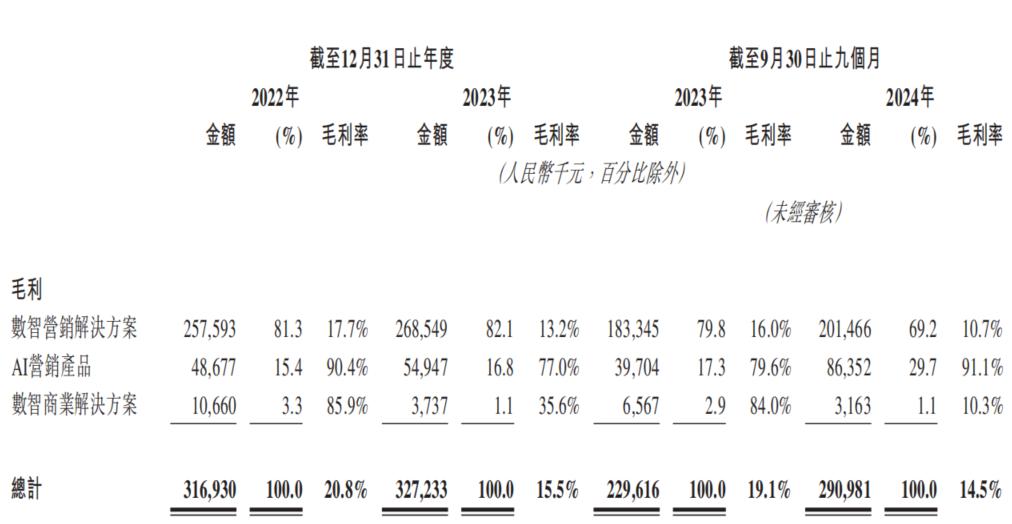
Core Viewpoint - Dongxin Marketing, claiming to be "China's largest AI marketing company," is attempting a second IPO on the Hong Kong Stock Exchange, but its financial data reveals a troubling trend of increasing revenue without corresponding profit growth, indicating significant operational and financial challenges [1][2][15]. Financial Performance - Dongxin Marketing's revenue has shown rapid growth, with 2022 revenue at 1.525 billion RMB, 2023 at 2.118 billion RMB (up 38.9%), and 2024's first three quarters at 2.005 billion RMB (up 66.41%) [2][18]. - In contrast, net profit has drastically declined from 104.4 million RMB in 2022 to 28.5 million RMB in 2023 (down 72.72%), and a net loss of 42.4 million RMB in the first three quarters of 2024 [2][6]. - The gross margin has also decreased significantly, from 20.8% in 2022 to 14.5% in the first three quarters of 2024, highlighting issues with cost control and profitability [2][3]. Cost Structure - Service costs have risen faster than revenue, with costs of 1.208 billion RMB in 2022, 1.790 billion RMB in 2023 (up 48.26%), and 1.714 billion RMB in the first three quarters of 2024 (up 75.75%) [3][5]. - The primary revenue driver, the digital marketing solutions segment, has seen its gross margin drop from 17.7% in 2022 to 10.7% in 2024, adversely affecting overall profitability [3][12]. Dependency on Non-Core Income - A significant portion of Dongxin Marketing's net profit is derived from government subsidies and other non-core income, which accounted for 52.18% of net profit in 2022 and 146.78% in 2023 [6][7]. - In 2024, despite a net loss, non-core income still contributed 26.3 million RMB, indicating that the company's actual profitability is much lower than reported [6][7]. Cash Flow and Debt Issues - The company has faced cash flow challenges, with negative operating cash flow of -337 million RMB in 2022, positive 111 million RMB in 2023, and again negative -156 million RMB in 2024 [8][9]. - Dongxin Marketing's debt has increased from 731 million RMB at the end of 2022 to 1.705 billion RMB by September 2024, with a current ratio indicating potential liquidity risks [9][10]. Market Position and Competition - Despite being labeled as the largest AI marketing company in China with a market share of 5%, the industry remains fragmented, with the top five companies holding only 14.9% of the market [12][16]. - Dongxin Marketing's AI marketing segment has not yet achieved significant revenue contributions, with only 3.5% to 4.7% of total revenue from AI marketing products from 2022 to 2024 [10][12]. Strategic Challenges - The company's shift in branding from a "leading mobile marketing service provider" to an "AI marketing company" raises questions about its strategic direction and the sustainability of its business model [13][15]. - High customer concentration poses risks, with the top five clients contributing a significant portion of revenue, indicating potential vulnerabilities in client relationships [13][14].

面向即时零售万亿市场机遇,微盟再升级同城业务
Xin Lang Ji Jin· 2025-05-08 07:29
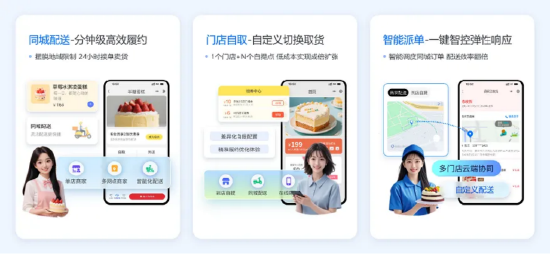
Core Insights - Weimob has upgraded its local business to enhance sustainable growth for merchants through "technology optimization of fulfillment chain + scenario-based operational empowerment" [1] - The essence of instant retail is a data-driven efficiency revolution, with Weimob's upgraded local business featuring five core functions that automate order dispatching and enhance operational efficiency [1][3] - The upgrade represents a shift in Weimob's business model from tool output to scenario-based solutions, redefining efficiency standards in instant retail [1][3] Industry Overview - The instant e-commerce market in China reached a scale of 2 trillion yuan in 2023, with a year-on-year growth of 36%, and is expected to grow at an annual rate of 47.1% by 2026 [3] - Instant retail has emerged as a new competitive space for various platforms, driven by localized and immediate consumer demands [3] Technological Advancements - Weimob's upgraded local business utilizes cloud collaboration technology to break down data barriers across multiple stores, achieving real-time inventory synchronization and dynamic capacity pooling [3] - The system employs LBS heat maps and real-time traffic data to implement a "dual optimal matching" strategy for order allocation, ensuring efficiency in delivery [3] User Experience Enhancement - The upgraded service includes features for user self-service order modifications and differentiated self-pickup options, addressing consumer needs for accuracy in delivery [5] - Merchants have reported significant improvements in operational efficiency and customer satisfaction through the integration of Weimob's services, such as precise order distribution and enhanced delivery times [4][6] Future Outlook - As demand for instant retail continues to grow, focusing on private domain management and strengthening fulfillment capabilities will be crucial for merchants to thrive [7] - Weimob aims to reconstruct the relationship between people, goods, and venues through intelligent systems, positioning technology as a core engine for creating incremental value [7]
智通决策参考︱5月行情值得期待
Sou Hu Cai Jing· 2025-05-06 00:53
Market Overview - The Hang Seng Index showed upward movement at the end of April, providing guidance for May's market trends [1] - Historically, overseas markets tend to rise during long holidays, with notable increases in AI giants' stock prices, such as Microsoft and Mate [2] Economic Indicators - The U.S. non-farm payroll data for April exceeded expectations, with an increase of 177,000 jobs compared to the forecast of 138,000 [3] - The upcoming Federal Reserve meeting on May 7 is expected to maintain current interest rates, with a strong focus on the strengthening of the RMB, which recently surpassed the 7.20 mark for the first time since November [4] - The fiscal deficit for the year is projected at 5.66 trillion yuan, an increase of 1.6 trillion yuan from the previous year, indicating a higher deficit rate of 4% [4] Industry Trends - The release of the Harmony OS PC version is anticipated soon, which aims to reduce reliance on Windows and create a self-sufficient ecosystem, potentially reshaping the PC market [5] - Xiaomi's MiMo model, with a parameter scale of 7 billion, is designed for lightweight deployment, particularly in mobile and automotive applications [5] - The humanoid robot market is expected to see significant growth, with projections indicating that humanoid robots will enter the general product category by 2026, reaching a production or sales threshold of 100,000 units [5] Company Performance - UBTECH Robotics (09880) is projected to achieve a revenue of 1.305 billion yuan in 2024, a year-on-year increase of 23.7%, driven by growth in educational and customized intelligent robot products [6] - The company’s revenue from educational robots and solutions is expected to reach 363 million yuan, while revenue from customized robots is projected to grow by 126.1% to 141 million yuan [6][7] - The company has made advancements in navigation, machine vision, and AI integration, which are expected to accelerate the industrialization of humanoid robots [8] AI Industry Developments - The AI sector remains a focal point in the U.S.-China tech rivalry, with recent calls for restrictions on AI technology flow to China [9] - Major Chinese tech companies are ramping up AI development, with Alibaba and Tencent making significant advancements in their AI models [9] - Upcoming releases and investments in AI infrastructure are expected to catalyze growth in the technology sector, with Huawei set to launch new products in May [9] Market Sentiment - The Hang Seng Index is showing bullish sentiment, supported by a concentration of market interest in technology and consumer sectors, particularly in robotics and AI applications [10][11]
港股收盘(05.02) | 恒指收涨1.74% 科技、汽车股走势强劲 小米集团-W(01810)大涨超6%
智通财经网· 2025-05-02 08:40
Market Overview - Hong Kong stocks experienced a strong start in May, with all three major indices rising collectively. The Hang Seng Index increased by 1.74% to close at 22,504.68 points, with a total trading volume of HKD 133.73 billion. The Hang Seng China Enterprises Index rose by 1.92%, and the Hang Seng Tech Index surged by 3.08% [1] - For the week, the Hang Seng Index gained 2.38%, the China Enterprises Index rose by 1.86%, and the Tech Index increased by 5.24% [1] Blue-Chip Stocks Performance - Xiaomi Group-W (01810) continued its upward trend, closing up 6.31% at HKD 53.1, contributing 91.5 points to the Hang Seng Index. The company is expected to report strong revenue growth and significant margin expansion in Q1, with adjusted net profit projected to increase by 43% year-on-year to RMB 9.3 billion [2] - Other blue-chip stocks included WuXi AppTec (02359) up 7.07%, WuXi Biologics (02269) up 5.7%, while China National Pharmaceutical Group (01099) and Bank of China Hong Kong (02388) saw declines [2] Sector Performance - Major technology stocks saw significant gains, with Xiaomi up over 6%, Alibaba rising nearly 4%, and Tencent increasing over 2%. The automotive sector also performed well, with several companies reporting high year-on-year sales growth in April [3][4] - The AI sector remained active, with companies like GDS Holdings (09698) and Kingsoft (03888) seeing substantial increases in their stock prices [4][5] - Consumer electronics stocks generally rose, with companies like Hong Teng Precision (06088) and KANAT (02276) experiencing notable gains [6] Automotive Sector Highlights - Several automotive companies reported impressive April delivery figures, with Li Auto delivering 33,939 vehicles (up 31.6% year-on-year), Xiaopeng Motors delivering 35,045 vehicles (up 273%), and NIO delivering 23,900 vehicles (up 53%) [4] - The overall retail sales of new energy vehicles in China reached 728,000 units in April, marking a 24% increase year-on-year [4] AI Industry Developments - The domestic AI large model sector is witnessing rapid advancements, with several companies releasing new models. For instance, Xiaomi launched its inference-focused open-source model, Xiaomi MiMo, while Alibaba introduced its Qwen3 model [5] - Analysts predict that the AI industry in China is poised for significant growth, with expectations for a "golden development period" by 2025 [5] Gold Sector Performance - The gold sector faced pressure, with several gold stocks declining as international gold prices fluctuated. The price of gold fell below USD 3,230 per ounce, influenced by reduced market risk appetite and profit-taking by investors [7] - Analysts suggest that the market's focus may shift from "credit logic" to "interest rate logic," indicating potential for gold prices to stabilize in the short term [7]




港股异动 | AI概念股活跃 国内人工智能大模型领域近期动作不断 机构看好行业迎来黄金发展期
智通财经网· 2025-05-02 03:08
Group 1 - AI concept stocks are generally active, with notable increases in share prices for companies such as Kingsoft (up 4.92%), Xiaomi (up 4.3%), Alibaba (up 3.23%), and Tencent (up 2.01%) [1] - The domestic AI large model sector has seen significant developments, including the release of DeepSeek-Prover-V2-671B with 671 billion parameters and the introduction of Xiaomi's open-source large model [1] - Other companies like Alibaba, Baidu, and Keling have also launched new models, indicating a competitive landscape in the AI large model market [1] Group 2 - The current development momentum of China's large model industry is strong, with domestic models like DeepSeek series performing comparably to leading overseas models at lower costs [2] - Large models are being applied across various sectors in China, including education, finance, media, and healthcare, showcasing their versatility [2] - Analysts predict that by 2025, the "Artificial Intelligence +" sector is expected to enter a golden development period, driven by continuous policy support and technological breakthroughs [2]



高盛:生成式 AI 如何重塑中国软件业?这 5 家公司被重点看好(附 2025 增长密码)
Zhi Tong Cai Jing· 2025-04-28 01:39
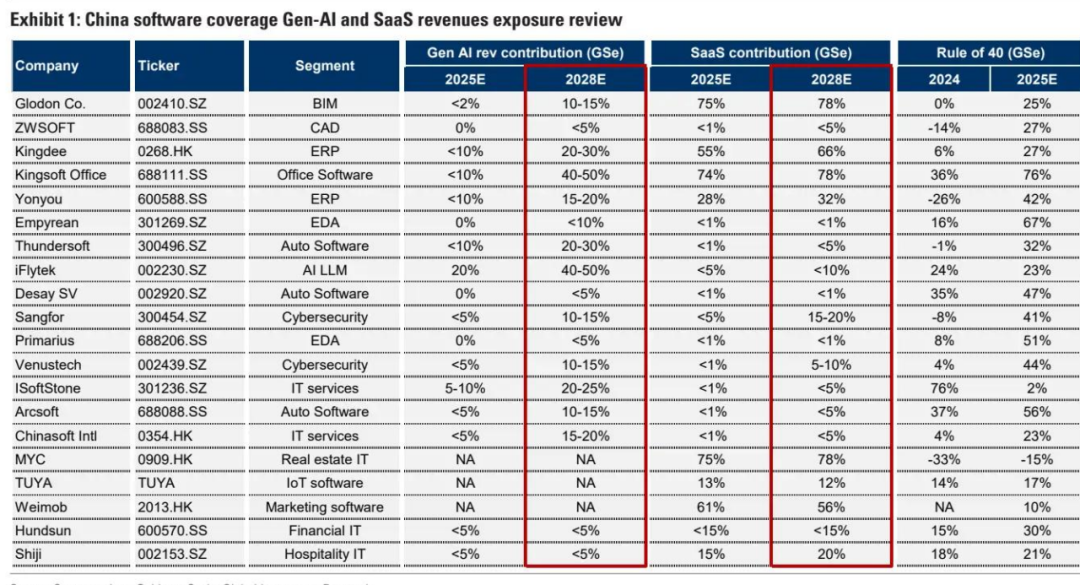
Core Insights - Goldman Sachs recently engaged with Chinese software supply chain companies to discuss customer software budgets, advancements in generative AI, and growth and profitability prospects for the second half of 2025. It is anticipated that the average revenue growth for Chinese software companies covered by Goldman Sachs will be 26% year-on-year in 2025, with sequential revenue growth expected across all four quarters [1]. Group 1: Generative AI Impact - The emergence of enhanced local foundational models, such as deep search models, has shifted customer software budgets from functional tools to generative AI software, leading to increased average revenue per user and attracting new paying customers [1]. - As demand rises and profitable business models for enterprise (B-end) and consumer (C-end) users become clearer, more software companies are investing in the development of application software based on foundational models [1]. - Generative AI is enabling enterprises to reduce operational costs, such as recruitment tools, with revenue from generative AI for covered Chinese software companies expected to rise from 0%-10% in 2025 to 10%-50% by 2028 [1]. Group 2: Revenue Contributions and Projections - The contribution of generative AI revenue to various companies is projected to increase significantly by 2028, with specific companies like Kingsoft Office and iFlytek expected to see substantial growth in their generative AI revenue contributions [2]. - The revenue growth for different segments, including electronic design automation, marketing, CAD/BIM, and automotive software, is expected to be robust in 2025, with generative AI applications playing a key role [10][29]. Group 3: Software Company Strategies - Companies are shifting their business models to subscription-based services, which provide predictable revenue streams and better operational leverage, particularly in the context of generative AI applications [7]. - Software companies are focusing on providing customized solutions for large clients while also developing standardized solutions for small and medium enterprises [24][25]. - The monetization of generative AI is occurring in both B-end and C-end markets, with existing clients paying more for upgraded versions with AI features and new clients converting from free to paid status more rapidly [26]. Group 4: Growth and Profitability Outlook - Companies like Kingsoft Office and Yonyou are expected to achieve steady revenue growth, with Kingsoft focusing on expanding its AI user base and Yonyou optimizing its product mix to improve gross margins [31]. - The automotive software sector is witnessing increased demand due to the push for intelligent vehicle strategies, benefiting the entire automotive technology supply chain [29]. - Cybersecurity companies are adapting to market demands by integrating multiple point solutions into platform offerings, driven by the increasing need for security solutions in the context of generative AI [30].


微盟集团(02013) - 2024 - 年度财报
2025-04-22 08:30
Financial Performance - Total revenue for 2024 was approximately RMB 1.34 billion, a decrease of 39.9% compared to the previous year[12]. - Gross profit decreased by 59.8% to approximately RMB 596.3 million, with a gross margin dropping from 66.6% to 44.5%[12]. - Adjusted net loss narrowed to approximately RMB 532.8 million from RMB 549.4 million in 2023[12]. - The company experienced a one-time price discount of approximately RMB 129 million related to advertising services, impacting total revenue by about RMB 299 million[12]. - Revenue reduction of approximately RMB 300 million was attributed to the divestment of the smart restaurant business and reduced investment in small and micro businesses[12]. - The adjusted gross profit decreased by 33.5% to approximately RMB 906 million in 2024[12]. - The operating cash flow for 2024 improved significantly from a cash outflow of approximately RMB 596 million in the same period last year to a cash outflow of approximately RMB 332 million, marking a continuous narrowing for three years[14]. - Subscription solutions revenue for 2024 was approximately RMB 919 million, a year-on-year decrease of 31.9%, with the number of paying merchants at 62,924, down 34.7%[15]. - The gross revenue from advertising support for merchants was approximately RMB 18.015 billion, a year-on-year increase of 24.5%, while merchant solution revenue was approximately RMB 421 million, a decrease of 52.1%[16]. - The average revenue per user increased by 4.2% to RMB 14,598, reflecting improved operational efficiency[15]. - The company reported a net loss attributable to equity holders of RMB 1,728.5 million in 2024, compared to RMB 758.3 million in 2023[35]. - The company recorded an operating loss of approximately RMB 1,431.2 million in 2024, compared to an operating loss of approximately RMB 604.3 million in 2023[71]. - Adjusted EBITDA for 2024 was RMB (1,228.6) million, reflecting an adjusted net loss of RMB (1,744.0) million, with a net loss margin of (130.2%) for the year[80]. Assets and Liabilities - The total assets decreased to RMB 6.96 billion in 2024 from RMB 7.87 billion in 2023[10]. - Non-current assets decreased to RMB 2.55 billion in 2024 from RMB 3.04 billion in 2023[10]. - Total liabilities increased slightly to RMB 5.15 billion in 2024 from RMB 5.07 billion in 2023[10]. - The company had cash and bank balances of approximately RMB 1,779.0 million as of December 31, 2024, including restricted cash of RMB 526.9 million[85]. - As of December 31, 2024, the company had total bank borrowings of approximately RMB 2,222.7 million, with various short-term and long-term loans listed[90]. - The company’s liquidity position remains stable with cash and cash equivalents of RMB 1,194.2 million as of December 31, 2024[85]. Business Strategy and Development - The company focused on AI technology development and optimization of business structure to improve operational efficiency[12]. - The AI product "WIME" launched for small and micro e-commerce operators improved product material creation efficiency by 80% and reduced team operation costs by 60%[17]. - The company has successfully integrated AI technology into its core business, launching 15 AI Agent products that cover 58 business scenarios in e-commerce and retail[20]. - The company aims to enhance its services in the WeChat ecosystem, leveraging its position as a core service provider to drive business growth for merchants[33]. - The company plans to expand AI Agent applications in e-commerce and retail sectors, focusing on high-performance, low-cost models to enhance operational efficiency[33]. - The company is exploring overseas market opportunities, particularly in North America, to drive product-led growth and capitalize on international business prospects[33]. - The company expanded its overseas business footprint to five major regions, with new market entries in East Asia and Africa during the reporting period[23]. Marketing and Customer Engagement - The company achieved a 24.5% year-on-year growth in advertising gross revenue, amounting to approximately RMB 18.015 billion[30]. - The number of paid merchants for marketing solutions decreased by 0.4% to 66,669, while the average spending per paid merchant increased by 25.0% to RMB 270,208[30]. - The average spending per advertiser increased from RMB 216,215 in 2023 to RMB 270,208 in 2024, contributing to the growth in gross revenue for merchant solutions[47]. - User retention rates improved to 85%, up from 80% in the previous quarter[8]. - The company reported a significant increase in user engagement, with a year-over-year growth of 25% in active users[1]. Cost Management and Efficiency - Sales and distribution expenses decreased by 34.6% from approximately RMB 1,551.5 million in 2023 to approximately RMB 1,014.0 million in 2024, primarily due to a reduction in contract acquisition costs and employee costs[62]. - Research and development expenses decreased by 30.7% from approximately RMB 586.7 million in 2023 to approximately RMB 406.3 million in 2024[66]. - Total sales costs slightly decreased by 0.2% from approximately RMB 744.2 million in 2023 to approximately RMB 743.0 million in 2024[50]. - Sales costs for subscription solutions increased to 79.1% of total sales costs in 2024, up from 61.4% in 2023[52]. - Adjusted sales costs for subscription solutions decreased by 9.5% from approximately RMB 449.1 million in 2023 to approximately RMB 406.6 million in 2024[54]. - Sales costs for merchant solutions decreased by 46.0% from approximately RMB 287.4 million in 2023 to approximately RMB 155.1 million in 2024[55]. Shareholder and Capital Management - The company reported a total issuance of convertible bonds amounting to $90 million on September 5, 2024, with a conversion price set at HKD 1.30 per share, potentially resulting in the issuance of up to 542,090,769 new shares[130]. - The net proceeds from the issuance of the convertible bonds are approximately $86 million, which will be utilized for strategic purposes as detailed in the report[130]. - The company completed a placement of 277,000,000 new shares at a price of HKD 1.13 per share, raising approximately HKD 313.0 million[141]. - The net proceeds from the 2024 placement are approximately HKD 308.0 million, aimed at improving the company's financial position and supporting long-term business expansion[141]. - The company believes that issuing the 2024 convertible bonds optimizes its capital structure and diversifies funding sources, supporting sustainable development[136]. - The company has the capacity to meet its redemption obligations under the 2024 convertible bonds based on its cash and cash equivalents as of December 31, 2024[136]. Compliance and Risk Management - The company is committed to maintaining compliance with all relevant laws and regulations, ensuring operational integrity[126]. - The company faces significant risks including reliance on Tencent's platform, evolving customer demands, and potential cybersecurity threats[128]. - The company emphasizes its commitment to environmental protection and resource conservation, adhering to relevant environmental laws and regulations without any reported violations during the period[127]. - The management team emphasized a commitment to sustainability initiatives, aiming for a 30% reduction in carbon footprint by 2025[10].
微盟集团20250323
2025-04-15 14:30
Summary of Conference Call Company and Industry - The conference call pertains to 威猛 (Weimeng), a company operating in the SaaS and advertising industry, particularly focusing on e-commerce solutions and digital marketing. Key Points and Arguments 1. **Revenue Adjustments**: The company reported a significant revenue adjustment due to a one-time advertising discount of 129 million in 2023, leading to an adjusted revenue of 1.468 billion for 2024, which reflects a 22% decline compared to the previous year [1][2]. 2. **Impact of Policy Changes**: The company's revenue from merchant solutions is expected to decrease by 170 million in 2024 due to policy changes that affected the rebate structure with Tencent, which were not fully passed on to clients [2][4]. 3. **Subscription Revenue Trends**: Subscription solutions are projected to see a total decline of approximately 300 million for the year, with a stabilization trend observed in orders, particularly for SaaS products [3][4]. 4. **Advertising Revenue Growth**: Despite challenges, the company reported a 24.5% growth in gross advertising revenue last year, reaching 18 billion, although profitability was impacted by policy mismanagement [5][20]. 5. **AI Integration**: The company is focusing on AI solutions to enhance customer engagement and operational efficiency, with significant improvements in customer retention rates observed after implementing AI tools [9][10]. 6. **Cost Management**: The company has successfully reduced its workforce from 4,584 to 3,563, resulting in a 23.7% decrease in total salary expenses, which is part of a broader cost-cutting strategy [18][19]. 7. **Financial Performance**: The total revenue for 2024 is reported at 1.34 billion, a 40% decline year-over-year, with subscription revenue at 918 million (down 31.9%) and merchant solutions revenue at 420 million (down 52%) [17][21]. 8. **Future Outlook**: The company remains optimistic about 2025, expecting a return to growth in subscription revenue by 5-10%, driven by improved order trends and AI integration [33][34]. Other Important but Possibly Overlooked Content 1. **Market Potential**: The company believes that the overall market for WeChat e-commerce could grow significantly, potentially reaching a scale of 2-3 trillion, which presents substantial opportunities for growth [12][40]. 2. **Client Structure Optimization**: The company is actively restructuring its client base to focus on higher-margin clients, which is expected to improve overall profitability [43][44]. 3. **New Product Development**: The company is developing new AI-based SaaS products aimed at the North American market, which could enhance its competitive position [14][32]. 4. **Cash Flow Management**: The company is focused on improving cash flow, with expectations of a positive cash flow in 2025, following a significant outflow in 2024 [31][32]. This summary encapsulates the critical insights from the conference call, highlighting the company's current challenges, strategic adjustments, and future growth prospects.
AI专题:2025中国AI Agent 营销市场发展潜力研究报告
Sou Hu Cai Jing· 2025-04-02 01:32
Core Insights - The report highlights the significant growth potential of AI Agents in the marketing sector, with the market size expected to reach 3.3 trillion yuan by 2028 from 147.3 billion yuan in 2024, indicating a rapid growth trend [1][20][21] - AI Agents are expected to enhance efficiency and effectiveness in marketing through integration with various technologies, such as LLM and NLP, leading to improved customer understanding and optimized marketing strategies [1][10][11] - The SaaS model for AI Agents is rapidly expanding, providing businesses with more convenient and flexible application methods, with notable examples including HubSpot and Salesforce [1][19] Market Overview - The AI Agent market in China is projected to grow from 147.3 billion yuan in 2024 to 3.3 trillion yuan by 2028, with a compound annual growth rate (CAGR) indicating a strong upward trajectory [1][20] - The penetration rates for key accounts (KA) and small to medium-sized businesses (SMB) are expected to increase significantly, with KA penetration rising from 3% in 2023 to 25% by 2028, and SMB penetration from 0.5% to 15% in the same period [17][23] Application Scenarios - AI Agents are being utilized across various marketing applications, including customer interaction, content production, data analysis, and strategy optimization, showcasing their versatility [5][6][30] - In customer interaction, AI Agents facilitate real-time communication and personalized strategies, addressing the need for dynamic engagement with consumers [28][32] - For content production, AI Agents enable rapid generation of diverse content types, enhancing creativity and compliance while reducing the burden on human resources [34][38] Industry Trends - The integration of AI Agents with SaaS platforms is expected to redefine the value proposition of marketing services, with AI capabilities enhancing traditional SaaS functionalities [22][27] - The shift towards data-driven decision-making is evident, as AI Agents facilitate real-time insights and predictive analytics, transforming marketing strategies from experience-based to data-algorithm-action cycles [11][41] - The report emphasizes the importance of multi-modal data integration and real-time processing capabilities to meet the evolving demands of the marketing landscape [40][41] Case Studies and Best Practices - Successful implementations of AI Agents by companies like HubSpot and Salesforce demonstrate the potential for increased productivity and cost savings, with reported ROI improvements of up to 78% [1][11][26] - The report outlines various case studies where AI Agents have been effectively deployed to enhance marketing outcomes, showcasing their role in driving innovation and efficiency [3][30][36]

小店交易,微信不想卷了
雷峰网· 2025-04-01 06:14
Core Viewpoint - WeChat aims to sustain its platform for another decade, focusing on building a robust ecosystem rather than pursuing aggressive growth strategies [25][33]. Group 1: WeChat's E-commerce Performance - In 2024, WeChat's small shop GMV is projected to be 1.92 times that of 2023, with order numbers increasing by 2.25 times, yet it still lags significantly behind major competitors like Taobao and Douyin, with a GMV gap of nearly one trillion [2][24]. - Predictions suggest that 2025 could be a pivotal year for WeChat's small shop to reach a trillion in GMV, contingent on achieving 3-5 times growth [3][4]. - Despite the growth, WeChat's operational approach is criticized for being slow and lacking in support for merchants, which may hinder its ability to reach the trillion GMV target by 2026 [4][10]. Group 2: Operational Challenges - WeChat's operational team is significantly smaller compared to competitors, with estimates suggesting only a few dozen people managing a vast number of merchants [12][19]. - Merchants express frustration over WeChat's inadequate infrastructure and slow response times, which contrasts sharply with the more responsive support systems of platforms like Douyin [10][11]. - The lack of urgency in WeChat's operational strategy is evident, as there is no clear attribution for performance metrics, leading to confusion among merchants [8][9]. Group 3: Ecosystem and Product Strategy - WeChat's strategy emphasizes "light operation and heavy product," allowing merchants to drive their own growth without heavy reliance on platform intervention [23][29]. - The platform is integrating various business lines to create a more cohesive user experience, which includes consolidating transactions through WeChat's official channels [30][31]. - WeChat's focus on building a comprehensive ecosystem aims to balance user and merchant interests, prioritizing user experience over aggressive monetization [28][29]. Group 4: Future Outlook - Analysts believe that WeChat's long-term vision is to establish a sustainable ecosystem that can thrive without immediate profit pressures, contrasting with the aggressive monetization strategies of competitors [25][27]. - The potential for WeChat's small shop to become a leading player in e-commerce hinges on its ability to enhance product offerings, improve user experience, and streamline operational processes [33][35]. - If WeChat can successfully attract content creators and merchants from other platforms, it may significantly alter the competitive landscape in e-commerce [34][35].