
通威股份

Search documents
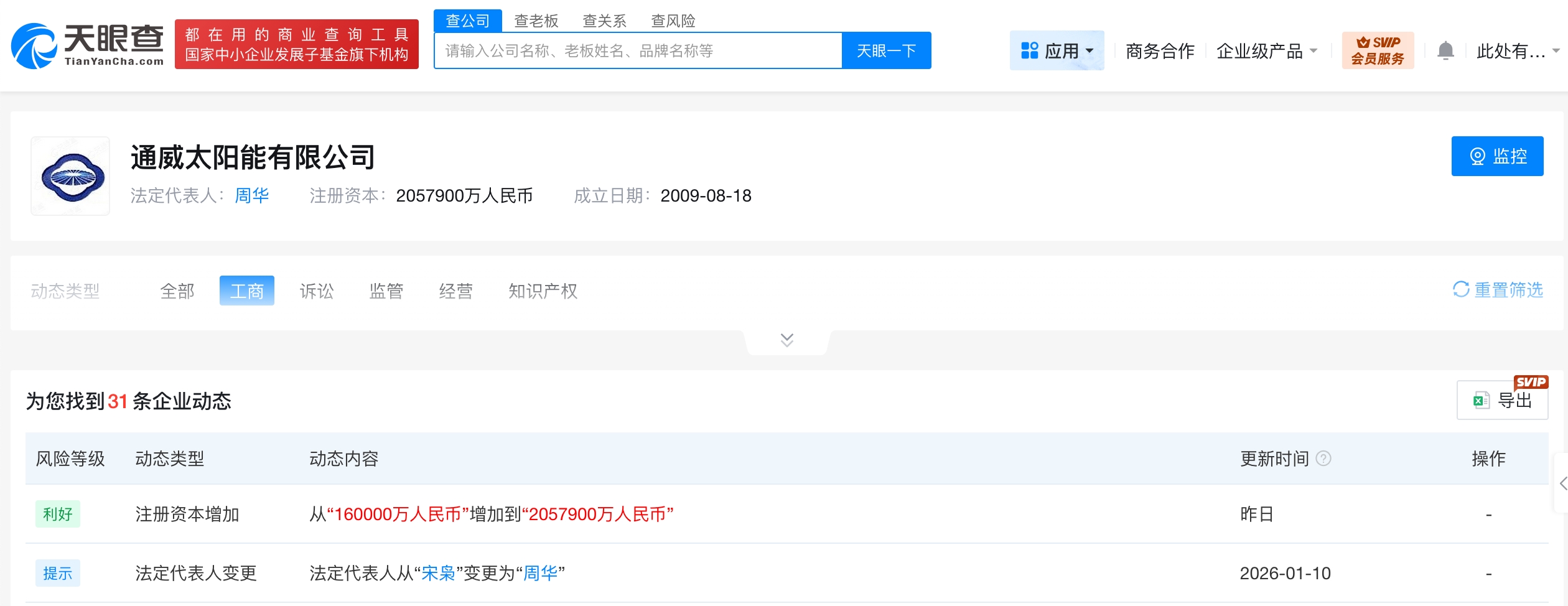
通威太阳能公司增资至205.79亿元
Mei Ri Jing Ji Xin Wen· 2026-01-13 03:47
Core Viewpoint - Tongwei Solar Co., Ltd. has significantly increased its registered capital from 1.6 billion RMB to 20.579 billion RMB, marking an increase of approximately 1186% [1][2]. Group 1: Company Information - The legal representative of Tongwei Solar has changed from Song Xiao to Zhou Hua [1][2]. - The company was established in August 2009 and operates in the manufacturing and installation of electrical machinery and equipment, battery manufacturing, and the production of household appliances using gas, solar, and similar energy sources [1][4]. - Tongwei Solar is wholly owned by Tongwei Co., Ltd. (stock code: 600438) [1][5]. Group 2: Financial Changes - The registered capital increase is from 1,600 million RMB to 20,579 million RMB, indicating a substantial financial growth [2][4]. - The company is classified as a limited liability company (wholly owned by a legal entity) and is currently in a state of existence [4][5].


通威太阳能公司增资至205.79亿
2 1 Shi Ji Jing Ji Bao Dao· 2026-01-13 03:42
Group 1 - The core point of the article is that Tongwei Solar Co., Ltd. has significantly increased its registered capital from 1.6 billion RMB to 20.579 billion RMB, marking an increase of approximately 1186% [1][2] - The legal representative of the company has changed from Song Xiao to Zhou Hua [1][2] - Tongwei Solar was established in August 2009 and operates in various sectors including electrical machinery manufacturing, battery manufacturing, and solar energy equipment [1][3] Group 2 - The company is wholly owned by Tongwei Co., Ltd. (stock code: 600438) [1][3] - The business scope includes wholesale and retail of goods, import and export business, and professional technical services [1][3] - The company is registered as a limited liability company and is located in Chengdu, Sichuan, China [3]
取消退税谁突围 谁出清?A股光伏龙头企业核心财务数据拆解
Nan Fang Du Shi Bao· 2026-01-13 03:37
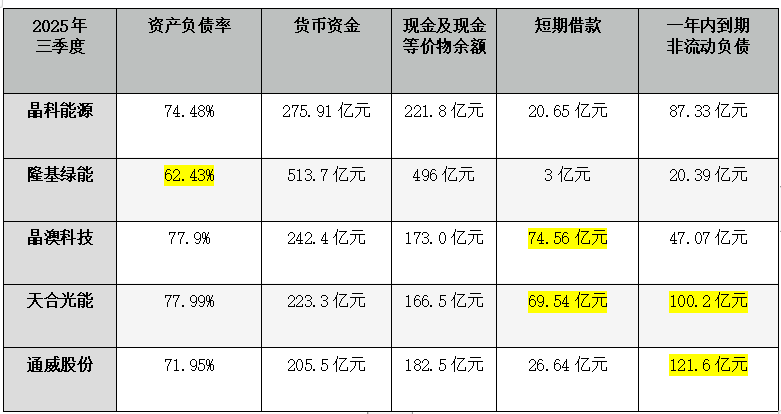
Core Viewpoint - The Ministry of Finance announced the cancellation of export VAT rebates for photovoltaic products starting April 1, 2026, affecting 249 products, which may accelerate the exit of weaker companies and optimize industry capacity structure [1] Group 1: Market Reaction - The A-share "photovoltaic equipment" sector surged by 2.72% following the announcement, with notable increases in stock prices for major companies such as JinkoSolar (3.56%), LONGi Green Energy (4.57%), JA Solar (3.4%), Trina Solar (8.62%), and Tongwei Co. (2.11%) [1] Group 2: Financial Health of Leading Companies - Leading photovoltaic companies exhibit high asset-liability ratios, with JinkoSolar, JA Solar, Trina Solar, and Tongwei Co. all exceeding 70%, and JA Solar and Trina Solar nearing 78% [2] - As of Q3 2025, JinkoSolar reported an asset-liability ratio of 74.48%, LONGi Green Energy at 62.43%, JA Solar at 77.9%, Trina Solar at 77.99%, and Tongwei Co. at 71.95% [3] - JinkoSolar had cash and cash equivalents of 22.18 billion, with 5 billion restricted for guarantees, while LONGi Green Energy maintained a lower short-term borrowing of 300 million [5] Group 3: Accounts Receivable and Payable - The five leading companies collectively had accounts payable nearing 200 billion, with accounts receivable totaling approximately 72.3 billion, resulting in a significant payment demand [8] - The accounts receivable turnover days increased for several companies, with LONGi Green Energy at 69.31 days, JA Solar at 67.02 days, and Trina Solar at 82.38 days [7] Group 4: Profitability Challenges - All leading companies faced significant losses in the first three quarters of 2025, with JinkoSolar, LONGi Green Energy, JA Solar, Trina Solar, and Tongwei Co. reporting net losses of 4.543 billion, 4.454 billion, 3.453 billion, 4.315 billion, and 5.471 billion respectively [10] - The gross profit margins varied, with Trina Solar at 5.09% and JA Solar at -2.6%, indicating a wide disparity in profitability [11] Group 5: Debt Structure and Financing - Tongwei Co. had a notably high long-term debt of 53.78 billion, while JinkoSolar's financial expenses were relatively low due to favorable foreign exchange gains [12] - The actual controllers of LONGi Green Energy and Tongwei Co. had some share pledges, with LONGi at 14.62% and Tongwei at 28.36%, indicating potential financial constraints [14]




通威太阳能公司增资至205.79亿,增幅约1186%
Zhong Guo Neng Yuan Wang· 2026-01-13 03:16
Core Insights - Tongwei Solar Co., Ltd. has increased its registered capital from 1.6 billion RMB to 20.579 billion RMB, representing a growth of approximately 1186% [1] - The legal representative has changed from Song Xiao to Zhou Hua [1] Company Overview - The company was established in August 2009 and operates in the manufacturing and installation of electrical machinery and equipment, battery manufacturing, and the production of gas, solar, and similar energy household appliances [1] - Tongwei Solar is wholly owned by Tongwei Co., Ltd. (stock code: 600438) [1]
山西证券研究早观点-20260113
Shanxi Securities· 2026-01-13 00:47
Group 1: Market Overview - The domestic market indices showed positive performance, with the Shanghai Composite Index closing at 4,165.29, up by 1.09% [4] - The SW textile and apparel sector rose by 2.65%, while the SW light industry manufacturing sector increased by 2.98%, indicating a general upward trend in the market [8] Group 2: Company Insights - Fast Retailing Group reported a revenue of 1,027.745 billion JPY for FY2026 Q1, a year-on-year increase of 14.8%, and raised its FY2026 revenue guidance to 3,800 billion JPY, up from the previous estimate of 3,570 billion JPY [6] - Ximai Foods achieved a revenue of 1.896 billion CNY in 2024, reflecting a year-on-year growth of 20.16%, and is positioned as the leading player in the oat industry in China [15][16] - Blue Sky Technology is expected to see revenues of 2.286 billion CNY in 2025, with a growth rate of 20.6%, driven by advancements in small nucleic acid technology [17] Group 3: Industry Trends - The solar energy sector experienced a decline in new installations, with a year-on-year decrease of 11.9% in November 2025, while the cumulative installed capacity for the year reached 274.89 GW, a 33.2% increase [11] - The retail sector is witnessing a shift towards community stores, as evidenced by Walmart's expansion in Shenzhen, indicating a competitive landscape in community retail [7] - The oat industry in China is projected to exceed 10 billion CNY in market size by 2024, driven by increasing health consciousness among consumers [15]
光伏“淡季不淡”背后: 出口退税取消 推升抢出口行情
Sou Hu Cai Jing· 2026-01-12 16:34
Core Viewpoint - The photovoltaic industry is experiencing an unexpected surge in demand during the traditionally slow first quarter due to the cancellation of export tax rebates, prompting overseas buyers to place orders in advance to avoid higher costs after April 2026 [1] Group 1: Policy Changes and Market Reactions - The Ministry of Finance and the State Taxation Administration announced the cancellation of the value-added tax export rebate for photovoltaic products starting April 1, 2026, marking a shift to a "no rebate subsidy" phase for the industry [1] - The cancellation of the rebate is expected to increase export costs, leading to a rush in orders from overseas buyers before the policy takes effect, thus boosting first-quarter export demand [1] - Major photovoltaic companies, such as Dongfang Risen and Trina Solar, saw significant stock price increases, with Dongfang Risen hitting a new high since September 2023 [1] Group 2: Industry Dynamics and Price Trends - The photovoltaic supply chain is showing a divergence, with upstream silicon material companies experiencing relatively low performance, while leading component manufacturers are raising prices to capitalize on the export window [2] - The price increase in components is expected to enhance profit margins for component manufacturers in the first quarter, while silicon material prices will depend on the self-regulation of the industry and profit margins [2] - There is a concern that the rush for exports may preemptively exhaust overseas demand for the second quarter, potentially leading to a sharp decline in demand similar to previous years [2][3] Group 3: Future Outlook and Demand Stability - Analysts suggest that after the export rush, there may be a significant drop in demand, which could put pressure on silicon prices again [3] - The stability of the photovoltaic industry's supply and demand dynamics will rely heavily on self-regulation within the industry and the actual trends in production control [3] - The domestic photovoltaic installation is expected to grow steadily under policy guidance, with leading companies that have integrated overseas production and sales likely to be less affected by the cancellation of the rebate [3]


光伏“淡季不淡”背后:出口退税取消 推升抢出口行情
Sou Hu Cai Jing· 2026-01-12 15:30
Group 1 - The core viewpoint of the articles indicates that the cancellation of export tax rebates for photovoltaic products has led to an unexpected increase in demand during the traditionally slow first quarter, as companies rush to secure orders before costs rise [1][2] - The Ministry of Finance and the State Taxation Administration announced that the export tax rebate for photovoltaic products will be canceled starting April 1, 2026, marking a shift to a "no rebate subsidy" phase for the industry [1] - As a result of this policy change, companies are experiencing increased export demand, with major photovoltaic component companies seeing significant stock price increases, such as Dongfang Risheng rising over 14% and Trina Solar increasing by over 8% [1] Group 2 - The photovoltaic supply chain is showing signs of differentiation, with upstream silicon material companies experiencing relatively low growth, while component manufacturers are raising prices to capitalize on the export window [2] - The phenomenon of rushing to export may lead to a potential overshoot of overseas demand in the second quarter, reminiscent of previous demand fluctuations caused by policy changes [2][3] - Analysts suggest that while the current rush to export may temporarily alleviate supply-demand imbalances, it could also lead to a sharp decline in demand later, with the stability of industry prices relying heavily on self-discipline within the industry [3]
A股越走越强引全球关注,瑞银报告:2026趋势上行,七大板块值得超配
Zhi Tong Cai Jing· 2026-01-12 14:21
Group 1 - The core viewpoint of the article is that the A-share market is entering a new upward trend in 2026, supported by a recovery in funds and sentiment, along with corporate earnings, highlighting structural investment opportunities [1][2] - UBS predicts that the overall profit growth rate of A-shares will increase from 6% in 2025 to 8% in 2026, driven by both profit and valuation [3] - The report emphasizes that the current equity risk premium in A-shares is still above historical averages, indicating clear potential for valuation recovery [4] Group 2 - Key factors supporting profit growth include the recovery of nominal GDP growth, narrowing PPI declines, and targeted policy support such as equipment upgrade subsidies and new infrastructure investments [4] - The report suggests focusing on growth stocks, with a preference for cyclical sectors over defensive ones, as growth stocks are expected to outperform in an upward market cycle [6] - UBS recommends overweighting seven key sectors: electronics, telecommunications, non-bank financials, defense and military, non-ferrous metals, chemicals, and electric power equipment, each with specific growth drivers [7] Group 3 - The report identifies four thematic investment directions: technology self-sufficiency, consumer recovery, beneficiaries of "anti-involution," and global leaders with competitive advantages [8][9] - The A-share market has seen a significant increase in trading activity, with average daily turnover rising to 24.6 trillion yuan, up from 17.3 trillion yuan in 2025, indicating strong investor interest [2] - The influx of various long-term funds, including insurance capital and foreign investment, is expected to provide ongoing support for the market [2]

光伏“淡季不淡”背后:出口退税取消,推升抢出口行情
第一财经· 2026-01-12 10:49
Core Viewpoint - The cancellation of the export VAT rebate for photovoltaic products starting April 1, 2026, is a significant policy shift that has led to an unexpected surge in demand during the traditionally slow first quarter, as companies rush to secure orders before costs rise [3][4]. Group 1: Policy Impact - The Ministry of Finance and the State Taxation Administration announced the cancellation of the VAT export rebate for photovoltaic products, marking the industry’s transition into a "no rebate subsidy" phase, which will increase export costs [3][4]. - This policy change has prompted overseas buyers to place orders in advance to avoid higher costs, resulting in a spike in export demand during the first quarter [3][4]. Group 2: Market Reactions - Major photovoltaic companies such as Dongfang Risen, Trina Solar, and Longi Green Energy saw significant stock price increases, with Dongfang Risen hitting a new high since September 2023, closing up over 14% [3]. - The market has reacted to the antitrust situation in the silicon material sector, leading to a divergence in the photovoltaic industry chain, with upstream silicon material companies experiencing relatively low growth [4]. Group 3: Price Dynamics - Leading component manufacturers have begun raising component prices in response to the export rush, indicating a strong willingness to increase prices downstream, which may lead to improved profit margins for component manufacturers in the first quarter [4]. - The price dynamics in the silicon material sector will depend on the self-regulation of the industry alliance and the profit margins of the companies involved [4]. Group 4: Future Outlook - While the current export rush has temporarily alleviated the "double weakness" in supply and demand within the photovoltaic industry, there is a risk of preemptively exhausting overseas demand for the second quarter [4][5]. - Analysts suggest that the potential for a sharp decline in demand following the export rush could mirror past experiences, emphasizing the need for self-regulation within the industry to stabilize prices [5].

通威股份入选“2025中国企业ESG百强”榜单
Xin Lang Cai Jing· 2026-01-12 10:06
Core Insights - The article emphasizes the growing importance of ESG (Environmental, Social, and Governance) as a key metric for high-quality corporate development and a vital link between corporate and social value [1][12]. - The "2025 China ESG Top 100" list was released by Sina Finance, evaluating over 5,000 A-share listed companies and mainland companies listed in Hong Kong using 18 industry-specific ESG evaluation models and over 150 ESG indicators [1][12]. Industry Overview - The ESG ecosystem in China is rapidly evolving, with tightening regulatory policies and increasing market focus on ESG performance, making sustainable development a core competitive advantage for companies [1][12]. - The release of the ESG Top 100 list serves as a benchmark for industry development and provides valuable decision-making references for investors [1][12]. Company Highlights - Tongwei Co., Ltd. was recognized for its significant contributions in the ESG domain, ranking 28th on the "2025 China ESG Top 100" list, reflecting its strong performance in sustainable practices [2][12]. - The recognition of companies in the ESG Top 100 is seen as authoritative validation of their sustainable development efforts and a call for more companies to integrate ESG principles into their strategic planning and operations [2][12].
