
Stellantis N.V.

Search documents
欧盟:将放弃2035年燃油车禁令
3 6 Ke· 2025-12-17 01:23
Group 1 - The European Commission is preparing to abandon the "2035 internal combustion engine ban," which would have completely prohibited the sale of internal combustion engine vehicles in the EU from 2035 [1] - The new proposal will allow certain plug-in hybrid vehicles and electric vehicles with fuel range extenders to be sold, with a target to reduce automotive emissions by 90% by 2035, compared to the original goal of 100% reduction [2] - This shift is driven by pressure from European automakers who are struggling to compete with Chinese electric vehicle manufacturers like Tesla and BYD, marking the most significant concession in green policy by the EU in the past five years [3] Group 2 - The electric vehicle industry opposes this move, arguing it will weaken investment in the sector and hinder the EU's transition to electric vehicles, potentially falling further behind China [4] - Future plans from the EU include promoting electric vehicle adoption in corporate fleets, which account for about 60% of new car sales in Europe, with potential incentives for local production [4] - The EU may propose a new regulatory category for small electric vehicles, allowing them to pay lower taxes and earn additional credits towards carbon emission targets, alongside promoting sustainable production methods [4]
竞争不过中国就掀桌,欧盟不惜“违背祖训”…
Guan Cha Zhe Wang· 2025-12-17 01:17
Core Viewpoint - The European Union (EU) is planning to abandon its 2035 ban on new combustion engine vehicles due to pressure from automotive manufacturers, marking a significant retreat from its green policies [1][7]. Group 1: Proposal Details - The EU Commission's proposal will allow the continued sale of certain non-electric vehicles, including plug-in hybrid and range-extended combustion engine vehicles, in response to competition from Tesla and Chinese manufacturers [1][4]. - The new carbon emission targets will be adjusted to a 90% reduction from 2021 levels, rather than achieving zero emissions for all new cars and vans by 2035 as previously mandated [1][2]. Group 2: Industry Reactions - Major automotive manufacturers, such as Volkswagen, view the new carbon reduction targets as economically reasonable and support the flexibility in setting goals for electric vehicles [5]. - The Climate Group criticized the measures as a "tragic victory" for traditional automotive industries, arguing that it undermines the push for electric vehicles and stability in the market [5]. Group 3: Competitive Landscape - German automakers are under significant pressure as they face fierce competition from Chinese electric vehicle manufacturers, both domestically and in international markets [6][10]. - The EU's decision to relax emission targets is seen as a response to the anxiety among European leaders regarding the competitiveness of their automotive industry against Chinese firms [7][8]. Group 4: Broader Implications - The relaxation of emission targets may weaken investments in critical charging infrastructure and hinder Europe's transition to clean driving, potentially allowing China to advance further in the electric vehicle sector [10][11]. - The EU's shift in policy reflects a broader trend of reevaluating environmental goals in light of economic pressures and competitive dynamics in the global automotive market [8][10].

段永平,他还没有彻底“看懂”汽车
汽车商业评论· 2025-12-16 23:06
Core Viewpoint - The electric vehicle (EV) industry is facing significant challenges, with many companies struggling to achieve profitability, as highlighted by the statement from Duan Yongping, a prominent investor in China [4][10]. Group 1: Industry Challenges - Duan Yongping emphasizes that while the automotive industry has value, it is difficult to turn it into a "good business" due to intense competition and product homogenization [6][14]. - The automotive sector has historically experienced a high level of product similarity, which has led to fierce competition and a lack of unique selling propositions [14][18]. - The transition from traditional fuel vehicles to electric vehicles may exacerbate these challenges, as the EV market is predicted to become increasingly homogeneous [15][18]. Group 2: Business Model Insights - A strong business model requires differentiation, which is currently lacking in the automotive industry, making it hard for companies to establish a competitive moat [12][14]. - Duan Yongping argues that the automotive industry is at risk of falling into a price war, which can undermine long-term profitability and innovation [20][21]. - Companies need to focus on creating unique value propositions rather than competing solely on price, as this can lead to a race to the bottom [20][21]. Group 3: Strategic Recommendations - To transform the automotive business into a sustainable venture, companies should concentrate their efforts and resources rather than diversifying too broadly [22][24]. - The single product model, exemplified by companies like Apple, allows for focused resource allocation and can lead to superior product quality and customer loyalty [26][29]. - Companies should explore the potential of electric vehicles as platforms for additional services, leveraging the time consumers spend in their vehicles to create new revenue streams [32][36]. Group 4: Future Outlook - The future of the automotive industry may hinge on the ability to innovate beyond traditional vehicle sales, potentially integrating software and services that enhance user experience [32][36]. - Duan Yongping's evolving views on electric vehicles and autonomous driving reflect a broader trend of adapting to new market realities and consumer behaviors [37][39].




Ford Scales Back EV Push & Lifts EBIT View: Is F Stock a Buy Now?
ZACKS· 2025-12-16 15:42
Core Insights - Ford is pausing some of its electric vehicle (EV) ambitions and shifting focus towards more profitable hybrids, gas-powered vehicles, and smaller, affordable EVs due to slower EV adoption and rising costs [1][3][4] Group 1: Strategic Shift - The company is moving away from plans to manufacture large EVs and is opting for a more pragmatic approach by focusing on profitable hybrids and internal combustion vehicles [3][4] - Ford's new Universal EV Platform will support a family of affordable, high-volume electric vehicles, with the first vehicle being a midsize electric pickup set to launch in 2027 [4][5] - The F-150 Lightning will be redesigned as a hybrid instead of a fully electric version, and Ford is canceling its upcoming electric van [5] Group 2: Industry Context - Other automakers, such as General Motors and Stellantis, are also scaling back their EV ambitions due to disappointing demand in the U.S. market [6] - The U.S. has fallen behind in EV adoption, exacerbated by the rollback of government incentives under the Trump administration [7] Group 3: Profitability Focus - Ford is launching a battery energy storage systems business, with shipments expected to begin in 2027 and an annual capacity of 20 GWh [8] - The company anticipates margin improvements across its business units and expects the Model e EV unit to reach profitability by 2029 [9] - Ford has raised its 2025 adjusted EBIT outlook to approximately $7 billion, up from a previous range of $6-$6.5 billion [11] Group 4: Financial Performance - Ford expects to record about $19.5 billion in special items, primarily in Q4, related to its EV strategy adjustments [10] - Despite challenges, Ford's stock has gained 31% over the past six months, although it has underperformed compared to competitors [12] - The consensus estimate for Ford's 2025 EPS indicates a 43% year-over-year decline, followed by a projected 35% rebound in 2026 [14]

车百会:年销不足10万辆的跨国车企,退出概率超80%
Di Yi Cai Jing· 2025-12-16 12:56
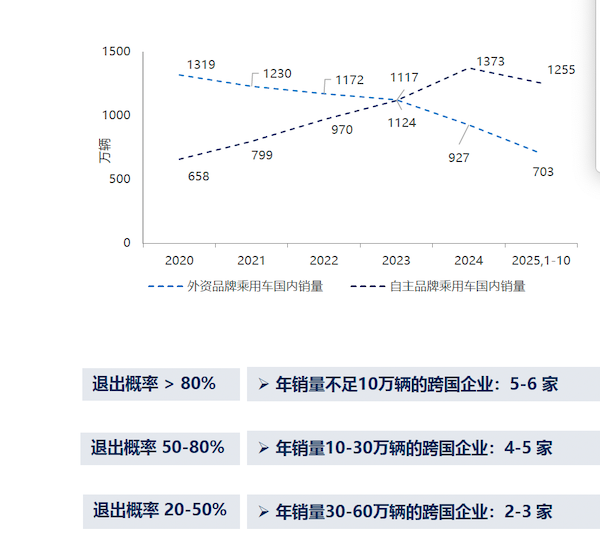
Core Viewpoint - Foreign brands in China are facing significant challenges, with a high probability of exit for multinational car companies with annual sales below 100,000 units, estimated at over 80% for 5 to 6 companies [1] Group 1: Market Share Dynamics - In 2020, domestic brands held a market share of 36%, while foreign brands had 64%. By January to October of this year, domestic brands increased their share to 65%, while foreign brands decreased to 35% [3] - In November, the retail market shares were reported as follows: German brands at 14%, Japanese at 11.7%, American at 5.7%, and Korean at 0.9% [4] Group 2: Exit Probability of Multinational Companies - The probability of exit for multinational companies is closely linked to their market scale. Companies with annual sales between 100,000 to 300,000 units have a 50% to 80% exit probability, with an expectation of 4 to 5 companies exiting; those with sales between 300,000 to 600,000 units have a lower exit probability of 20% to 50%, with an expectation of 2 to 3 companies [4] - Companies with annual sales below 100,000 units include Shenlong Automobile, Chery Jaguar Land Rover, smart, Changan Lincoln, Changan Mazda, and Jiangling Ford [4] Group 3: Strategic Adaptations of Multinational Companies - Leading multinational companies are accelerating their transformation towards a "made in China, for China" strategy. Volkswagen has established a China Technical Research Center (VCTC) for electric vehicle architecture; Toyota has set up an electric intelligent vehicle R&D center in China; Nissan has founded Nissan Technology Development (Shanghai) Co., Ltd. for smart driving and new energy research [4] - In joint ventures, the influence of Chinese teams on product definition is increasing. For instance, Toyota has adopted a local chief engineer management model; Volkswagen has upgraded its strategy from "headquarters directive, local execution" to "joint definition, co-development"; General Motors has shifted product definition authority to local teams, focusing entirely on Chinese customer needs [5] Group 4: Global Sharing of R&D Achievements - Some multinational companies are beginning to share their R&D achievements from China with global markets. For example, BMW has developed a voice interaction system based on Alibaba and DeepSeek's large model for global application; Tesla has integrated over 60 Chinese suppliers into its global procurement system; Stellantis has formed a joint venture with Leap Motor to fill the market gap for affordable electric vehicles [5]




Wall Street Breakfast Podcast: Ford Takes $19.5B EV Reset
Seeking Alpha· 2025-12-16 11:56
Ford's EV Strategy Shift - Ford is taking a $19.5 billion write-down of its electric vehicle division due to weak demand, high costs, and regulatory changes [3] - The company will end production of the current generation F-150 Lightning and focus on hybrids, extended range vehicles, and smaller EV models [5] - By 2030, Ford aims for approximately 50% of its global volume to consist of hybrids, extended range EVs, and pure EVs, up from 17% currently [5] Financial Projections - Ford raised its 2025 EBIT estimate to $7 billion from a previous range of $6 billion to $6.5 billion and confirmed free cash flow guidance of $2 billion to $3 billion for 2025 [4] Production and Infrastructure Changes - The next generation of the F-150 Lightning will utilize an extended range electric vehicle architecture and will be assembled at the Rouge Electric Vehicle Center in Dearborn, Michigan [6] - Ford plans to convert its Kentucky and Michigan EV battery plants to produce energy cells for the electric grid and data center demand [6] Market Reaction - Following the announcement, Ford's shares increased by 2% in after-hours trading, while Tesla shares fell slightly, and General Motors and Stellantis remained unchanged [7]

福特带头“悔棋”,美国汽车工业的纯电泡沫破了
Guan Cha Zhe Wang· 2025-12-16 09:02
Core Viewpoint - The American automotive industry is reevaluating its future strategies amid turmoil, with major companies like Ford announcing significant asset write-downs and scaling back electric vehicle (EV) plans in response to declining demand and policy changes under the Trump administration [1][6]. Group 1: Ford's Strategic Shift - Ford announced a $19.5 billion (approximately 137.67 billion RMB) asset impairment and will cancel several electric vehicle models, including the next-generation electric pickup truck T3 and an electric commercial van [2][6]. - The company plans to replace the fully electric F-150 Lightning with a range-extended electric vehicle and will focus on producing lower-cost electric models, although this will no longer be the company's strategic priority [2][3]. - CEO Jim Farley indicated that recent market changes prompted this decision, emphasizing the need for a diverse powertrain strategy rather than a singular focus on electric technology [3][6]. Group 2: Industry-Wide Trends - Other automakers, including General Motors, Stellantis, and Volkswagen, are also scaling back their electric vehicle initiatives and returning to fuel and hybrid models [2][6]. - General Motors reported a $1.6 billion impairment due to adjustments in EV factory plans and warned of potential future impairments [3][6]. - Volkswagen plans to reduce production of its ID.4 electric SUV in Tennessee, temporarily laying off 160 employees to align production with market demand [4][6]. Group 3: Market Dynamics - The recent decline in electric vehicle sales in the U.S. has led traditional automakers to compete in a shrinking consumer market, potentially benefiting pure EV companies like Tesla and Rivian [5][6]. - The Trump administration's policies have reduced federal support for electric vehicles and relaxed emissions standards, encouraging automakers to focus more on traditional fuel vehicles [6][7]. - The termination of EV subsidies, effective September 30, has contributed to a significant drop in electric vehicle sales, with November figures showing a year-on-year decline of approximately 40% [6][7].
阿尔及利亚本土生产的菲亚特汽车将有望配备本地刹车片
Shang Wu Bu Wang Zhan· 2025-12-16 03:18
Core Viewpoint - Stellantis Group has signed a new supply contract with Algeria's IKAM company to produce multi-brand brake pads, enhancing local production and aiming for a localization rate exceeding 30% by 2026 [1] Group 1: Partnership and Production - The partnership between Stellantis and IKAM will facilitate the production of brake pads at the Fiat factory in Tiaret, Algeria [1] - This collaboration is part of a broader localization strategy to improve the supply of aftermarket parts [1] Group 2: Compliance and Market Goals - IKAM's products have received certification that meets international safety and quality standards, ensuring they meet the requirements of the Algerian market [1] - Stellantis aims to establish a complete and competitive automotive industry system in Algeria, with plans to export products to other markets in the Middle East and Africa [1]
美股高开 发布新版开源AI模型 英伟达开涨1.5%
Ge Long Hui· 2025-12-15 14:40
Market Overview - The three major U.S. stock indices opened higher, with the Dow Jones up 0.31%, the Nasdaq up 0.58%, and the S&P 500 up 0.47% [1] Sector Performance - Storage sector stocks saw broad gains, with Micron Technology rising over 2%, and Western Digital and Seagate Technology both increasing by more than 1% [1] - Nvidia opened up 1.5% following the announcement of its new Nemotron 3 series open-source models [1] Company-Specific News - iRobot, a manufacturer of robotic vacuum cleaners, experienced a dramatic drop of 69% in its opening price after announcing its bankruptcy filing [1] - Stellantis shares rose by 1.3% as the European Commission is expected to withdraw the ban on internal combustion engine vehicles by 2035 [1] - ServiceNow's stock fell by 7.2% as it nears a deal to acquire cybersecurity startup Armis [1]


道指开盘涨0.3%,标普500涨0.5%,纳指涨0.6%
Xin Lang Cai Jing· 2025-12-15 14:36
Group 1 - Stellantis shares increased by 1.3% as the European Commission is expected to withdraw the ban on internal combustion engine vehicles by 2035 [1] - Dollar General shares rose by 1.6% after JPMorgan upgraded its rating to "Overweight," with the target price raised from $128 to $166 [1] - iRobot, a leading company in the robotic vacuum sector, saw a significant decline of 72.7% as it filed for bankruptcy protection in the U.S. [1] - ServiceNow shares fell by 7.2% as it is nearing a deal to acquire cybersecurity startup Armis [1]

