奇瑞汽车

Search documents
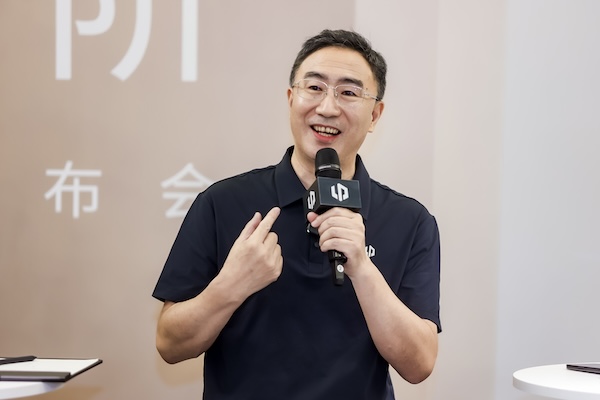
视频|奇瑞董事长尹同跃:外国有乔布斯,中国有余承东 对技术有极致的追求
Xin Lang Cai Jing· 2025-12-29 14:31
责任编辑:何俊熹 责任编辑:何俊熹 炒股就看金麒麟分析师研报,权威,专业,及时,全面,助您挖掘潜力主题机会! 来源:奇瑞汽车安庆冠豪店 炒股就看金麒麟分析师研报,权威,专业,及时,全面,助您挖掘潜力主题机会! 来源:奇瑞汽车安庆冠豪店 ...
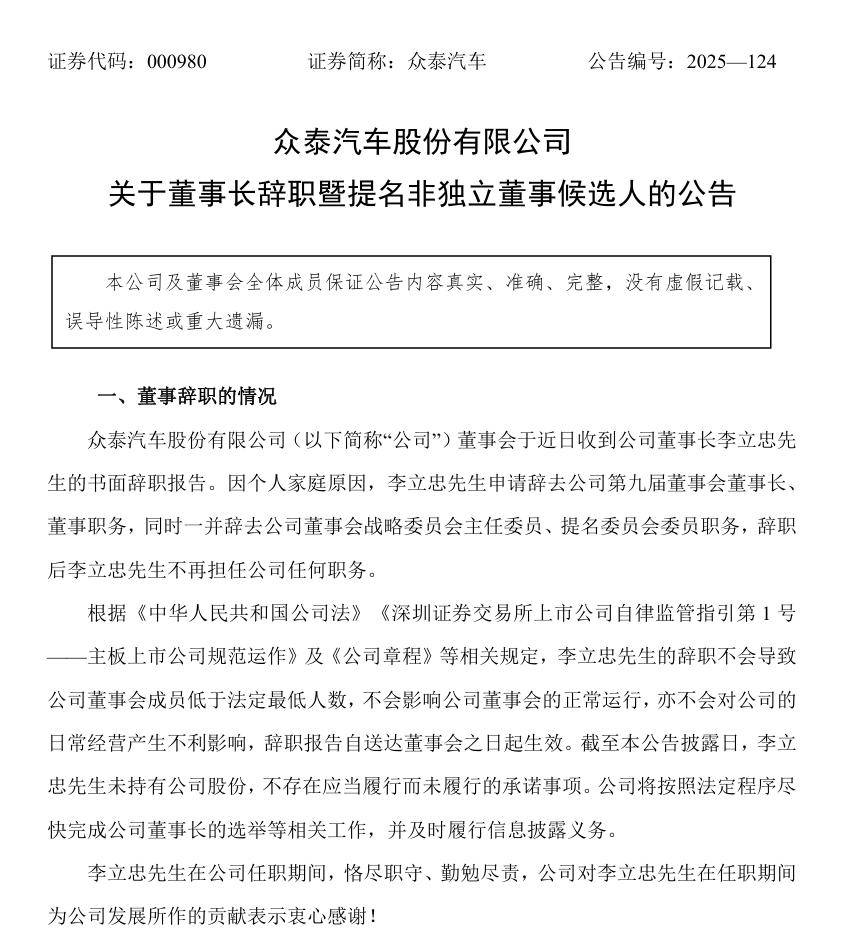
上任仅两个月辞职!众泰汽车62岁“奇瑞系”董事长离场,称个人原因,昔日“神车”复产难,去年仅卖出14辆车
Xin Lang Cai Jing· 2025-12-29 14:00
Core Viewpoint - The resignation of Li Lizhong, the chairman of Zotye Auto, after only two months in office, raises concerns about the company's leadership stability and ongoing operational challenges, as the company struggles to revive its production and sales [1][3][10]. Group 1: Leadership Changes - Li Lizhong resigned from his positions as chairman and director of Zotye Auto due to personal family reasons, having served only two months since his appointment on October 30 [1][3]. - The company has nominated Han Biwen as a candidate for the non-independent director position, with his term starting upon approval at the shareholders' meeting [3][12]. - Han Biwen has extensive experience in the automotive industry, having held various positions at Chery Automobile and is expected to bring valuable expertise to Zotye Auto [4][15]. Group 2: Company Performance - Zotye Auto has faced significant operational difficulties, with production and sales of complete vehicles nearly halted; the company sold only 14 vehicles last year [1][7]. - The company has reported continuous losses since 2019, with a total of six years of losses, and declared bankruptcy reorganization in September 2020 due to insolvency [7][16]. - The latest financial report indicates that for the first three quarters of this year, Zotye Auto generated revenue of 419 million yuan, an increase of 8.98% year-on-year, but still reported a net loss of 223 million yuan, which is a 33.13% increase in losses compared to the previous year [9][19]. Group 3: Market Position and Future Outlook - Zotye Auto's main revenue sources have shifted to components like automotive instrument parts and stamping welding parts, while complete vehicle production has stagnated [7][16]. - The company has not resumed vehicle production this year due to a lack of operational funds, indicating ongoing financial challenges [18].


僵尸车企复活,你会买单吗?
3 6 Ke· 2025-12-29 13:34
Core Viewpoint - The article discusses the revival attempts of struggling automotive companies, referred to as "zombie car manufacturers," highlighting their efforts to restructure and attract investment despite their previous failures and challenges in the competitive market [1]. Group 1: Company Restructuring and Investment - Jidu Auto, backed by Baidu and Geely, has initiated a pre-restructuring process, attracting interest from various investors, including those from real estate and technology sectors [1]. - Zhejiang Qianhe Automobile Co., Ltd. was established in mid-December, focusing on electric logistics vehicles, having transitioned from real estate to high-end manufacturing [1]. - Robo.ai Inc. from Dubai has applied to participate in Jidu's restructuring as a strategic investor [3]. - WM Motor has announced plans to resume production of its EX5 and E5 models, aiming for significant sales and revenue targets by 2026 [5]. Group 2: Financial Health and Challenges - Companies like Shanzi Gaoke, which has transitioned to automotive manufacturing, face financial difficulties, with assets reported at 8.8 billion yuan and significant debt obligations [7]. - WM Motor's new backer, Xiangfei Automotive, was established in September 2023, raising concerns about its financial stability given its ties to the struggling Baoneng Group [8]. - The new board of directors at Zotye Auto includes several members with backgrounds in Chery Automobile, suggesting potential financing involvement from Chery [9]. Group 3: Market Viability and Future Prospects - Despite signs of revival, the long-term viability of these "zombie car manufacturers" remains uncertain due to their outdated products and lack of competitiveness [13]. - Companies like Nezha Auto and WM Motor have seen declining sales, raising questions about their ability to attract consumers with older models [14]. - The article suggests that the best path forward for these companies may involve selling production lines or engaging in contract manufacturing with more competitive firms [16].
2025,最得意的四大车企掌门人
第一财经· 2025-12-29 10:25
Core Viewpoint - The article discusses the competitive landscape of the Chinese automotive market in 2025, highlighting a multi-faceted battle involving new products, marketing, public opinion, and values. It identifies four prominent automotive leaders who have made significant strides in this challenging environment [1][3]. Group 1: Key Figures in the Automotive Industry - **Zhu Jiangming of Leap Motor**: Successfully transitioned from proving the company's survival to achieving significant sales, with 2025 sales expected to approach 600,000 units, including 60,000 from overseas. The company is projected to achieve profitability for the first time, driven by a self-research technology strategy and a cost-effective pricing model [6][8]. - **Zhu Huarong of Changan**: Led the establishment of Changan Automobile as a state-owned enterprise, achieving significant milestones such as the production of the 30 millionth Chinese brand vehicle. The company aims for 5 million units in sales by 2030, with over 60% from new energy vehicles [10][12]. - **Yin Tongyue of Chery**: Celebrated the successful IPO of Chery, raising HKD 9.14 billion, and achieving a market value exceeding HKD 200 billion. Chery's global sales surpassed 1 million units, with a focus on local production in markets like Spain [15][17]. - **He Xiaopeng of Xpeng Motors**: Approaching profitability with a projected delivery of 350,000 units in 2025, marking a 156% year-on-year increase. The company is also expanding into robotics and flying cars, with significant advancements in AI technology [20][22]. Group 2: Challenges and Future Goals - **Leap Motor's Challenges**: Despite its success, Leap Motor faces the challenge of enhancing brand value to move into higher price segments. Zhu Jiangming aims for 1 million units in sales by 2026 and plans to introduce new products across a broader price range [7][8]. - **Changan's Strategic Focus**: Zhu Huarong must balance ambitious strategic goals with operational effectiveness, particularly in integrating resources within the large enterprise structure to navigate competitive pressures [12]. - **Chery's High-End Market Struggles**: Chery's efforts to penetrate the high-end market face challenges, particularly with its collaboration with Huawei and the Starway brand, which has yet to establish a strong domestic presence [17]. - **Xpeng's Technological Ambitions**: He Xiaopeng's focus on expanding into robotics and flying vehicles presents both opportunities and risks, as the company navigates the complexities of its technological roadmap and market expectations [22].
众泰汽车董事长李立忠因个人家庭原因辞职,仅上任两个月
Sou Hu Cai Jing· 2025-12-29 10:16
Group 1 - The chairman of Zotye Auto, Li Lizhong, has resigned from his positions due to personal family reasons, which will not affect the normal operation of the board or daily business [1] - The company will promptly complete the election of a new chairman and fulfill its information disclosure obligations [1] - Han Biwen has been nominated as a candidate for a non-independent director of the ninth board, with a term starting from the date of approval by the shareholders' meeting until the end of the ninth board's term [1] Group 2 - Li Lizhong previously held multiple positions at Chery Automobile, including executive vice president and chairman of Chery New Energy, and was elected chairman of Zotye Auto in late October this year [3] - Han Biwen, the new president of Zotye Auto, also has a long history with Chery, having worked there for 23 years [3] - Zotye Auto announced a change in its accounting firm, proposing to appoint Zhongming Guo as the auditing institution for the 2025 financial report and internal control audit, with a one-year term [5] Group 3 - The previous accounting firm, Zhongxing Caiguanghua, is under investigation by the China Securities Regulatory Commission for other audit-related issues, prompting the change to avoid impacts on the 2025 audit [5] - The company has communicated with the previous accounting firm regarding the change, and both parties have confirmed there are no objections to this decision [5]
2025,最得意的四大车企掌门人
Di Yi Cai Jing· 2025-12-29 09:59
Core Insights - The Chinese automotive market in 2025 is characterized by intense competition across multiple dimensions, including new products, marketing, public opinion, and values, leading to a "multi-front war" among companies [1] - Four prominent automotive leaders have been recognized for their significant achievements in this competitive landscape [1] Group 1: Leap Motor - Zhu Jiangming - Leap Motor is projected to approach sales of 600,000 vehicles in 2025, with overseas deliveries contributing approximately 60,000 units, achieving its annual target ahead of schedule [3] - The company is expected to achieve its first annual profit in 2025, marking a transition to a self-sustaining phase [3] - Zhu Jiangming's strategy focuses on "full self-research" technology and a "cost pricing" business model, with 65% of components being self-developed, allowing for a competitive edge in pricing [3] - Leap Motor has expanded its global presence to 35 markets with over 800 overseas stores [3] - Despite challenges, including a brief restriction on high consumption due to a subsidiary's contract dispute, Zhu Jiangming aims for a sales target of 1 million vehicles in 2026 [4] Group 2: Changan - Zhu Huarong - Changan Automobile was officially established as a state-owned enterprise in July 2025, ranking 73rd among state-owned enterprises, with Zhu Huarong as its chairman [6] - The company achieved a significant milestone with the production of its 30 millionth vehicle in December 2025, setting ambitious targets for 2030, including sales of 5 million vehicles with over 60% from new energy sources [6][7] - Changan's high-end brand, Avita Technology, submitted a listing application to the Hong Kong Stock Exchange, aiming to be the first state-owned new energy vehicle company to go public [7] - Zhu Huarong faces the challenge of balancing strategic ambitions with operational effectiveness amid intense market competition [7] Group 3: Chery - Yin Tongyue - Chery Automobile completed its long-awaited IPO on the Hong Kong Stock Exchange, raising HKD 9.14 billion and achieving a market valuation exceeding HKD 200 billion [10] - The company exported over 1 million vehicles in 2025, with European sales increasing by over 200% year-on-year, contributing nearly 40% to total revenue [10] - Yin Tongyue aims to establish Chery as a global corporate citizen through localized production in markets like Spain [10] - Chery faces challenges in its high-end branding efforts, particularly with its collaboration with Huawei and the Xingtai brand [11] Group 4: Xpeng - He Xiaopeng - Xpeng is nearing its profitability goal, with a projected delivery of 350,000 vehicles in 2025, reflecting a year-on-year increase of 156% [13] - The company anticipates delivering between 125,000 and 132,000 vehicles in the fourth quarter of 2025, with total revenue expected to range from CNY 21.5 billion to CNY 23 billion [13] - Xpeng's stock has surged over 80% in Hong Kong and 75.8% in the U.S. since the beginning of the year, surpassing Li Auto's market capitalization [13] - The company is also venturing into robotics and flying cars, with plans to launch three Robotaxis in 2026 and a new generation of robots [14]
汽车行业周报:反内卷+国补预计延续,看好2026年车市向好-20251229
CHINA DRAGON SECURITIES· 2025-12-29 09:12
Investment Rating - The report maintains a "Recommended" investment rating for the automotive industry [2][4]. Core Viewpoints - The automotive market is expected to improve in 2026 due to the continuation of the "trade-in" subsidy and measures against excessive competition [4][15]. - The central economic work conference in 2025 emphasized the optimization of the "two new" policies, which include large-scale equipment updates and trade-in subsidies [4][15]. - The National Development and Reform Commission has highlighted the importance of regulating competition in the automotive market, particularly for new energy vehicles and related industries [4][15]. Industry Dynamics - **Industry News**: Beijing has issued the first L3 level special license plates for autonomous driving vehicles, marking a significant milestone in the automotive industry's shift towards intelligent vehicles [16][18]. - **New Models**: New models launched include Great Wall Motors' Wei brand Blue Mountain and Dongfeng's Fengxing Lightning [30][31]. Market Performance - The automotive sector outperformed the CSI 300 index by 0.79 percentage points, with a sector increase of 2.74% from December 22 to December 26, 2025 [4][33]. - The price-to-earnings (PE) ratio for the automotive sector is 29.2 times, reflecting an increase from the previous week [39]. Data Tracking - **Monthly Data**: In November 2025, retail sales of passenger vehicles reached 2.2254 million units, a year-on-year decrease of 8.11% [40][54]. - **Weekly Data**: From December 15 to 21, 2025, retail sales of passenger vehicles totaled 536,000 units, a year-on-year decline of 11% [109]. Investment Recommendations - The report suggests focusing on companies with strong new product cycles such as Great Wall Motors, Seres, SAIC Motor, and XPeng Motors [4][5]. - It also recommends companies involved in supply chains and advanced technologies like Longsheng Technology and Junsheng Electronics [4][5].
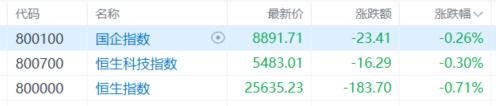
港股收评:指数集体下跌!博彩股、贵金属股低迷,汽车股逆势走强
Ge Long Hui· 2025-12-29 08:50
Market Overview - The Hong Kong stock market indices collectively declined on December 29, with the Hang Seng Index falling by 0.71%, the Hang Seng China Enterprises Index down by 0.26%, and the Hang Seng Tech Index decreasing by 0.3% after an initial rise of 2.2% [1][2]. Sector Performance - Technology stocks experienced a downturn, with Alibaba, Xiaomi, Kuaishou, and Tencent Holdings each dropping over 1%, while JD.com and Baidu saw slight declines. Conversely, Meituan rose nearly 1% and NetEase increased by 1.41% [4][5]. - Gaming stocks faced significant losses, particularly MGM China, which plummeted over 17%. Other gaming companies like Sands China and Wynn Macau also reported declines [6]. - The gold and precious metals sector saw a sharp decline, with companies like Zijin Mining and Shandong Gold dropping over 5% [7]. - The paper industry saw gains, with Nine Dragons Paper rising over 4%, as several large paper companies announced plans to reduce production or slow expansion, signaling a shift towards price stability [9][10]. - The automotive sector experienced a collective rise, with NIO, Xpeng, and BYD showing notable increases, supported by government initiatives to boost consumer spending [11][12]. - Airline stocks became active again, with China National Aviation rising by 2.5%, driven by expectations of increased travel during the upcoming New Year holiday [12][13]. - Oil stocks were also active, with major companies like Sinopec and CNOOC seeing gains, supported by a favorable long-term supply-demand outlook [14]. Individual Company Highlights - Jiangxi Copper saw a significant increase of over 6% to HKD 39.66, following news of a potential acquisition of SolGold for up to GBP 764 million, which would enhance its position in the copper and gold mining sector [15][19]. - The net selling of southbound funds reached HKD 3.414 billion, indicating a cautious sentiment among investors [19]. Market Outlook - The market is expected to remain relatively quiet due to holiday liquidity effects, with alternating activity between technology growth and cyclical resources. Despite short-term uncertainties from global macro fluctuations, the current valuation of Hong Kong stocks remains attractive, with structural opportunities still prominent [21].
中国汽车ABS和ESC系统市场现状研究分析与发展前景预测报告
QYResearch· 2025-12-29 08:18
Core Viewpoint - The article discusses the current status and future trends of the automotive ABS (Antilock Brake System) and ESC (Electronic Stability Control) systems in the Chinese market, highlighting the transition from traditional mechanical braking to electronic and intelligent systems, driven by regulatory requirements and technological advancements [3][10][14]. Market Development Status and Future Trends - The revenue from the automotive ABS and ESC systems in China is projected to reach 12.31 billion yuan in 2024, with an expected decline to 6.022 billion yuan by 2031, indicating a compound annual growth rate (CAGR) of -10.10% from 2025 to 2031 [3]. - The market is experiencing a shift towards electronic hydraulic brake (EHB) systems, particularly the One-Box solution, which integrates multiple functions and is expected to penetrate the market significantly, with over 10 million units installed by 2024 [10][13]. Industry Concentration and Competition Analysis - Major players in the Chinese market include Bosch, Continental, ZF, Aisin, and others, with the top three companies holding approximately 65.25% of the market share in 2024 [7]. Technological Evolution - The transition from traditional hydraulic braking to ABS and ESC systems has been rapid, with ESC installation rates exceeding 90% in new passenger vehicles since 2020 [10]. - In the commercial vehicle sector, the market is primarily dominated by pneumatic braking systems, with a projected EBS penetration rate of 80% by 2025 for key models [11][12]. Driving Factors - Regulatory requirements are a significant driver, with ABS and ESC becoming mandatory for all new passenger and commercial vehicles in China [14]. - The growth in vehicle ownership and sales, particularly in the new energy vehicle segment, is expanding the market for ABS and ESC systems [15]. - The development of intelligent driving and ADAS (Advanced Driver Assistance Systems) is increasing the demand for enhanced vehicle dynamic control systems [16]. Constraints - The industry faces challenges such as reliance on imported high-end chips and core technologies, which creates barriers for domestic manufacturers [18]. - Intense price competition and the pressure on suppliers to reduce costs are compressing profit margins and limiting R&D investments [19]. - The lengthy certification process for new products poses significant entry barriers for new players in the market [20]. Supply Chain Analysis - The supply chain for automotive ABS and ESC systems includes upstream suppliers of raw materials, midstream manufacturers who integrate and assemble the systems, and downstream customers, primarily automotive OEMs [28][29]. - Key components of ABS and ESC systems include electronic control units (ECUs), hydraulic control units (HCUs), and various sensors, with a focus on technological integration and system performance [29][32].
港股异动丨汽车股集体大涨,财政部明年继续安排资金支持消费品以旧换新
Ge Long Hui· 2025-12-29 03:59
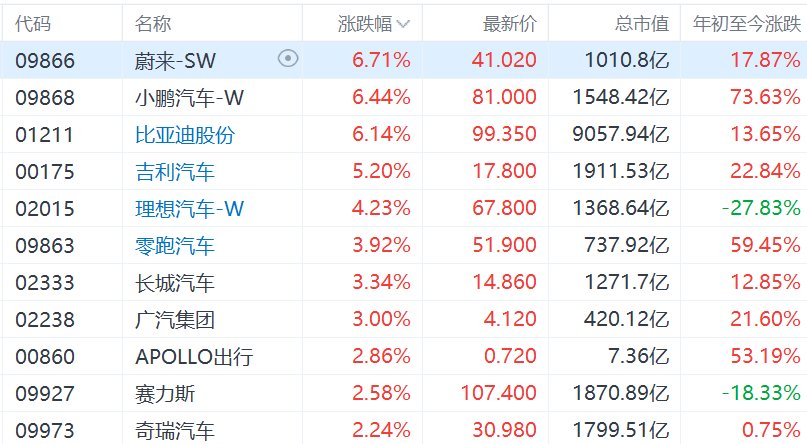
Core Viewpoint - The Hong Kong stock market saw a significant rise in automotive stocks, driven by government initiatives to boost consumer spending in the upcoming year [1] Group 1: Market Performance - NIO (09866) increased by 6.71%, reaching a latest price of 41.020 with a market capitalization of 101.08 billion, and a year-to-date increase of 17.87% [2] - Xpeng Motors (09868) rose by 6.44%, with a latest price of 81.000 and a market cap of 154.842 billion, showing a year-to-date increase of 73.63% [2] - BYD (01211) saw a 6.14% increase, with a latest price of 99.350 and a market cap of 905.7947 billion, reflecting a year-to-date increase of 13.65% [2] - Geely (00175) increased by 5.20%, with a latest price of 17.800 and a market cap of 191.153 billion, showing a year-to-date increase of 22.84% [2] - Li Auto (02015) rose by 4.23%, with a latest price of 67.800 and a market cap of 136.864 billion, but has a year-to-date decrease of 27.83% [2] - Leap Motor (09863) increased by 3.92%, with a latest price of 51.900 and a market cap of 73.792 billion, reflecting a year-to-date increase of 59.45% [2] - Great Wall Motors (02333) rose by 3.34%, with a latest price of 14.860 and a market cap of 127.17 billion, showing a year-to-date increase of 12.85% [2] - GAC Group (02238) increased by 3.00%, with a latest price of 4.120 and a market cap of 42.012 billion, reflecting a year-to-date increase of 21.60% [2]