青岛银行

Search documents
“息差保卫战”出战绩,8家上市银行息差环比二季度扩大
Hua Xia Shi Bao· 2025-10-31 11:15
Core Viewpoint - The overall net interest margin (NIM) of A-share listed banks shows signs of stabilization and recovery, reflecting positive trends in the banking sector's performance in Q3 [2][3][5]. Group 1: Net Interest Margin Trends - Among the 26 listed banks that disclosed NIM data, 12 banks reported stable or improved NIM, indicating a significant expansion in the stabilization [3][5]. - Notably, smaller banks such as Guiyang Bank and Minsheng Bank showed the most significant improvements, with Guiyang Bank's NIM increasing by 0.04 percentage points [3][4]. - The number of banks with stable or rising NIM in Q3 is markedly higher compared to the previous two quarters, suggesting a positive shift in the banking sector [3][5]. Group 2: Factors Influencing NIM - The stabilization of NIM is attributed to banks' proactive management of liabilities and the delayed effects of monetary policy [2][4]. - Banks have optimized deposit structures and managed high-interest deposits effectively, alleviating funding cost pressures [4][5]. - The "policy bottom" established by previous monetary and fiscal measures has reinforced the stability of the financial system [4]. Group 3: Profitability and Asset Quality - In Q3, 35 out of 42 listed banks reported year-on-year net profit growth, with 16 banks achieving growth rates exceeding 5% [7]. - The fastest-growing banks in terms of net profit include Qilu Bank and Qingdao Bank, with growth rates of 16.14% and 15.86%, respectively [7]. - Asset quality has also improved, with 32 banks reporting stable or reduced non-performing loan (NPL) ratios compared to the beginning of the year [7][8].


专家:AI正重塑全球金融格局 “十五五”时期我国金融科技发展面临四大机遇
Qi Huo Ri Bao Wang· 2025-10-31 07:15
Core Insights - The forum focused on the opportunities, risks, and practical applications of integrating artificial intelligence with the financial sector, emphasizing the importance of digital transformation in achieving high-quality development in finance [1][4]. Group 1: Financial Technology Development - Beijing is committed to building a modern financial system, prioritizing digital transformation and supporting projects that are reliable and adaptable to service scenarios through regulatory sandbox testing [1]. - The insurance industry is undergoing intelligent upgrades in business processes and risk management, with a focus on data governance, talent cultivation, and ensuring data security through various technologies [2]. - The "14th Five-Year Plan" presents significant opportunities for financial technology development, with advancements in digital infrastructure and the marketization of data elements driving innovation [3]. Group 2: Asset Management and Investment Strategies - The asset management industry is expected to experience strong growth driven by technological advancements, requiring institutions to adapt their investment strategies and enhance their capabilities [4]. - AI applications in finance face challenges related to professionalism, compliance, and user experience, necessitating a focus on inclusivity and investment returns [4]. Group 3: Research and Collaboration - Research findings highlight Beijing's advantages in digital financial cooperation within the Shanghai Cooperation Organization, emphasizing the need for collaboration in digital finance [5]. - The integration of technology and finance in the Beijing-Tianjin-Hebei region has shown positive progress, although challenges remain in coordination and market connectivity [5].
青岛银行(002948):利润维持高增速,质效提升驱动价值重估
Changjiang Securities· 2025-10-31 05:12
Investment Rating - The report maintains a "Buy" rating for Qingdao Bank [9]. Core Insights - Qingdao Bank's revenue growth for the first three quarters is 5.0%, while net profit attributable to shareholders grows at 15.5%, indicating sustained high profit growth. Net interest income increases by 12.0%, primarily driven by rapid credit expansion. Non-interest income declines by 10.7%, mainly due to a weak bond market in the third quarter. Total assets grow by 11.0% compared to the beginning of the year, with loans increasing by 10.2%, and corporate loans rising significantly by 14.6% [2][6]. Summary by Relevant Sections Performance - Interest income remains robust, with net interest income up 12.0% year-on-year. The third quarter shows a high growth of 11.6%. Non-interest income declines by 10.7%, largely due to weak bond market performance, with investment income and other non-interest income down 15.5%. The cost-to-income ratio and tax expenses have decreased significantly, supporting high profit growth [2][6][12]. Scale - The asset-liability structure is improving, with total assets increasing by 11.0% and loans by 10.2% year-to-date. Corporate credit has surged by 14.6%, primarily directed towards manufacturing and retail sectors. Retail loans have decreased by 4.6% due to a strategic tightening of credit standards. Overall, credit growth is expected to stabilize around 11% for the year, mainly driven by corporate lending [2][6][12]. Interest Margin - The focus is on enhancing efficiency, with net interest margin significantly outperforming peers since 2023. The third quarter's net interest margin decreased by 5 basis points to 1.68%. The yield on loans is expected to remain in a downward trend, with the average yield on interest-earning assets dropping by 9 basis points to 3.55% [2][6][12]. Asset Quality - Loan quality is steadily improving, reaching the best level since the bank's listing. The non-performing loan ratio decreased to 1.10%, down 2 basis points from the previous quarter and 4 basis points from the beginning of the year. The coverage ratio for provisions has significantly improved to 270%, up 17 percentage points [2][6][12]. Investment Recommendation - The report highlights sustained high profit growth and steady improvement in asset quality, validating the logic of enhancing quality and efficiency in the bank's three-year strategic plan. The major shareholder, Guoxin Group, plans to significantly increase its stake, reflecting strong confidence in the bank's long-term value. Current valuations indicate significant room for recovery, with PB ratios at 0.72x/0.56x and PE ratios at 6.2x/4.8x [2][6][12].

金融街论坛年会观察:金融AI应用如何创造价值?
Huan Qiu Wang· 2025-10-31 03:37
Core Insights - The integration of AI in the financial sector is enhancing operational efficiency and service quality, with AI's accuracy in risk control audits reaching 90% [1][8] - The 2025 Financial Street Forum highlighted the transition of AI from a technological application to a value-creating tool in finance, sparking discussions among experts [1][2] AI in Financial Services - AI is driving the intelligent upgrade of traditional insurance processes, improving pricing accuracy and risk prevention, thus addressing the shortcomings of conventional insurance models [1][2] - The penetration rate of large models in the financial sector is currently at 35%, with a focus on understanding specific scene demands and pain points for effective implementation [2] Data Governance and Collaboration - Emphasis on enhancing data governance through better data integration, quality improvement, and risk prevention is crucial for the development of digital insurance [2] - Collaboration between insurance institutions and academic research organizations is necessary to cultivate interdisciplinary talent for digital insurance [2] Financial Institutions' Practices - The financial support for technological innovation is increasing, but challenges remain, such as the reliance on indirect financing and mismatches in risk control for tech enterprises [3] - Asset management institutions are encouraged to focus on human-centered approaches to discover new asset values and optimize investor demand profiles [3] AI's Role in Banking - AI is becoming essential for city commercial banks to navigate challenges like narrowing net interest margins and intensified competition, transitioning from a cost center to a core service and value creation tool [4][5] - Different financial institutions are advised to adopt AI evolution paths suited to their capabilities, with regional banks encouraged to start with practical applications [5] Regional Financial Cooperation - The digital financial landscape among Shanghai Cooperation Organization (SCO) countries presents opportunities for collaboration despite existing disparities in digital finance levels [5] - Beijing is positioned to lead in areas such as digital currency, cross-border settlement, and data security, leveraging its technological and policy advantages [5][6] AI and Risk Management - Experts agree that AI is transforming financial business models, necessitating the establishment of matching risk governance systems [7] - The challenges posed by AI, including algorithmic opacity and data integrity, require a focus on human-machine collaboration and clear accountability in decision-making [7][8]

青岛银行(002948)2025三季报点评:扩规模、调结构、降成本 不良指标持续优化
Ge Long Hui· 2025-10-30 20:24
Core Insights - Qingdao Bank reported a revenue of 11.013 billion yuan for the first three quarters of 2025, representing a year-on-year growth of 5.03% and a net profit of 3.992 billion yuan, up 15.54% year-on-year [1] - The bank's total assets reached 765.571 billion yuan, a year-on-year increase of 14.44%, with loans totaling 375.298 billion yuan, growing 13.34% year-on-year [1][2] - Non-interest income decreased by 10.72% year-on-year to 2.874 billion yuan, primarily due to fair value changes [3] Financial Performance - Interest income for the first three quarters of 2025 was 8.139 billion yuan, a 12.00% increase year-on-year, despite a decline in net interest margin to 1.68% [2] - The bank's non-performing loan ratio improved to 1.10%, down 4 basis points from the end of 2024, indicating a positive trend in asset quality [3] - The provision coverage ratio increased to 269.97%, reflecting a stronger safety margin [3] Strategic Focus - Qingdao Bank is focusing on expanding loans in key sectors such as green finance, blue economy, and rural revitalization, while enhancing the quality of liabilities [1][2] - The bank is actively managing its liability structure and costs, leading to a steady growth in both corporate and personal deposits [1] Future Outlook - The bank is expected to maintain strong profit growth, with projected net profit growth rates of 19.5%, 18.52%, and 19.98% for 2025-2027 [4] - Earnings per share (EPS) forecasts for 2025, 2026, and 2027 are 0.88 yuan, 1.04 yuan, and 1.24 yuan, respectively [4]
青岛银行(002948):业绩稳健 资产质量持续改善
Ge Long Hui· 2025-10-30 20:24
Core Insights - Qingdao Bank reported a revenue growth of 5.0% year-on-year in Q3 2025, compared to 8.8% in the first half of 2025, while net profit increased by 15.5% year-on-year, slightly down from 16.1% in 1H 2025 [1] - The bank's net interest margin showed resilience, with a slight decrease of 2 basis points to 1.66% in Q3 2025, while the annualized asset yield decreased by 4 basis points to 3.52% [1] - The bank's loan growth remained robust, with total loans increasing by 13.3% year-on-year, driven primarily by corporate loans, which grew by 19%, while retail loans faced a decline of 4.8% [1] Revenue and Profitability - Q3 2025 revenue growth was impacted by fluctuations in the bond market, leading to pressure on other non-interest income, which declined by 10.7% year-on-year [2] - The bank's fee income showed signs of recovery, with a year-on-year decline of only 3.5% in Q3 2025, compared to a 13.4% decline in 1H 2025 [3] Asset Quality - The non-performing loan (NPL) ratio slightly decreased to 1.10% in Q3 2025, with a year-on-year decline in the NPL generation rate by 20 basis points [3] - The provision coverage ratio improved, rising by 17.2 percentage points to 269.99% in Q3 2025, indicating a strengthening of the bank's asset quality [3] Capital and Valuation - The core Tier 1 capital adequacy ratio decreased by 30 basis points to 8.75% [4] - The bank's projected price-to-book (PB) ratios for 2025, 2026, and 2027 are 0.77X, 0.55X, and 0.51X, respectively, while the price-to-earnings (PE) ratios are projected at 6.16X, 5.55X, and 5.04X [4] - The bank is expected to maintain favorable growth in credit and performance, leveraging its roots in Qingdao and the economic dynamics of Shandong [4]
恒生指数止跌企稳,大消费和银行涨幅居前,医疗、科技等逆势小跌
Ge Long Hui· 2025-10-30 20:13
Group 1 - The Hang Seng Index opened with a sharp rise and maintained high-level consolidation, increasing by 0.54% by midday [1] - The consumer sector showed signs of recovery, with a slight increase of 0.12% at midday, driven by notable gains in Meituan (up 4%) and XPeng Motors (up 3.22%) [3] - The banking sector opened high but experienced a decline, stabilizing with a 0.18% increase at midday, led by HSBC Holdings (up 1.78%) and Bank of China (up 1.13%) [3] Group 2 - The healthcare sector experienced a sharp drop after opening, followed by a rebound, but ultimately fell by 1.62% at midday, with WuXi AppTec down 4.26% and China Biologic Products down 3.41% [3] - Other healthcare stocks such as Innovent Biologics and CSPC Pharmaceutical Group also saw declines exceeding 2% [3]
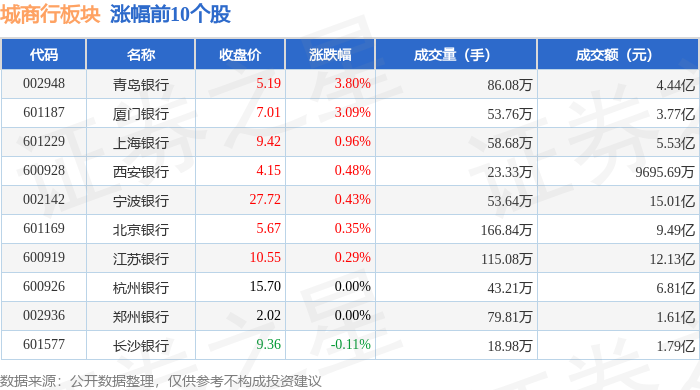
城商行板块10月30日涨0.16%,青岛银行领涨,主力资金净流出5851.22万元
Zheng Xing Xing Ye Ri Bao· 2025-10-30 08:40
Market Overview - The city commercial bank sector rose by 0.16% on October 30, with Qingdao Bank leading the gains [1] - The Shanghai Composite Index closed at 3986.9, down 0.73%, while the Shenzhen Component Index closed at 13532.13, down 1.16% [1] Individual Stock Performance - Qingdao Bank (002948) closed at 5.19, up 3.80% with a trading volume of 860,800 shares and a turnover of 444 million yuan [1] - Xiamen Bank (601187) closed at 7.01, up 3.09% with a trading volume of 537,600 shares and a turnover of 377 million yuan [1] - Shanghai Bank (601229) closed at 9.42, up 0.96% with a trading volume of 586,800 shares and a turnover of 553 million yuan [1] - Other notable performances include Ningbo Bank (002142) at 27.72, up 0.43%, and Beijing Bank (601169) at 5.67, up 0.35% [1] Capital Flow Analysis - The city commercial bank sector experienced a net outflow of 58.51 million yuan from institutional investors, while retail investors saw a net outflow of 150 million yuan [2] - Conversely, speculative funds recorded a net inflow of 209 million yuan [2] Detailed Capital Flow for Selected Banks - Jiangsu Bank (600919) had a net inflow of 79.4 million yuan from institutional investors, while retail investors experienced a net outflow of 129 million yuan [3] - Qingdao Bank (002948) saw a net inflow of 70.3 million yuan from institutional investors but a net outflow of 31.9 million yuan from speculative funds [3] - Shanghai Bank (601229) had a net inflow of 44.9 million yuan from institutional investors, with retail investors seeing a net outflow of 46.8 million yuan [3]


国泰海通晨报-20251030
GUOTAI HAITONG SECURITIES· 2025-10-30 06:26
Core Insights - The report highlights a strong demand for AI data center construction, leading to a significant increase in storage prices, while the consumer durable sector remains under pressure due to weak overall consumption [2][19] - The real estate market continues to struggle, with a year-on-year decline in transaction volumes across major cities, indicating a lack of demand momentum [3][23] - The manufacturing sector shows mixed signals, with increased demand for high-performance storage chips but a weak construction materials market [4][21] Strategy Observation - Storage prices are accelerating due to strong demand from AI data centers, while the durable goods sector is facing challenges [2][19] - The construction and real estate sectors are experiencing weak demand, with prices for steel and building materials remaining low [4][21] - Overall consumption is weak, with signs of overspending on national subsidies affecting durable goods [2][19] Downstream Consumption - Real estate sales are at a low point, with a 23.2% year-on-year decline in transaction volume across 30 major cities [3][20] - Durable goods consumption is also under pressure, with a 3.0% year-on-year decline in retail sales of passenger cars [3][20] - The agricultural sector shows some improvement, with a 3.5% increase in pig prices due to better supply-demand dynamics [3][20] Technology & Manufacturing - The price of DRAM storage has increased by 11.7% month-on-month, driven by strong demand from overseas AI server markets [4][21] - The construction materials sector is under pressure, with weak demand reflected in fluctuating prices for steel and building materials [4][21] - Manufacturing activity has seen a slight increase in operating rates, indicating some recovery in the sector [4][21] Logistics & Transportation - There is a slight recovery in long-distance travel demand, with a 5.5% month-on-month increase in the migration index [5][22] - Freight demand remains stable, with logistics activity increasing ahead of the "Double Eleven" shopping festival [5][22] - Port throughput has decreased, indicating potential challenges in the shipping sector [5][22] Real Estate Industry Tracking - The real estate market shows signs of continued weakness, with only 19% of cities indicating a bottoming out in the market [23][24] - Inventory pressure remains significant, with over 80% of cities experiencing extended new housing de-stocking cycles [23][26] - The overall market is characterized by a supply-demand imbalance, with ongoing challenges in inventory reduction [23][26] Company Performance Insights - Company reports indicate a robust performance in Q3, with significant revenue growth driven by internal transformations and market expansion [27][28] - The furniture sector shows resilience, with a projected EPS growth for 2025-2027, reflecting strong market positioning [27][28] - Companies in the technology sector are also experiencing growth, with increased EPS forecasts due to expanding business lines in AI and automotive electronics [30][31]
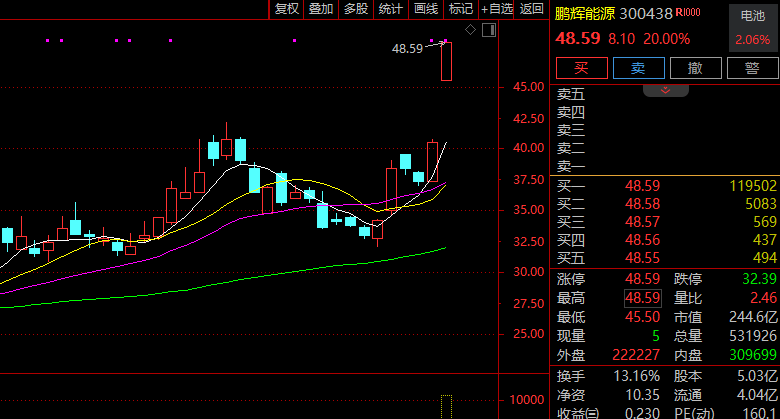
仅1分钟!300438,直线20%封板!A股这一赛道,全线爆发!
Sou Hu Cai Jing· 2025-10-30 04:44
Market Overview - A-shares experienced slight fluctuations with major indices showing mixed results, as the Shanghai Composite Index opened lower but rose to a 10-year high, while the North Star 50 continued its strong performance, breaking through 1600 points [1] - The market showed a moderate increase in trading volume, with sectors such as new energy, shipping ports, insurance, and coal leading in gains, while sectors like glass fiber, medical beauty, communication equipment, and ground weaponry faced declines [1] New Energy Sector - The new energy industry saw a strong performance, with energy metals leading the charge, and the sector index surged nearly 6%, reaching a new high not seen in two and a half years, with half-day trading volume approaching the previous day's total [3] - Key stocks such as Tianhua New Energy, Jiangte Electric, and Yongxing Materials hit the daily limit or rose over 10%, while wind power equipment, photovoltaic equipment, battery recycling, and lithium mining also showed significant gains [3] - The "14th Five-Year Plan" emphasizes accelerating the construction of a new energy system, increasing the proportion of new energy supply, and promoting the orderly replacement of fossil energy [5] - Lithium battery electrolyte core material hexafluorophosphate (6F) saw a rapid price increase, reaching 98,000 yuan/ton, up over 66% from the end of September, indicating a tight supply and potential for further price increases [5] - Global photovoltaic installations exceeded 380 GWac in the first three quarters, a year-on-year increase of over 30%, with domestic installations reaching 240 GW, up 49% year-on-year, accounting for 63% of the global total [5] Insurance Sector - The insurance sector saw a significant rally, with the insurance index reaching a historical high, and stocks like New China Life Insurance surged over 4% within an hour of trading, surpassing the previous day's total volume [7] - The China Insurance Industry Association discussed the evaluation interest rate for life insurance products, suggesting a current research value of 1.90%, with expectations for a decrease in the cost of liabilities following the next round of interest rate adjustments in 2025 [9] Banking Sector - The banking sector index rose nearly 1%, with banks like Qingdao Bank, Xiamen Bank, Changshu Bank, and Ningbo Bank leading in gains [10] - Analysts from JPMorgan noted that Chinese bank stocks still hold significant investment value due to stable dividend yields and strong performance in the current interest rate environment [10] - Zhejiang Merchants Securities indicated that with risk appetite stabilizing and risk-free interest rates declining, bank stocks are expected to yield absolute returns in the fourth quarter [10]