AMD

Search documents
台积电狂建封装厂
半导体芯闻· 2026-01-20 10:05
Core Viewpoint - TSMC plans to expand its advanced packaging (AP) factories to address capacity shortages and maintain its competitive edge in the semiconductor industry, particularly in advanced packaging technologies like CoWoS [1][4][6] Group 1: TSMC's Expansion Plans - TSMC is set to announce the construction of four advanced packaging factories in Tainan, including locations in Chiayi Science Park and Southern Science Park [1] - The company aims to start mass production at its AP factory 1 in the Ziyi Technology Park in the first half of this year [1] - TSMC's expansion is also a response to concerns about its potential transformation into "American TSMC" due to recent factory expansions in the U.S. [1] Group 2: Advanced Packaging Technology - The global tech industry is in a fierce competition for advanced packaging technology, particularly TSMC's CoWoS, which is crucial for connecting high-performance chips with ultra-fast memory [4][5] - The complexity of modern AI hardware and the need for advanced packaging techniques like CoWoS-L are creating significant bottlenecks in the supply chain [5][6] - TSMC's shift to hybrid bonding technology enhances performance and reduces heat but requires stringent cleanroom conditions, elevating the risk associated with packaging processes [6] Group 3: Market Dynamics and Competition - NVIDIA has secured nearly 60% of TSMC's CoWoS capacity for 2026, forcing competitors like AMD and Broadcom to vie for the remaining capacity [7] - The advanced packaging secondary market is rapidly maturing, with companies like Intel and Samsung offering alternatives to TSMC's services [8] - The dependency on TSMC for advanced packaging remains a vulnerability for the industry, as geopolitical stability in Taiwan is critical for global AI economic growth [8] Group 4: Financial Performance and Projections - TSMC reported a record revenue of $122.42 billion in 2025, a 35.9% year-over-year increase, with a net profit of $55.18 billion [14][20] - The company anticipates significant capital expenditures to meet future chip etching and packaging demands, with estimates suggesting $250 billion over the next few years [22] - AI-related revenue is projected to grow substantially, with estimates indicating that AI accelerator sales could account for approximately 27.3% of total revenue by 2025 [27][28]



闪德资讯存储市场洞察报告 2025年4月
闪德资讯· 2026-01-20 08:45
Investment Rating - The report indicates a cautious outlook for the storage industry due to tariff impacts and market uncertainties, suggesting a "Hold" rating for investments in this sector [7][20][36]. Core Insights - Tariffs have become a dominant variable affecting the entire storage industry chain, with the U.S. imposing tariffs as high as 125%, impacting prices of DRAM modules and SSDs [7]. - Major manufacturers like Micron and SK Hynix are adjusting strategies by raising prices and shifting focus towards high-end products such as HBM and DDR5, anticipating a significant increase in HBM demand [7][36]. - The market is experiencing short-term price volatility due to tariffs and supply-demand tensions, with SSD and DRAM prices fluctuating as demand remains uncertain [7][36]. - The rise of AI applications is driving demand for high-performance memory, despite an overall weak smartphone market [7][36]. - Various semiconductor policies are being implemented across the U.S., South Korea, and China, affecting the industry's operational landscape [7]. Summary by Sections Macroeconomic Overview - In April, China's manufacturing PMI index was at 49%, indicating a decline in manufacturing activity, while the U.S. PMI was at 48.7%, reflecting ongoing contraction in the manufacturing sector [8][9][11]. Upstream Market Dynamics - Morgan Stanley predicts a three-phase impact from tariffs on the storage industry, with the first phase leading to price increases due to stockpiling [20][22]. - The current phase is characterized by short-term price increases that are not sustainable, with economic recession risks looming [20][22]. - Major manufacturers are reducing production of older process technologies, focusing on advanced products to enhance profitability [26][30]. Passive Components - Major passive component manufacturers are raising prices due to strong demand and rising costs, with expectations of double-digit percentage increases [38]. Module Manufacturer Dynamics - Companies like Nanya and Adata are seeing revenue growth driven by AI applications, with expectations of improving DRAM contract prices in the upcoming quarters [39][40]. - The overall market is experiencing a price increase trend as supply-demand dynamics stabilize [43]. Domestic Spot Market - The storage market in April was characterized by tariffs, price increases, stockpiling, and a cautious market outlook, with significant fluctuations in SSD and DRAM prices [49][51]. - The market is expected to stabilize once tariff policies are fully established, allowing for a return to normal supply-demand dynamics [66].


2 Artificial Intelligence Stocks to Buy in 2026 That Could Be Better Picks Than Nvidia
The Motley Fool· 2026-01-20 06:00
Core Insights - Nvidia is the leader in the AI accelerator market, which is projected to grow at a CAGR of 29% through 2030, indicating continued strong performance for Nvidia [1] - With a market cap of $4.6 trillion, achieving significant stock price growth becomes increasingly challenging, prompting investors to consider smaller companies with higher growth potential [2] Company Analysis Micron Technology - Micron develops high-bandwidth memory (HBM), which is in high demand due to the AI data center boom, positioning it favorably in the market [3] - In Q1 of fiscal 2026, Micron reported revenue of $13.6 billion, a 57% increase year-over-year, with net income reaching $5.2 billion compared to $1.9 billion in the same quarter last year [4] - The stock price has risen by 250% over the past year, leading to a market cap of over $340 billion, with a P/E ratio of 34, slightly above the S&P 500 average [6] Advanced Micro Devices (AMD) - AMD is well-positioned to compete with Nvidia, with a market cap around $380 billion and plans to release the MI450 AI accelerator, which may outperform Nvidia's offerings [7][8] - In Q3 of 2025, AMD's revenue was $9.2 billion, reflecting a 36% year-over-year growth, with net income of $1.2 billion and a profit growth rate of 61% [9] - Despite a P/E ratio of 115, AMD's forward P/E of 35 suggests potential for rapid profit growth, making it an attractive investment opportunity [11]


投资者- 2026 展望:偏好 AI 优于非 AI;逻辑芯片与存储芯片均具吸引力-Investor Presentation-2026 Outlook Prefer AI to Non-AI; Both Logic and Memory Are Attractive
2026-01-20 03:19
Summary of Key Points from the Conference Call Industry Overview - The semiconductor industry is experiencing a shift towards AI-driven demand, with a preference for AI semiconductors over non-AI counterparts. This trend is expected to continue into 2026, with both logic and memory sectors being attractive for investment [6][10][87]. Key Companies Mentioned - **TSMC**: Identified as a top pick in the AI semiconductor space, with expected revenue CAGR of 60% from AI semis between 2024 and 2029 [6][33]. - **SMIC**: Mentioned as a significant player in the semiconductor industry [6]. - **MediaTek, Alchip, GUC, Winbond, Phison, Nanya Tech**: Other notable companies highlighted for their roles in the semiconductor landscape [6]. Core Insights - **Demand Drivers**: - Tech inflation is anticipated to impact demand due to rising costs in wafers, OSAT, and memory, creating margin pressures for chip designers [6]. - AI cannibalization is a concern, as AI technologies may replace certain human jobs, affecting overall demand [6]. - The proliferation of generative AI is expected to drive demand across various verticals, including robotics and AI glasses [6]. - **Market Dynamics**: - The semiconductor supply chain is prioritizing AI semiconductors, leading to shortages in non-AI semiconductors [6]. - The memory sector's stock prices are seen as leading indicators for logic semiconductors, with an attractive industry view on Greater China technology semiconductors [16]. Financial Metrics and Valuation - **TSMC**: - Current share price is 1,760 TWD with a target price of 2,088 TWD, indicating a 19% upside potential [8]. - Expected P/E ratios for 2025, 2026, and 2027 are 26.6, 18.9, and 15.7 respectively, with EPS growth rates of 46%, 40%, and 21% [8]. - **SMIC**: - Current share price is 77.0 HKD with a target price of 80.0 HKD, indicating a 4% upside potential [8]. - Expected P/E ratios are not meaningful (NM) due to negative growth projections [8]. Potential Risks - **Supply Chain Issues**: The semiconductor supply chain is facing challenges, including inventory management and the prioritization of AI semiconductors, which could lead to shortages in non-AI products [6][14]. - **Economic Factors**: Rising costs and inflation in the tech sector may impact overall demand and profitability for semiconductor companies [6]. Additional Insights - **Capex Trends**: Major cloud service providers (CSPs) are expected to increase capital expenditures significantly, with a projected 65% year-over-year increase in Q3 2025 [52]. - **AI Semiconductor Market Size**: The global semiconductor market size is projected to reach $1 trillion by 2030, driven largely by cloud AI [85]. This summary encapsulates the critical insights and data points from the conference call, providing a comprehensive overview of the current state and future outlook of the semiconductor industry, particularly in relation to AI technologies.
台积电新建四个封装厂
半导体行业观察· 2026-01-20 02:02
Core Viewpoint - TSMC plans to build four advanced packaging (AP) factories to address capacity shortages and maintain its competitive edge in the semiconductor industry, particularly in advanced packaging technologies like CoWoS [1][4][11] Group 1: TSMC's Expansion Plans - TSMC will announce the expansion of four advanced packaging factories in Tainan, including locations in Chiayi Science Park and Southern Science Park [1] - The company aims to start mass production at its AP factory 1 in the Ziyi Technology Park in the first half of this year [1] - TSMC's expansion is a response to concerns about its potential transformation into "American TSMC" due to recent factory expansions in the U.S. [1] Group 2: Industry Trends and Challenges - The global tech industry is facing intense competition for advanced packaging technology, particularly TSMC's CoWoS, which is critical for connecting high-performance chips with ultra-fast memory [4][9] - By 2026, the bottleneck in AI GPU supply will shift from chip shortages to the complex assembly processes required for advanced packaging [4][9] - The transition from wafer-level packaging (WLP) to fan-out panel-level packaging (FOPLP) is expected to increase processing capacity significantly [11] Group 3: Strategic Implications - NVIDIA has secured nearly 60% of TSMC's CoWoS capacity for 2026, influencing competitors like AMD and Broadcom to vie for the remaining capacity [7] - The advanced packaging secondary market is rapidly maturing, with companies like Intel positioning their packaging technologies as alternatives to TSMC [8] - The industry's reliance on TSMC for advanced packaging creates vulnerabilities, as geopolitical stability in the Taiwan Strait remains a critical factor for the global AI economy [8][12] Group 4: Future Outlook - The industry's focus is shifting towards the physical realities of AI hardware, with advanced packaging becoming a crucial factor in the growth of AI capabilities [9][10] - Upcoming challenges include the transition to glass substrates for improved interconnect density and thermal management, which could disrupt TSMC's current dominance [11] - The success of HBM4 chip yields and the ramp-up of TSMC's AP7 capacity will be closely monitored, as delays could impact the release of next-generation AI models [12]
Nvidia (NVDA) Tariff Impact Seen as Limited, Wolfe Research Says
Yahoo Finance· 2026-01-19 20:53
NVIDIA Corporation (NASDAQ:NVDA) is one of the AI Stocks Analysts Are Watching Closely. On January 15, Wolfe Research analyst Chris Caso reiterated an Outperform rating on the stock with a $250.00 price target. Firm analysts see minimal impact from newly announced tariffs, calling it a mechanism for pre-agreed payments. The White House recently announced a 25% tariff on certain advanced semiconductors, anticipating it to be application on Nvidia’s H200 shipments to China. Wolfe Research noted how this ta ...

5 Stocks You'll Regret Not Buying in 2026
The Motley Fool· 2026-01-19 19:45
Core Viewpoint - Artificial intelligence (AI) is expected to drive significant growth in the stock market in 2026, with a focus on AI infrastructure investments [1] Group 1: AI Computing Hardware Providers - Nvidia is the leader in AI computing, with unmatched graphics processing units (GPUs) and a strong ecosystem, leading to sold-out production capacity for cloud GPUs [4] - AMD is positioned as a second-choice GPU provider, potentially gaining market share as Nvidia's capacity is maxed out, presenting growth opportunities for AMD [6] - Broadcom is developing specialized computing units (ASICs) for AI, which could outperform GPUs in specific workloads, indicating a different approach to AI computing hardware [7][9] Group 2: Cloud Computing Providers - Alphabet and Amazon are heavily investing in AI through their cloud computing platforms, which are benefiting from the growing demand for AI workloads [10] - Google Cloud reported a 34% year-over-year revenue growth in Q3, while AWS saw a 20% increase, highlighting the strong demand for accessible AI computing power [12] - The trend of success in cloud computing for AI is expected to continue into 2026, with both companies likely to see significant returns on their investments in AI data centers [13]



Could AMD stock really surge 348% by 2030? Here's what analysts say
Invezz· 2026-01-19 15:53
Core Viewpoint - Advanced Micro Devices (AMD) projects significant growth in its data center revenue, potentially leading to a stock price increase of 348% by 2030, but there are concerns about whether this growth is already priced into the stock [1][3][6]. Group 1: Growth Projections - AMD expects its data center revenue to grow at a compounded annual growth rate (CAGR) exceeding 60% through 2030, with AI accelerators projected to grow at over 80% annually [2]. - The AI infrastructure market is anticipated to exceed $1 trillion by 2030, positioning AMD as a serious competitor to Nvidia [3]. - AMD's overall revenue is expected to grow at a CAGR of over 35% in the next three to five years [3]. Group 2: Stock Valuation and Market Sentiment - AMD's stock trades at a forward price-to-earnings multiple of approximately 33 times, indicating that significant growth is already factored into the current valuation [6]. - Analysts have set a 12-month price target for AMD stock at approximately $281–$284, reflecting a 22–23% upside from current levels, which is significantly lower than the projected 348% [11]. Group 3: Competitive Landscape - AMD has signed a deal with OpenAI to supply up to 6 gigawatts of GPU capacity by 2030, providing demand certainty [4]. - Oracle Cloud Infrastructure plans to deploy 50,000 of AMD's MI450 chips, indicating customer confidence in AMD's technology [5]. - AMD's gross margin is reported at 44%, while Nvidia's is at 70%, highlighting a significant margin gap that AMD needs to address to achieve its growth targets [7][9]. Group 4: Execution Risks - AMD faces execution risks, particularly with Nvidia's upcoming Rubin GPU line, which is expected to outperform AMD's MI450 [10]. - For AMD to achieve the 348% growth scenario, it must not only grow rapidly but also close the margin gap with Nvidia, which analysts believe is a challenging task [8][12].
Advanced Micro Devices (NASDAQ: AMD) Price Prediction and Forecast 2026-2030 (January 2026)
247Wallst· 2026-01-19 12:30
Core Insights - Advanced Micro Devices (AMD) has shown significant stock performance, gaining 10.83% over the past month and achieving a 95.74% increase over the past year [1] - The company reported strong Q3 FY 2025 earnings, with EPS of $1.20 and revenue of $9.25 billion, surpassing analyst expectations [2] - AMD's data center revenue reached a record $4.3 billion, marking a 22% year-over-year increase, while client and gaming revenues saw substantial growth of 46% and 181% respectively [2] Financial Performance - AMD's revenue and net income have shown a positive trend over the years, with revenues increasing from $3.991 billion in 2015 to an expected $25.785 billion in 2024 [13] - The company reported a net income of $854 million in 2023, with projections indicating a rise to $1.64 billion in 2024 [13] Market Position and Strategy - AMD has gained a 45% market share in Japan's gaming chip market, with a target of reaching 70% [3] - The introduction of the Ryzen CPU in 2017 marked a significant turning point for AMD, allowing it to outperform Intel in speed and efficiency while being more cost-effective [4] - AMD's MI300 GPU is positioned as a competitor to Nvidia's H100, with a price point at 25% of Nvidia's offering, despite similar performance [8] Future Growth Drivers - The acquisition of ZT Systems for $4.9 billion is part of AMD's strategy to enhance its AI development capabilities [15] - The data center segment is projected to generate $12.6 billion in revenue in 2024, reflecting a 94% increase compared to 2023 [16] - AMD's stock price target for 2026 is set at $311.18, indicating a potential upside of 34.22% from current levels [18] Analyst Projections - Wall Street analysts have a consensus 12-month price target of $284.07 for AMD, with 24 out of 32 analysts rating it as a "Buy" [17] - Projections for EPS growth show an increase from $7.90 in 2026 to $13.21 by 2030, reflecting a strong upward trajectory [20]
3nm产能告急,台积电大客户被迫分流,三星、英特尔机会来了?
Hua Er Jie Jian Wen· 2026-01-19 02:21
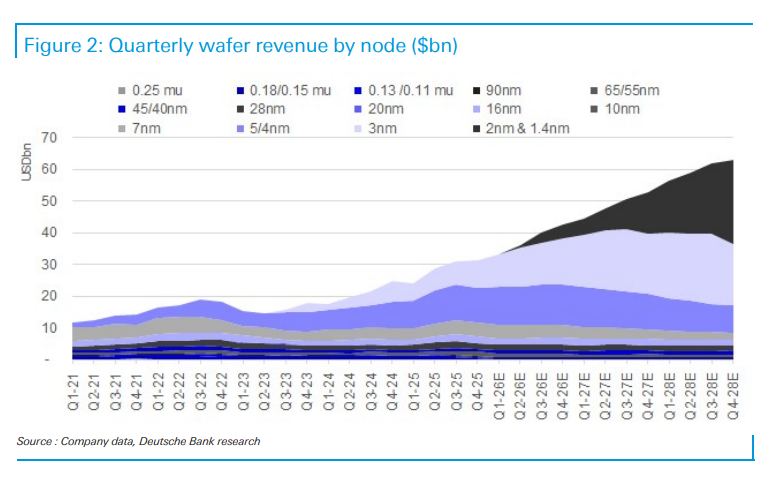
Core Viewpoint - The demand for chips is surging due to the AI wave, leading TSMC to face capacity constraints until 2027, prompting major clients like Apple and Nvidia to consider shifting some orders to Samsung and Intel [1][2]. Group 1: TSMC's Capacity and Capital Expenditure - TSMC is experiencing a "happy trouble" as its 3nm process capacity is extremely tight, with orders booked through 2026 and into 2027, necessitating a significant increase in capital expenditure plans [1]. - TSMC's capital expenditure guidance for 2026 is projected to be between $52 billion and $56 billion, exceeding Deutsche Bank's expectation of $50 billion and market consensus of $46 billion [1][3]. - The current situation reflects a severe shortage in core wafer manufacturing capacity, particularly for the 3nm process, rather than just CoWoS packaging capacity [1][3]. Group 2: Market Share and Client Dynamics - The supply-demand imbalance is causing a direct market spillover effect, with TSMC's market share in advanced process foundry expected to decline from 95% to 90% as clients seek alternative capacity [2]. - Major clients including Apple, Nvidia, AMD, Broadcom, Qualcomm, and MediaTek are left with no choice but to explore alternative suppliers due to the extreme capacity constraints [2][5]. Group 3: Client Shifts and Competitive Landscape - TSMC is delaying new 3nm development projects and encouraging clients to shift their product plans towards 2nm GAA processes for 2027/28 [5]. - Samsung's Taylor factory is likely to be the preferred alternative for clients seeking to diversify their supply sources, with Qualcomm and AMD being the most likely to consider Samsung [5]. - Apple and Broadcom are reportedly looking into Intel as an alternative, although Intel still has significant work to do despite its potential with the 14A process [5]. Group 4: Long-term Growth and Profitability - Despite short-term capacity challenges, the long-term growth potential driven by AI is highly certain, with TSMC raising its expected CAGR for AI-related growth from the mid-40s to the mid-to-high 50s for 2024-2029 [6]. - TSMC's long-term overall growth forecast has been adjusted to a 25% CAGR, with long-term gross margin targets raised to 56% [6][7]. - The focus remains on TSMC's core profitability, despite potential margin dilution from overseas expansion and challenges related to talent and infrastructure [6][7]. Group 5: Valuation Adjustments - Deutsche Bank has raised TSMC's target price by 10% to NT$2,200, reflecting a 20x P/E ratio based on expected EPS for 2027, consistent with industry peers [9]. - This valuation indicates TSMC's solid position and strong growth rate until 2028, although potential risks such as geopolitical tensions and competition from Intel are noted [9].