
洋河股份

Search documents
从APEC国宴到韩国免税榜首,洋河拓展中国白酒的全球版图
Shen Zhen Shang Bao· 2025-12-29 04:31
Core Insights - The article highlights the challenges and strategies of Chinese baijiu brands, particularly Yanghe, in expanding into international markets, emphasizing the importance of breaking through established distribution channels and building brand trust through high-profile events like the APEC summit [1][2][4]. Group 1: Market Expansion and Performance - Chinese baijiu exports account for only 2.4% of the global spirits market, indicating significant room for growth [1]. - Yanghe achieved a 23% growth in sales in the Korean duty-free market, becoming the top seller despite an overall industry decline [1]. - The brand has expanded its market presence to 86 countries and regions across six continents, with continuous growth in overseas sales over the past three years [1]. Group 2: Building Brand Trust - Yanghe's strategy to enter high-end channels began with its participation in the APEC summit, where it was featured as the official banquet wine, establishing a strong trust signal [2][4]. - The brand has successfully positioned itself as a premium product, gaining recognition through its presence in Chinese embassies and international forums [4]. - Yanghe has participated in nearly 30 global wine exhibitions annually, receiving positive feedback from key political figures, which enhances its credibility [4][5]. Group 3: Cultural Engagement and Consumer Experience - Yanghe has launched the "Chinese Banquet" cultural IP in markets like Thailand and Singapore, integrating traditional craftsmanship and quality narratives to create engaging consumer experiences [6][8]. - The brand has established cultural exchange centers in various countries, hosting over 20 events annually to promote baijiu as part of local lifestyles [8]. - Yanghe's approach transforms static product displays into dynamic cultural events, facilitating deeper market penetration and consumer engagement [8]. Group 4: Strategic Channel Development - Yanghe focuses on the duty-free channel as a strategic high point for growth, leveraging its status as the APEC banquet wine to gain entry into premium retail spaces [9][10]. - The brand has opened image stores in international airports and is expanding its presence in duty-free markets across Europe and along the Belt and Road Initiative [11]. - Yanghe's success in the Korean market illustrates a replicable model for other Chinese brands aiming for high-end international expansion, emphasizing the need for a coherent commercial strategy [11].



酒价内参12月29日价格发布,洋河梦之蓝M6+大幅反弹12元
Xin Lang Cai Jing· 2025-12-29 01:37
Core Insights - The Chinese liquor market has shown signs of recovery, with the average retail price of the top ten liquor products stabilizing and rebounding after a two-day decline, reaching a total price of 9210 yuan, an increase of 23 yuan from the previous day [1] Price Movements - The market experienced a general upward trend, with most brands seeing price increases. Notably, Yanghe Dream Blue M6+ led the market with a price rebound of 12 yuan per bottle, while Qinghua Lang increased by 7 yuan per bottle, marking its eighth consecutive day of price growth [1] - Other price changes include: - Wuliangye Pu 58th generation up by 5 yuan per bottle - Qinghua Fen 20 up by 4 yuan per bottle - Guizhou Moutai premium up by 3 yuan per bottle - Gujing Gonggu 20 and Shuijing Jian Nan Chun up by 1 yuan per bottle - Xijiu Junpin down by 6 yuan per bottle, continuing a three-day decline - Guojiao 1573 down by 4 yuan per bottle - Feitian Moutai down by 3 yuan per bottle [1][5] Market Data Collection - The data for the liquor price reference is sourced from approximately 200 collection points across various regions, including designated distributors, social distributors, mainstream e-commerce platforms, and retail outlets, ensuring a comprehensive and objective representation of the market [2] Industry Developments - Guizhou Moutai held a national distributor conference on December 28, where the new management team emphasized respect for distributors and outlined a development strategy for 2026. The company acknowledged its shortcomings in market penetration and consumer engagement while asserting the broad market potential for Moutai products [2] - Moutai's new strategy focuses on preventing price speculation, promoting market-driven pricing, and building a pyramid product system centered around the 500ml Feitian Moutai as the main product, while enhancing boutique and zodiac products as key offerings [2] - The company aims to integrate online and offline channels, encouraging compliant distributors to expand online operations and shifting towards a consumer-centric marketing approach. The chairman redefined the relationship with distributors, ensuring they do not incur losses while also requiring a shift from passive to proactive consumer service [2]

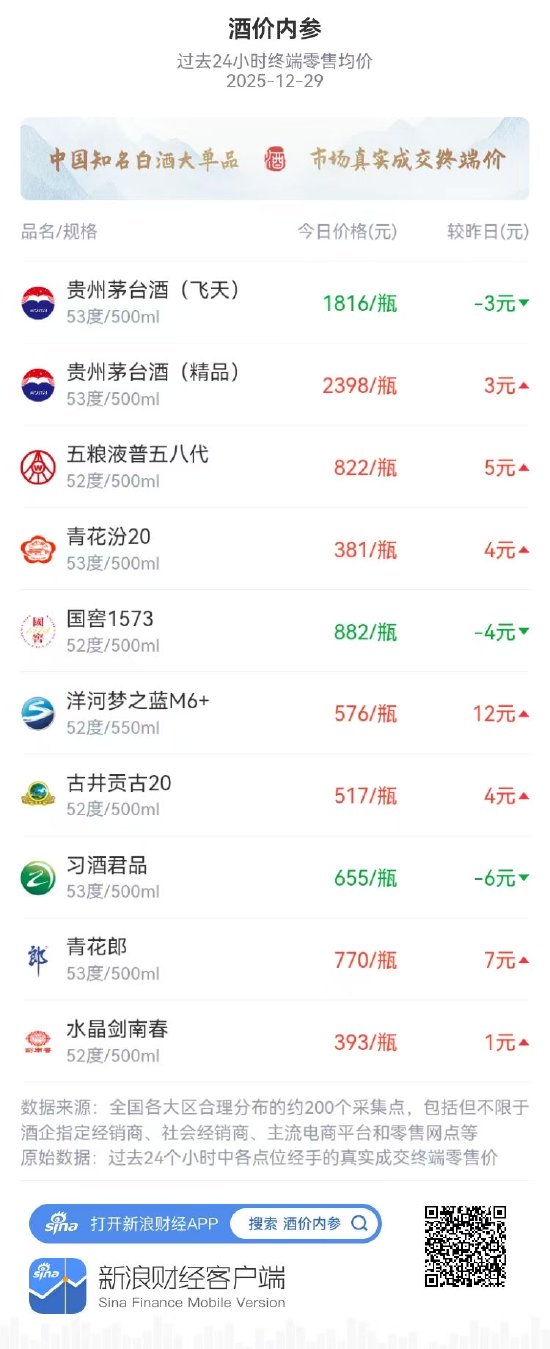
酒价内参12月29日价格发布,青花郎上涨7元连涨八天
Xin Lang Cai Jing· 2025-12-29 01:25
Core Insights - The core viewpoint of the article is that the Chinese liquor market, particularly the top ten baijiu products, has shown signs of price recovery after a brief decline, with an overall increase in retail prices observed on Monday [1][6]. Price Trends - The average retail price of the top ten baijiu products has stabilized and rebounded, with a total price of 9,210 yuan for a bundled sale, reflecting an increase of 23 yuan from the previous day [1][6]. - The market is experiencing a general upward trend, with most brands seeing price increases. Notably, Yanghe Dream Blue M6+ saw a significant rebound of 12 yuan per bottle, leading the market [1][7]. - Other price increases include: - Qinghua Lang up 7 yuan per bottle, marking its eighth consecutive day of price increases [1][7]. - Wuliangye Pu 58th generation up 5 yuan per bottle [1][7]. - Qinghua Fen 20 up 4 yuan per bottle [1][7]. - Guizhou Moutai premium up 3 yuan per bottle [1][7]. - Gujing Gong 20 and Shuijing Jian Nan Chun each up 1 yuan per bottle [1][7]. - Conversely, some products have seen price declines, such as: - Xijiu Junpin down 6 yuan per bottle, continuing a three-day decline [1][7]. - Guojiao 1573 down 4 yuan per bottle [1][7]. - Feitian Moutai down 3 yuan per bottle [1][7]. Data Collection Methodology - The daily data for "Liquor Price Reference" is sourced from approximately 200 collection points across various regions, including designated distributors, social distributors, mainstream e-commerce platforms, and retail outlets, ensuring a comprehensive and objective representation of the market [2][7]. Industry Developments - On December 28, Guizhou Moutai held a national distributor conference where the new management team emphasized respect and openness towards distributors and outlined the 2026 development strategy [2][7]. - Moutai acknowledged its shortcomings in marketization and consumer reach while asserting the broad market potential for Moutai liquor [2][7]. - The core plan for the upcoming year includes preventing price speculation, promoting market-driven pricing, and establishing a pyramid product system centered around the 500ml Feitian Moutai as the main product [2][7]. - Moutai aims to enhance online and offline integration, encouraging compliant distributors to expand online business while focusing on consumer-centric marketing transformation [2][7]. - The chairman, Chen Hua, has redefined the relationship with distributors, promising not to let them incur losses while urging a shift from passive to proactive consumer service [2][7].
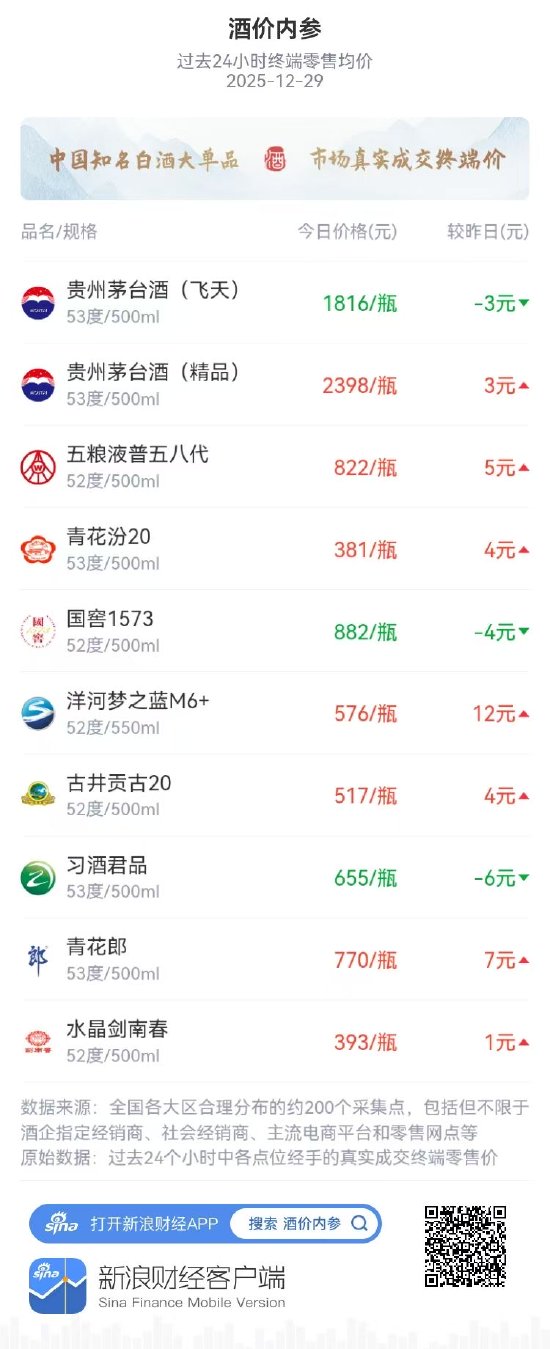
酒价内参12月29日价格发布,青花汾20上涨4元
Xin Lang Cai Jing· 2025-12-29 01:25
Core Insights - The core viewpoint of the article is that the Chinese liquor market, particularly the top ten liquor products, has shown signs of price recovery after a brief decline, with an overall increase in retail prices observed on Monday [1][6]. Price Trends - The average retail price of the top ten liquor products has stabilized and rebounded, with a total price of 9,210 yuan for a bundled sale of one bottle from each product, reflecting an increase of 23 yuan from the previous day [1][6]. - The market is experiencing a general upward trend, with most brands seeing price increases. Notably, Yanghe Dream Blue M6+ saw a significant rebound of 12 yuan per bottle, leading the market [1][7]. - Other notable price increases include: - Qinghua Lang up 7 yuan per bottle, marking its eighth consecutive day of price increases [1][7]. - Wuliangye Pu 58th generation up 5 yuan per bottle [1][7]. - Qinghua Fen 20 up 4 yuan per bottle [1][7]. - Guizhou Moutai premium up 3 yuan per bottle [1][7]. - Gujing Gong 20 and Shuijing Jian Nan Chun each up 1 yuan per bottle [1][7]. - Conversely, some products have seen price declines, including: - Xijiu Junpin down 6 yuan per bottle, continuing a three-day downward trend [1][7]. - Guojiao 1573 down 4 yuan per bottle [1][7]. - Feitian Moutai down 3 yuan per bottle [1][7]. Data Collection Methodology - The daily data for "Liquor Price Reference" is sourced from approximately 200 collection points across various regions, including designated distributors, social distributors, mainstream e-commerce platforms, and retail outlets, ensuring a comprehensive and objective representation of the market [2][7]. Industry Developments - On December 28, Guizhou Moutai held a national distributor conference, where the new management team emphasized respect and openness towards distributors and outlined a development strategy for 2026 [2][7]. - Moutai acknowledged its shortcomings in marketization and consumer reach while asserting the broad market potential for Moutai liquor [2][7]. - The core plan for the upcoming year includes preventing price speculation, promoting market-driven pricing, and establishing a pyramid product system centered around the 500ml Feitian Moutai as the main product [2][7]. - Moutai aims to enhance online and offline integration, encouraging compliant distributors to expand online business while focusing on consumer-centric marketing transformation [2][7]. - The chairman, Chen Hua, redefined the relationship with distributors, promising not to let them incur losses while urging a shift from passive to proactive consumer service [2][7].



酒价内参12月29日价格发布 市场止跌回升整体价格反弹
Xin Lang Cai Jing· 2025-12-29 01:12
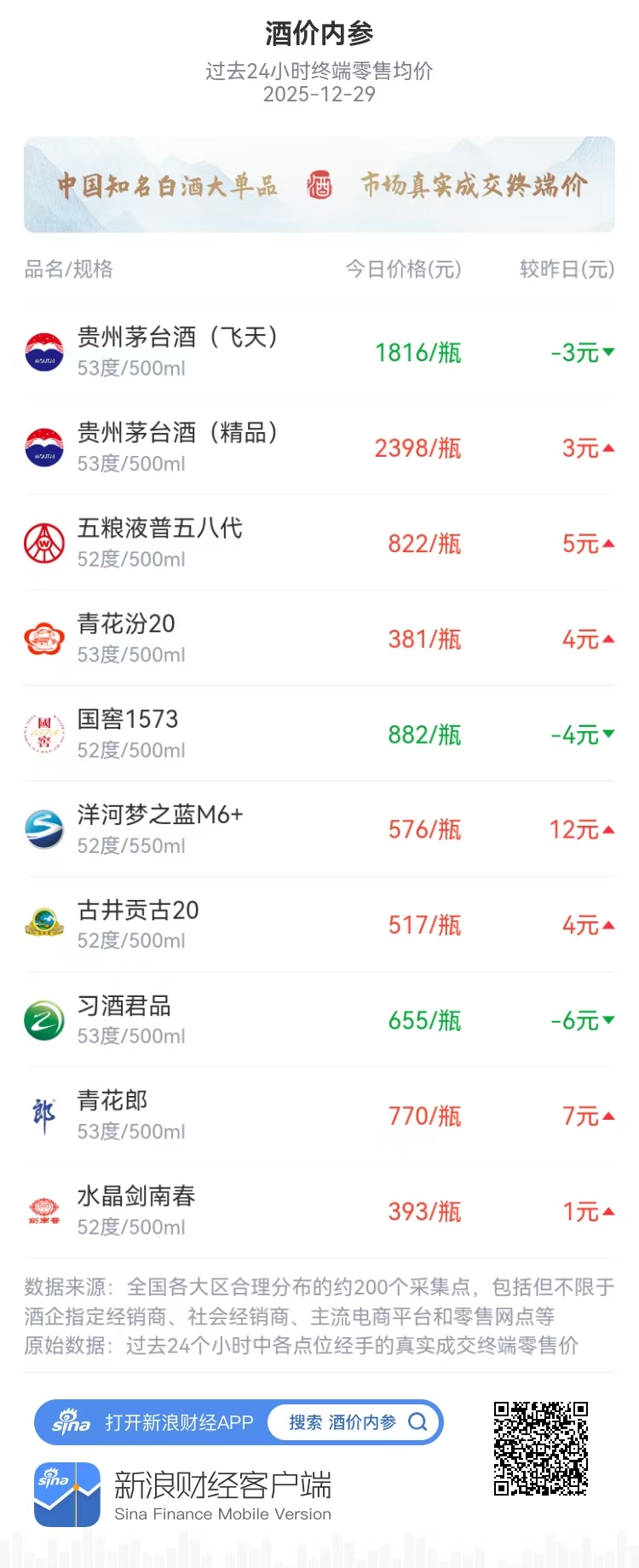
Core Viewpoint - The Chinese liquor market has shown signs of recovery, with the average retail price of the top ten liquor products stabilizing and rebounding after two days of decline, indicating a renewed buying interest in the market [1]. Price Trends - The total price for a package of one bottle from each of the top ten products is 9,210 yuan, which is an increase of 23 yuan from the previous day [1]. - The market is experiencing a broad-based price increase, with most brands seeing a rebound in prices [1]. - Notable price increases include: - Yanghe Dream Blue M6+ rising by 12 yuan per bottle, leading the market [1][4]. - Qinghualang increasing by 7 yuan per bottle, marking its eighth consecutive day of price growth [1]. - Wuliangye Pu Wu 58th generation up by 5 yuan per bottle [1]. - Qinghua Fen 20 rising by 4 yuan per bottle [1]. - Guizhou Moutai (Premium) increasing by 3 yuan per bottle [1]. - Gujing Gonggu 20 and Shuijing Jian Nan Chun both rising by 1 yuan per bottle [1]. Price Declines - Products experiencing price declines include: - Xijiu Junpin down by 6 yuan per bottle, marking its third consecutive day of decline [1]. - Guojiao 1573 decreasing by 4 yuan per bottle [3]. - Feitian Moutai dropping by 3 yuan per bottle [3].
对话白酒专家
2025-12-29 01:04
Summary of the White Liquor Industry Conference Call Industry Overview - The white liquor industry is currently in a downward adjustment cycle, with overall market demand remaining weak, particularly in November and December. This trend is expected to continue until at least the second half of 2026 or later [2][3][7]. Key Points and Arguments - **Price and Supply Adjustments**: The industry has not yet reached a bottom in terms of price and supply. For instance, Moutai's price has decreased but has not hit the bottom, and the supply from strong brands like Moutai and Fenjiu has not been fully adjusted [2][4]. - **Impact of Price Cuts**: Moutai (1,935) and Wuliangye (1,618) have seen some sales growth from price cuts, but brands like Yanghe M3 have not experienced significant improvements. The long-term effects of these price cuts on sales remain uncertain [2][6]. - **Challenges for Moutai**: Moutai faces difficulties in maintaining its pricing structure, with the price of its flagship product declining and distributors at risk of losses. Reducing supply is seen as a method to stabilize prices, but this conflicts with growth targets [2][10]. - **Wuliangye's Issues**: Wuliangye is dealing with wholesale price inversion and channel system problems. Digital transformation is crucial but challenging due to organizational structure limitations [2][11]. - **Luzhou Laojiao's Strategy**: Luzhou Laojiao has taken a calm approach to market conditions, refusing to lower prices, which may lead to short-term sales losses but is expected to strengthen its brand position in the long run [2][14]. Additional Important Insights - **External Economic Factors**: The recovery of the white liquor market is heavily influenced by external economic conditions and policy factors, such as the potential long-term impact of alcohol bans on high-end demand, estimated to affect demand by 20% to 30% [2][5][19]. - **Future Market Outlook**: The first half of 2026 is expected to remain in a bottoming phase, with potential improvement in the second half depending on external conditions. Continuous policy factors like alcohol bans may limit market rebound [2][7]. - **Strategic Adjustments**: Companies are adopting various strategies to cope with the adjustment cycle. Some are cutting prices to boost sales, while others are focusing on structural adjustments to navigate market changes [2][8][9]. - **Consumer Behavior During Festivals**: The white liquor market typically sees unexpected performance during the Spring Festival, as it is a rigid consumption scenario where consumers tend to purchase more expensive liquor regardless of the economic environment [2][5][23]. Conclusion - The white liquor industry is navigating a challenging period characterized by price adjustments, supply issues, and varying strategies among key players. The outlook remains cautious, with significant reliance on external economic factors and internal strategic decisions to shape future performance.
国货进免税,25个深圳品牌获推介
Sou Hu Cai Jing· 2025-12-28 23:41
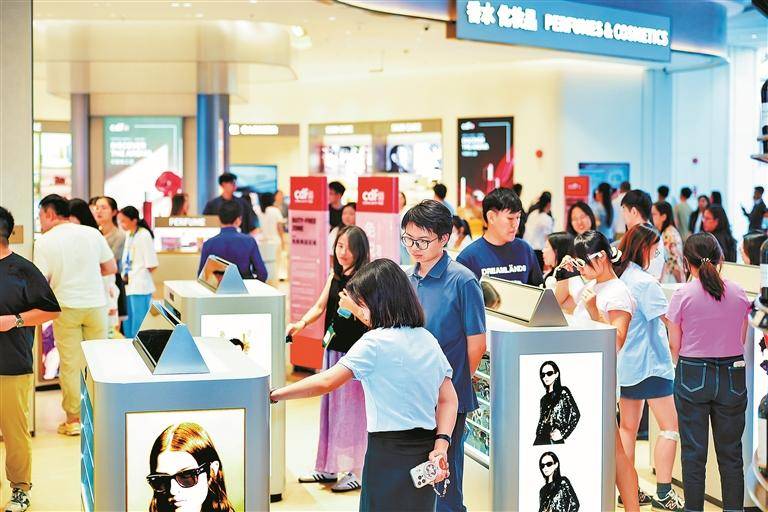
Core Viewpoint - The introduction of domestic "trendy" brands into duty-free stores is a significant step towards promoting local brands on a global scale, enhancing their competitiveness and meeting domestic consumer demand for high-quality products [4][5][6]. Group 1: Policy and Implementation - The Ministry of Commerce has officially announced the first batch of 174 domestic "trendy" brands recommended for duty-free stores, covering 19 categories across 26 provinces [5][6]. - This initiative aims to facilitate the entry of quality domestic brands into duty-free channels, which is crucial for expanding domestic demand and boosting consumption [5][6]. - Shenzhen has established a three-dimensional operational model combining "duty-free + tax refund + taxable" to effectively address the operational challenges of domestic products entering duty-free channels [6]. Group 2: Market Impact and Brand Promotion - The duty-free stores serve as a vital platform for showcasing Shenzhen's manufacturing and design to the international market, with brands like Honor and Doctor Glasses demonstrating innovation and high-end appeal [7][8]. - The inclusion of traditional cultural products and time-honored brands revitalizes their market presence, with examples like Liu's bamboo weaving and Tianjin Seagull's mechanical watches highlighting the blend of technology and cultural aesthetics [7][8]. - The overseas retail channels for domestic brands have seen significant growth, with some companies reporting a threefold increase in overseas business compared to the previous year [8].



去库信号仍待观察
CAITONG SECURITIES· 2025-12-28 13:21
Profit Trends - In November, the profit of industrial enterprises decreased by 13.1% year-on-year, a significant drop from the previous value of -5.5%[5] - The profit margin for industrial enterprises in November was approximately 5.7%, which is significantly lower than seasonal levels[12] - The total profit for industrial enterprises in November was 676.6 billion yuan, marking the lowest level for the same period since 2021[12] Price and Cost Dynamics - The Producer Price Index (PPI) in November fell by 2.2% year-on-year, widening from a decline of 2.1% in October[9] - The cost per 100 yuan of revenue for industrial enterprises increased to 85.5 yuan, up by 0.16 yuan year-on-year[29] - The unit revenue expense for the first eleven months was 8.39 yuan, a slight decrease of 0.01 yuan year-on-year[32] Inventory Insights - As of the end of November, the inventory of finished products for industrial enterprises increased by 4.6% year-on-year, with a 0.9 percentage point rise from October[33] - The actual inventory growth rate, excluding PPI effects, was 6.8%, slightly up from 5.8% in October[33] - The PMI data indicated a divergence, showing a decrease in inventory while actual inventory levels were still rising, suggesting unclear signals regarding destocking[33] Sector Performance - The upstream mining sector showed significant improvement with revenue growth of 5.3% and profit growth of 24.4% in November[23] - The midstream intermediate goods manufacturing sector faced challenges, with revenue and profit growth rates of -10.7% and -21.2%, respectively[26] - The downstream consumer goods manufacturing sector reported a profit margin of 11.7%, but revenue and profit growth were both negative at -12.2% and -22.6%[27]
50亿,一支新基金落地宿迁
Sou Hu Cai Jing· 2025-12-28 12:59
Group 1 - The Suqian Industrial Gathering Development Fund has been established with a total investment of 5 billion RMB, marking the largest single industrial mother fund in Suqian's history [1][2] - The fund operates under a "limited partnership" structure, with Suqian Chanfang Venture Capital as the General Partner (GP) responsible for daily operations [2] - Major Limited Partners (LPs) include Suqian Chanfang Group contributing nearly 1.5 billion RMB, accounting for nearly 30%, making it the largest single LP [2] Group 2 - Suqian Chanfang Venture Capital was established on July 20, 2022, with a registered capital of 100 million RMB and is fully controlled by Yanghe Group [2] - As of Q3 2025, Suqian Chanfang Venture Capital manages 7 funds with a total management scale exceeding 12 billion RMB, covering investment areas such as new materials, biomedicine, high-end equipment, and advanced manufacturing [2] - The median investment return rate (IRR) is 18.4%, ranking first among state-owned fund managers in Northern Jiangsu [2]
2025年1-10月中国白酒(折65度,商品量)产量为290.2万千升 累计下降11.5%
Chan Ye Xin Xi Wang· 2025-12-27 03:02
Group 1 - The core viewpoint of the article highlights a significant decline in the production of Chinese liquor, specifically a projected decrease of 18.3% in production volume for the year 2025 compared to the previous year [1] - According to data from the National Bureau of Statistics, the cumulative production of Chinese liquor from January to October 2025 is expected to reach 2.902 million kiloliters, reflecting a year-on-year decline of 11.5% [1] - The report by Zhiyan Consulting provides an analysis of the market status and investment prospects for the Chinese liquor industry from 2025 to 2031, indicating a challenging environment for producers [1] Group 2 - The article lists several key companies in the Chinese liquor industry, including Kweichow Moutai, Wuliangye, Yanghe, Luzhou Laojiao, Shanxi Fenjiu, Gujing Gongjiu, Shui Jing Fang, Shede Liquor, Jiu Gui Jiu, and Lao Bai Gan Jiu [1] - Zhiyan Consulting is identified as a leading industry consulting firm in China, specializing in in-depth industry research reports, business plans, feasibility studies, and customized services [1] - The data presented in the article is sourced from the National Bureau of Statistics and organized by Zhiyan Consulting, emphasizing the reliability of the information [1]
