
贝达药业

Search documents
医疗板块早盘异动,创新+国际化趋势下,行业迎来发展黄金周期
Sou Hu Cai Jing· 2025-08-07 06:32
Group 1 - The core viewpoint is that the innovative drug sector in China is entering a sustainable growth phase, with expectations for significant overseas product launches by 2025, leading to record-breaking licensing deals [1][3] - The trend of "innovation + internationalization" remains the central focus of the pharmaceutical sector, driven by global industry development patterns, technological advancements, and supportive policies [3][5] - By 2025, over 30 billion USD drugs will face patent expirations, necessitating innovation for revenue growth, as exemplified by Heng Rui Medicine's innovative drug revenue reaching 6.612 billion CNY in the first half of 2025, a 33% increase year-on-year [3][4] Group 2 - The internationalization of Chinese innovative drugs is evolving from single licensing transactions to comprehensive ecosystem outputs, with over 50 global collaborations totaling 48.448 billion USD in the first half of 2025 [4][5] - Recent policies have established a dual support system for the pharmaceutical industry, enhancing R&D, approval processes, and internationalization efforts, including a 30-day fast-track approval for innovative drugs [5][6] - The current landscape shows a key development phase for Chinese innovative drug companies, characterized by policy benefits, improved R&D efficiency, and accelerated internationalization, with leading companies investing over 20% of their revenue in R&D [7][8] Group 3 - Notable advancements in specific therapeutic areas include Rongchang Biotech's ADC product, which has secured a 2.6 billion USD licensing deal, and the emergence of innovative players in the biotech sector focusing on differentiated pathways [8][9] - In the cell and gene therapy sector, WuXi AppTec leads in CRDMO services, while Fosun Pharma's CAR-T therapy is projected to achieve 1.2 billion CNY in sales by 2024 [8][9] - In the metabolic and weight loss sector, Gan Li Pharmaceutical's GZR18 shows promising results, with a net profit increase of 224.9% year-on-year in Q1 2025 [9]



贝达药业:经销品种安瑞泽已于7月启动销售
Mei Ri Jing Ji Xin Wen· 2025-08-06 12:52
Core Viewpoint - The company has a total of eight products in its sales pipeline and aims to leverage its successful commercialization experience in oncology to enhance market coverage through differentiated clinical value and efficient promotion strategies [2]. Group 1: Product Information - The company currently has several products for sale, including 凯美纳, 贝美纳, 贝安汀, 赛美纳, 伏美纳, and 康美纳, which was approved for sale on June 30. Additionally, 安瑞泽 started sales in July, and a plant-derived recombinant human albumin injection (水稻) named 奥福民 was also approved in July [2]. Group 2: Sales Performance and Strategy - The company is addressing questions regarding its sales performance compared to industry peers, specifically mentioning that its revenue, gross profit, and net profit metrics are currently lower than those of艾力斯. The company emphasizes the importance of innovation and adaptability in response to new challenges in the industry [2].
2024年抗肿瘤药物医保目录准入回顾
Huafu Securities· 2025-08-05 11:40
Group 1 - The core viewpoint of the report highlights the accelerated inclusion of anti-tumor drugs in the medical insurance directory, with significant effects from target coverage and volume expansion [2][10] - In 2024, 91 new drugs were added to the medical insurance directory, of which 29 were anti-tumor and immune modulators, accounting for 32% of the total [10][11] - The hospital sales revenue for anti-tumor and immune modulators reached 57.9 billion yuan, representing over half of the total sales for negotiated varieties [10][11] Group 2 - The report notes that the new anti-tumor drugs are predominantly focused on lung cancer, with 11 new drugs added for this indication, while no new drugs were included for liver, stomach, or esophageal cancers [4][23] - The current directory adjustments do not align with the cancer spectrum in China, where lung cancer accounts for 27.7% of cancer deaths, indicating unmet needs in other cancer types [4][23] Group 3 - High-priced therapies face dual challenges regarding medical insurance funds and efficacy value, particularly CAR-T therapies, which are priced significantly above the implicit payment threshold [5][27] - The report emphasizes the need for innovative payment ecosystems to support high-value therapies, as the current pricing and reimbursement models are unsustainable [28][27]
化学制药板块8月4日涨0.48%,海辰药业领涨,主力资金净流入9700.43万元
Zheng Xing Xing Ye Ri Bao· 2025-08-04 08:30
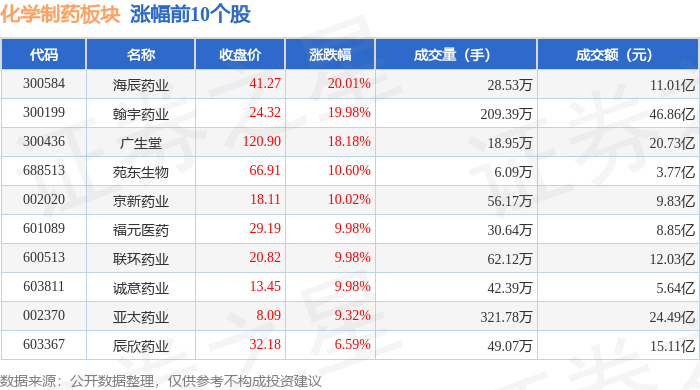
Group 1 - The chemical pharmaceutical sector increased by 0.48% on August 4, with Hai Chen Pharmaceutical leading the gains [1] - The Shanghai Composite Index closed at 3583.31, up 0.66%, while the Shenzhen Component Index closed at 11041.56, up 0.46% [1] - Hai Chen Pharmaceutical's stock price rose by 20.01% to 41.27, with a trading volume of 285,300 shares and a transaction value of 1.101 billion [1] Group 2 - The top gainers in the chemical pharmaceutical sector included Han Yu Pharmaceutical, which rose by 19.98% to 24.32, and Guangsheng Tang, which increased by 18.18% to 120.90 [1] - The sector saw a net inflow of 97.0043 million in main funds, while retail investors contributed a net inflow of 1.279 billion [2] - The main funds showed significant net outflows in several companies, including Hai Chen Pharmaceutical, which had a net inflow of 182 million, but retail investors had a net outflow of 579.696 million [3]


非农数据点燃降息预期,A500ETF基金(512050)盘中飘红,成交额位居同类第一
Sou Hu Cai Jing· 2025-08-04 06:59
Group 1 - The A500 index (000510) increased by 0.38%, with notable gains from companies such as Giant Network (002558) up 9.99% and Aerospace Electronics (600879) also up 9.99% [1] - The A500 ETF fund (512050) rose by 0.40%, with the latest price reported at 1.01 yuan [1] - The U.S. non-farm payroll data for July fell short of expectations, which may lead to an earlier interest rate cut [1] Group 2 - According to Zhongyin Securities, the impact of U.S. tariff policies is gradually diminishing, and market risk appetite is recovering [2] - The A500 index is designed to reflect the overall performance of the most representative listed companies across various industries, selecting 500 securities with larger market capitalization and better liquidity [2] - As of July 31, 2025, the top ten weighted stocks in the A500 index accounted for 19.83% of the index, including companies like Kweichow Moutai (600519) and CATL (300750) [2]
艾力斯的大单品依赖症
3 6 Ke· 2025-08-04 01:13
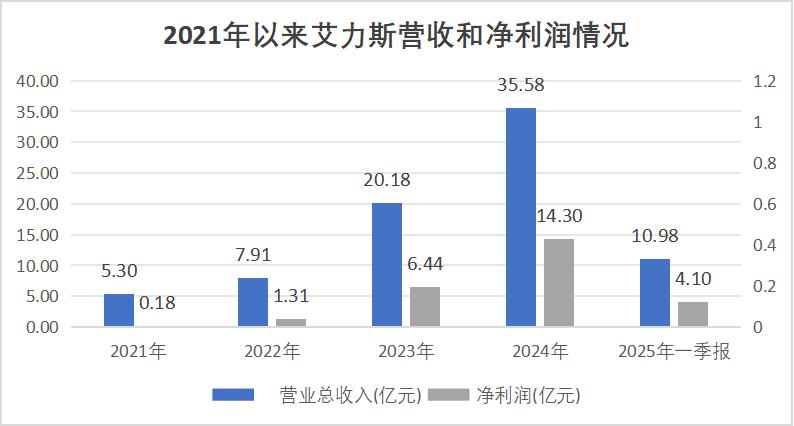
Core Insights - The article highlights the significant achievement of Ailis in the Chinese pharmaceutical industry, particularly with its drug Fumetinib, which has won the highest honor in intellectual property in China [1][2] - Ailis has successfully commercialized Fumetinib, establishing itself as a representative of innovation in the pharmaceutical sector, achieving a remarkable revenue growth and market capitalization increase [1][6] - Despite its success, Ailis faces challenges due to its heavy reliance on a single product, prompting the company to seek new growth opportunities [1][4][11] Group 1: Company Achievements - Ailis was founded in 2004 and has become a significant player in the pharmaceutical industry, particularly with the success of Fumetinib [3][4] - Fumetinib's sales revenue skyrocketed from 5.3 billion yuan in 2021 to 35.58 billion yuan in 2024, with a compound annual growth rate of 88.6% [4][6] - The company's stock price increased from 14.16 yuan to nearly 100 yuan, representing a growth of over 586%, leading to a market capitalization exceeding 40 billion yuan [6][7] Group 2: Market Dynamics - The EGFR inhibitor market in China reached a sales scale of 204.4 billion yuan in 2024, with a year-on-year growth of 19.5% [7][8] - Fumetinib's market share increased to 14.3% in 2024, while competitors like Osimertinib and Amivantamab faced challenges, allowing Ailis to capture market share [7][8] - The competitive landscape is intensifying with the entry of multiple new third-generation EGFR inhibitors and the development of fourth-generation drugs, posing a threat to Fumetinib's market position [8][9] Group 3: Strategic Responses - Ailis is focusing on deepening the development of Fumetinib through various clinical studies to expand its indications and market potential [11][12] - The company is pursuing a dual strategy of "independent research and development + collaborative partnerships" to build a diverse product portfolio [12][14] - Despite the ongoing growth, Ailis's revenue growth rate is showing signs of slowing down, indicating the need for new growth drivers beyond Fumetinib [12][14]

贝达药业:公司与益方生物就项目商业合作中的新情况已展开相关的沟通和交流
Zheng Quan Ri Bao· 2025-07-31 11:45
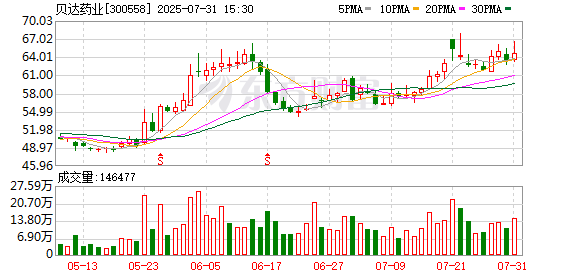
证券日报网讯贝达药业7月31日在互动平台回答投资者提问时表示,公司与益方生物就项目商业合作中 的新情况已展开相关的沟通和交流,会尽早妥善解决。根据交易所的减持披露规定,公司大股东减持首 发前股份和公司董事、高级管理人员减持股份都需要通知上市公司并发布减持预披露公告,除此之外, 公司无法知晓股东大宗交易的相关信息。 (文章来源:证券日报) ...
“上市热潮”+“政策支持”助力创新药提质向新,恒生创新药ETF(159316)连续获资金布局
Mei Ri Jing Ji Xin Wen· 2025-07-31 07:56
Group 1 - Several innovative pharmaceutical companies received positive news regarding product launches in July, including Betta Pharmaceuticals' approval of Tazemetostat capsules for breast cancer, classified as a category 1 innovative drug [1] - Ascentage Pharma's self-developed Bcl-2 selective inhibitor, Lisenglitazone, received conditional approval, becoming the first Bcl-2 inhibitor approved in China for the treatment of adult chronic lymphocytic leukemia/small lymphocytic lymphoma (CLL/SLL) [1] - The support for innovative drug policies remains strong, with the National Healthcare Security Administration's Director Wang Xiaoning stating that high-level innovative drugs will be supported to achieve returns that correspond to high investment and risk during the initial market phase [1] Group 2 - The government is implementing measures to facilitate the rapid clinical introduction of new drugs, including a streamlined approval process where one province can handle applications from multiple regions [1]
“上市快+出海热” 国产创新药向新提质迎新机
Shang Hai Zheng Quan Bao· 2025-07-30 18:03
Group 1 - The Chinese innovative drug industry is transitioning from "follow-up innovation" to "global leadership," with a record number of innovative drugs approved in the first half of the year [1][2] - In the first half of 2023, 43 innovative drugs were approved in China, representing a 59% year-on-year increase, compared to only 48 approvals for the entire year of 2024 [2][3] - China's innovative drug R&D pipeline accounts for about one-fourth of the global total, with approximately 3,000 clinical trials conducted annually, placing China at the forefront of global innovative drug development [2][3] Group 2 - Companies like Fosun Pharma and Hengrui Medicine have successfully launched multiple innovative drugs, with Hengrui having 23 first-class innovative drugs and 4 second-class innovative drugs approved domestically [3][4] - The commercialization of innovative drugs is leading to a recovery in performance for domestic pharmaceutical companies, with companies like Luoxin Pharma and MicuRx reporting significant profit increases [3][4] - The trend of Chinese pharmaceutical companies expanding internationally is accelerating, with a shift from license-in to explosive growth in license-out transactions, contributing nearly 50% of the total transaction value globally [4][5] Group 3 - Notable license-out deals include a partnership between 3SBio and Pfizer, with an upfront payment of $1.25 billion and a potential total deal value of $6.05 billion, setting a record for Chinese innovative drugs [5][6] - The rapid growth of license-out transactions is providing substantial cash flow for domestic innovative drug companies, supporting their core pipelines overseas and creating more collaboration opportunities with multinational pharmaceutical companies [6]
中银国际:医保局明确集采反内卷 关注医药板块重估机会
智通财经网· 2025-07-30 08:19
Core Viewpoint - The State Council's press conference highlighted the deepening of medical insurance reform during the 14th Five-Year Plan, emphasizing the principle of "anti-involution" in the 11th batch of centralized procurement, which aims to stabilize drug prices and improve profitability in the pharmaceutical industry [1][2]. Group 1: Centralized Procurement and Policy Changes - The National Medical Insurance Administration (NMI) has initiated the 11th batch of centralized procurement, focusing on principles such as "stabilizing clinical use, ensuring quality, preventing collusion, and anti-involution" [1]. - The NMI has optimized procurement rules, moving away from a simple lowest price reference, which previously led to low pricing and affected profitability and quality [2][3]. - The new rules require the lowest bidding companies to justify their pricing and ensure it does not fall below cost, indicating a potential improvement in drug pricing dynamics [1][2]. Group 2: Pharmaceutical Industry Outlook - The pharmaceutical sector is expected to gradually recover from the impacts of centralized procurement, with policy shifts and improved profitability on the horizon [3]. - The industry has seen significant R&D investments, and many companies are entering a phase of product realization, enhancing their competitive edge globally [3]. Group 3: Investment Opportunities - Three main investment lines are suggested: 1. Areas with stable growth, particularly in medical devices and pharmaceuticals, with specific companies highlighted for potential investment [4]. 2. The CXO and medical equipment sectors are anticipated to benefit from favorable domestic financing and fiscal policies, with recommended companies listed [5]. 3. Innovative fields related to national medical insurance negotiations, focusing on companies with international expansion capabilities [5]. - Additional sectors of interest include traditional Chinese medicine, raw materials, medical services, vaccines, and retail pharmacies, with specific companies identified for potential investment [6][7].