华熙生物

Search documents
新材料领航医美升级,千亿赛道竞逐正酣
2 1 Shi Ji Jing Ji Bao Dao· 2025-10-31 08:49
Core Viewpoint - The Chinese medical aesthetics industry is transitioning from rapid growth to high-quality development, driven by increasing consumer demand for personalized aesthetics and advancements in medical materials technology [1][4]. Industry Overview - The Chinese medical aesthetics market has surpassed 300 billion yuan, with the light medical aesthetics segment expected to grow at a compound annual growth rate (CAGR) of over 20% in the next five years [1][4]. - Injection projects, as a core growth driver, have seen their market size grow from 25.7 billion yuan in 2018 to 67 billion yuan in 2023, with a CAGR of 21.1%, projected to reach 147 billion yuan by 2027 [1]. Market Dynamics - The influx of new materials and products has intensified competition, prompting both startups and established companies to enhance their research and development efforts [2][6]. - The approval of multiple new medical aesthetic products has expanded market offerings, providing consumers with more choices and potentially leading to price segmentation [5][9]. Innovation and Competition - The competition in the medical aesthetics market is shifting from a focus on single materials to a multi-dimensional contest involving various materials and differentiated products for the same indications [6][8]. - Companies are increasingly focusing on material innovation to build competitive advantages amid rising product homogeneity [4][5]. Investment and Growth - The medical aesthetics sector is attracting significant capital investment, with numerous startups securing funding to accelerate clinical application and market penetration [6][8]. - Established companies are also expanding their presence through new divisions and strategic partnerships, enhancing their capabilities in the medical aesthetics field [6][7]. Regulatory Environment - The regulatory landscape is becoming more stringent, with increased oversight from authorities on all aspects of the industry, which is essential for ensuring high-quality development [9].


医疗美容板块10月31日涨0.81%,锦波生物领涨,主力资金净流入581.51万元
Zheng Xing Xing Ye Ri Bao· 2025-10-31 08:48
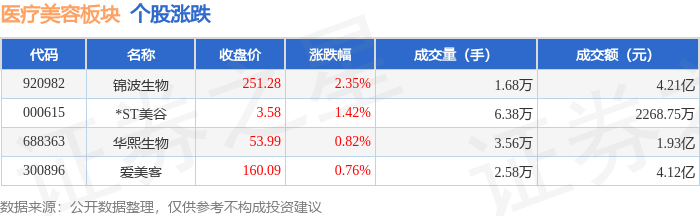
Core Viewpoint - The medical beauty sector experienced a slight increase of 0.81% on October 31, with Jinbo Biological leading the gains, while the overall market indices saw declines [1]. Group 1: Market Performance - On October 31, the Shanghai Composite Index closed at 3954.79, down 0.81%, and the Shenzhen Component Index closed at 13378.21, down 1.14% [1]. - Jinbo Biological's stock price rose by 2.35% to 251.28, with a trading volume of 16,800 hands and a transaction value of 421 million yuan [1]. - Other notable stocks in the medical beauty sector included *ST Meigu, which increased by 1.42% to 3.58, and Huaxi Biological, which rose by 0.82% to 66.65 [1]. Group 2: Capital Flow - The medical beauty sector saw a net inflow of 5.8151 million yuan from institutional investors, while retail investors experienced a net outflow of 7.1663 million yuan [2]. - The sector also recorded a net inflow of 1.3512 million yuan from speculative funds [2].



皮肤科学创新转化业务“拖后腿”,华熙生物前三季度净利降超三成
Bei Ke Cai Jing· 2025-10-31 06:56
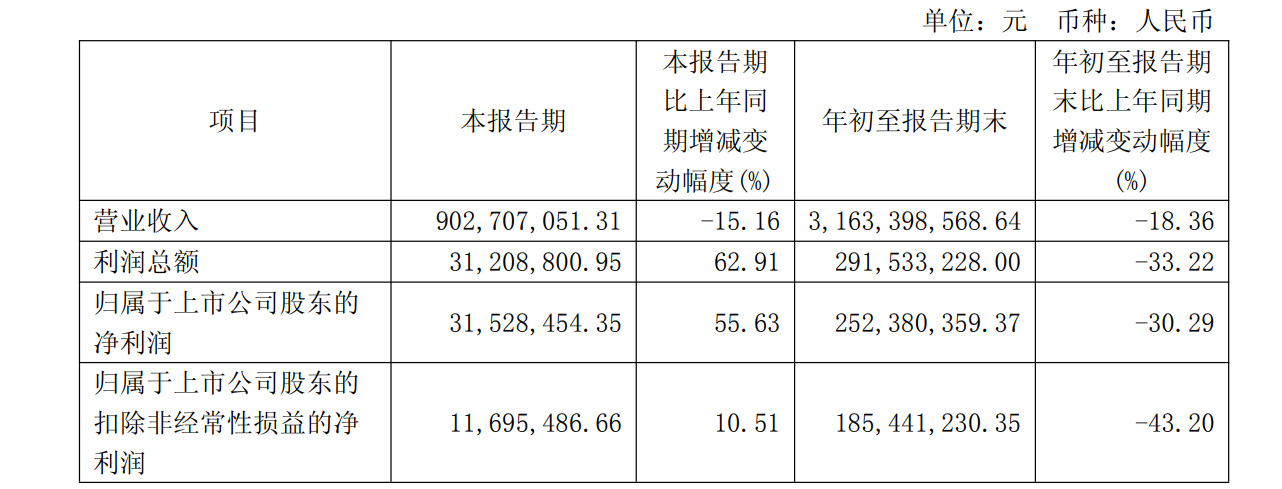
Core Viewpoint - The performance of Bloomage Biotechnology, a leading hyaluronic acid company, continues to be negatively impacted by the ongoing transformation pains in its skin science innovation business, with a significant decline in revenue and mixed profit results in the third quarter of 2025 [1]. Financial Performance - In Q3 2025, the company reported revenue of 903 million yuan, a year-on-year decrease of 15.16%, while net profit attributable to shareholders increased by 55.63% to 31.53 million yuan [1][3]. - For the first three quarters of 2025, revenue decreased by 18.36% to 3.163 billion yuan, and net profit fell by 30.29% to 252 million yuan [1]. Business Segment Analysis - The skin science innovation business has been a major drag on the company's performance, with revenue from this segment declining significantly [4]. - In 2022, the functional skincare business peaked with revenue of 4.607 billion yuan, but in 2023, it showed signs of fatigue, with a year-on-year decline of 18.45% to 3.757 billion yuan [5]. - The skin science innovation business's revenue for 2024 was 2.569 billion yuan, down 31.62%, accounting for 47.92% of the company's main business revenue [5]. Strategic Adjustments - The company has made strategic adjustments to focus on core brands and reduce non-essential brand incubation plans, aiming to strengthen the integration of technological achievements with consumer products [6]. - In Q3 2025, the sales expense ratio dropped to 34.26%, the lowest in five years, due to optimized brand communication and channel structure [6]. Asset Impairment and Investments - The company reported significant asset impairment losses in Q3 2025, totaling 23.25 million yuan, which did not affect the overall profit and loss situation [8]. - Bloomage Biotechnology has made strategic investments in the biopharmaceutical sector, including a 138 million HKD subscription for shares in Saintno Pharmaceuticals, aiming to explore collaboration opportunities [9]. - The company also participated in a strategic placement for Heyuan Biotechnology, investing 20 million yuan, focusing on plant-based bioactive substances [10].
赵燕重回一线的成绩单来了:华熙生物净利降超30%
阿尔法工场研究院· 2025-10-31 01:34
Core Viewpoint - The article discusses the challenges faced by Huaxi Biological, particularly its declining performance and the strategic changes initiated by its founder Zhao Yan to revitalize the company after a period of poor financial results [5][19]. Financial Performance - In the first three quarters of 2025, Huaxi Biological reported revenue of 3.163 billion yuan, a year-on-year decrease of 18.36%, and a net profit attributable to shareholders of 252 million yuan, down 30.29% year-on-year [5]. - The decline in profit is attributed to the drop in revenue from the skin science innovation transformation business, previously known as functional skincare products [5][10]. - Despite the overall decline, there was a notable improvement in the second quarter of 2024, with net profit increasing by 20.89% year-on-year, marking the first growth since the second quarter of 2024 [5][6]. Strategic Changes - Zhao Yan returned to the operational front line in March 2024, initiating a comprehensive reform of the company's management, sales expenses, and strategic direction [5][19]. - The company has reduced its sales expense ratio to 34.26%, the lowest in five years, by cutting costs in marketing and promotional activities [6]. - Huaxi Biological is undergoing a transformation process that includes organizational restructuring, talent system adjustments, and marketing model innovations [7][19]. Market Context - The medical beauty market is rapidly changing, with Huaxi Biological's market value dropping significantly from nearly 150 billion yuan at its peak in July 2021 to 25.977 billion yuan by October 29, 2024 [9]. - The stock price has also seen a dramatic decline, falling over 82% from its historical high of 312.99 yuan per share [9][10]. - The emergence of collagen peptide products has shifted investor focus away from hyaluronic acid, leading to a decline in Huaxi Biological's market position [12][13]. Competitive Landscape - Other companies in the hyaluronic acid sector, such as Haohai Biological and Aimeike, have also experienced significant stock price declines, indicating a broader trend in the market [11]. - New entrants focusing on collagen products have gained traction, with companies like Juzhibio and Jinbo Biological reporting substantial revenue growth, further challenging Huaxi Biological's market share [12][13]. Product Performance - The functional skincare product line, once a growth driver, has seen revenue declines exceeding 15% year-on-year in recent quarters, significantly impacting overall performance [6][13]. - The revenue from key brands like Runbaiyan and Kuaidi has also decreased, with projections indicating further declines in 2024 [21].

医疗美容板块10月30日跌0.81%,锦波生物领跌,主力资金净流出215.53万元
Zheng Xing Xing Ye Ri Bao· 2025-10-30 08:35
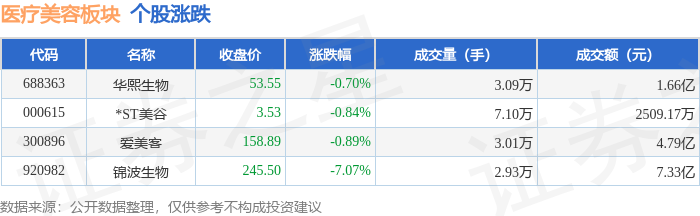
Core Insights - The medical beauty sector experienced a decline of 0.81% on October 30, with Jinbo Biological leading the drop at 7.07% [1] - The Shanghai Composite Index closed at 3986.9, down 0.73%, while the Shenzhen Component Index closed at 13532.13, down 1.16% [1] Medical Beauty Sector Performance - Huaxi Biological closed at 53.55, down 0.70%, with a trading volume of 30,900 shares and a transaction value of 166 million [1] - *ST Meigu closed at 3.53, down 0.84%, with a trading volume of 71,000 shares and a transaction value of 25.09 million [1] - Aimeike closed at 158.89, down 0.89%, with a trading volume of 30,100 shares and a transaction value of 47.9 million [1] - Jinbo Biological closed at 245.50, down 7.07%, with a trading volume of 29,300 shares and a transaction value of 733 million [1] Capital Flow Analysis - The medical beauty sector saw a net outflow of 2.1553 million from main funds, while retail funds experienced a net outflow of 3.2717 million [1] - Speculative funds had a net inflow of 5.4269 million [1] Individual Stock Capital Flow - Aimeike had a net outflow of 15.355 million, down 3.21%, with a net inflow of 21.139 million, down 0.44% [2] - *ST Meigu experienced a net outflow of 5.6326 million, down 22.45%, with a net inflow of 4.3275 million, up 17.25% [2] - Huaxi Biological had a net outflow of 13.9915 million, down 8.41%, with a net inflow of 16.4544 million, up 9.89% [2]
华熙生物(688363):环比25Q2营收利润双改善,聚焦高质量发展
Shenwan Hongyuan Securities· 2025-10-30 08:12
Investment Rating - The investment rating for the company is "Outperform" (maintained) [2] Core Insights - The company reported a revenue of 3.163 billion yuan for the first three quarters of 2025, a year-on-year decrease of 18.36%, while the net profit attributable to the parent company was 252 million yuan, down 30.29% [7] - In Q3 2025, the company achieved a revenue of 903 million yuan, a year-on-year decline of 15.16%, but the net profit increased by 55.63% to 31.53 million yuan [7] - The company is focusing on high-quality development and has reduced sales expenses significantly, leading to the lowest sales expense ratio in five years at 34.26% [7] - The company is enhancing its research and development capabilities, particularly in high-end raw materials and medical terminal businesses, while also exploring brand building in skincare [7] Financial Data and Profit Forecast - Total revenue for 2025 is estimated at 4.789 billion yuan, with a year-on-year decline of 10.8% [6] - The net profit for 2025 is projected to be 425 million yuan, representing a significant increase of 143.8% compared to the previous year [6] - The company’s gross margin is expected to be 71.6% in 2025, with a return on equity (ROE) of 5.9% [6] - The earnings per share (EPS) for 2025 is forecasted to be 0.88 yuan [6] Business Segments - The raw materials business generated revenue of 923 million yuan in the first three quarters of 2025, with a gross margin of 84.81% [7] - The medical terminal business achieved revenue of 1.031 billion yuan, with a 14.51% year-on-year growth in Q3 2025 [7] - The skincare innovation segment is undergoing transformation, focusing on long-term technological advantages and product conversion [7]
珀莱雅赴港上市:营销投流式增长放缓,研发和国际化托词下的资本运作,轻研发、重分红已成惯例
Xin Lang Cai Jing· 2025-10-30 03:02
Core Viewpoint - The Chinese beauty brand Proya is planning a secondary listing in Hong Kong, a significant move under the leadership of the second-generation successor, Hou Yameng, as the company's growth momentum is weakening [2][4]. Group 1: Financial Performance - In the first half of 2025, Proya achieved revenue of 5.362 billion yuan, a year-on-year increase of 7.21%, and a net profit of 799 million yuan, up 13.80% [7]. - Despite maintaining growth, the revenue and net profit growth rates are the lowest since the company went public in 2017, with previous year-on-year growth rates of 37.9% and 40.48% respectively [7]. - Proya's revenue growth has been closely tied to its marketing expenses, which have risen significantly, with sales expenses reaching 5.161 billion yuan in 2024, accounting for 47.88% of revenue [10]. Group 2: Marketing Strategy - Proya has relied heavily on celebrity endorsements and social media marketing, achieving remarkable growth from 2.361 billion yuan in 2018 to 10.778 billion yuan in 2024 [9]. - The company has signed multiple high-profile celebrity endorsements in 2025, but the revenue growth has sharply declined to 7.21% due to rising customer acquisition costs and diminishing internet marketing returns [12]. Group 3: Research and Development - Proya's R&D expenses have been notably low, with a R&D expense rate of only 1.95% in 2024, significantly lower than competitors like Huaxi Biological and Beitaini [19][20]. - The company has historically prioritized high cash dividends over R&D investment, with cumulative cash dividends exceeding 2.125 billion yuan since its IPO [22]. Group 4: Internationalization and Future Plans - Proya aims to use the funds raised from the Hong Kong listing to enhance R&D, smart manufacturing, and global expansion, although skepticism exists regarding the company's commitment to these areas [17][24]. - The company plans to pursue international growth primarily through acquisitions, which could provide quick market entry and new product technologies, but this strategy also carries risks and uncertainties [23].


“玻尿酸女王”重回业务一线半年,华熙生物核心业务未止跌
3 6 Ke· 2025-10-30 02:57
Core Viewpoint - The return of Zhao Yan, the founder of Hyaluronic Acid Biotech, to the frontline of operations has not yet led to a recovery in the company's performance, which remains in decline despite some signs of improvement in recent quarters [1][3]. Financial Performance - In the first three quarters of 2025, the company reported revenue of 3.163 billion yuan, a year-on-year decrease of 18.36%, and a net profit attributable to shareholders of 252 million yuan, down 30.29% year-on-year [1]. - The decline in profit is attributed to a decrease in revenue from the skin science innovation transformation business, previously known as functional skincare products [1]. - The company experienced its worst performance since its IPO in 2024, prompting Zhao Yan to return to operational management and initiate significant internal reforms [1][3]. - Despite the overall decline, the second quarter of 2025 saw a net profit increase of 20.89% year-on-year, marking the first growth since the second quarter of 2024 [1][2]. Cost Control Measures - The improvement in profit margins is primarily due to cost control, with the sales expense ratio dropping to 34.26% in the third quarter, the lowest in five years [2]. - The company has shifted away from a purely promotional sales model, focusing instead on optimizing brand research and communication, which has allowed for a significant reduction in promotional expenses [2]. Market Position and Stock Performance - The company's market capitalization has significantly decreased from nearly 150 billion yuan at its peak in July 2021 to approximately 25.977 billion yuan as of October 29, 2025, representing less than 20% of its peak value [3]. - The stock price has fallen over 82% from its all-time high of 312.99 yuan per share [3]. Industry Context - The decline in Hyaluronic Acid Biotech's performance is mirrored by other major players in the hyaluronic acid market, such as Haohai Biological and Aimeike, which have also seen significant stock price drops [5]. - The emergence of collagen peptide products has shifted investor focus away from hyaluronic acid, with companies like Juzhibio and Jinbo Biological experiencing substantial revenue growth [5][6]. - The functional skincare segment, which previously saw rapid growth, has faced challenges, with revenue declining over 15% year-on-year in both the second and third quarters of 2025 [2][6]. Strategic Adjustments - The company is undergoing a comprehensive transformation involving organizational structure, talent systems, marketing models, and supply chain collaboration [2]. - Zhao Yan's return to the operational front is seen as a critical move to address the company's recent performance issues and align its strategies with market changes [9][10].
美妆行业公私域融合经营白皮书
Sou Hu Cai Jing· 2025-10-30 02:53
Core Insights - The beauty industry is transitioning from "traffic competition" to "full-domain operation," driven by refined consumer demand and diverse touchpoints [5][11] - The report highlights the integration of public and private domains in the beauty sector, emphasizing the importance of Tencent's ecosystem in facilitating this transition [5][11] Market Overview - The retail scale of China's cosmetics market is projected to reach 435.7 billion yuan in 2024, with online sales surpassing offline for the first time, accounting for over 51% [11][12] - The industry is experiencing a slowdown, with a forecasted growth rate of -1.1% in 2024, marking a shift to structural growth [11][12] Consumer Insights - Skincare products dominate consumer purchases, with 87.3% of users buying them, followed by color cosmetics (50.7%) and perfumes (49.0%) [24][25] - There is a notable generational difference in purchasing behavior, with younger consumers (post-00s and post-90s) being more influenced by KOLs and collaborations, while older generations prioritize efficacy and personal enjoyment [24][25] Channel Dynamics - Traditional e-commerce remains the leading channel (62.6%), but the WeChat ecosystem is rapidly gaining traction, with 56.2% of transactions occurring through it [11][24] - WeChat mini-programs are becoming the primary transaction entry point, and social trust significantly influences purchasing decisions, with 45.5% of users buying based on friends' recommendations [11][24] Product Trends - High-end functional skincare products and male skincare (projected market size of 17 billion yuan in 2024, with a CAGR of 11% from 2025 to 2029) are experiencing significant growth [11][12] - Multi-functional and "makeup and skincare combined" products are gaining popularity, reflecting a trend towards convenience and efficiency in beauty routines [16][26] Brand Strategies - Leading brands are leveraging public-private domain integration to drive growth, with examples including Huahua Xizi and Proya utilizing mini-programs and KOLs for effective marketing [11][24] - Future strategies should focus on product innovation, targeted audience engagement, and leveraging video content for brand awareness and conversion [11][24]

济南:工业土壤长出消费品牌新枝
Xin Hua Wang· 2025-10-30 01:51
Core Insights - The rise of new consumer brands in Jinan is driven by technological advancements and a focus on meeting consumer needs, showcasing the potential of local industries to innovate and adapt [2][3][4][5][6][7] Group 1: Technological Innovation - Tanghe Tang Biotechnology, a subsidiary of Shengquan Group, has transformed from a traditional industrial player to a high-end food ingredient provider, increasing its revenue from 10 million to over 400 million yuan through the development of a fully automated xylitol production line [3] - Huaxi Biological has shifted from B2B to B2C, investing 3 billion yuan to build the world's largest pilot platform, enabling rapid transformation of research into consumer products and achieving a 44% global market share in hyaluronic acid [4] - The technological breakthroughs in these companies have restructured the supply chain and allowed Jinan's manufacturing sector to penetrate the functional sugar market, with Tanghe Tang aiming for an annual output value of 1 billion yuan in the next 3-5 years [3][4] Group 2: Market Demand and Consumer Focus - Tangpai Group has been addressing the silver economy since 2010, creating a comprehensive supply chain for elderly products, with over 3,000 items integrated into its brand, and establishing the first silver economy center in Shandong [6] - The company has introduced a new consumption model that includes a silver economy center, elderly care display center, and community service stations, ensuring accessibility and affordability of products for the elderly [6] - Weirkan Group has transformed from a traditional meat processing factory to a cold chain service provider, expanding its cold storage capacity from 10,000 tons to 360,000 tons and increasing its distributor network from 200 to over 1,800 [7]