幻方量化

Search documents
私募行业再现10亿“日光基”资金入市升温
Chang Jiang Shang Bao· 2026-01-12 03:04
Core Viewpoint - The private equity market in China is experiencing a strong start in 2026, highlighted by the rapid fundraising success of Shanghai Fusheng Asset, which raised 1 billion yuan in a single day for its actively managed stock private equity product, indicating a renewed interest in high-quality subjective private equity products among high-net-worth individuals [1][3]. Group 1: Market Performance and Trends - In 2025, the private equity sector saw significant performance improvements, with an average return of 32.66% across 5022 private equity securities investment funds, and a 95.02% positive return rate, marking the best annual performance in nearly five years [6]. - The average return for 71 billion-yuan private equity firms was 33.59%, with 98.59% achieving positive returns, showcasing the strong performance of leading firms in the market [6]. - The stock quantitative long strategy led the performance with an average return of 45.02%, significantly outperforming the subjective long strategy, which had an average return of 29.51% [7]. Group 2: Fundraising and Product Performance - Fusheng Asset's product, which achieved a return of 80.19% in 2025, reflects the strong demand for high-performing private equity products, with its other product, Fusheng Positive Energy No. 3, achieving a remarkable return of 668.7% since its inception in 2018 [2][3]. - The rapid fundraising success of Fusheng Asset is indicative of a broader trend where subjective private equity is regaining market favor after a period dominated by quantitative strategies [5]. Group 3: Market Environment and Capital Flow - The A-share market has shown strong performance at the beginning of 2026, with the Shanghai Composite Index reaching a ten-year high of 4121.7 points, reflecting a 7.7% increase since January 5 [4]. - The total margin financing balance exceeded 2.62 trillion yuan, marking a historical high, and the trading volume in the Shanghai and Shenzhen markets has consistently surpassed 1 trillion yuan [4]. - The private equity fundraising event is seen as a manifestation of the trend of household savings shifting towards capital markets, with an expectation of over 2 trillion yuan in new capital entering the A-share market in 2026 [4]. Group 4: Industry Growth and Strategy Diversification - The private equity industry in China has reached a record management scale of over 22 trillion yuan, with private equity securities investment funds growing to 7.01 trillion yuan, a significant increase of 34% from the previous year [8]. - The number of newly registered private equity securities investment funds exceeded 12,000 in 2025, with stock strategy funds making up 65.8% of the total, indicating a strong focus on this investment strategy [7].
私募行业再现10亿“日光基”资金入市升温 2025年百亿私募98.59%获正收益
Chang Jiang Shang Bao· 2026-01-11 23:34
Core Insights - The private equity market in China has started 2026 with a strong performance, highlighted by the rapid fundraising success of Shanghai Fusheng Asset, which raised 1 billion yuan in a single day for its actively managed stock private equity product, marking it as the first "daylight" private equity product of the year [1][3] - The overall performance of private equity funds in 2025 was exceptional, with an average return of 32.66% across 5022 funds, and a staggering 95.02% of these funds reported positive returns [6][8] - The trend indicates a shift in investor preference back towards subjective private equity strategies, as evidenced by the strong performance of Fusheng Asset and other leading firms, which have regained market favor after a period dominated by quantitative strategies [5][6] Fundraising and Market Dynamics - Fusheng Asset's product was sold out within seconds, reflecting a renewed interest from high-net-worth individuals in quality subjective private equity products amid a recovering equity market [1][3] - The Shanghai Composite Index has shown strong performance, reaching a ten-year high of 4121.7 points, contributing to increased market activity and investor confidence [4] - The total margin financing balance exceeded 2.62 trillion yuan, indicating heightened market liquidity and investor engagement [4] Performance Metrics - Fusheng Asset's flagship products have demonstrated remarkable returns, with the "Fusheng Positive Energy No. 2" achieving an 80.19% return in 2025, and the "Fusheng Positive Energy No. 3" yielding a cumulative return of 668.7% since its inception in 2018 [2][3] - The average return for large private equity firms (over 10 billion yuan) was 33.59%, with 98.59% of these firms reporting positive returns, showcasing their robust performance in the market [6][8] Strategy Trends - The private equity landscape is witnessing a strategic shift, with quantitative strategies previously dominating now facing competition from subjective strategies, which are regaining traction due to their strong performance [5][7] - The average return for quantitative long strategies was 45.02%, significantly outperforming subjective long strategies, which averaged 29.51% [7] - The number of large private equity firms has increased, with 113 firms now managing over 10 billion yuan, indicating a growing trend towards larger, more established players in the market [7][8]
DeepSeek等8大产品都是意外?! 改变世界的项目们,最初都没被“当个事儿办”
量子位· 2026-01-11 04:02
Core Viewpoint - Side projects, often overlooked initially, can lead to groundbreaking products and innovations in the tech industry, demonstrating that exploration and experimentation can yield significant results [1][2][3]. Group 1: Definition and Characteristics of Side Projects - A side project is defined as a non-core, non-KPI driven initiative that is not strategically planned at its inception [2]. - These projects are less constrained by traditional business structures, allowing for more creative freedom and innovation [3][12]. - The lack of formal oversight enables these projects to evolve organically, often leading to unexpected successes [13][40]. Group 2: Examples of Successful Side Projects - DeepSeek, a side project of Huafang Quantitative, emerged from internal technical research and has become a significant tool in quantitative trading [4][11]. - Qwen, initially a side project at Alibaba, has successfully transitioned into a prominent open-source model, benefiting from reduced decision-making constraints [18][22]. - Claude Code started as an experimental project by engineer Boris Cherny and evolved into a key product for Anthropic, showcasing the potential of side projects to disrupt traditional product development [27][32]. Group 3: Advantages of Side Projects - Side projects can enhance the likelihood of success due to less bureaucratic interference, allowing teams to iterate quickly and adapt based on real-world feedback [22][25]. - The cost of experimentation is lower in the AI era, enabling individuals to validate ideas more swiftly without extensive resource coordination [37][44]. - The flexibility of side projects allows for rapid adjustments and improvements, ultimately leading to more robust and mature products [41][43]. Group 4: Implications for Future Projects - The trend indicates that early signals of future innovations may increasingly arise from projects initially deemed non-essential [53]. - While not all side projects guarantee success when scaled, they provide a foundation for larger initiatives once their value is proven [54][55].


资本市场年度人物 老将承压,新生代突围
Nan Fang Du Shi Bao· 2026-01-08 23:12
Capital Market Trends - The Chinese capital market in 2025 is characterized by the rise of new tech players and deep adjustments in traditional industries, indicating a shift from scale expansion to value return and from concept speculation to solid capabilities [2] - The experiences of key figures in the market reflect a clear trend: only by respecting risks, adhering to fundamentals, and embracing innovation can one maintain a foothold in the changing capital landscape [2] Challenges for Established Players - The resignation of Vanke's former CEO, Zhu Jiusheng, marks a significant event in the real estate sector, revealing the vulnerabilities of high-leverage models amid a downturn, as Vanke faces over 36 billion in public debt due in 2025 [3] - Xiaomi's CEO Lei Jun faces scrutiny as the company transitions into the automotive sector, with safety concerns and brand reputation challenges arising despite impressive sales figures [3] New Generation Entrepreneurs - Liu Jingkang, born in 1991, leads Ying Shi Innovation to a market cap of 70 billion after a strong debut on the Sci-Tech Innovation Board, but faces intense competition from established players like DJI [5] - Peng Zhihui, known as Zhi Hui Jun, transitions from Huawei to entrepreneurship, achieving a remarkable 1820.29% stock price increase for Wei Xin New Materials, but must now focus on sustainable profitability [5] - Wang Xingxing's Yushut Technology aims for an IPO, showcasing advanced robotics technology, with the success of its commercialization path being crucial for the industry's future [5] Family Business Dynamics - In 2025, Zong Fuli faces legal challenges and internal power struggles at Wahaha, highlighting the complexities of succession and governance in private enterprises [6] Market Volatility and Value Reconstruction - Bubble Mart's LABUBU 3.0 series drives a significant stock price increase, but the subsequent decline in IP premium raises questions about sustainable growth strategies [6] - Cambricon Technologies experiences a turnaround with four consecutive profitable quarters, driven by core technology accumulation, positioning itself as a leader in the AI computing sector [6] Innovation in AI - Liang Wenfeng, founder of DeepSeek, gains recognition for significant advancements in AI, emphasizing that market presence will ultimately yield to technological strength and continuous innovation [7]
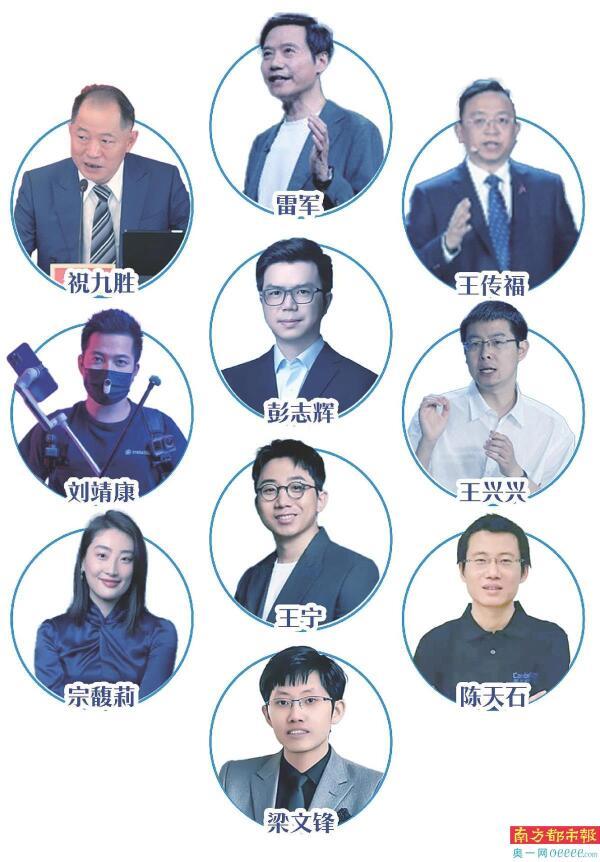
2025资本市场年度人物盘点:老将承压,新生代突围
Nan Fang Du Shi Bao· 2026-01-07 04:17
Group 1 - The core trend in the 2025 Chinese capital market indicates a shift from scale expansion to value return, emphasizing hard-core strength over conceptual speculation [2] - The experiences of industry veterans and new generation entrepreneurs reflect the necessity of risk awareness, essence adherence, and innovation embrace to navigate market changes [2] Group 2 - The resignation of Vanke's former CEO, Zhu Jiusheng, marks a significant event in the real estate sector, highlighting the vulnerabilities of high-leverage models amid industry downturns [4] - Xiaomi's CEO Lei Jun faces challenges in the automotive sector, where safety concerns and brand reputation are critical as consumer expectations evolve from mere production to quality [6] - BYD's Wang Chuanfu celebrates record sales of 4.6024 million electric vehicles globally, yet faces declining domestic revenue and profit, indicating the need for technological depth and operational excellence [8] Group 3 - The emergence of new entrepreneurs like Liu Jingkang, who launched a drone brand to compete with DJI, illustrates the survival imperative of differentiation in a competitive landscape [11] - Peng Zhihui's transition from Huawei employee to entrepreneur showcases the capital market's recognition of technical talent, but the challenge remains in converting technical prowess into sustainable profits [13] - Wang Xingxing's company, Yushutech, aims for an IPO, representing the maturation of the embodied intelligence sector, where commercialization and market expectations will dictate future success [15] Group 4 - Bubble Mart's founder Wang Ning experiences a volatile year, with significant revenue growth followed by a sharp decline in stock price, emphasizing the need to shift from reliance on hit products to ecosystem building [20] - Cambricon's Chen Tian Shi sees a turnaround with consecutive profitable quarters, driven by AI computing demand, highlighting the importance of technological barriers and ecosystem development in hard tech [22] - Liang Wenfeng's low-profile yet impactful contributions in AI through DeepSeek demonstrate that sustained innovation is crucial for success in the artificial intelligence era [24][25]

五年潮变 量化私募走到了舞台中央
2 1 Shi Ji Jing Ji Bao Dao· 2026-01-06 23:50
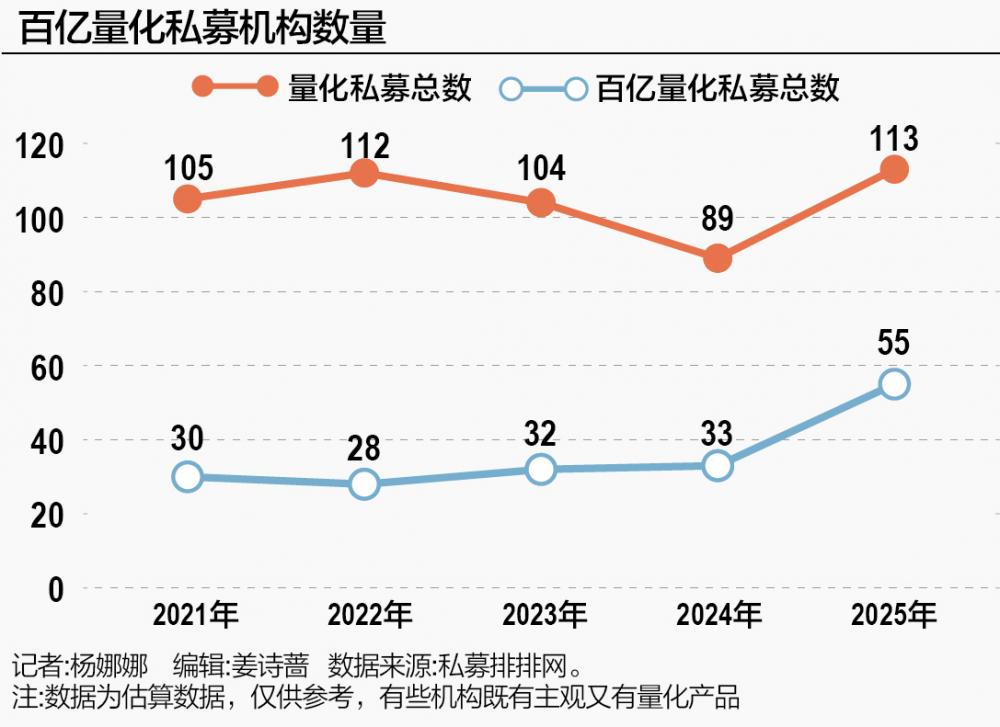
Core Insights - The private equity industry is projected to exceed 22 trillion yuan by 2025, with many firms surpassing 10 billion yuan in scale and numerous products reaching historical net value highs. Notably, by July 2025, the number of quantitative private equity firms with over 10 billion yuan in assets has surpassed that of subjective firms, marking a significant shift in the industry [1][9]. Group 1: Industry Growth and Structure - By the end of 2025, the number of private equity firms with over 10 billion yuan has increased to 113, with 55 being quantitative and 45 subjective, indicating a structural change in the market [2][10]. - The top firms, known as the "Four Kings," continue to dominate with a combined management scale of approximately 300 billion yuan, while new entrants like Century Frontier and Wan Yan Asset have made significant gains, with Century Frontier increasing its scale by over 30 billion yuan in one year [4][11]. Group 2: Performance and Competitive Landscape - Quantitative firms have gained favor among institutional and high-net-worth investors due to their performance, risk control capabilities, and standardized products, with six out of the top ten performing firms being quantitative [3][10]. - The competitive landscape has evolved into a more defined pyramid structure, with the top tier consisting of firms managing over 70 billion yuan, a level that did not exist in 2022 [5][14]. Group 3: Technological Advancements and Talent Acquisition - The competition among quantitative private equity firms has shifted towards a comprehensive ecological competition, with technology, talent, and global perspectives becoming critical factors [6][15]. - AI technology has transitioned from a supportive tool to a core engine for firms, with companies like Huanfang Quantitative and Jiukun Investment heavily investing in AI capabilities and talent development [6][15]. Group 4: International Influence and Investor Education - The entry of international quantitative giants like Two Sigma is reshaping competition rules and elevating industry standards, prompting local firms to accelerate their internationalization efforts [7][16]. - Leading firms are actively promoting investor education through various initiatives to enhance public understanding of quantitative investment, thereby improving the industry's image [7][16]. Group 5: Future Trends - Looking ahead, the industry is expected to face challenges such as strategy homogenization and diminishing excess returns, with innovation focusing on product line design rather than factor models [8][17].
2026掘金指南来了!A股机会在哪? “慢牛”共识凝聚,淡水泉、景林、仁桥、重阳、清和泉等最新观点分享| 私募透视镜
Jin Rong Jie· 2026-01-05 06:39
Group 1 - The core viewpoint of the article emphasizes a consensus on a "slow bull" market, with a focus on "uncrowded growth" opportunities in sectors like AI and high-end manufacturing [2][13] - The macro liquidity environment is expected to remain ample, supporting a favorable capital market for 2026, with a recovery in investor risk appetite [2][13] - There is a recognition of potential valuation bubbles in certain industries, prompting a strategy to identify quality companies that are not overvalued and have solid performance [2][13] Group 2 - The investment outlook for 2026 includes a focus on the AI industry chain, semiconductor domestic substitution, and the expansion of China's advantageous manufacturing overseas [2][13] - The report highlights the importance of structural growth deepening, with a significant emphasis on sectors that are expected to benefit from global technological innovation [2][13] - The article notes that while some industries show signs of valuation bubbles, there is a commitment to continuously track areas with positive marginal changes to ensure sustainable returns for investors [2][13]
吴晓波:“AI闪耀中国”2025(年度演讲全文)
Xin Lang Cai Jing· 2025-12-29 03:18
Group 1 - The AI revolution is a significant competition that impacts national fortunes, with China and the US as the main players [1][13][32] - The development of AI has evolved through key milestones, starting from Turing's question in 1950 to the emergence of GPT-3.5 in 2022, marking a pivotal moment in AI's integration into daily life [10][24][30] - The AI infrastructure investment in the US is projected to exceed $350 billion by 2025, while China's investment is expected to reach 630 billion RMB, indicating a massive scale of infrastructure development in both countries [24][26] Group 2 - The competition between the US and China in AI is characterized by different approaches: the US focuses on AI chips and closed-source models, while China leverages its manufacturing capabilities and open-source models [30][28] - By 2025, the majority of large AI models will be concentrated in the US and China, with both countries accounting for over 80% of the global total [26][28] - The AI industry is witnessing a surge in applications across various sectors, including finance, healthcare, and manufacturing, with companies like Shanghai Bank and Xiamen Guomao leading the way in AI integration [44][50][57] Group 3 - The emergence of multi-modal technologies is revolutionizing content production, allowing non-technical users to create high-quality content easily [34][36] - The AI animation industry has seen a dramatic increase in production and efficiency, with a reported 600% growth in output and a significant reduction in production costs [38][39] - Companies are increasingly adopting AI to innovate their business models, as seen in the case of Jinpai Home, which utilizes AI for home renovation services [53][57] Group 4 - The robotics sector is rapidly evolving, with a new generation of companies emerging to develop intelligent robots capable of performing complex tasks [72][74] - The market for embodied intelligent robots is expected to become a significant part of China's economy, with predictions of four trillion-yuan markets emerging in various sectors [80][82] - Innovations in AI-driven products, such as the ROBOT PHONE by Honor, highlight the integration of AI into consumer electronics, showcasing the potential for new market opportunities [84][85]

林园回应业绩倒数第一:依然在,不调仓,12年闭着眼也能回本
Sou Hu Cai Jing· 2025-12-28 17:50
Core Viewpoint - The private equity industry is experiencing significant performance differentiation, with Lin Yuan Investment ranking last with a -4.25% return, while the top firm, Guoyuan Xinda, achieved a 55.24% return, highlighting the challenges faced by traditional value investors in a changing market environment [1][3]. Performance Analysis - Lin Yuan Investment's 18 disclosed products underperformed the CSI 300 index, with the best-performing product, Lin Yuan Investment No. 218, yielding 15.36%, which is lower than the CSI 300's 18.77% increase during the same period [3]. - The product Lin Yuan Investment No. 173 is nearing liquidation with a unit net value of 0.7620 yuan, significantly underperforming the market [3]. - Market reactions have been mixed, with some investors expressing dissatisfaction over missed opportunities in a bull market, while others defend Lin Yuan's long-term investment strategy [3][5]. Investment Strategy - Lin Yuan maintains a calm demeanor amidst performance pressures, denying any risk of liquidation and attributing poor performance to short-term declines in holdings [5]. - He has passively allocated to technology stocks to meet market requirements but expressed regret over this decision, indicating discomfort with tech investments [5]. - Lin Yuan remains committed to his investment strategy without additional risk control measures or adjustments to his holdings [5]. Sector Focus - Lin Yuan expresses strong confidence in the liquor industry, viewing it as a source of "pleasure demand" and suggesting that holding liquor stocks for over 12 years could yield returns through dividends that cover initial investment costs [7]. - He remains cautious about trends targeting younger consumers, noting past attempts by liquor companies to appeal to this demographic have not been very successful [7]. Market Context - The performance struggles of Lin Yuan Investment and other value-focused private equity firms reflect a broader shift in the A-share market, where sectors like AI and semiconductors are leading, while traditional sectors like liquor and pharmaceuticals are lagging [9]. - The rise of quantitative strategies poses significant challenges to traditional value investing, which is undergoing a "test of patience" amid short-term market fluctuations [9]. - Historical parallels are drawn to investment legends like Warren Buffett, who also faced performance challenges while adhering to his investment philosophy during market upheavals [9].

AI大模型分野:从技术狂热到商业价值回归
Xin Lang Cai Jing· 2025-12-25 12:40
Core Insights - The Chinese large model market in 2025 has undergone a significant "value return," with diminishing marginal effects of technological breakthroughs and a shift towards sustainable business models and deep industry integration [2][11] - The emergence of DeepSeek has disrupted the existing large model market, temporarily dethroning ChatGPT and becoming a global phenomenon [3][12] - The competitive landscape is evolving from a binary narrative of "giants" versus "small tigers" to a more complex, multidimensional competitive stage [3][12] Company Developments - DeepSeek experienced a surge in popularity at the beginning of 2025 but faced a decline in attention by the second half of the year, with updates failing to generate significant market interest [4][13] - The "AI Six Tigers," including Zero One Everything and Baichuan Intelligence, have shifted focus from training large models to practical commercial applications [5][14] - Zero One Everything reported significant revenue growth in 2025, achieving multiple times the revenue of 2024, and successfully launched international projects [6][15] - Baichuan Intelligence has optimized its business focus towards the medical sector, indicating a strategic shift in resource allocation [6][15] Market Trends - The investment landscape has shifted from funding foundational model companies to prioritizing AI applications and infrastructure, reflecting a broader market demand for practical solutions [8][17] - Companies like Zhipu and MiniMax are moving towards IPOs, becoming the first independent large model firms to list in Hong Kong, which is expected to attract significant investor interest [18] - The focus on sustainable revenue growth and reduced losses will be critical for long-term success in the capital markets [18] Technological Insights - The current Transformer architecture may not support the next generation of agents, with research indicating a potential shift towards Non-Linear RNNs for improved performance in long-context environments [19]