
锦波生物

Search documents
北交所2026年投资策略:蓄势于微,成势于稀
Southwest Securities· 2026-02-02 03:05
Core Insights - The report highlights that the North Exchange (北交所) experienced a year of significant excess returns in 2025, with the North Exchange 50 Index rising by 38.8%, outperforming the CSI 300 by 21.1 percentage points [60]. - The report emphasizes the importance of liquidity improvements in 2026, driven by various factors including increased retail participation and the introduction of passive investment products like the North Exchange 50 ETF [7][54]. 2025 Sector Review - In 2025, the North Exchange showed a characteristic of "stable revenue, pressured profits," with overall revenue growing by 7.0% year-on-year in Q3 2025, while net profit attributable to shareholders declined by 4.8% [5][17]. - The report notes that sectors such as robotics, AI, military industry, and semiconductors demonstrated significant performance, indicating a strong correlation with the broader market [5][60]. 2026 Liquidity Outlook - The liquidity outlook for 2026 is expected to improve systematically, with increased retail investment and the launch of passive products anticipated to bring substantial incremental funds [7][54]. - Historical data suggests that previous market rallies in the North Exchange were driven by liquidity expansion, indicating a solid foundation for market support in 2026 [7]. Investment Themes - The investment strategy for 2026 focuses on three dimensions: technology growth sectors such as semiconductors and AI, macroeconomic recovery signals in consumer and cyclical sectors, and unique assets in the North Exchange that are key to domestic substitution and growth [8][5]. - The report highlights the importance of identifying high-scarcity and performance-driven targets within these themes [8]. New Stock Market Insights - The average first-day gain for new stocks in 2025 was an impressive 368.1%, primarily due to the valuation gap between primary and secondary markets [9]. - The North Exchange has a robust pipeline of new listings, particularly from advanced manufacturing sectors, which is expected to continue [9]. Industry Structure - As of December 31, 2025, the North Exchange had 287 listed companies, with 61.0% concentrated in mechanical equipment, electric power equipment, and other high-end manufacturing sectors, significantly higher than the corresponding figures for the ChiNext and STAR Market [10][12]. - The report indicates a strong focus on advanced manufacturing and "specialized, refined, distinctive, and innovative" enterprises, with a notable increase in the proportion of such companies over the years [14][16]. Financial Performance - In Q3 2025, the North Exchange's companies experienced a decline in net profit margins, with a year-on-year drop of 4.8%, contrasting with the growth seen in other markets [17][24]. - The report notes that the return on equity (ROE) was adversely affected by pressures on net profit margins and asset turnover rates, indicating a need for operational efficiency improvements [25][31]. Sector Profitability - The report highlights significant profitability disparities across sectors, with industries like automotive and home appliances showing strong growth resilience, while sectors such as media and pharmaceuticals faced severe profit declines [39]. - The automotive sector, in particular, saw a remarkable profit increase of 110.5%, indicating robust demand and market share gains [39]. Investment Participation - Institutional participation in the North Exchange has been increasing, with the number of funds holding North Exchange stocks rising significantly [40]. - The report notes that the North Exchange theme funds have outperformed the average industry returns, with several funds achieving returns exceeding 40% in 2025 [47][49]. Market Trends - The North Exchange's liquidity improved significantly in 2025, with daily trading volumes increasing from 29.9 billion yuan in 2023 to 266.9 billion yuan in 2025 [58]. - The report indicates that the North Exchange's volatility has decreased, reflecting a more stable trading environment [58].
万联晨会-20260202
Wanlian Securities· 2026-02-02 01:35
Core Insights - The A-share market experienced fluctuations with the Shanghai Composite Index falling by 0.96% to 4117.95 points, while the Shenzhen Component Index decreased by 0.66%. The ChiNext Index, however, rose by 1.27% [1][7] - The total trading volume in the A-share market was 2.86 trillion RMB, with nearly 2900 stocks declining. The communication sector led the gains, while the non-ferrous metals sector saw the largest losses [1][7] - In the Hong Kong market, the Hang Seng Index dropped by 2.08%, and the Hang Seng Tech Index fell by 2.1%. In the overseas markets, all three major U.S. stock indices declined, with the Dow Jones down by 0.36%, the S&P 500 down by 0.43%, and the Nasdaq down by 0.94% [1][7] Important News - The Central Committee of the Communist Party of China emphasized the acceleration of the new round of technological revolution and industrial transformation, highlighting the importance of leveraging comparative advantages to promote breakthroughs in future industries [2][8] - The National Bureau of Statistics reported that the manufacturing PMI for January was 49.3%, a decrease of 0.8 percentage points month-on-month. The non-manufacturing PMI also fell to 49.4%, indicating a decline in business activity due to seasonal factors and insufficient market demand [2][8] Sector Analysis - In the social services sector, the proportion of heavy positions in funds increased, with 286 funds holding shares, up by 109 from the previous quarter. The total market value of holdings reached 5.57 billion RMB, an increase of 0.975 billion RMB [9][10] - The heavy position ratio for the social services sector was 0.06%, up by 0.01 percentage points, ranking 27th among 31 sectors, indicating potential for rebound as it remains below the 5-year average of 0.34% [9][10] - The hospitality and restaurant sectors showed slight recovery, while the education sector saw a significant decline in heavy position ratios [9][10] Individual Stocks - Leading stocks in the social services sector saw increased holdings, with the top ten stocks' combined heavy position ratio rising to 0.058%, an increase of 0.013 percentage points from the previous quarter. Notable stocks include Huace Testing, Shoulv Hotel, and JiuHua Tourism [10][11] - The report suggests focusing on companies benefiting from the upcoming long holiday and those positioned to take advantage of the Hainan Free Trade Port's opportunities [11] Beauty and Personal Care Sector - The beauty and personal care sector saw a decrease in fund allocation, with the total market value of A-shares at 255.096 billion RMB, down by 10.43% from the previous quarter. The fund allocation ratio was 0.14%, a decrease of 0.06 percentage points [12][13] - The personal care and cosmetics segments remain in a low allocation zone, while the medical beauty segment is in an over-allocated position [12][13] - Key stocks in the beauty and personal care sector include Jinbo Biological, Aimeike, and Baiya Shares, with their heavy position ratios declining compared to the previous quarter [14]
美容护理行业跟踪报告:25Q4美护基金配置比例环比下滑,个护、化妆品处于低配区间
Wanlian Securities· 2026-01-30 09:54
Investment Rating - The investment rating for the beauty and personal care industry is "outperforming the market" [4][22]. Core Insights - The fund allocation ratio for the beauty and personal care industry decreased to 0.14% in Q4 2025, down 0.06 percentage points from Q3 2025, indicating a continued low allocation status [1][3][9]. - The total market capitalization of the beauty and personal care industry reached 255.096 billion yuan in Q4 2025, reflecting a 10.43% decrease from Q3 2025 [1][9]. - The medical beauty sector remains in an over-allocated position, while personal care and cosmetics are in a low allocation zone [2][11]. Summary by Sections Industry Overview - In Q4 2025, the fund allocation ratio for personal care products was 0.03%, down 0.01 percentage points from Q3 2025, with an over-allocation ratio of -0.04% [2][13]. - The cosmetics sector saw a fund allocation ratio of 0.02% in Q4 2025, down 0.02 percentage points from Q3 2025, with an over-allocation ratio of -0.1% [2][13]. - The medical beauty sector's fund allocation ratio was 0.09% in Q4 2025, down 0.03 percentage points from Q3 2025, with an over-allocation ratio of 0.02% [2][13]. Individual Stocks - The top three stocks in the beauty and personal care sector by fund allocation in Q4 2025 were Jinbo Biological, Aimeike, and Baiya Shares, with a total heavy holding ratio of 0.05%, down 0.02 percentage points from Q3 2025 [2][15][19]. - Jinbo Biological had a heavy holding ratio of 0.0163%, Aimeike at 0.0156%, and Baiya Shares at 0.0040% in Q4 2025, all showing a decline compared to Q3 2025 [15][19]. Investment Recommendations - In the context of stabilizing the economy and expanding domestic demand, it is recommended to focus on: 1. Cosmetics and medical beauty: There is significant demand potential in the medium to long term, supported by regulatory policies favoring compliant companies [3][20]. 2. Personal care products: The growing emphasis on health and wellness among consumers suggests opportunities for leading companies with strong R&D capabilities [3][20].
医疗美容板块1月30日跌3.14%,爱美客领跌,主力资金净流出7658.45万元
Zheng Xing Xing Ye Ri Bao· 2026-01-30 09:00
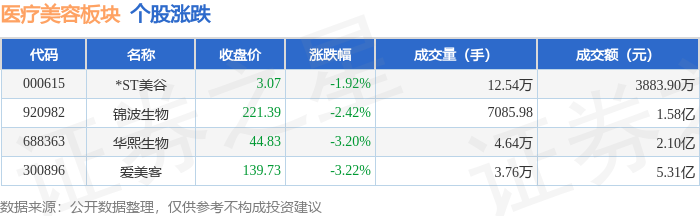
证券之星消息,1月30日医疗美容板块较上一交易日下跌3.14%,爱美客领跌。当日上证指数报收于 4117.95,下跌0.96%。深证成指报收于14205.89,下跌0.66%。医疗美容板块个股涨跌见下表: | 代码 | 名称 | 收盘价 | 涨跌幅 | 成交量(手) | 成交额(元) | | --- | --- | --- | --- | --- | --- | | 000615 | *ST美谷 | 3.07 | -1.92% | 12.54万 | 3883.90万 | | 920982 | 锦波生物 | 221.39 | -2.42% | 7085.98 | 1.58亿 | | 688363 | 华熙生物 | 44.83 | -3.20% | 4.64万 | 2.10亿 | | 300896 | 爱美客 | 139.73 | -3.22% | 3.76万 | 5.31亿 | 从资金流向上来看,当日医疗美容板块主力资金净流出7658.45万元,游资资金净流入4438.38万元,散户 资金净流入3220.06万元。医疗美容板块个股资金流向见下表: | 代码 | | | | 名称 |主力净流入(元)|主力净占比| ...


整个社会都在喊没钱了,为什么这些公司反而年赚百亿?
创业家· 2026-01-29 10:34
Core Viewpoint - The article emphasizes that despite the prevailing narrative of economic hardship, certain industries are thriving and generating significant profits, particularly in the context of Japan's "lost 30 years" and the evolving consumer behavior in China [3][4]. Group 1: Economic Shifts and Opportunities - The concept of a "low-desire society" does not equate to a lack of opportunities, as consumer demand is shifting towards different sectors [4]. - The article identifies eight key industries that are capitalizing on changing consumer preferences, highlighting that demand migration presents substantial business opportunities [5]. Group 2: Key Industries and Trends - **Second-Hand Economy**: The second-hand luxury market in Japan, exemplified by companies like Daikokuya, has seen a significant revenue increase. In China, platforms like Hongbulin and Panghu are experiencing similar growth [6][7]. - **Pet Economy**: With declining birth rates, spending on pets is rising, as seen with brands like Inaba in Japan and Guobao in China, indicating a robust market for pet products and services [12][13][14]. - **Adult Care**: The adult diaper market in Japan has surpassed $10 billion, showcasing the potential of the aging population as a lucrative economic segment [17][18]. - **Health Food and Beverages**: The rise in health consciousness has led to increased demand for products like sugar-free tea and functional beverages in both Japan and China [21]. - **Beauty and Aesthetics**: The beauty industry continues to thrive, with products like collagen supplements and home beauty devices gaining popularity, indicating a strong consumer focus on personal care [23][24][26]. - **Outdoor Recreation**: Companies in the outdoor equipment sector, such as Snow Peak in Japan, are profiting from the growing interest in outdoor activities, reflecting a shift in consumer spending priorities [29][31]. - **Convenience Economy**: The demand for convenience products, such as frozen foods and smart home appliances, is increasing as younger generations seek to save time in their daily routines [39][40]. - **Leisure and Experience Economy**: Consumers are willing to spend on experiences and small pleasures, indicating a dual trend of frugality and indulgence in spending [36][44].

医疗美容板块1月29日涨2.96%,爱美客领涨,主力资金净流入1.05亿元
Zheng Xing Xing Ye Ri Bao· 2026-01-29 09:00
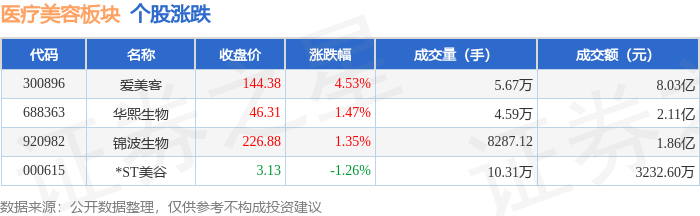
Core Insights - The medical beauty sector experienced a rise of 2.96% on January 29, with Ai Meike leading the gains [1] - The Shanghai Composite Index closed at 4157.98, up 0.16%, while the Shenzhen Component Index closed at 14300.08, down 0.3% [1] Medical Beauty Sector Performance - Ai Meike (300896) closed at 144.38, with a gain of 4.53%, trading volume of 56,700 shares, and a transaction value of 803 million [1] - Huaxi Biological (688363) closed at 46.31, up 1.47%, with a trading volume of 45,900 shares and a transaction value of 211 million [1] - Jinbo Biological (920982) closed at 226.88, up 1.35%, with a trading volume of 8,287 shares and a transaction value of 1.86 billion [1] - ST Meigu (000615) closed at 3.13, down 1.26%, with a trading volume of 103,100 shares and a transaction value of 32.32 million [1] Capital Flow Analysis - The medical beauty sector saw a net inflow of 105 million from main funds, while retail investors experienced a net outflow of 33.44 million [1] - Ai Meike had a main fund net inflow of 103 million, representing 12.77%, with retail outflows of 38.71 million [2] - Huaxi Biological had a main fund net inflow of 10.25 million, representing 4.86%, with retail outflows of 1.15 million [2] - Jinbo Biological had a main fund net inflow of 9.45 million, representing 5.09%, with retail inflows of 1.25 million [2] - ST Meigu had a main fund net outflow of 7.90 million, representing -24.43%, with retail inflows of 4.02 million [2]


经济越来越差,这八大行业越赚爆!
创业家· 2026-01-28 10:09
Core Insights - The article discusses how certain industries are thriving despite a general perception of economic downturn, highlighting eight key sectors that present significant business opportunities in a low-desire society [3][4]. Group 1: Key Industries - **Second-Hand Economy**: The second-hand luxury market in Japan, represented by companies like Daikokuya, has seen a surge in revenue. In China, platforms like Hongbulin and Panghu are experiencing similar growth, indicating a shift in consumer spending towards second-hand goods [6][7][8][9]. - **Pet Economy**: With declining birth rates, young people are spending more on pets, leading to a boom in pet food and healthcare products. Companies like Inaba in Japan and Guobao in China are capitalizing on this trend [11][12][14][15]. - **Adult Care Products**: The adult diaper market in Japan has surpassed $10 billion, indicating a growing demand for adult care products in China, with companies like Kexin poised for growth [16][17][18]. - **Health Food and Beverages**: The rise in health consciousness has led to increased sales of sugar-free beverages and functional drinks in both Japan and China, with brands like Suntory and Dongpeng gaining traction [21][22]. - **Beauty Economy**: The demand for beauty products, including collagen supplements and at-home beauty devices, is on the rise, with companies like Jinbo Bio and U like seeing significant sales growth [23][25]. - **Outdoor Recreation**: The outdoor equipment market is thriving, with brands like Snow Peak in Japan and various Chinese brands experiencing rapid sales growth, as consumers seek leisure activities despite economic constraints [25][26][27]. - **Emotional Economy**: Brands like Labubu and Rio are tapping into the emotional needs of consumers, offering products that provide comfort and joy, even in a frugal spending environment [28][29][30]. - **Lazy Economy**: The trend towards convenience has led to increased sales of frozen foods and smart home appliances, with companies like Anjijia and Kewos leveraging technology to save consumers time [33][35][36]. Group 2: Market Trends - The article emphasizes that the current economic climate, often described as a "cold winter," presents unique opportunities for those willing to invest in counter-cyclical sectors [39]. - It suggests that the key to success in this low-desire era is recognizing and seizing opportunities in these emerging markets, rather than succumbing to pessimism [39].

医疗美容板块1月28日跌1.57%,锦波生物领跌,主力资金净流出4981.38万元
Zheng Xing Xing Ye Ri Bao· 2026-01-28 09:04
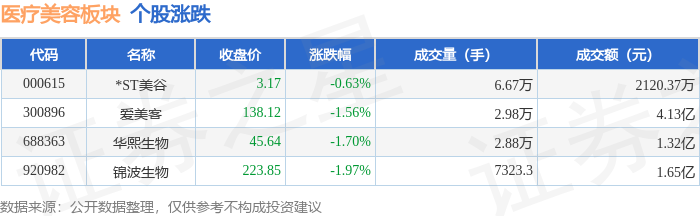
Market Overview - The medical beauty sector experienced a decline of 1.57% on January 28, with Jinbo Biological leading the drop [1] - The Shanghai Composite Index closed at 4151.24, up 0.27%, while the Shenzhen Component Index closed at 14342.9, up 0.09% [1] Stock Performance - Key stocks in the medical beauty sector showed the following performance: - *ST Meigu closed at 3.17, down 0.63% with a trading volume of 66,700 shares and a turnover of 21.20 million yuan [1] - Aimeike closed at 138.12, down 1.56% with a trading volume of 29,800 shares and a turnover of 413 million yuan [1] - Huaxi Biological closed at 45.64, down 1.70% with a trading volume of 28,800 shares and a turnover of 13.20 million yuan [1] - Jinbo Biological closed at 223.85, down 1.97% with a trading volume of 7,323 shares and a turnover of 165 million yuan [1] Capital Flow - The medical beauty sector saw a net outflow of 49.81 million yuan from main funds, while retail investors had a net inflow of 55.20 million yuan [1] - Detailed capital flow for key stocks includes: - *ST Meigu: Main funds net outflow of 1.98 million yuan, retail net inflow of 1.61 million yuan [2] - Huaxi Biological: Main funds net outflow of 9.06 million yuan, retail net inflow of 3.16 million yuan [2] - Jinbo Biological: Main funds net outflow of 25.03 million yuan, retail net inflow of 0.38 million yuan [2] - Aimeike: Main funds net outflow of 38.77 million yuan, retail net inflow of 50.43 million yuan [2]
朗姿股份董事长申东日入选“2025年度医疗美容业十大杰出人物”
Sou Hu Cai Jing· 2026-01-28 06:24
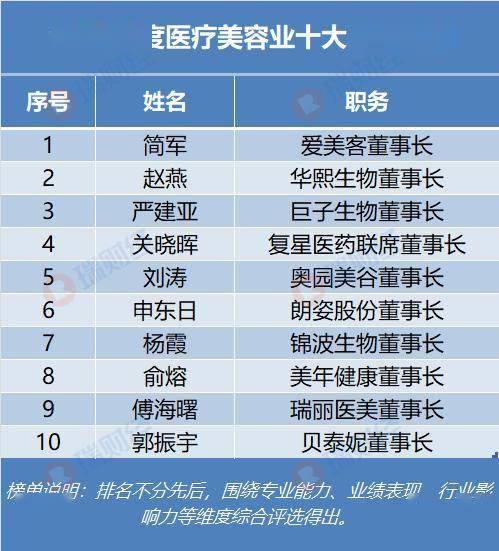
Group 1 - The core viewpoint of the article highlights the announcement of the "Top Ten Outstanding Figures in the Medical Aesthetic Industry for 2025," with Shen Dongri, the chairman of Langzi Co., being recognized for his contributions [2]. - The selection criteria for the "Top Ten Outstanding Figures" include professional ability, performance, and industry influence [2]. - Shen Dongri, born in October 1972, is a co-founder and actual controller of the company, holding multiple leadership positions within the Langzi Group [3]. Group 2 - Under Shen Dongri's leadership, the group is expected to achieve explosive growth in net profit in 2025, with continuous expansion in the medical aesthetic business [3]. - The overall business of the group is projected to achieve stable growth through diversified layout strategies [3].

奥园美谷董事长刘涛入选“2025年度医疗美容业十大杰出人物”
Sou Hu Cai Jing· 2026-01-28 06:19
刘涛,1974 年生,东北财经大学会计系,本科,中国注册资产评估师、注册税务师。现任中国安泰控 股有限公司董事、副董事长,深圳市汇财城市更新有限公司董事;国测(苏州)智慧城市科技产业园有 限公司董事、辽宁国测黄金股份有限公司董事、辽宁仙子湖农业高新技术产业有限公司董事等。曾任信 达证券投资银行部高级经理、苏州国测基金管理有限公司副总裁,国测地理信息科技产业园集团有限公 司副总裁、董事局副主席。 2025年,刘涛带领集团深化布局医美产业,通过产业基金和基地建设持续孵化医美相关业务。 瑞财经 1月28日,由瑞财经推出的"2025年度医疗美容业十大杰出人物"榜单揭晓,奥园美谷董事长刘涛 入选。 "2025年度医疗美容业十大杰出人物"榜单围绕专业能力、业绩表现、行业影响力等维度综合评选得出。 | 1 15 3 | | --- | | S | | 2 | | 白菜 - - - | | 1 1 1 1 24 1 | | 序号 | 姓名 | 职务 | | --- | --- | --- | | 1 | 简军 | 爱美客董事长 | | 2 | 赵燕 | 华熙生物董事长 | | 3 | 严建亚 | 巨子生物董事长 | | 4 ...