
博通

Search documents
通信行业:博通ASIC预期再上调,深圳光博会预热
Shanxi Securities· 2025-09-12 07:27
Investment Rating - The report maintains an "Outperform" rating for the communication industry, indicating expected growth exceeding the benchmark index by over 10% [1][46]. Core Insights - Broadcom's latest financial report shows continued high growth in AI business, with new ASIC customer orders reaching 10 billion USD. The company reported Q3 2025 revenue of 15.95 billion USD, a 22% year-on-year increase, and a non-GAAP EPS of 1.69 USD, up 36.3% year-on-year, exceeding analyst expectations. The forecast for Q4 revenue is approximately 17.4 billion USD, indicating nearly double-digit sequential growth. AI revenue has seen a 63% year-on-year increase, reaching 5.2 billion USD, with expectations to rise to 6.2 billion USD next quarter. Broadcom anticipates ASIC demand to reach 60 to 90 billion USD by FY2027, suggesting potential for annual doubling of AI business growth if it captures a significant market share [3][15][41]. - The upcoming Shenzhen Optical Expo (CIOE2025) on September 10 is expected to boost the optical module sector. Key areas of focus include the introduction of 3.2T optical modules, TFLN thin-film lithium niobate chips, silicon photonic chips, CPO high-density optical connection products, and hollow-core fiber products. These innovations are anticipated to enhance the capabilities and offerings within the optical communication industry [4][16]. Summary by Sections Weekly Viewpoint and Investment Suggestions - Broadcom's strong AI financial results alleviate concerns regarding investment slowdowns among North American cloud providers, indicating a potential resonance between GPU and ASIC markets in 2026-2027 [15][17]. - The report suggests focusing on companies in various sectors, including domestic computing servers (ZTE, Unisoc, Huaqin Technology), optical modules (Zhongji Xuchuang, NewEase, Tianfu Communication), and satellite internet (Chengchang Technology, Zhenlei Technology) [18]. Market Overview - The overall market performance for the week of September 1-7, 2025, showed mixed results, with the ChiNext Index rising by 2.35%, while the Shanghai Composite Index fell by 1.18%. The communication index dropped by 2.68%, with the optical module sector leading gains at +8.4% [6][17]. Sector Performance - The optical module sector is highlighted as having a strong upward trend, with major companies showing a safety margin in performance post-adjustment. The report indicates that upstream related stocks have been undervalued and warrant investor attention [6][17].
甲骨文燃起AI交易热情,中国AI硬件股也重拾动能
Di Yi Cai Jing· 2025-09-12 07:13
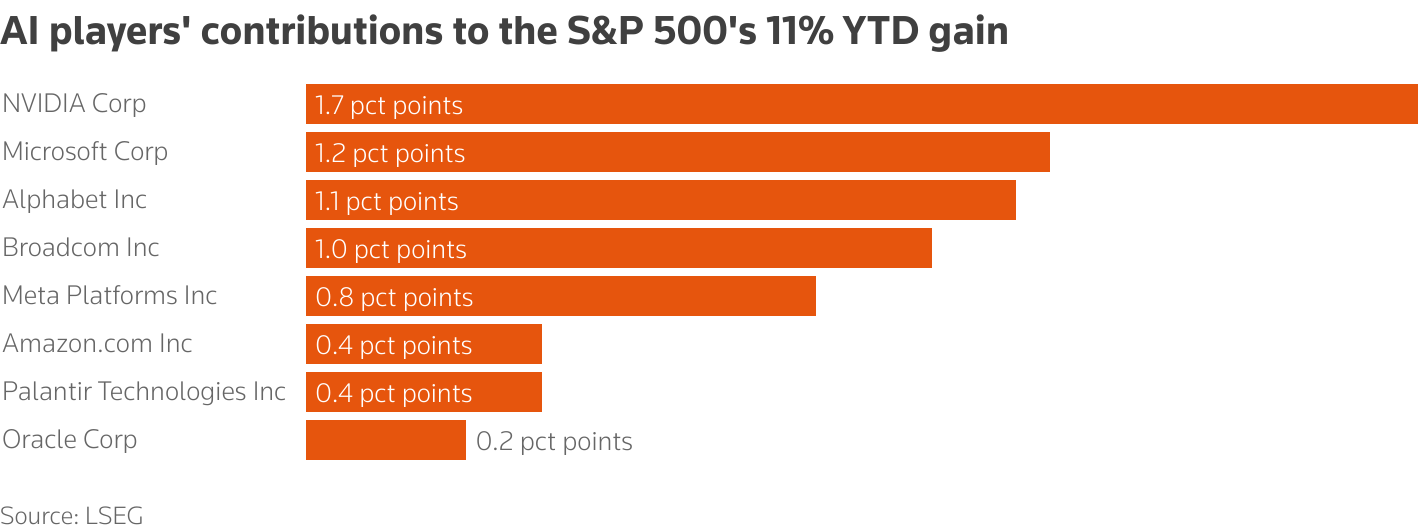
美股市值前八大的AI概念股已占据标普500指数权重的30%,并贡献了该指数今年涨幅的约一半。 软件巨头甲骨文本周股价大涨令投资者对人工智能(AI)交易的乐观情绪重燃,甲骨文斩获多份巨额合同向投资者证明了AI驱动的云计算需求依然高涨, 缓解了AI概念股估值过高的担忧。 由于苹果和特斯拉股价下跌,传统的"美股科技七巨头"今年整体录得下跌。而截至周三,美股市值前八大的AI概念股已占据标普500指数权重的30%,并贡 献了该指数今年涨幅的约一半。同样得益于这种AI交易情绪重燃,中国AI硬件股也重拾动能,继续被看好。 AI交易热情重燃 甲骨文(ORCL.N)周三股价一度上涨36%,使其市值达到9220亿美元,向万亿美元市值俱乐部进军,周四收跌6.23%,但分析师普遍预计其股价调整后仍 将上涨。 Stock Trader Network的首席策略师迪克(Dennis Dick)表示:"在创纪录飙升后,买家略微疲惫,但逢低买入的投资者会重新出现。甲骨文的前瞻指引是如 此令人难以置信,很难想象围绕于此的交易故事已经结束。"根据伦敦证交所(LSEG)的数据,分析师对该股的目标价中位数为342美元,较目前股价仍有 约10%的上涨 ...

日本芯片股“新王”诞生
Hua Er Jie Jian Wen· 2025-09-12 04:19
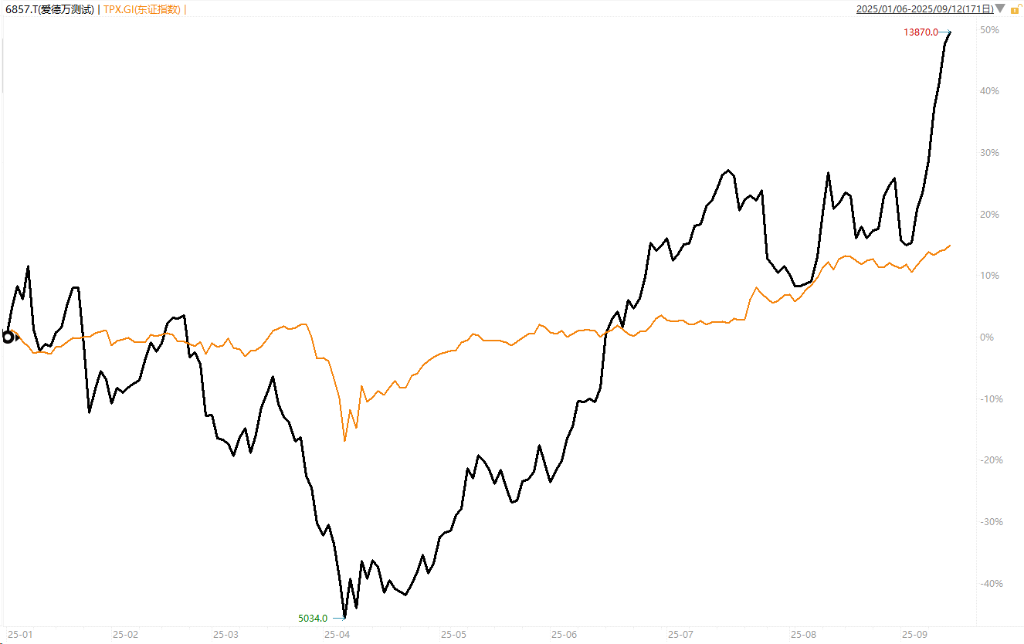
Core Viewpoint - Advantest, a Japanese semiconductor testing equipment manufacturer, has seen its market capitalization exceed 10 trillion yen (approximately 68 billion USD) for the first time, becoming the largest company in the semiconductor-related sector in Japan, driven by strong profit growth expectations fueled by AI demand [1]. Group 1: Market Performance - Advantest's stock price closed at 13,125 yen on September 10, marking a significant milestone as its market value surpassed 10 trillion yen for the first time since 2006, outpacing Tokyo Electron [1]. - The stock has risen over 50% this year, significantly outperforming the Tokyo Stock Exchange index [2]. Group 2: Financial Flows and Returns - Strong capital inflows have provided solid support for Advantest's stock price, with a net inflow of 17.34 billion yen recorded on September 11, making it one of the highest net bought stocks [3]. - Over the past five years, Advantest's total return has reached 967.12%, reflecting long-term investor confidence in its market strategy, with a recent quarterly stock price surge of 58%, far exceeding the semiconductor industry's 13.3% return [3]. Group 3: Technological Innovation - Advantest's recent launch of the next-generation CD-SEM E3660 aims to meet the stringent requirements of 2-nanometer advanced node semiconductor manufacturing, reinforcing its position in the measurement sector [4]. - The company's stock buyback plan, set to be completed by mid-2025, has further boosted investor confidence [4]. Group 4: Valuation and Future Outlook - Despite the positive market sentiment, Advantest faces challenges related to high valuation, with its stock trading above the consensus target price of 11,562.11 yen [5]. - Analysts predict a revenue growth rate of 5.2% and an earnings growth rate of 6.9%, indicating moderate growth expectations [5].
中州国际证券:港股晨報
CENTRAL CHINA INTERNATIONAL SECURITIES· 2025-09-12 02:46
Core Insights - The report highlights the performance of the Hong Kong stock market, with the Hang Seng Index at 26,086 points, reflecting a year-to-date increase of 30.0% despite a daily decline of 0.4% [3] - The report discusses the impact of macroeconomic factors, including the recent interest rate adjustments by the People's Bank of China and ongoing trade tensions between China and the U.S., which are expected to influence market conditions in the short to medium term [10][11] - The report provides a detailed analysis of the performance of individual stocks within the Hang Seng Index, noting significant gains for companies like SMIC and China Hongqiao, while highlighting losses for companies such as Hansoh Pharmaceutical [4][25] Market Overview - The Hang Seng Index has seen a trading volume of HKD 3,252.1 billion, with a price-to-earnings (PE) ratio of 11.9 and a price-to-book (PB) ratio of 1.22 [5] - The report notes that the H-share index and technology index also experienced declines, with the H-share index at 9,260 points, down 0.7% for the day and up 27.0% year-to-date [3][11] - The report indicates that the A-share market has shown positive performance, with the Shanghai Composite Index rising to 3,875 points, an increase of 1.7% [13] Company Performance - Galaxy Entertainment reported a year-on-year revenue increase of 8.3% to HKD 23.25 billion, with adjusted EBITDA rising 14.2% to HKD 6.87 billion, and a net profit increase of 19.4% to HKD 5.24 billion [25][26] - The report details the revenue breakdown for Galaxy Entertainment, noting a 10.7% increase in gaming operations revenue, while hotel and shopping center revenues grew by 2.5% [25] - The company's total assets are approximately HKD 94.8 billion, with total liabilities decreasing by 18.9% to HKD 14.7 billion, indicating a strong balance sheet [26] New Stock Dynamics - The report outlines upcoming IPOs, including Health 160 and Jinfang Pharmaceutical-B, with expected market interest due to their moderate fundraising sizes and potential for high demand [30][31] - The report provides insights into the pricing and expected market performance of these new listings, suggesting a favorable environment for new stock offerings [31]
巨额订单风险重重?质疑声四起,甲骨文股价从历史高点回调逾6%
Feng Huang Wang· 2025-09-12 02:44
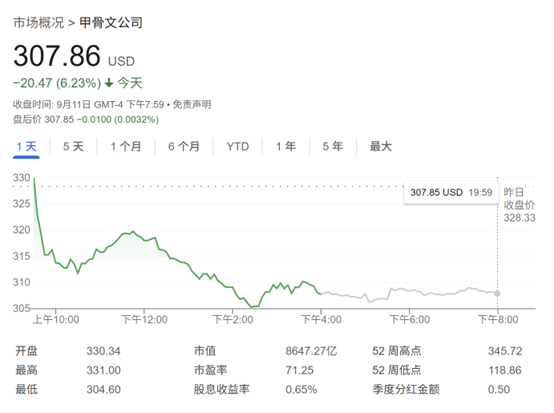
Core Insights - Oracle's stock price fell over 6% after reaching a record high, with analysts raising concerns about the company's reliance on a single client, OpenAI, for future growth [1][3] - Oracle reported a significant increase in remaining performance obligations (RPO) to $455 billion, a 359% year-over-year growth, with $317 billion added in the first quarter alone [1][2] - The company anticipates cloud infrastructure revenue to grow 14 times by 2030, driven by its competitive position in the AI computing market [1] Financial Performance - Oracle's first-quarter earnings report revealed a surge in future contract revenue, with a notable contract with OpenAI valued at $300 billion over five years, starting in 2027 [2][3] - The recent quarterly report indicated that nearly 95% of the new future contract revenue was attributed to the OpenAI deal [2] Market Reaction - Following the earnings announcement, Oracle's stock rose by 30% in after-hours trading and nearly 36% the following day, reaching a closing price of $328.33 [1] - However, after the concerns regarding customer concentration emerged, Oracle's stock price dropped to $307.86, a decrease of 6.23% [3][4] Analyst Concerns - Analysts expressed skepticism about Oracle's order backlog, highlighting risks related to customer concentration and the potential delay in revenue recognition [3] - Morgan Stanley estimated that only about 10% of the $455 billion RPO would be recognized as revenue within the next 12 months, raising questions about the sustainability of Oracle's growth [3]
报道称阿里、百度使用自研芯片训练AI模型 阿里巴巴高开近6% 百度高开近4%
Zhi Tong Cai Jing· 2025-09-12 01:36
Core Viewpoint - Alibaba and Baidu have begun using internally designed chips to train their AI models, replacing some NVIDIA chips, indicating a shift towards self-sufficiency in AI infrastructure [1] Group 1: Company Developments - Alibaba's stock rose by 5.86% to HKD 151.7, while Baidu's stock increased by 3.76% to HKD 110.5 [1] - Alibaba has been applying its self-developed chips for lightweight AI model training since the beginning of this year [1] - Baidu is experimenting with its Kunlun P800 chip to train the new version of its Wenxin AI model [1] Group 2: Industry Trends - The trend of self-developed AI chips is emerging, as evidenced by OpenAI's collaboration with Broadcom to design its first self-developed AI chip [1] - Google is accelerating its self-developed TPU to compete directly with NVIDIA in third-party data centers [1] - According to招商证券, the shift towards self-developed AI chips signifies a transition in the AI infrastructure industry from a "single GPU supply constraint" to "diversified custom chip solutions," altering the investment logic from hardware monopoly to ecosystem competition [1]


港股异动 | 报道称阿里、百度使用自研芯片训练AI模型 阿里巴巴(09988)高开近6% 百度(09888)高开近4%
Zhi Tong Cai Jing· 2025-09-12 01:36
Core Viewpoint - Alibaba and Baidu have begun using internally designed chips to train their AI models, replacing some NVIDIA chips, which has led to significant stock price increases for both companies [1][1][1] Group 1: Company Developments - Alibaba's stock rose by 5.86% to HKD 151.7, while Baidu's stock increased by 3.76% to HKD 110.5 following the news [1][1][1] - Since the beginning of this year, Alibaba has been applying its self-developed chips for training lightweight AI models [1][1][1] - Baidu is experimenting with its Kunlun P800 chip to train the new version of its Wenxin AI model [1][1][1] Group 2: Industry Trends - The trend of self-developed AI chips is emerging, indicating a shift in the AI infrastructure industry from a "single GPU supply constraint" to "diversified custom chip solutions" [1][1][1] - This shift in investment logic is moving from hardware monopoly to ecological competition [1][1][1] - OpenAI has announced a partnership with Broadcom to design its first self-developed AI chip, while Google is accelerating its self-developed TPU into third-party data centers to compete directly with NVIDIA [1][1][1]
芯原股份(688521):披露订单创新高 收购芯来智融复牌在即
Xin Lang Cai Jing· 2025-09-12 00:37
Group 1 - The company reported a record high order backlog of 30.25 billion yuan as of the end of Q2 2025, maintaining high levels for seven consecutive quarters [1] - New orders signed from July 1 to September 11, 2025, amounted to 12.05 billion yuan, representing a significant year-on-year increase of 85.88%, with AI computing-related orders accounting for approximately 64% [1] - The company plans to acquire 97.0070% of Chipwise Technology through a combination of share issuance and cash payment, with the share price set at 106.66 yuan per share [1] Group 2 - The acquisition of Chipwise Technology is expected to create threefold synergy: business, customer, and cost [2] - Business synergy will enhance the company's competitive advantage in AI ASIC design services, as Chipwise is one of the first RISC-V CPU IP providers in China [2] - Customer synergy will strengthen the company's positioning in high-growth areas such as AI, IoT, and automotive electronics, leveraging Chipwise's existing client base [2] - Cost synergy will be achieved through the integration of resources, reducing R&D and operational costs [2] Group 3 - The company is projected to achieve revenues of 30 billion, 38 billion, and 47 billion yuan from 2025 to 2027, with expected net profits of -1.0 billion, 2.0 billion, and 4.2 billion yuan respectively [2] - The current valuation premium is attributed to the company's status as a leading ASIC provider in China, with significant advantages in technology accumulation, customer resources, and product deployment [2]

AI算力下半场,具备预期差的方向梳理
Ge Long Hui A P P· 2025-09-12 00:18
Core Insights - The rise of ASIC chip manufacturers, exemplified by Broadcom, is reshaping the technology investment landscape, with ASICs transitioning from a supporting role to a leading position in the market [1] Market Overview - The global ASIC chip market is projected to reach approximately $12 billion in 2024, with expectations to exceed $30 billion by 2027, reflecting a compound annual growth rate (CAGR) of 34% from 2024 to 2027 [1] Company Performance - Broadcom reported a 63% year-over-year increase in AI chip revenue in Q3, driven by a significant $10 billion custom AI chip (XPU) order from a fourth major client [3] - The demand for ASICs is being fueled by cloud service providers (CSPs) favoring ASICs over traditional GPUs due to performance and cost advantages [3] Technological Advancements - ASICs are designed for specific tasks, offering superior efficiency compared to general-purpose GPUs, which are likened to multi-functional tools [4] - Recent innovations have reduced the design cycle for ASICs from 18-24 months to 6-12 months, cutting costs by over 60% [4] Competitive Landscape - Major players in the ASIC design space include IDM giants like Broadcom, cloud companies like Amazon and Google, and specialized design firms such as Cambricon and Rockchip [6] - Broadcom holds a 60% market share in data center interconnect scenarios with its XPU products [6] Manufacturing and Supply Chain - Domestic manufacturers are leveraging advanced manufacturing and packaging technologies to meet ASIC production demands, with companies like SMIC and Changdian Technology playing key roles [7] Supporting Industries - The high power consumption of ASICs has led to increased demand for cooling solutions and optical interconnects, with companies like Invec and Taicheng providing innovative products [8] Investment Opportunities - Investors are advised to focus on companies with visible long-term orders, strong technological barriers, and flexible supply chains in the ASIC ecosystem [9] - The shift towards ASICs represents a significant investment opportunity as the technology landscape evolves, similar to the transition from feature phones to smartphones [9]

东吴证券-芯原股份-688521-披露订单创新高!收购芯来智融复牌在即-250911
Xin Lang Cai Jing· 2025-09-11 15:57
Group 1 - The company reported a record high order backlog of 30.25 billion yuan as of Q2 2025, maintaining high levels for seven consecutive quarters [1] - New orders signed from July 1 to September 11, 2025, amounted to 12.05 billion yuan, representing a significant year-on-year increase of 85.88%, with AI computing-related orders accounting for approximately 64% [1] - The company plans to acquire 97% of Xinlai Zhihong through a combination of share issuance and cash payment, with the share price set at 106.66 yuan per share, not lower than 80% of the average trading price over the previous 20 trading days [1] Group 2 - Xinlai Zhihong, established in 2018, is one of the first domestic RISC-V CPU IP providers, and the acquisition will enhance the company's strategic layout in heterogeneous computing platforms and strengthen its competitive advantage in AI ASIC design services [2] - The target company has a wide range of downstream applications, including partnerships with China Mobile and other tech firms, which will help the company enhance its presence in high-growth areas such as AI, IoT, and automotive electronics [2] - Post-acquisition, the company aims to achieve cost synergies by standardizing integration and sharing resources like wafer fabs and EDA tools, thereby reducing R&D and operational costs [2] Group 3 - The company is expected to achieve revenues of 30 billion, 38 billion, and 47 billion yuan from 2025 to 2027, with projected net profits of -1.0 billion, 2.0 billion, and 4.2 billion yuan respectively [2] - The current valuation premium is attributed to the company's status as a top ASIC provider in China, with significant advantages in technology accumulation, customer resources, and product implementation [2]
