石头科技

Search documents
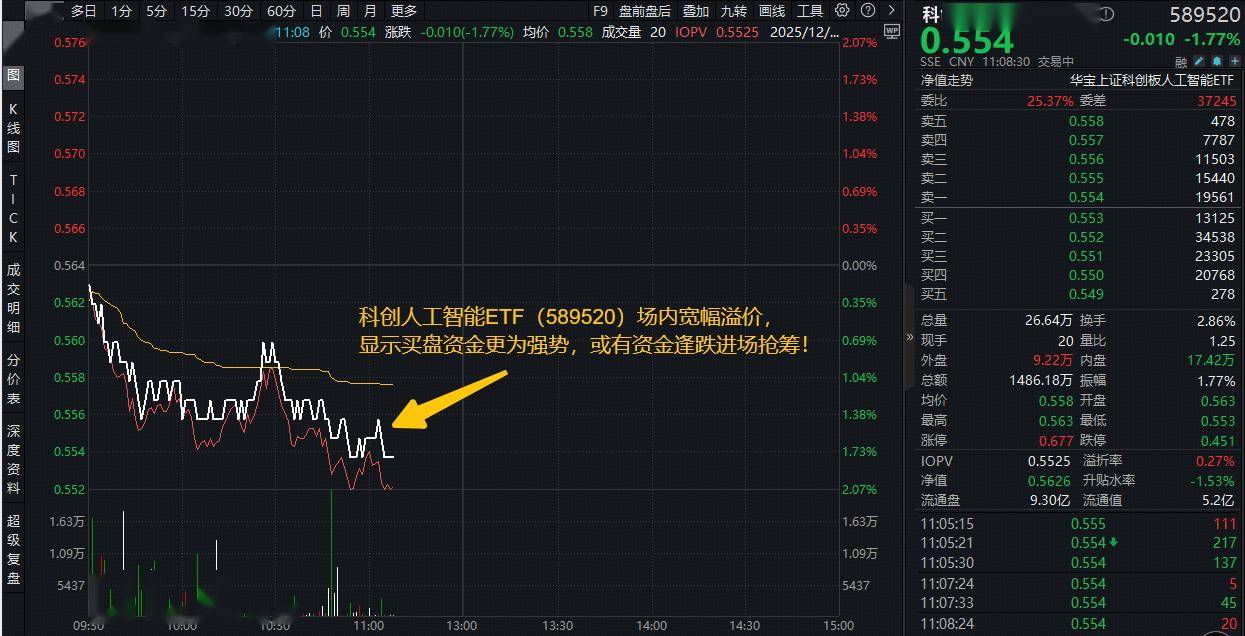
ETF盘中资讯|寒王大动作!资本公积金弥补亏损!如何解读?科创人工智能ETF(589520)宽幅溢价,资金积极进场!
Sou Hu Cai Jing· 2025-12-16 03:29
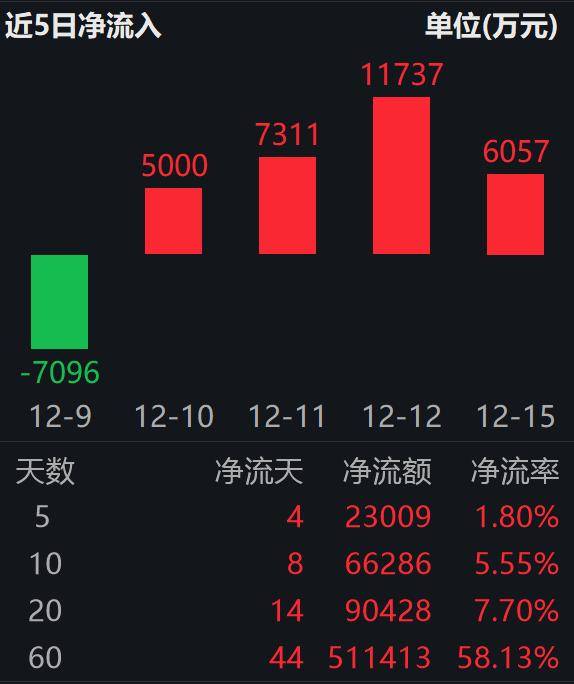
Group 1 - The core point of the news is that AI chip manufacturer Cambricon plans to use 2.778 billion yuan from its capital reserve to offset accumulated losses, which will improve its financial condition by turning its retained earnings from negative to positive by the end of 2024 [1] - Market analysts indicate that the capital reserve adjustment is an internal accounting measure that does not affect the company's net assets or cash flow, thus posing no operational risks [1] - Cambricon has shown strong performance, with significant revenue and net profit growth expected in the first three quarters of 2025, driven by the substantial release of cloud products like the Siyuan 590 [1] Group 2 - The AI industry is shifting focus from hardware and infrastructure ("selling shovels") to practical applications and commercialization ("mining for gold"), indicating a growing potential in AI applications [2] - The Sci-Tech Innovation AI ETF (589520) is strategically positioned to invest in the AI industry chain, which is transitioning from cloud-based solutions to edge computing, emphasizing self-sufficiency in technology [2] - On December 16, the Sci-Tech Innovation AI ETF experienced a price drop of 1.77%, but it attracted significant investment, indicating strong buying interest despite market fluctuations [2] Group 3 - The importance of information and industrial security has been highlighted in the context of technological friction, with AI being a core technology for achieving self-sufficiency [4] - The Sci-Tech Innovation AI ETF and its connected funds focus on the domestic AI industry chain, with a high concentration in semiconductor stocks, indicating a strong offensive strategy [4]


寒王大动作!资本公积金弥补亏损!如何解读?科创人工智能ETF(589520)宽幅溢价,资金积极进场!
Xin Lang Cai Jing· 2025-12-16 03:27
Group 1 - The core point of the article is that AI chip manufacturer Cambricon plans to use 2.778 billion yuan from its capital reserve to offset accumulated losses, which will not affect its net assets or cash flow, and will allow for potential dividend distribution after the adjustment [1][6] - Analysts noted that the capital reserve adjustment is an internal accounting measure that increases retained earnings without actual cash flow impact, thus posing no operational risks [1][6] - Cambricon's performance has been strong, with significant revenue and net profit growth expected in the first three quarters of 2025, driven by the increased sales of its cloud products [1][6] Group 2 - The AI application sector is seen as having greater potential compared to computing power, with the investment logic shifting from hardware to actual applications and commercialization [2][7] - The Sci-Tech Innovation AI ETF (589520) is strategically positioned to capture the AI industry chain, focusing on software applications, terminal applications, and chips, indicating a shift towards domestic technology [2][7] - On December 16, the ETF experienced a price drop of 1.77%, but still showed strong buying interest, indicating potential for future investment [2][8] Group 3 - The importance of information and industrial security has been highlighted in the context of technological friction, emphasizing the need for self-reliance in core technologies like AI [4] - The ETF and its associated funds are heavily invested in the domestic AI industry, with over 70% of the top ten holdings focused on semiconductor sectors, indicating a high concentration and aggressive investment strategy [4]
家电行业2026年度投资策略:出海+红利,优选龙头
2025-12-16 03:26
Summary of Key Points from the Conference Call on the Home Appliance Industry Industry Overview - The home appliance industry is currently valued below the median level, with leading white goods companies like Gree, Midea, and Haier having valuations that have not exceeded 15 times earnings, indicating a high safety margin [1][3] - The dividend yield of the home appliance sector ranks fourth among 32 industries, with Gree at approximately 7%, Midea over 5%, and Haier exceeding 4% [1][4] Core Investment Themes for 2026 - The main investment themes for 2026 are expected to revolve around "going overseas" and "dividends," with dividends being a strategy that spans the next 2 to 5 years [1][5] - The cash dividend ratio in the home appliance industry is relatively high, placing it in the top third among 32 industries, despite its lower valuation [5] Cost Pressures and Market Dynamics - Rising copper prices have significantly impacted air conditioning costs, as copper accounts for 30% to 40% of air conditioning costs. However, the feasibility of replacing copper with aluminum is being studied to mitigate cost impacts [6] - The real estate market's influence on home appliance sales is diminishing, with the contribution of real estate to sales of washing and refrigeration products dropping to around 10% [7][8] Government Policies and Domestic Demand - The continuation of national subsidy policies is expected to support domestic demand in 2026, limiting the potential decline in demand [9] - Air conditioning is anticipated to benefit the most from these subsidy policies, while refrigerators have not shown significant benefits [9] Export Market Outlook - A turning point for exports is expected in the second quarter of 2026, driven by a recovery in overseas demand and inventory replenishment due to low stock levels [10] - The transfer of some export capacity to Southeast Asia and improvements in overseas factory profitability are contributing to this positive outlook [10] Segment Performance - The white goods segment is experiencing a slowdown in price competition, with a favorable outlook for air conditioning exports due to increased demand from emerging markets and climate changes in Europe and the U.S. [12] - The black goods segment is projected to be one of the best-performing sub-sectors by 2026, benefiting from the World Cup effect and stable panel prices [13] Recommendations for Investment - Recommended companies include Midea and Haier for white goods, as they possess dividend attributes and overseas expansion advantages [16] - For black goods, companies are heavily reliant on the U.S. market, with over 30% of their export revenue coming from there, and they are in a high dividend state [16] - In the robotic vacuum segment, companies like Ecovacs and Roborock are recommended, with a long-term growth outlook despite current pressures [17] - Attention is also drawn to leading companies in the tool chain sector, which are expected to benefit directly from the recovery in the U.S. real estate market [17]
国内外利好不断,人形机器人行业密集爆发;机器人ETF易方达(159530)连续4日“吸金”合超3亿
Sou Hu Cai Jing· 2025-12-16 02:44
相关产品: 近段时间,人形机器人行业持续迎来密集催化。特斯拉审厂行程开启,是OptimusV3人形机器人量产前 的关键验证环节;北京人形机器人创新中心发布国内首个全自主无人化人形机器人导览解决方案;松延 动力与慧辰股份就小布米(Bumi)人形机器人达成1000台订单签约;宇树科技宣布上线人形机器人 App Store,公测首批推出搞笑动作、扭扭舞、李小龙三款预设;优必选与国内领先的AI大模型公司签订人 形机器人销售合同,总金额超过0.5亿元人民币。 中信建投研报称,人形机器人方面,机器人供应链海外产能规划推进,建议聚焦优质环节。后续Gen3 定点、新品发布、宇树IPO进展等事件催化值得重点关注,底部建议聚焦优质环节,把握确定性和灵巧 手等核心变化。 国证机器人产业指数特点鲜明:1.指数人形机器人含量居首:指数中人形机器人相关公司权重显著高于 同类指数;2.指数聚焦高成长龙头:前十大权重股占比约40%,涵盖汇川技术、科大讯飞、石头科技等 细分领域龙头,技术壁垒高、市场竞争力强。 截至9:35,国证机器人产业指数(980022)跌0.68%,成分股中,科沃斯涨1.65%、奥比中光涨 1.18%、拓普集团涨1.17 ...

东吴证券晨会纪要-20251216
Soochow Securities· 2025-12-16 01:13
Macro Strategy - The report indicates that the recent Federal Reserve interest rate cut, combined with dovish signals from Powell, has led to a decline in short-term U.S. Treasury yields, despite concerns over an AI investment bubble impacting the stock market [1] - Analysts expect November's non-farm payrolls to show a weak job addition of 50,000, with a high standard deviation of 33,000, indicating significant market divergence [1] - The Consumer Price Index (CPI) is projected to rise by 3.1% year-on-year, with core CPI at 3%, maintaining an inflation center around 3% [1] Financial Products - The A-share market outlook suggests maintaining patience while waiting for stabilization in overseas markets, with a macro timing model scoring -2 for December, indicating a potential adjustment in the A-share index [2] - The report notes a significant inflow into ETFs such as A500 ETF and STAR 50 ETF, indicating some market participants are gradually entering through ETF investments [2] Industry Insights - The Central Economic Work Conference has shifted focus away from M2 and social financing scale, emphasizing stable economic growth and reasonable price recovery as key considerations for monetary policy [4] - The report highlights the importance of effective financing demand over the supply of financial resources, suggesting a continued shift in monetary policy focus for 2026 [4] Fixed Income - The report discusses the impact of recent central meetings on the bond market, suggesting that the flexibility of policies may prevent a repeat of the unilateral interest rate decline seen from 2022 to 2024 [5] - It recommends focusing on convertible bonds in sectors with significant valuation discrepancies, particularly in AI, core materials, and power distribution equipment [5] Utilities Sector - The report emphasizes the deepening of electricity reforms and the significant value of dividend configurations in the power sector, particularly in renewable energy [6] - It recommends companies like Longyuan Power and China Nuclear Power, highlighting their growth potential and dividend capabilities [6] Environmental Sector - The report outlines the Central Economic Work Conference's commitment to a comprehensive green transition and energy independence, which is expected to benefit the environmental sector [8] - It suggests that companies involved in waste resource recovery and clean energy will see growth opportunities due to market reforms and international expansion [8] Gas Industry - The report anticipates a favorable supply environment for gas companies, with cost optimization and demand growth expected in 2025 [9] - It highlights companies like Xinao Energy and China Gas, which are positioned to benefit from ongoing market adjustments [9] Construction Materials - The report notes a potential shift towards high-yield assets during a period of market volatility, recommending companies like Rabbit Baby and Upwind Cement [10] - It emphasizes the importance of domestic and international market dynamics in shaping the construction materials sector [10] Retail Sector - The report discusses the Ministry of Commerce's plans for high-quality development in the retail sector, focusing on opportunities in quality retail transformation [12] - It recommends leading supermarket chains and retail brands that demonstrate strong adaptation capabilities [12] Automotive Sector - The report highlights the regulatory environment for automotive pricing and the ongoing investment opportunities in AI and smart vehicles [13] - It identifies key players in the automotive sector, including Tesla and Xiaopeng Motors, as potential beneficiaries of technological advancements [13] Power Equipment Sector - The report indicates a robust demand for energy storage solutions, projecting a growth rate of over 60% in the coming years [15] - It recommends leading companies in the energy storage and battery sectors, such as CATL and BYD, as key investment opportunities [15] Lithium Battery Industry - The report forecasts a 32% growth in lithium battery demand in 2026, driven by strong market fundamentals and supply-demand dynamics [26] - It highlights leading companies in the lithium battery supply chain, including CATL and Yahua, as attractive investment targets [26] Wind Power Sector - The report anticipates significant growth in offshore wind installations, with a focus on companies like Goldwind and Mingyang Smart Energy [28] - It emphasizes the potential for increased market activity and pricing power in the wind power sector as demand rises [28] Commercial Aerospace - The report discusses the rapid development of the commercial aerospace sector, particularly in reusable rocket technology and satellite launches [22] - It identifies key players in the aerospace supply chain, such as Superjet and Srey New Materials, as beneficiaries of this growth [22]
曾占据全球80%市场!扫地机器人鼻祖iRobot要破产了,背后中国公司强势崛起,包揽全球前五强,市值领先100多倍
Sou Hu Cai Jing· 2025-12-16 01:12
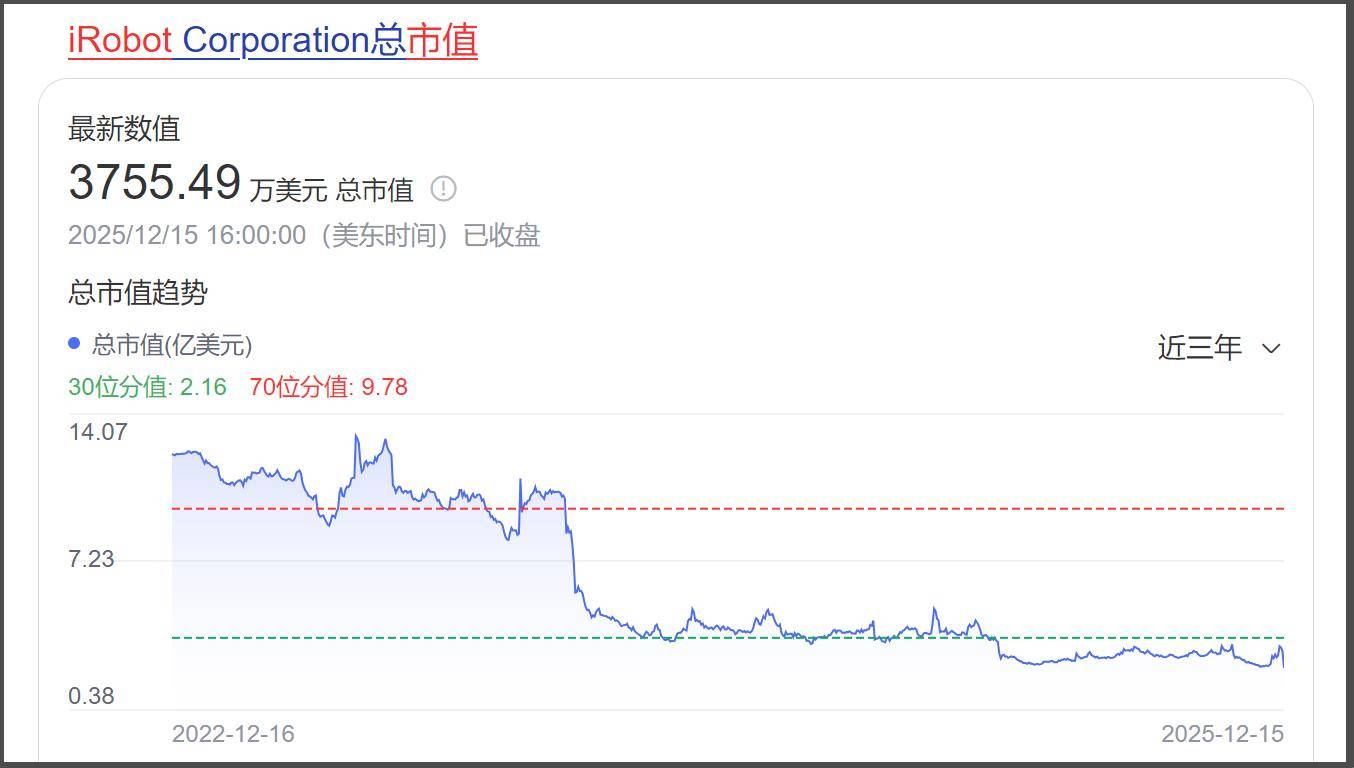
Core Viewpoint - iRobot has filed for Chapter 11 bankruptcy protection due to severe financial distress, losing its dominant market position and facing significant debt obligations [1][2]. Financial Situation - iRobot's liquidity crisis is evident, with cash and equivalents at only $24.8 million against total liabilities of $508 million, resulting in a negative equity of $26.8 million [2]. - For the first three quarters of 2025, iRobot reported revenues of $375 million, a decline of 26.47% year-over-year, and a net loss that surged 90% to $130 million [2]. - In Q3 alone, revenue was $145.8 million, down 24.6% from the previous year, shifting from a profit of $15.1 million to a loss of $9.9 million [2]. Market Position and Competition - iRobot, once holding over 80% of the global market share, has seen its share plummet to 7.9%, being pushed out of the top five rankings by Chinese competitors [3]. - Chinese brands have rapidly advanced in technology, with companies like Roborock and Ecovacs leading the market, capturing significant shares of 21.7% and 14.1% respectively [3]. - iRobot's pricing strategy has also hindered its competitiveness, with flagship products priced over $1,000, three times higher than similar Chinese products [3]. Company Valuation and Acquisition Attempts - iRobot's market capitalization has dwindled to $37.55 million, approximately 2.65 billion RMB, significantly lower than its Chinese counterparts, which are valued over 100 times more [6]. - An attempted acquisition by Amazon at $1.7 billion in 2022 failed due to regulatory scrutiny, leading to significant layoffs and the resignation of the CEO [4].
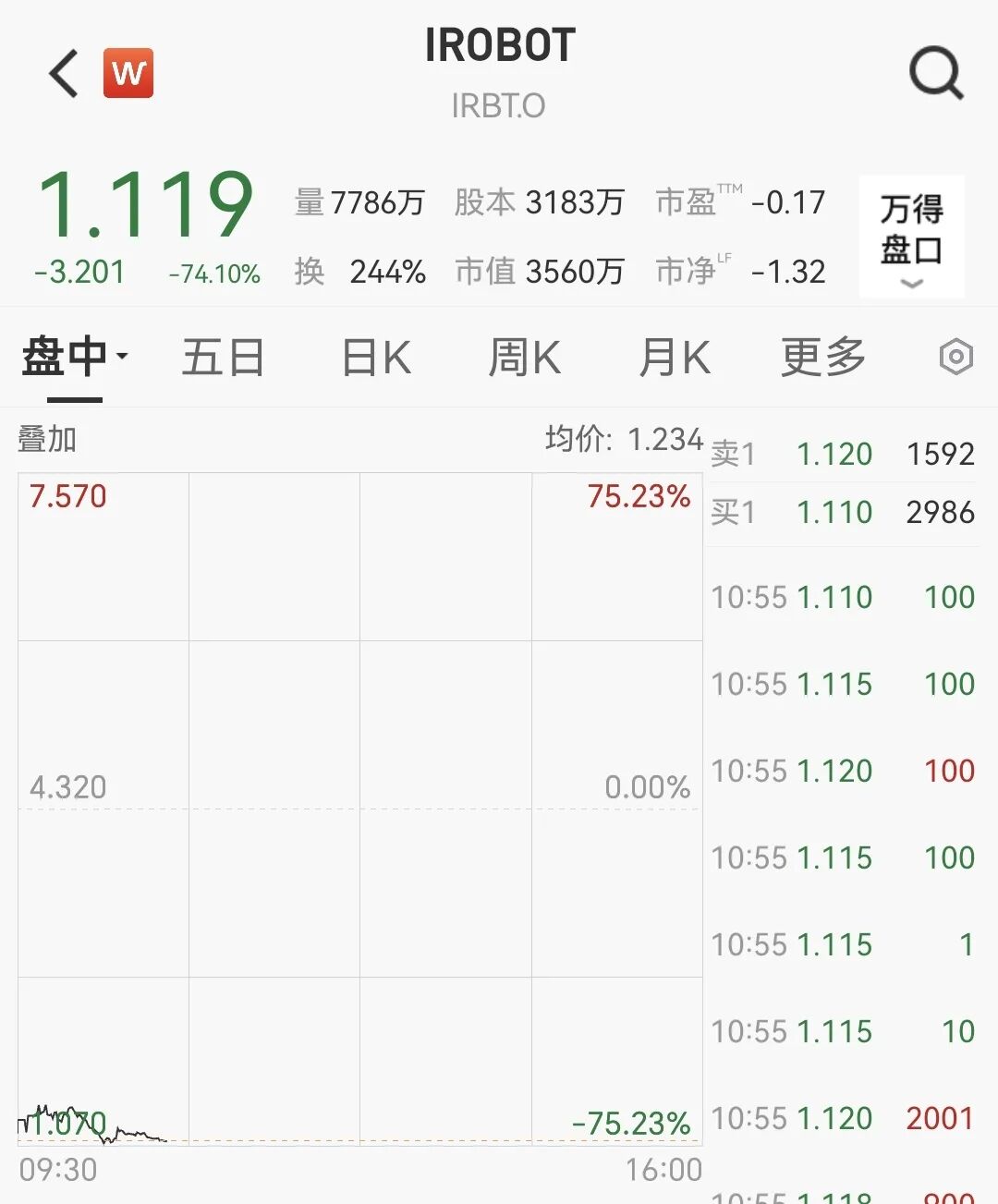
熔断!暴跌72% 扫地机器人鼻祖破产!中资或接盘
Xin Lang Cai Jing· 2025-12-16 00:47
Core Viewpoint - iRobot, the pioneer of robotic vacuum cleaners, has filed for bankruptcy protection in the U.S. due to declining sales, increased competition, and rising operational costs from new tariffs [1][10]. Company Overview - iRobot was founded in 1990 by MIT professors Rodney Brooks, Colin Angle, and Helen Greiner, and launched the first Roomba vacuum in 2002 [11]. - The company went public in 2005 and saw its stock peak at $197.4 in 2021, with a market cap exceeding $6 billion. However, its stock price fell to $4.3, resulting in a market cap of $140 million by the previous week [3][11]. Financial Performance - iRobot's revenue has been on a decline, dropping from $1.183 billion in 2022 to an estimated $682 million in 2024. The company reported a net profit of $286 million in 2022 but is projected to incur a loss of $146 million in 2024 [4][15]. - The company has faced a vicious cycle of rising costs and declining prices due to competition from Chinese brands, leading to shrinking profit margins [4][14]. Impact of Tariffs - The U.S. government's introduction of a 46% tariff on home appliances imported from Vietnam, where iRobot manufactures its products, is expected to add approximately $23 million to operational costs in 2025, further straining profit margins [4][14]. Acquisition Attempts - Amazon attempted to acquire iRobot for $1.7 billion in August 2022, but the deal was ultimately terminated in January 2024 due to regulatory hurdles, with the acquisition price dropping to $1.4 billion before cancellation [5][15]. - Following the termination of the acquisition, iRobot received $94 million in breakup fees, most of which went to pay consulting fees and repay a $200 million loan from Carlyle Group [15]. New Ownership - Shenzhen PICEA Robotics Co. and its subsidiary Santrum Hong Kong Co. will acquire all shares of iRobot, leading to its delisting from NASDAQ and privatization [16]. - This acquisition aims to significantly improve iRobot's balance sheet and ensure continued operations while maintaining its global business presence [18]. Market Trends - According to IDC, global shipments of smart robotic vacuums reached 17.424 million units in the first three quarters of 2025, marking an 18.7% year-over-year increase [18]. - Chinese companies dominate the market, with Roborock leading at 3.788 million units shipped, followed by Ecovacs with 2.453 million units, reflecting a 27.7% growth [9][18].

Former iRobot CEO calls Roomba maker's bankruptcy 'a tragedy for consumers'
CNBC· 2025-12-15 20:23
Colin Angle, co-founder and chief executive officer of iRobot Corp., speaks during a Prime Air delivery drone reveal event in Las Vegas, Nevada, U.S., on Wednesday, June 5, 2019.In a Sunday court filing , iRobot said it had between $100 million and $500 million of assets and liabilities. The company said it owes almost $100 million to its new owner Picea, more than $5.8 million to GXO Logistics and roughly $3.4 million to U.S. Customs and Border Protection for unpaid tariffs, among other liabilities."Today' ...


Roomba Robot Vacuums Face a Shakeup as iRobot Files for Bankruptcy
CNET· 2025-12-15 17:10
Core Viewpoint - iRobot has filed for Chapter 11 bankruptcy protection, marking a significant shift for the company that pioneered the robot vacuum market with its Roomba product line [1][2]. Company Overview - Founded in 1990, iRobot launched the first Roomba in 2002 and became synonymous with robot vacuums, but has faced increasing competition from brands like Ecovacs and Roborock, leading to a decline in market share [2]. - The company attempted to strengthen its position through a proposed acquisition by Amazon in 2022, which was ultimately blocked by regulators, leaving iRobot to navigate a challenging competitive landscape alone [3]. Financial Restructuring - iRobot's restructuring plan involves acquisition by Shenzhen Picea Robotics, its primary manufacturing partner, which aims to ensure continuity in operations and product availability [1][5]. - The CEO of iRobot stated that this transaction is crucial for securing the company's long-term future and improving its financial position [5][9]. Product Strategy - In response to competitive pressures, iRobot revamped its product line and collaborated with Picea to introduce new models while also reducing prices [4]. - Despite these efforts, the company continued to lose market ground, exacerbated by US tariffs [4]. Consumer Implications - iRobot products will remain available through major retailers, but potential buyers may have concerns about the company's future stability following the bankruptcy filing [5][6]. - While current Roomba models are still highly rated, consumers are advised to consider alternatives from brands with more stable prospects, such as Roborock and Ecovacs, especially for long-term app support and updates [6][8].

深夜暴跌74%一度触及熔断,扫地机器人巨头宣布破产
2 1 Shi Ji Jing Ji Bao Dao· 2025-12-15 16:36
Core Viewpoint - iRobot, once a leader in the robotic vacuum market, has filed for bankruptcy after failing to maintain cash flow and market share, primarily due to competition from Chinese manufacturers and operational challenges [2][17]. Group 1: Company History and Market Position - iRobot was founded in 1990 by three MIT graduates and initially gained fame for its military and space robotics, including the Sojourner rover for NASA [3][4]. - The company launched its first consumer robot, Roomba, in 2002, achieving significant sales milestones and dominating the market with over 60% global market share by 2015 [5]. - However, by 2022, iRobot's revenue dropped by 24% to $1.183 billion, and it reported a net loss of $286 million, marking a significant decline from its previous successes [5]. Group 2: Financial Decline and Bankruptcy - iRobot's financial struggles continued, with Q3 2025 revenue falling to $146 million, a 25% year-over-year decline, and a net loss of $17.7 million, marking the 11th consecutive quarter of losses [5]. - The company's market share plummeted from 60% in 2015 to below 8% by Q3 2025, with significant revenue declines in key markets such as Europe, the Middle East, and the U.S. [5][6]. Group 3: Competitive Landscape - The global smart vacuum market is growing rapidly, with shipments reaching approximately 17.42 million units in the first three quarters of 2025, a year-over-year increase of nearly 19% [6]. - Chinese manufacturers, including Roborock and Ecovacs, have captured significant market share, with Roborock leading in Europe with a 42% market share [7][8]. Group 4: Supply Chain and Production Challenges - iRobot's decision to relocate part of its supply chain to Malaysia in 2019 distanced it from the Chinese consumer market, where most production capabilities are concentrated [8][9]. - Chinese brands have rapidly innovated and reduced product iteration cycles to 6-8 months, while iRobot has struggled to keep pace, leading to a loss of market relevance [9][10]. Group 5: Debt and Restructuring - iRobot's total liabilities reached $350 million, with overdue payments to its primary manufacturer, Shenzhen-based Santrum, amounting to $90.9 million [15][16]. - Following the bankruptcy filing, Santrum acquired a significant portion of iRobot's debt and agreed to extend the debt waiver period, allowing iRobot to continue operations under new terms [16][17].