康方生物

Search documents
中国创新药,10亿赌注的「药神」游戏
3 6 Ke· 2025-11-08 01:23
Core Insights - The emergence of dual-target weight loss drugs has created significant market dynamics, with contrasting experiences for Chinese and foreign pharmaceutical companies [2] - Eli Lilly's weight loss drug, tirzepatide, generated $16.4 billion in sales last year due to its dual action on GLP-1 and GIP hormones, effectively suppressing appetite and controlling blood sugar [2] - Chinese company Hansoh Pharmaceutical's HS-20094, also a dual-target drug, was licensed to Regeneron for an upfront payment of only $80 million, highlighting the disparity in financial returns between Chinese and Western firms [4][6] Industry Dynamics - The pharmaceutical industry operates under a "three tens" rule: 10 years of development, $1 billion investment, and a 10% success rate, though actual conditions are more complex [7] - Innovative drugs are categorized into two types: First-in-class, which are groundbreaking, and Fast Follow, which modify existing drugs without infringing patents [9][11] - First-in-class drugs tend to have higher profit potential, while Fast Follow drugs have a higher success rate and quicker market access [11][13] Market Trends - Chinese pharmaceutical companies are increasingly recognized for their innovative capabilities, with their first-in-class drugs accounting for 24% of the global pipeline, second only to the U.S. [13] - The trend of multinational companies seeking to acquire Chinese innovations is driven by the expiration of patents on their main drugs and the high costs of internal R&D [15] - China’s advantages include faster clinical trial patient recruitment and the ability to develop competitive drugs in high-tech fields [16][18] Talent and Infrastructure - The rise of the pharmaceutical outsourcing industry (CXO) has created a large pool of skilled professionals familiar with international standards [20] - The return of Chinese scientists from abroad has brought advanced technology and a global perspective, enhancing the competitive edge of local firms [22][24] Challenges and Strategies - Chinese innovative drug companies often start by developing generics to build cash flow before investing in original research [25][30] - The licensing-out model allows Chinese firms to secure upfront payments for drugs in development, which can fund further R&D [32] - Despite successes, many companies face challenges such as product shortages and financial difficulties, emphasizing the risks inherent in drug development [34]



医药指数相继发布 机构多路径布局
Shang Hai Zheng Quan Bao· 2025-11-07 19:07
Core Viewpoint - The pharmaceutical industry is becoming a focal point for investment, with new indices launched to reflect the performance of innovative drug and medical device companies, indicating strong market optimism for future investment opportunities [1][2][3]. Group 1: New Indices and Market Trends - On November 7, two new pharmaceutical-related indices were launched: the CSI Innovation Drug Index and the CSI Medical Device Index, aimed at reflecting the overall performance of listed companies in their respective fields [2]. - The CSI Innovation Drug Index includes companies involved in innovative drug research and development, while the CSI Medical Device Index focuses on companies providing medical devices and related services [2]. - The frequent introduction of new pharmaceutical indices highlights the market's positive outlook on investment opportunities in the pharmaceutical sector, with many funds achieving significant returns this year [3]. Group 2: Fund Launches and Institutional Interest - Public funds are increasingly focusing on pharmaceutical-themed products, with 45 new pharmaceutical-themed funds established this year, including 18 innovative drug index funds, compared to only 30 last year [4]. - In the past month, nine new pharmaceutical-themed funds have been reported, indicating a trend towards actively managed equity funds to explore investment opportunities in the pharmaceutical sector [4]. - Institutional interest in the pharmaceutical sector has surged, with over 40,000 institutional research visits in the past month, particularly in the medical device sector, which saw over 2,800 visits [4]. Group 3: Future Outlook - Industry experts predict that the pharmaceutical sector will experience a turning point starting in 2025, with innovative drugs leading the way, followed by other sub-sectors like medical devices and services entering a growth cycle [5]. - The domestic policy adjustments are expected to strengthen, with ongoing supportive policies for the healthcare sector anticipated [5]. - Breakthroughs in AI-assisted drug development are expected to significantly shorten drug screening cycles, creating new growth opportunities for the innovative drug sector [6].
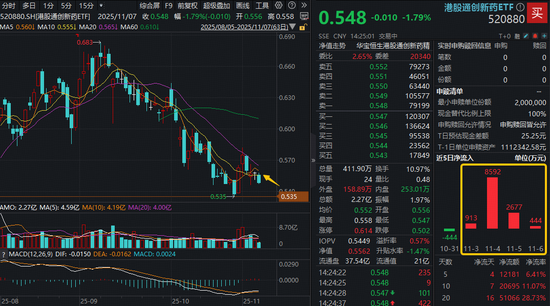
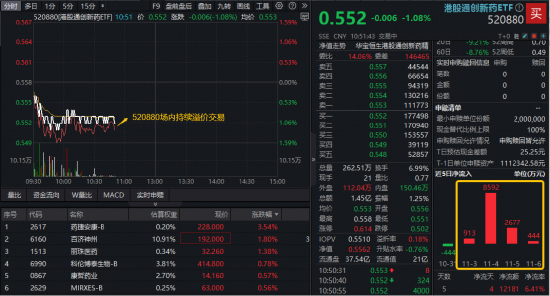
港股通创新药午后走低,再鼎医药重挫10%,520880下探2%跌落10日线,场内溢价飙升!
Xin Lang Ji Jin· 2025-11-07 06:42
Core Viewpoint - The Hong Kong stock market for innovative drugs is experiencing a downturn, with significant declines in several key companies, while the innovative drug ETF is seeing increased investment interest despite the market drop [1][3]. Group 1: Company Performance - Zai Lab reported a third-quarter product revenue net of $115.4 million, a year-on-year increase of 13%, with a net loss of $36 million, which is an improvement compared to the same period last year [3]. - BeiGene, known as the "king of innovative drugs," achieved a remarkable third-quarter revenue of 10.077 billion yuan, marking a year-on-year growth of 41.1%. The total revenue for the first three quarters reached 27.595 billion yuan, up 44.2% year-on-year, surpassing the total revenue of the previous year, with a net profit attributable to shareholders of 1.139 billion yuan [3]. Group 2: ETF Insights - The Hong Kong Stock Connect Innovative Drug ETF (520880) exclusively tracks the Hang Seng Hong Kong Stock Connect Innovative Drug Select Index, which has three unique advantages: it is purely focused on innovative drugs, has a high concentration of leading companies, and offers better risk control by reducing the weight of less liquid stocks [4][5][6]. - As of the end of October, the top ten holdings in the index accounted for 71.51% of the total weight, indicating a strong representation of leading innovative drug companies [7]. - The ETF has surpassed 2 billion yuan in total assets for the first time, with an average daily trading volume of 474 million yuan, making it the largest and most liquid ETF tracking this index [8].
东方证券:首次引入商保目录 创新药支付端政策趋暖愈发明确
智通财经网· 2025-11-07 06:40
Core Viewpoint - The introduction of the commercial insurance innovative drug directory is expected to address the accessibility and affordability issues of high-priced innovative drugs by guiding market forces [1][3]. Group 1: Policy Changes - The National Medical Insurance Administration organized a 5-day negotiation for the medical insurance drug directory and commercial insurance innovative drug directory, with 120 domestic and foreign companies participating [2]. - The new directory is set to be released in early December and will officially take effect on January 1 of the following year [2]. Group 2: Market Opportunities - The commercial insurance innovative drug directory aims to open market space for high-cost or rare disease medications, particularly for rare disease treatments and high-value innovative drugs [3]. - Notably, five CAR-T drugs have been submitted for approval, which could significantly benefit patients due to their high annual treatment costs [3]. Group 3: Drug Submission Strategies - The introduction of the "dual directory" submission allows companies to choose between submitting for both the basic medical insurance directory and the innovative drug directory, providing more strategic options [4]. - For example, BMS's O drug (Nivolumab) opted for dual submission after previous failures, while competitors like Merck's K drug (Pembrolizumab) have not submitted any applications [4]. Group 4: Competitive Landscape - Domestic innovative drugs are becoming major competitors to imported drugs, with examples like the TROP2 ADC drug Gosituzumab (Gilead) and its domestic counterpart [5]. - The increasing support for innovative drugs from the government and the diversification of the medical insurance payment system are expected to create new market demand for innovative drugs [5]. Group 5: Investment Recommendations - The medical insurance bureau is encouraging the high-quality development of innovative drugs, indicating a warming trend in payment policies [6]. - Relevant investment targets include companies such as Heng Rui Medicine, Kelun Pharmaceutical, and others that are actively transitioning towards innovation [6].

地方政策助力创新药产业,借道场内T+0,恒生创新药ETF(520500)助力把握板块新一轮发展机遇
Mei Ri Jing Ji Xin Wen· 2025-11-07 05:48
Group 1 - The core viewpoint of the news highlights the recent policy initiatives in the innovative drug industry, particularly the measures introduced by the Chongqing Municipal Government to support high-quality development in this sector [1] - The policy aims to achieve the approval of 1 to 3 innovative drugs annually by 2027, with a target of reaching a total of 10 innovative drugs, alongside the establishment of 3 comprehensive innovation industry complexes and high-level innovation platforms [1] - The comprehensive nature of the policy covers various aspects from R&D subsidies to clinical acceleration and international cooperation, indicating a significant boost for the biopharmaceutical industry in Chongqing and potentially influencing the national innovative drug industry [1] Group 2 - In terms of product layout, the innovative drug sector is experiencing positive capital inflow, particularly into the Hang Seng Innovative Drug ETF (520500), which has seen net inflows for six consecutive trading days [2] - The latest scale of the Hang Seng Innovative Drug ETF has reached 1.872 billion, with an average daily trading volume of 1.197 billion over the past five trading days, showcasing its substantial size and liquidity advantages [2] - The ETF focuses on companies in the Hong Kong market involved in the research, development, and production of innovative drugs, emphasizing firms with strong R&D capabilities and growth potential [2] Group 3 - The innovative drug industry is also benefiting from internationalization and advancements in R&D pipelines, which are expected to further enhance the industry's fundamentals [3] - Factors such as the rising international status of innovative drugs, explosive growth in business development (BD) overseas, and the transition to profitability are positioning innovative drugs as a key investment theme for 2026 [3] - The Hang Seng Innovative Drug ETF (520500) facilitates T+0 trading, providing a convenient tool for investors looking to capitalize on opportunities in the innovative drug sector [3]
“创新药一哥”绩后逆市上涨!第三季度营收突破百亿,上调全年业绩指引!机构:积极把握创新药调整后的机会
Xin Lang Ji Jin· 2025-11-07 03:07
Group 1: Company Performance - BeiGene reported a significant revenue increase, with Q3 revenue reaching 10.077 billion yuan, a year-on-year growth of 41.1% [1] - For the first three quarters, BeiGene's revenue totaled 27.595 billion yuan, up 44.2% year-on-year, surpassing the total revenue of the previous year [1] - The net profit attributable to shareholders for the first three quarters was 1.139 billion yuan, with product revenue growing by 43.9% to 27.314 billion yuan, driving the overall revenue growth [1] Group 2: Financial Guidance and Market Reaction - BeiGene raised its financial guidance for 2025, projecting annual revenue between 36.2 billion yuan and 38.1 billion yuan, an increase of 400 million yuan from previous estimates [1] - Following the earnings report, BeiGene's stock opened higher on November 7, showing resilience in a generally declining market for innovative drug stocks [1] Group 3: Market Trends and Investment Opportunities - The Hong Kong Stock Connect innovative drug sector has seen recent adjustments, attracting low-buying funds, with over 1.25 billion yuan flowing into the ETF over four consecutive days [3] - Analysts suggest that the current stock price levels are more reasonable after a period of adjustment, indicating potential investment opportunities in the innovative drug sector [3] Group 4: ETF Overview - The Hong Kong Stock Connect Innovative Drug ETF (520880) tracks the Hang Seng Hong Kong Stock Connect Innovative Drug Select Index, which includes only pure innovative drug companies [4][5] - The top ten innovative drug leaders account for over 71% of the ETF's weight, highlighting the strength of leading companies in the sector [5][7] - As of November 3, the ETF's scale surpassed 2 billion yuan, making it the largest and most liquid ETF tracking this index [8]
探底回升,科技、医疗跌幅居前,银行、消费逆势收涨
Ge Long Hui· 2025-11-06 12:24
Group 1 - The Hang Seng Index experienced a sharp decline after opening, followed by a rebound, closing with a slight decrease of 0.07% [1] - The Hang Seng Technology Index opened significantly lower, fluctuating throughout the day, and closed down 1.01%, with notable declines in stocks such as BYD down 1.75% and Bilibili down 4.09% [3] - The Hang Seng Medical Index opened with a deep V shape and maintained a weak consolidation below the midline, closing down 0.6%, with JD Health down 1.32% and WuXi AppTec up 2% [3] Group 2 - Bank stocks opened low but rose throughout the day, closing with a slight increase of 0.03%, with Chongqing Bank and Agricultural Bank both up 1.33% [3] - Other banks such as Zhengzhou Bank, Bank of Communications, and China Merchants Bank saw minor gains, while Qingdao Bank and Bank of China experienced declines [3]

涨疯了,狂飙190%!创新药新星港股首秀,“旺”到不行!
Xin Lang Cai Jing· 2025-11-06 11:47
Group 1 - The core point of the article highlights the significant market performance of the newly listed company, 旺山旺水, which saw its stock price surge by 145.73% on its debut, closing at 82 HKD, marking a 190% increase at one point during the trading day [1] - 旺山旺水, established in 2013, is a biopharmaceutical company focusing on the development and commercialization of small molecule drugs in the fields of neuropsychiatry and reproductive health, with nine innovative drug pipelines [1] - The article emphasizes the overall bullish sentiment in the innovative drug sector, which has gained traction this year, despite recent market fluctuations [2] Group 2 - The innovative drug sector is supported by strong underlying logic, with three main drivers: comprehensive policy support, explosive growth in business development (BD) transactions, and leading pharmaceutical companies moving towards profitability [2][3] - The article notes that the number of license-out transactions in the BD sector reached 103 in the first three quarters of 2025, with a total transaction value of 920.3 billion USD, reflecting a 77% year-on-year increase [2] - The global innovative drug market is projected to grow from 1.1 trillion USD in 2024 to 1.5 trillion USD by 2030, indicating significant market potential for companies in this sector [3] Group 3 - The 港股通创新药精选指数 is highlighted as a key investment vehicle, featuring a 100% focus on innovative drug companies, with the top ten constituents accounting for over 71% of the index weight [4][6] - The index is designed to manage risks effectively by assigning higher weights to more active stocks and reducing weights for less liquid stocks, thereby controlling tail risks [5] - The article suggests that the recent market adjustments present a buying opportunity for investors, as the index approaches its six-month moving average [6]

国泰海通医药 2025 年 11 月月报:Q3 态势良好,持续推荐创新药械产业链-20251106
GUOTAI HAITONG SECURITIES· 2025-11-06 08:06
Investment Rating - The report maintains an "Overweight" rating for the pharmaceutical sector, specifically recommending the innovative drug and medical device industry chain [5][10]. Core Insights - The pharmaceutical sector shows a positive recovery trend in Q3 2025, with overall revenue growth of 0.6% year-on-year and a net profit increase of 0.3% year-on-year. This indicates a return to growth after previous declines [6][13]. - Specific segments such as medical devices and medical research outsourcing are experiencing significant growth, with revenue and net profit growth rates of 10.6% and 0.6% for medical devices, and 10.9% and 47.9% for medical research outsourcing, respectively [13][14]. - The report highlights a continued recommendation for specific A-share and H-share stocks, including 恒瑞医药 (Hengrui Medicine), 科伦药业 (Kelun Pharmaceutical), and others, indicating strong potential for investment [7][10]. Summary by Sections 1. Continued Recommendation for Innovative Drug and Medical Device Industry Chain - The report continues to recommend the innovative drug and medical device industry chain, maintaining "Overweight" ratings for several A-share stocks including 恒瑞医药, 科伦药业, and others, and H-share stocks like 翰森制药 and 三生制药 [7][10]. 2. Recovery Trend in Pharmaceutical Sector Q3 2025 - The pharmaceutical sector's overall revenue increased by 0.6% year-on-year in Q3 2025, with net profit rising by 0.3%. Medical devices and medical research outsourcing are leading this recovery with notable growth rates [13][14]. 3. Performance of Pharmaceutical Sector in October 2025 - In October 2025, the pharmaceutical sector underperformed compared to the broader market, with the SW pharmaceutical index declining by 1.8% while the Shanghai Composite Index rose by 1.9% [15][26]. 4. Performance of Hong Kong and US Pharmaceutical Sectors - The Hong Kong pharmaceutical sector also underperformed, with the Hang Seng Healthcare index down by 11.1%, while the US pharmaceutical sector showed strength with a 3.5% increase in the S&P healthcare index [26][27]. 5. Valuation and Premium Levels - As of October 31, 2025, the pharmaceutical sector's premium level relative to all A-shares is at a normal level, with a current relative premium rate of 76.7% [25][28].



市场风格切换,关注创新药国际化、上游资源品涨价
Tebon Securities· 2025-11-06 06:11
Market Review - The A-share market experienced a style switch with a mixed index performance, as technology stocks led the decline while small-cap stocks showed active performance. The Shanghai Composite Index broke through 4000 points before retreating, with an average daily trading volume of 2.33 trillion yuan, up from 1.80 trillion yuan the previous week [4][5]. Hard Technology - The global semiconductor expansion driven by AI continues, with Q2 2025 global semiconductor equipment sales reaching 33.1 billion USD, a 23% year-on-year increase. In September, Japan's semiconductor equipment sales reached 424.6 billion yen, up 14.9% year-on-year [14][15]. - Domestic semiconductor equipment manufacturers saw significant revenue growth in Q3 2025, with an average year-on-year increase of 35%. This reflects strong order fulfillment from last year's orders and progress in downstream wafer fabs [25][26]. Healthcare - Chinese innovative drug companies showcased significant achievements at the 2025 ESMO conference, with 33 companies presenting research results and 35 studies selected for oral presentations. Chinese companies accounted for 15.3% of the total abstracts presented [28][29]. - The value of patent licensing transactions for Chinese innovative drugs exceeded 100.7 billion USD in the first three quarters of 2025, marking a 170% year-on-year increase, indicating accelerated globalization of Chinese innovative drugs [32][33]. High-end Manufacturing - The tungsten price has significantly increased, reflecting supply-side policy tightening and recovering downstream demand. The average price of domestic black tungsten concentrate reached 299,000 yuan per ton, up 109.8% from the beginning of the year [38][39]. - The excavator industry in China has shown a continuous recovery, with sales reaching 174,000 units in the first nine months of 2025, a year-on-year increase of 18.1%. Both domestic and export markets experienced double-digit growth [42][43]. Consumer Sector - Cross-border e-commerce has emerged as a new highlight in China's foreign trade, with a rich midstream ecosystem involving merchants, platforms, and service providers. The development is driven by domestic "push" factors and overseas "pull" factors, leading to a comprehensive export era for platforms, factories, and sellers [5][6].