华泰证券

Search documents
2025年港股IPO绿鞋观察:中资护盘积极却跌幅更大 建投保荐海螺材料跌幅近50% 外资破发率高但跌幅可控
Xin Lang Cai Jing· 2026-01-16 09:30
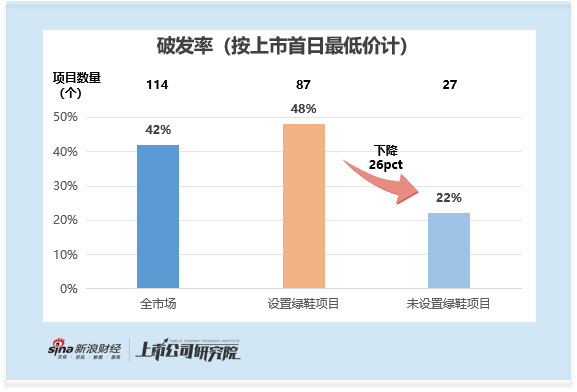
Group 1 - The core viewpoint of the article highlights the strong recovery of the Hong Kong IPO market in 2025, with 114 companies completing listings and raising a total of 285.6 billion HKD, making it the largest IPO fundraising exchange globally [1][13] - The average first-day gain for newly listed companies was 37%, significantly higher than the previous year's 8%, although over 40% of the projects experienced a first-day drop [1][13] - The green shoe mechanism, typically intended to stabilize new stock prices, showed limitations in 2025, with a first-day drop rate of 42%, and projects with green shoes had a higher drop rate of 48% compared to 22% for those without [1][15] Group 2 - The execution of the green shoe mechanism is closely tied to market demand, as it is allocated to non-anchor institutional investors, leading to a higher drop rate for projects with green shoes when demand is insufficient [3][15] - The strategy of green shoe funds typically involves controlling price declines rather than immediate full support, with concentrated buying near the market close to achieve a favorable closing price [3][15] - The performance of market stabilizers, such as CICC, showed a 44% drop rate based on intraday lows, which narrowed to 30% based on closing prices, indicating the effectiveness of their strategy [9][18] Group 3 - There is a notable difference in the green shoe execution strategies between Chinese and foreign institutions, with foreign investment banks generally exhibiting higher drop rates, such as Goldman Sachs at 75% and Morgan Stanley at 58% [6][20] - Chinese investment banks, such as CICC and CITIC Securities, reported lower drop rates of 41% and 25% respectively, indicating better performance among leading underwriters [6][20] - The average minimum drop for projects under Chinese investment banks was significantly higher, ranging from 14% to 32%, compared to 6% to 12% for foreign banks, highlighting greater volatility in the former's projects [10][22]




红相股份1月16日龙虎榜数据
Zheng Quan Shi Bao Wang· 2026-01-16 09:13
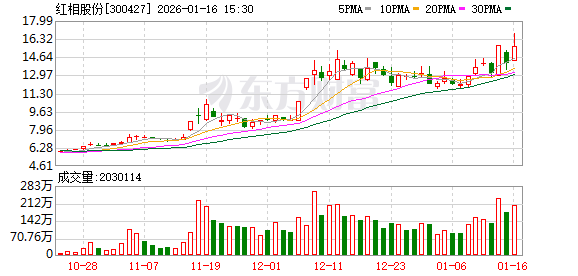
红相股份今日上涨11.33%,全天换手率40.36%,成交额31.87亿元,振幅17.74%。龙虎榜数据显示,机 构净买入2.02亿元,营业部席位合计净买入6604.67万元。 深交所公开信息显示,当日该股因日换手率达40.36%上榜,机构专用席位净买入2.02亿元。 证券时报·数据宝统计显示,上榜的前五大买卖营业部合计成交8.16亿元,其中,买入成交额为5.42亿 元,卖出成交额为2.74亿元,合计净买入2.68亿元。 具体来看,今日上榜的营业部中,共有3家机构专用席位现身,即买一、买二、买三、卖一、卖二,合 计买入金额3.84亿元,卖出金额1.82亿元,合计净买入2.02亿元。 近半年该股累计上榜龙虎榜10次,上榜次日股价平均涨2.80%,上榜后5日平均涨4.49%。 资金流向方面,今日该股主力资金净流入8997.27万元,其中,特大单净流入8374.08万元,大单资金净 流入623.19万元。近5日主力资金净流入7667.67万元。 红相股份1月16日交易公开信息 | 买/ 卖 | 会员营业部名称 | 买入金额(万元) | 卖出金额(万元) | | --- | --- | --- | --- | | 买 ...

研报掘金丨华泰证券:维持亚翔集成“买入”评级,上调目标价至235.62元
Ge Long Hui A P P· 2026-01-16 08:58
Group 1 - The core viewpoint of the report indicates that TSMC's FY26 capital expenditure guidance is optimistic, reflecting strong demand for global cleanroom construction and a clear expansion need among leading multinational semiconductor companies [1] - The report suggests that with the demand for AI applications and a shortage of advanced process and memory chips, cleanroom orders are expected to see both volume and price increases, leading to an upward revision in profit margins [1] - As a leading provider of high-end electronic cleanroom engineering services, Asia Cleanroom Integration is positioned to benefit significantly from these positive changes in the cleanroom infrastructure segment, with a maintained "buy" rating and an increased target price of 235.62 yuan, up from the previous 95.4 yuan, corresponding to a 20x PE for 2026 [1]


证券板块1月16日跌0.84%,华林证券领跌,主力资金净流出15.91亿元
Zheng Xing Xing Ye Ri Bao· 2026-01-16 08:56
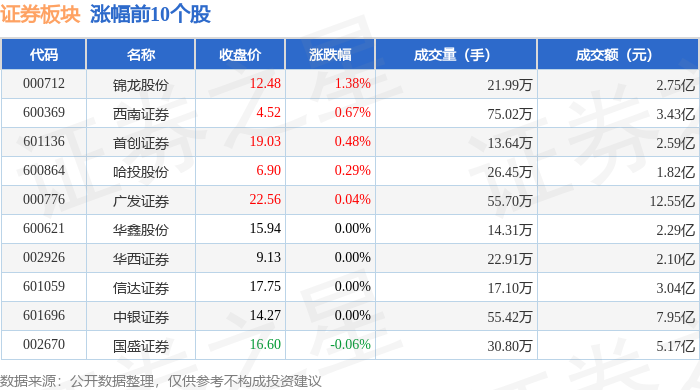
Market Overview - The securities sector experienced a decline of 0.84% on January 16, with Huayin Securities leading the drop [1] - The Shanghai Composite Index closed at 4101.91, down 0.26%, while the Shenzhen Component Index closed at 14281.08, down 0.18% [1] Individual Stock Performance - Jinlong Co., Ltd. (000712) saw an increase of 1.38% in its closing price at 12.48, with a trading volume of 219,900 shares and a transaction value of 275 million [1] - Huayin Securities (002945) reported a significant decline of 3.42%, closing at 17.78, with a trading volume of 493,300 shares and a transaction value of 893 million [2] - Other notable declines included Caizheng Securities (601108) down 2.04% and Xiangcai Co. (600095) down 1.91% [2] Capital Flow Analysis - The securities sector saw a net outflow of 1.591 billion in main funds, while retail investors contributed a net inflow of 580 million [2] - The main funds showed a significant net inflow in stocks like Zhaokang Le Yuan (601211) with 446 million, while Huatai Securities (601688) had a net inflow of 113 million [3] - Conversely, stocks like Huayin Securities (002945) and Guangfa Securities (000776) experienced notable net outflows from main funds [3]


央行:今年看降准降息还有一定空间,券商ETF(159842)盘中上涨,连续两日“吸金”累超2亿元
2 1 Shi Ji Jing Ji Bao Dao· 2026-01-16 05:40
Group 1 - The three major indices in China experienced collective gains on January 16, with the Shanghai Composite Index rising by 0.58%, the Shenzhen Component Index by 0.64%, and the ChiNext Index by 0.73% [1] - The CSI All Share Securities Company Index increased by 0.75%, with notable gains from Southwest Securities and Guosheng Securities, both rising over 2%, and several others including Bank of China Securities and Huatai Securities rising over 1% [1] - The Broker ETF (159842) rose by 0.69% with a trading volume of 26.77 million yuan and a real-time premium rate of 0.02%, indicating frequent premium trading [1] Group 2 - The net inflow for the Broker ETF on the previous trading day (January 15) was 99.73 million yuan, marking two consecutive days of net inflows, totaling 226 million yuan [1] - As of January 15, the latest circulating shares of the Broker ETF were 9.115 billion, with a total circulating scale of 10.522 billion yuan [1] - The Broker ETF closely tracks the CSI All Share Securities Company Index, which focuses on large-cap securities leaders in the A-share market, including both traditional and fintech leaders [1] Group 3 - The People's Bank of China indicated that there is still room for reserve requirement ratio cuts and interest rate reductions, with the average reserve requirement ratio currently at 6.3% [2] - It is anticipated that a 50 basis point reserve requirement cut may occur in the first quarter, aiming to maintain ample liquidity alongside government bond issuance [2] - The current monetary policy is characterized by a high degree of coordination with fiscal policy, with a focus on stabilizing expectations, employment, and the financial market [2]
4万亿利好!这一板块全线飘红!
Zheng Quan Ri Bao Wang· 2026-01-16 03:28
值得一提的是,为适应能源绿色低碳转型需要,支撑新能源大规模高比例发展,2025年12月26日,国家 发展改革委、国家能源局发布了《关于促进电网高质量发展的指导意见》,其中提到电网作为连接电力 生产和消费的枢纽平台,是加快构建新型电力系统的核心环节;要求到2030年,"西电东送"规模超过 4.2亿千瓦,新增省间电力互济能力4000万千瓦左右,支撑新能源发电量占比达到30%左右,接纳分布 式新能源能力达到9亿千瓦,支撑充电基础设施超过4000万台。 业内人士认为,展望"十五五",国内电网投资有望维持高景气度,国家电网公司"十五五"投资计划有望 驱动电网设备企业充分受益。 除国内电网投资景气度攀升外,在(人工智能)AI浪潮的推动下,全球其他市场电网投资也在提速。 华泰证券认为,目前海外电网资本支出普遍连续上调,预计可支撑3年至5年需求双位数高增,如美国、 欧洲、沙特等海外主要地区电力电网投资维持高增。在海外扩产节奏依旧温和背景下,国内具备出海能 力的企业将迎来持续的海外机遇。 中国银河(601881)证券认为,2026年电网出海将延续量价齐升;未来海外市场电网投资有望提速,且 海外市场供给端供不应求,欧美电力变压器 ...
机构看好“老经济“板块配置价值,自由现金流ETF(159201)成长线投资布局利器
Sou Hu Cai Jing· 2026-01-16 02:40
Group 1 - The core viewpoint of the article highlights the positive performance of the Free Cash Flow ETF (159201), which has seen a 0.64% increase in early trading on January 16, with leading stocks such as Yaxiang Integration, Pinggao Electric, and Silver Industry rising over 4% [1] - The Free Cash Flow ETF (159201) has experienced net inflows in 8 out of the last 10 trading days, totaling over 782 million yuan [1] - Huatai Securities Research Institute expresses optimism about the allocation value of the "old economy" sector, citing four key reasons for this outlook, including the positive correlation between new and old economies, low valuations in the old economy sector, strong recovery potential from the cyclical bottom, and a preference for value styles among incremental funds [1] Group 2 - The Free Cash Flow ETF (159201) and its linked funds (A: 023917; C: 023918) closely track the National Index of Free Cash Flow, selecting stocks with positive and high free cash flow after liquidity, industry, and ROE stability screening, indicating high quality and strong risk resistance suitable for long-term investment [2] - The fund management fee is set at an annual rate of 0.15%, and the custody fee at 0.05%, both of which are the lowest in the market, maximizing benefits for investors [2]
华泰证券1月15日获融资买入2.56亿元,融资余额61.44亿元
Xin Lang Cai Jing· 2026-01-16 02:18
Group 1 - On January 15, Huatai Securities experienced a decline of 1.23% with a trading volume of 2.424 billion yuan, and the net financing purchase was 10.62 million yuan [1] - As of January 15, the total margin balance of Huatai Securities was 6.157 billion yuan, with the financing balance at 6.144 billion yuan, accounting for 3.60% of the circulating market value, which is below the 10% percentile level over the past year [1] - The company repaid 91,100 shares of securities lending on January 15, with a securities lending balance of 13.5838 million yuan, which is above the 90% percentile level over the past year [1] Group 2 - As of September 30, Huatai Securities had 195,500 shareholders, a decrease of 6.96% from the previous period, while the average circulating shares per person increased by 7.62% to 38,566 shares [2] - For the period from January to September 2025, Huatai Securities reported operating revenue of 27.129 billion yuan, a year-on-year decrease of 13.67%, while the net profit attributable to shareholders increased by 1.69% to 12.733 billion yuan [2] - Since its A-share listing, Huatai Securities has distributed a total of 42.893 billion yuan in dividends, with 13.994 billion yuan distributed in the last three years [3]
解构2025金融收官数据:M2反弹源于理财回流,社融降速受累基数,信贷结构延续“企强民弱”
Hua Er Jie Jian Wen· 2026-01-16 01:08
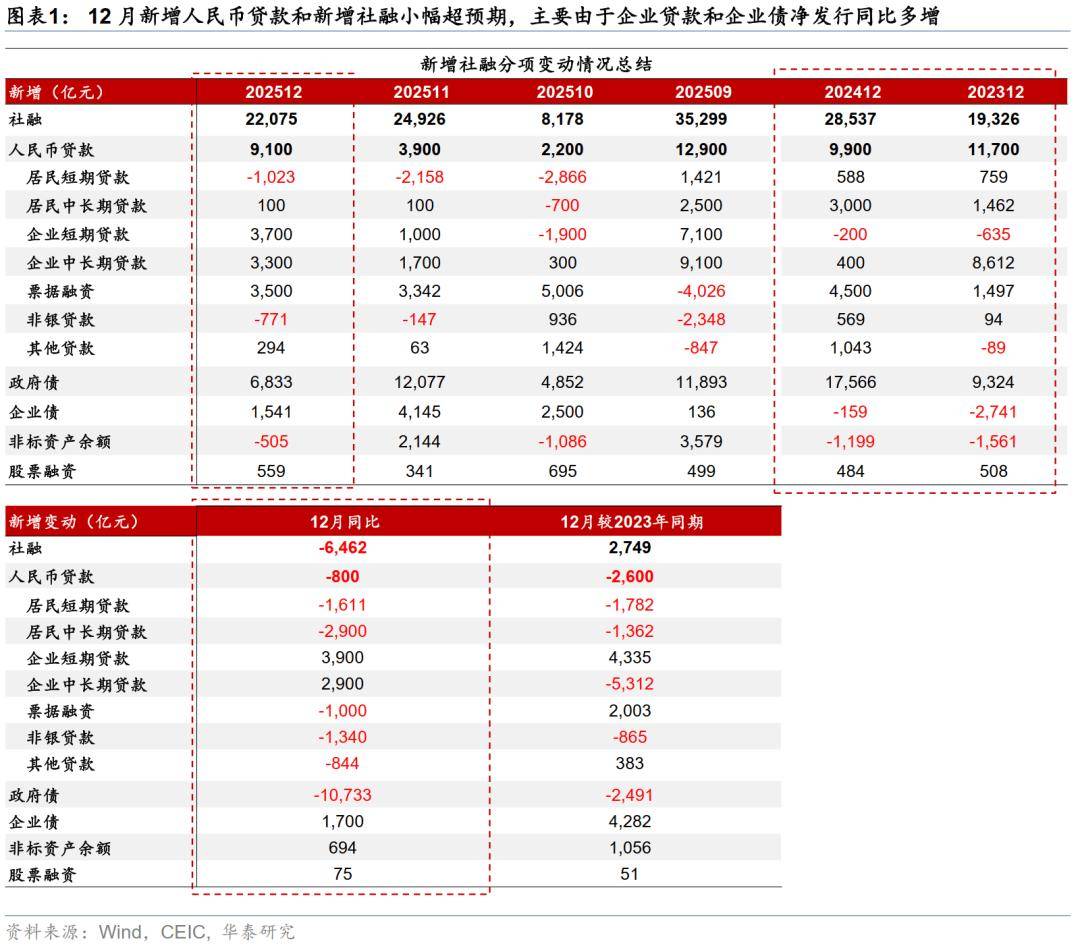
Core Viewpoint - The financial data for 2025 marks a significant point in China's macroeconomic transition, highlighting a divergence between M2 growth and social financing, indicating a shift from simple monetary expansion to a more precise restructuring of financial resources [1] Group 1: Social Financing Dynamics - The decline in social financing (社融) is not alarming; December saw a new social financing of 2.21 trillion yuan, a year-on-year decrease of 645.7 billion yuan [2] - The primary drag on social financing comes from government bonds, which saw a year-on-year decrease of 1.07 trillion yuan, attributed to a base effect from the previous year [3] - Direct financing channels are gaining strength, with corporate bond financing in December increasing by over 170 billion yuan year-on-year, driven by "hard technology" bonds [4][5] Group 2: Credit Structure Analysis - The credit structure shows a "K-shaped" dynamic, with strong corporate borrowing contrasted by weak household borrowing [6] - Corporate loans demonstrated unexpected resilience, with short-term loans increasing by 370 billion yuan in December, significantly higher than previous years [7] - In contrast, household loans are still in a repair phase, with short-term loans decreasing year-on-year, influenced by high real interest rates [8][9] Group 3: M2 and M1 Trends - M2 growth rebounded to 8.5%, primarily due to structural adjustments in bank liabilities rather than asset expansion [10][11] - M1 remains low at 3.8%, affected by a high base and a decrease in government contributions, although signs of "residential deposit migration" are emerging [12] Group 4: Policy Outlook for 2026 - The policy landscape for 2026 is expected to shift from a singular focus on monetary policy to a combination of fiscal and monetary strategies [13] - Monetary policy may see further easing during the upcoming Two Sessions, with potential for rate cuts [14] - Fiscal policy is anticipated to play a crucial role in stabilizing growth, with significant projects expected to be prioritized in early 2026 [15] - Improved liquidity conditions in the capital market are expected as M1 growth rebounds, potentially enhancing equity asset valuations [16] Conclusion - The financial data for 2025 reflects a complex interplay of factors, indicating a transition phase where structural optimization in corporate financing and direct financing channels is taking place, setting the stage for new growth logic in 2026 [17][18]
华泰证券:基建与地产相关融资走势分化
Sou Hu Cai Jing· 2026-01-16 00:23
Core Viewpoint - In December, new RMB loans and new social financing slightly exceeded market expectations but showed a year-on-year decrease, indicating a continued divergence in financing demand between enterprises and households, primarily reflecting accelerated financing related to infrastructure while household loan demand remains under pressure due to real estate market challenges [1] Summary by Relevant Sections New RMB Loans and Social Financing - December new RMB loans amounted to 910 billion yuan, exceeding Bloomberg's consensus estimate of 800 billion yuan, but showing a year-on-year decrease of 800 billion yuan, keeping the loan balance year-on-year growth rate stable at 6.4% [3] - New social financing in December was 2.21 trillion yuan, surpassing the consensus estimate of 1.9 trillion yuan, but down 6.457 billion yuan year-on-year, with a year-on-year growth rate slowing from 8.5% in November to 8.3% [5] Corporate and Household Loan Dynamics - Corporate loan financing accelerated in December, likely due to the implementation of new policy financial tools and local government debt limits, with corporate loans increasing by 580 billion yuan year-on-year, and the year-on-year growth rate rising from 8.8% in November to 9.1% [1][4] - In contrast, household loan demand remained weak, with a year-on-year decrease of 4.511 billion yuan in December, and the year-on-year growth rate of household loans slowing from 1.1% in November to 0.5% [1][4] Government Debt and Fiscal Deposits - The net issuance of government bonds in December decreased significantly by 1.07 trillion yuan year-on-year due to a high base effect, while fiscal deposit growth accelerated, indicating that the government may be reserving funds for economic stimulus in the first quarter of 2026 [2] Monetary Indicators - The year-on-year growth rate of M1 decreased from 4.9% in November to 3.8% in December, while M2 growth increased from 8.0% to 8.5%, indicating a mixed picture of liquidity in the economy [6] Future Outlook - The focus will be on the strength of credit growth in early 2026, the impact of the central bank's expansion of relending quotas, and the pace of fiscal fund disbursement, as well as the potential recovery of household purchasing intentions in the real estate market [3]