吉利汽车

Search documents
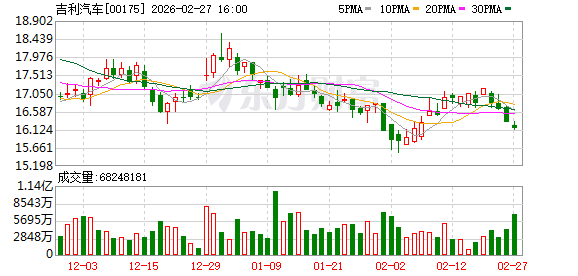
吉利汽车:2月汽车销量206160辆,同比增长约1%
Mei Ri Jing Ji Xin Wen· 2026-03-01 10:22
每经AI快讯,3月1日,吉利汽车在港交所公告,2月汽车销量206160辆,同比增长约1%。 ...
吉利汽车在港交所公告,2月汽车销量206160辆,同比增长约1%。
Xin Lang Cai Jing· 2026-03-01 10:14
吉利汽车在港交所公告,2月汽车销量206160辆,同比增长约1%。 来源:滚动播报 ...
吉利汽车(00175.HK):2月汽车总销量为20.616万部
Ge Long Hui· 2026-03-01 10:11
Core Viewpoint - Geely Automobile reported a total vehicle sales of 206,160 units in February 2026, representing a year-on-year increase of approximately 1% [1] Group 1: Overall Sales Performance - The total vehicle sales for Geely in February 2026 reached 206,160 units, showing a slight growth compared to the same month last year [1] Group 2: Brand Performance - Lynk & Co achieved sales of 27,359 units in February, marking a significant year-on-year growth of 59% [1] - Zeekr recorded sales of 23,867 units in February, reflecting a robust year-on-year increase of 70% [1]
吉利汽车(00175) - 月报表截至28/2/2026
2026-03-01 10:02
股份發行人及根據《上市規則》第十九B章上市的香港預託證券發行人的證券變動月報表 截至月份: 2026年2月28日 狀態: 新提交 致:香港交易及結算所有限公司 公司名稱: 吉利汽車控股有限公司 呈交日期: 2026年3月1日 I. 法定/註冊股本變動 | 1. 股份分類 | 普通股 | | 股份類別 | 不適用 | | | 於香港聯交所上市 (註1) | | 是 | | | --- | --- | --- | --- | --- | --- | --- | --- | --- | --- | --- | | 證券代號 (如上市) | 00175 | | 說明 | | | | | | | | | 多櫃檯證券代號 | 80175 | RMB | 說明 | | | | | | | | | | | | 法定/註冊股份數目 | | | 面值 | | | 法定/註冊股本 | | | 上月底結存 | | | | 18,000,000,000 | HKD | | 0.02 | HKD | | 360,000,000 | | 增加 / 減少 (-) | | | | | | | | HKD | | | | 本月底結存 | | | ...
吉利汽车(00175) - 未经审核之二零二六年二月销量
2026-03-01 10:01
未經審核之二零二六年二月銷量 吉利汽車控股有限公司(「本公司」,連同其附屬公司統稱為「本集團」)董事會欣然宣佈, 本集團於二零二六年二月的汽車總銷量為206,160部,較去年同期增長約1%。詳細如下: 香港交易及結算所有限公司及香港聯合交易所有限公司對本公佈之內容概不負責,對其 準確性或完整性亦不發表任何聲明,並表明不會就因本公佈全部或任何部份內容而產生 或因倚賴該等內容而引致之任何損失承擔任何責任。 GEELY AUTOMOBILE HOLDINGS LIMITED | 品牌 | 本月 (部) | 去年同期 (部) | 同比變動 (%) | 今年累計 (部) | 去年同期累計 (部) | 同比變動 (%) | | --- | --- | --- | --- | --- | --- | --- | | 吉利 | 154,934 | 173,633 | -11 | 372,372 | 398,351 | -7 | | 其中: 銀河 | 73,125 | 76,132 | -4 | 156,115 | 169,677 | -8 | | 領克 | 27,359 | 17,238 | 59 | 56,236 | 47 ...
光研之声2026年3月联合月报:春归-20260301




EBSCN· 2026-03-01 07:47
Current Strategy Viewpoints - The capital market experienced fluctuations in early February but rebounded later in the month, primarily due to reduced trading activity before the Spring Festival and short-term policy guidance [1] - The market is expected to enter a phase of economic data and policy verification, with a seasonal increase in trading activity post-Spring Festival, laying a foundation for future market performance [1] - Upcoming economic and corporate profit data, along with the National People's Congress in March, will be crucial for setting the annual policy tone and economic targets, which are significant for the capital market [1] Sector Focus - Short-term focus on safe-haven assets and resource products due to tensions in the Middle East, including precious metals and oil sectors [2] - Long-term focus on growth and cyclical sectors, with particular attention to small-cap stocks that typically perform well in spring [2] - Key sectors to watch include humanoid robots, computing, and AI, benefiting from sustained industry enthusiasm and increased risk appetite among investors [2] Macro Overview - The upcoming National People's Congress will set the tone for the annual economy, with GDP growth targets expected to be set between 4.5% and 5% [8] - Fiscal policy is anticipated to include a deficit rate of 4.0% and new special bonds totaling 5 trillion yuan, indicating a significant increase in fiscal deficit compared to last year [8] Financial Engineering - The A-share market has seen a rise in industry crowding, particularly in media and resource sectors, with the media sector showing a crowding degree of 98.25% [12][14] - The resource sector continues to perform well, with price fluctuations leading to a decrease in crowding indicators, suggesting a potential for continued upward movement [13] Electronic Communication Industry - The upcoming GTC conference is expected to showcase new chip developments from NVIDIA, reinforcing AI as a core investment theme [24] - The demand for storage products is projected to rise significantly, driven by strong AI customer needs and price increases in the DRAM market [25] Computer Industry - The rapid iteration of domestic AI large models is expected to drive significant growth in computing power investments, with a focus on world model technology advancements [28] - The demand for AI-driven applications is anticipated to increase, leading to a surge in computing needs and infrastructure investments [29] New Energy Industry - Focus on hydrogen and ammonia projects, with government support for integrated energy bases expected to drive growth in this sector [32] - The electric power equipment sector is poised for growth due to ongoing global energy demands and potential easing of import restrictions in India [32] High-end Manufacturing Industry - The humanoid robot sector is entering a phase of mass production, with significant advancements showcased during the Spring Festival [35] - The North American AI supply chain remains robust, with ongoing demand for advanced equipment and materials expected to drive growth [36]
吉利汽车集团CEO淦家阅:千里浩瀚辅助驾驶将在今年实现出海
Zhong Guo Jing Ying Bao· 2026-02-28 14:54
Group 1 - The core viewpoint of the article is that Geely Auto Group's CEO announced the international launch of the Qianli Haohan advanced driver assistance system (ADAS) this year, marking it as the first Chinese high-level ADAS to achieve large-scale application in overseas markets [2] - The Qianli Haohan system is recognized as one of the highest "containing modulus," largest data volume, and strongest hardware ADAS globally, utilizing an industry-leading Smart AI Agent architecture and fully implementing the "WAM World Behavior Model" [4] - The Qianli Haohan G-ASD H7 solution will be gradually equipped in more Lynk & Co and Geely Galaxy models this year, with plans to introduce highway L3 and urban L4 functionalities where regulations permit, as well as trial operations for Robotaxi [4] Group 2 - The Zeekr 8X, which will debut the latest version of the Qianli Haohan G-ASD, is set to launch in the first half of this year and features a high-performance tri-motor version with power exceeding 1,000 horsepower [4]

2026年乘用车:以高端、出海为矛破局
GUOTAI HAITONG SECURITIES· 2026-02-28 13:17
Investment Rating - The report rates the industry as "Overweight" [2] Core Insights - The passenger car market in China is expected to maintain resilient growth in 2025, with wholesale sales projected to reach 23.797 million units, a year-on-year increase of 6% driven by policy support and consumer recovery [8] - The export of passenger cars is anticipated to reach 5.731 million units in 2025, reflecting a significant year-on-year growth of 21%, benefiting from the accelerated expansion of domestic brands in overseas markets and the enhanced competitiveness of domestic new energy vehicles [8] - The trend of new energy vehicles replacing traditional fuel vehicles continues, with the insurance volume of pure electric passenger cars expected to reach 7.787 million units in 2025, an increase of 148.6 thousand units year-on-year, while fuel vehicle sales are projected to decrease by 164.5 thousand units [21] Summary by Sections Domestic Market Analysis - In 2025, the domestic passenger car wholesale sales are projected to be 23.797 million units, up 6% year-on-year, supported by policy and consumer recovery [8] - The insurance volume for domestic passenger cars is expected to be 22.995 million units, remaining flat year-on-year [21] Export Market Analysis - The export volume of passenger cars is expected to reach 5.731 million units in 2025, marking a 21% increase year-on-year [8] New Energy Vehicle Trends - The insurance volume of pure electric vehicles is projected to be 7.787 million units in 2025, contributing significantly to the overall growth, while fuel vehicle sales are expected to decline [21] - The market share of new energy vehicles continues to rise, with a notable increase in the number of new energy vehicles being registered [21] Price Segment Analysis - The market for passenger cars priced below 200,000 yuan remains concentrated, with a total sales volume of 15.098 million units in 2025, accounting for 66% of the overall market [27] - BYD leads the market with a sales volume of 3.023 million units, holding a market share of 20% [28] High-End Market Dynamics - In the 300,000 to 500,000 yuan segment, domestic brands are gaining market share, with sales of 3.154 million units, a 2% increase year-on-year [33] - The luxury segment remains dominated by traditional brands, but domestic brands are increasingly entering this space [33] Competitive Landscape - The top five companies in the new energy vehicle segment include Geely, Xiaomi, and Leap Motor, which have shown significant growth in sales [23] - The competitive dynamics in the high-end market are shifting, with new entrants challenging established luxury brands [73]
德国总理访华,动力电池企业出镜背后释放了哪些信号?
高工锂电· 2026-02-28 12:29
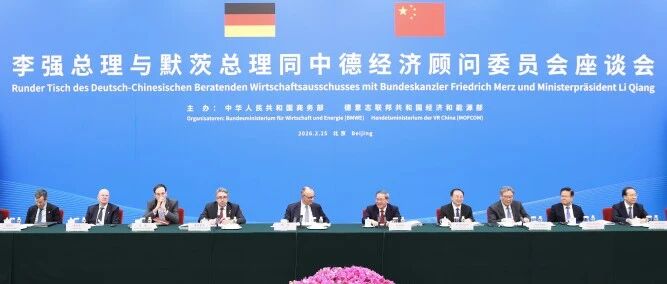
Core Viewpoint - The article highlights the evolving competition and cooperation between China and Germany in the electric vehicle (EV) sector, particularly focusing on the collaboration between Chinese battery manufacturers like CATL and Guoxuan High-Tech with German automotive giants such as BMW and Volkswagen [1][2]. Group 1: China-Germany Cooperation in the EV Sector - German Chancellor Merz's visit to China included discussions on bilateral economic cooperation, emphasizing the importance of the automotive industry as a core area for collaboration [2][3]. - CATL signed a memorandum of understanding with BMW to collaborate on battery passport cross-border data trials and supply chain carbon footprint reduction, indicating a shift from traditional product supply to higher-level rule collaboration [3][4]. - The cooperation reflects a mutual recognition of the need for German automakers to leverage Chinese technology and supply chains, as highlighted by statements from leaders of major German automotive companies [3][4]. Group 2: Industry Signals and Development Directions - The meeting of the China-Germany Economic Advisory Committee signaled three key directions for the lithium battery industry: joint standard building, collaborative battery technology research, and deepening supply chain cooperation [5][6]. - The collaboration aims to address the EU's new battery regulations, facilitating Chinese battery companies' entry into the European market and enhancing China's global influence in the lithium battery sector [6]. - Both parties are focusing on next-generation battery technologies, with CATL and BMW working on the sixth generation of batteries, while Guoxuan High-Tech collaborates with Volkswagen on standard cells and solid-state battery materials [6][7]. Group 3: Localized Production and Market Expansion - Chinese companies are increasingly investing in localized production in Europe, with CATL's battery production facility in Germany having an initial planned capacity of 14 GWh and a total investment of €1.8 billion [7]. - Guoxuan High-Tech has also established a production base in Germany with a planned capacity of 20 GWh, indicating a shift from product export to localized investment and supply chain integration [7][8]. - German automakers are deepening their investments in China, with BMW's investment exceeding 120 billion yuan in Shenyang, showcasing a commitment to local production and R&D [7][8]. Group 4: Mutual Benefits and Third-Party Market Development - The collaboration between China and Germany in the EV sector is characterized by mutual benefits, with both sides recognizing the importance of joint market expansion into third-party markets [9][10]. - Germany's market access and standards are crucial for Chinese automakers to penetrate the European high-end market, while Chinese battery supply chains can enhance the value of German EVs [9][10]. - The partnership aims to address the challenges posed by geopolitical tensions and supply chain fluctuations, fostering a collaborative development model that benefits both industries [8][10].



吉利磷酸铁锂再“落子”
起点锂电· 2026-02-28 10:22
Core Viewpoint - The article highlights the strategic advancements of Geely in the lithium battery sector, particularly through the establishment of its subsidiary, Jiangxi Yiyuan New Energy Technology Co., Ltd., which marks a significant step towards self-sufficiency in battery materials and supply chain security [2][3]. Group 1: Production and Capacity - Jiangxi Yiyuan New Energy is set to process 40,000 tons of waste lithium iron phosphate batteries annually and aims to produce 30,000 tons of lithium iron phosphate precursor and 30,000 tons of lithium iron phosphate cathode materials [3]. - The project represents a closed-loop system from battery recycling to material regeneration and production, enhancing Geely's supply chain stability and reducing raw material costs [3][4]. Group 2: Market Dynamics - The lithium iron phosphate industry is entering a new upward cycle, with prices rebounding from approximately 30,000 yuan per ton in mid-2025 to a range of 57,000 to 63,000 yuan per ton for power-type lithium iron phosphate as of late February 2026, reflecting an overall increase of over 90% [5]. - Geely's self-produced capacity will help mitigate some price risks and stabilize production costs amid rising raw material prices [5][6]. Group 3: Sales and Product Strategy - In 2025, Geely plans to sell 3.02 million vehicles, with 1.687 million being new energy vehicles, where the Galaxy series, representing low-end brands, is expected to account for 73.5% of total new energy sales [6]. - The Galaxy series, priced between 68,800 and 100,000 yuan, is projected to achieve sales of 460,000 units, making it the best-selling passenger car in China across all categories in 2025 [6]. Group 4: Supply Chain Integration - The establishment of Yiyuan New Energy will enhance Geely's self-sufficiency in lithium iron phosphate, reducing reliance on external suppliers and strengthening its position in the industry [7]. - Geely has created an integrated ecosystem covering "resources - materials - batteries - vehicles," ensuring a stable supply of upstream raw materials through strategic acquisitions and partnerships [8]. Group 5: Future Outlook - Geely aims to achieve a battery production capacity of 70 GWh by 2027, with a target of 40% self-sufficiency in battery supply, supporting both new energy vehicles and energy storage sectors [10]. - The company has seen a significant increase in battery installation volume, with a year-on-year growth of 156% in the first half of 2025, positioning it among the fastest-growing companies in the sector [9][10].