全域AI

Search documents
营收首破3400亿!从“大浪淘沙”到“引领全球”,吉利汽车驶向AI深海区
Jin Rong Jie· 2026-03-20 02:18
Core Insights - Geely has set ambitious goals to become a global leader in smart vehicles by 2030, aiming to rank among the top five global automakers in terms of sales [1] - The company reported record sales, revenue, and profitability in 2025, demonstrating strong market competitiveness and a commitment to technological advancement [2][3] Group 1: Financial Performance - In 2025, Geely's sales exceeded 3 million units, marking a 39% year-on-year increase, surpassing its annual sales target [2] - Total revenue reached 345.2 billion RMB, a 25% increase year-on-year, achieving a historical high [2] - Core net profit attributable to shareholders was 14.41 billion RMB, up 36% year-on-year, indicating high-quality growth [2] Group 2: Strategic Partnerships and Technological Advancements - Geely announced a strategic partnership with NVIDIA to collaborate on physical AI, enterprise AI, and industrial AI, aiming to create a comprehensive ecosystem for smart vehicles [3] - The partnership will lead to the launch of the world's first super intelligent vehicle, integrating smart cockpit, assisted driving, and digital ecosystems, set to debut in the Zeekr 8X model [3][4] Group 3: Brand Integration and Market Positioning - Geely has successfully integrated its three brands—Geely, Lynk & Co, and Zeekr—eliminating resource duplication and enhancing operational efficiency across the value chain [6] - The Galaxy brand saw a 150% increase in sales, reaching 1.236 million units, solidifying its position as the second-best-selling new energy brand in China [6] - Geely is expanding its global footprint by accelerating electric vehicle exports and deepening strategic partnerships, such as its investment in Renault Brazil [6] Group 4: AI and Future Outlook - Geely has established a comprehensive AI system that integrates artificial intelligence throughout the vehicle lifecycle, moving beyond traditional applications in cockpit and autonomous driving [7] - The company has set a new sales target of 3.45 million units for 2026, focusing on AI technology, energy diversification, luxury experience upgrades, and international expansion [7]

光大证券晨会速递-20260320
EBSCN· 2026-03-20 01:58
Group 1: Macro Insights - The recent FOMC meeting decided to pause interest rate cuts, aligning with market expectations, and highlighted a more optimistic view on inflation, suggesting that the recent energy supply shock is likely a one-time event [2] - There are concerns about potential stagflation, with the Fed raising its PCE inflation forecast and noting that the absolute level of new job creation is too low, posing risks [2] - Powell's comments on his future at the Fed depend on whether the new chairman, Waller, can be confirmed by the Senate in a timely manner, and whether the Trump administration will conclude its investigations [2] Group 2: Company Research - AIA Group (1299.HK) reported a 8.8% year-on-year decline in net profit attributable to shareholders for 2025, while new business value (NBV) increased by 17.1%. The company expects continued growth in NBV driven by agency and partner distribution channels [3] - Haitan International (1882.HK) achieved a 10.0% year-on-year revenue growth and a 7.2% increase in net profit attributable to shareholders for 2025. The company has adjusted its net profit forecasts for 2026-2027 downwards by 6.7% and 6.1% respectively, while introducing a new forecast for 2028 [4] - Geely Automobile (0175.HK) has adjusted its net profit forecasts for 2026 and 2027 down by 0.4% and 0.8% respectively, while introducing a new forecast for 2028. The company remains optimistic about product structure improvements and export growth [4] - Shengmei Shanghai (688082.SH) is progressing steadily in its cleaning equipment business, with new product development on track. The company is expected to see net profit attributable to shareholders of 1.829 billion, 2.285 billion, and 2.667 billion for 2026-2028 [5] - Saint Bella Group (2508.HK), a leader in high-end postpartum care, is well-positioned to benefit from industry upgrades and is expanding into overseas markets. The company forecasts adjusted net profits of 121 million, 178 million, and 279 million for 2025-2027 [6]

【吉利汽车(0175.HK)】2026E产品结构改善,全域AI赋能+全球化提速——2025年年报点评(倪昱婧/邢萍)
光大证券研究· 2026-03-19 23:07
Core Viewpoint - The article highlights the strong performance of Geely in 2025, driven by significant growth in electric vehicle sales and an improved vehicle lineup, alongside the successful privatization of Zeekr, which is expected to enhance operational efficiency and global expansion [4][5][6]. Financial Performance - In 2025, Geely's total revenue increased by 25.1% year-on-year to CNY 345.23 billion, with a gross margin remaining stable at 16.6%. The net profit attributable to shareholders rose by 0.2% to CNY 16.85 billion, while core net profit saw a substantial increase of 36% to CNY 14.41 billion [4]. Sales Growth - Geely's total sales in 2025 grew by 39.0% year-on-year to 3.025 million units, with electric vehicle sales surging by 90% to 1.688 million units, accounting for 55.8% of total sales, an increase of 15 percentage points [5]. Brand Performance - Sales by brand in 2025 included Geely Galaxy at 1.236 million units (up 149.9%), Lynk & Co at 350,000 units (up 22.8%), and Zeekr at 224,000 units (up 0.9%). The company anticipates a steady growth trajectory for 2026, targeting a 14% increase in sales to 3.45 million units [5]. Zeekr Privatization - The privatization of Zeekr was successfully completed in December 2025, with all revenues and profits from Zeekr fully integrated into Geely. Zeekr achieved profitability in Q4 2025, with a gross margin of approximately 23% [6]. Global Expansion and AI Integration - Geely is accelerating its global expansion, with a target of 640,000 units in export sales for 2026, focusing on key overseas markets. The company is also enhancing its AI capabilities, aiming for breakthroughs in smart mobility solutions, including the launch of Robotaxi services [6].

直击吉利汽车2025年业绩会:规模效应遇上利润释放,吉利“下半场”怎么打?
Xin Lang Cai Jing· 2026-03-19 12:06
Core Viewpoint - Geely Auto has demonstrated strong financial performance in 2025, achieving significant revenue and profit growth amidst a competitive automotive market, marking its "high-quality development year" [1][6]. Financial Performance - Geely Auto reported a revenue of 345.2 billion yuan, a 25% increase year-on-year, and a core net profit of 14.41 billion yuan, up 36% year-on-year, indicating a robust financial position [1][6]. - The company exceeded its sales target with over 3.02 million vehicles sold, achieving an overall gross margin of 16.7% and a total gross profit of 57.3 billion yuan [1][6]. - Total cash levels rose to 68.2 billion yuan, a 46% increase year-on-year, with a low debt-to-asset ratio compared to industry standards [1][6]. Shareholder Returns - Geely's board proposed a 51.5% increase in dividends to 0.5 HKD per share, totaling 5.39 billion HKD, setting a new historical high for shareholder returns [2][6]. Strategic Integration - The company's strategic integration, guided by the "Taizhou Declaration," has led to clearer brand positioning and reduced operational costs through shared technology and joint procurement [2][7]. - Geely completed a significant stock swap between its U.S. and Hong Kong shares in just over 200 days, enhancing brand synergy among its various divisions [2][7]. Research and Development - Geely's R&D investment reached 21.8 billion yuan, an 8.3% increase, with improved efficiency due to shared AI technology across its brands, avoiding redundancy in development [3][8]. - The profitability of the Zeekr brand, which sold over 224,000 units, has positively impacted Geely's overall profit margins, with the average transaction price exceeding 530,000 yuan [3][8]. Technological Advancements - Geely aims to achieve a level of intelligent driving comparable to Tesla's Full Self-Driving (FSD) by 2026, having received EU certification for its advanced driving assistance system [4][9]. - The company is collaborating with Nvidia to define the next generation of smart mobility technology, enhancing its competitive edge in the market [4][9]. International Expansion - Geely's overseas sales reached 420,000 units in 2025, with a 240% increase in new energy vehicle exports, indicating a shift from trade-based to localized international operations [5][10]. - The company plans to prioritize resources for international business, targeting 640,000 units in 2026, with a focus on establishing significant markets in Europe, Eastern Europe, and ASEAN [5][10].
吉利汽车(00175):——吉利汽车(0175.HK)2025年年报点评:2026E产品结构改善,全域AI赋能+全球化提速
EBSCN· 2026-03-19 02:14
Investment Rating - The report maintains a "Buy" rating for Geely Automobile [4] Core Insights - Geely's total revenue for 2025 increased by 25.1% year-on-year to CNY 345.23 billion, with a gross margin stable at 16.6% and a net profit attributable to shareholders rising by 0.2% to CNY 16.85 billion [1] - The company achieved a total sales volume of 3.025 million units in 2025, a 39.0% increase year-on-year, with new energy vehicle sales surging by 90% to 1.688 million units, accounting for 55.8% of total sales [2] - The successful privatization of Zeekr was completed in December 2025, with all revenues and profits from Zeekr fully integrated into Geely, and Zeekr achieving profitability in Q4 2025 with a gross margin of approximately 23% [3] Summary by Relevant Sections Financial Performance - Geely's total revenue for 2025 was CNY 345.23 billion, with a year-on-year growth rate of 25.1% [1] - The core net profit attributable to shareholders increased by 36% year-on-year to CNY 144.1 billion [1] - The projected revenue for 2026 is CNY 424.42 billion, with a growth rate of 22.9% [5] Sales and Market Position - The total sales volume for 2025 reached 3.025 million units, with a significant increase in new energy vehicle sales [2] - The company aims for a sales target of 3.45 million units in 2026, representing a 14% year-on-year increase [2] Strategic Initiatives - The report highlights the acceleration of Geely's global expansion, with a target of 640,000 units in export sales for 2026 [3] - The integration of AI technology is emphasized, with plans for the launch of L3 level production vehicles and the scaling of Robotaxi operations [3]
企业竞相打出“全域AI”明牌造车下半场“含模量”飙升
Xin Lang Cai Jing· 2026-01-16 20:08
Core Insights - The automotive industry in China is experiencing significant growth, with vehicle sales reaching 34.4 million units in 2025, a year-on-year increase of 9.4% [1] - The shift towards "full-domain AI" is becoming prominent, with major automotive manufacturers and supply chain giants like Geely and Bosch increasing their investments in AI technologies [1][2] - Geely has introduced a comprehensive technology system that includes the WAM model for intelligent cockpits and the G-ASD platform for advanced driving assistance, indicating a trend towards AI-driven automotive solutions [2][5] - The automotive sector is transitioning from electric vehicle transformation to AI-driven innovations, with "model inclusion" becoming a key metric for evaluating future trends in vehicle manufacturing [1][4] Industry Developments - AI is evolving from peripheral features to a central role in automotive technology, with companies adopting "full-domain AI" strategies to enhance user experience and operational efficiency [2][3] - Geely's G-ASD system is noted for its advanced capabilities, utilizing a SmartAIAgent architecture and achieving a high level of model inclusion, making it one of the leading driving assistance systems globally [2][4] - Bosch has unveiled a new AI cockpit platform that integrates personalized features and real-time environmental interpretation, showcasing the trend towards highly customized user experiences in vehicles [3] Technological Advancements - The automotive industry is witnessing a shift towards data and model-driven approaches in intelligent driving technologies, with systems like Geely's G-ASD integrating multi-modal models to enhance performance [4][5] - The introduction of high-performance AI models is expected to increase computational demands, necessitating significant investments in data centers and computational resources for training and validation [6][7] - The development of autonomous driving systems requires extensive data input and ongoing algorithm training, which may lead to increased costs and resource allocation challenges for companies [6][7] Competitive Landscape - The year 2026 is anticipated to be a pivotal moment for the automotive industry's "model inclusion" competition, with companies possessing robust self-research capabilities likely to capture higher market segments [7] - Smaller manufacturers lacking sufficient R&D investment may face marginalization in the rapidly evolving technological landscape [7] - Geely is positioned as a leader in the full-domain AI landscape, being the first to establish a comprehensive ecosystem that includes automotive, chip, satellite, and AI technologies [8] Strategic Recommendations - The Chinese automotive industry is encouraged to maintain a "self-controllable" approach in AI technology development, focusing on core models and safety mechanisms to avoid dependency on external sources [7][9] - Collaboration with global standards and open-source communities is recommended to mitigate technological gaps and enhance innovation [9]
读懂吉利WAM模型,便懂中国智驾的突围逻辑
Xin Lang Cai Jing· 2026-01-14 04:09
Core Insights - The WAM (World Action Model) by Geely is seen as a significant step for China's smart driving industry, potentially reshaping the competitive landscape for the next five years [2][33]. - WAM aims to unify various automotive systems under a single cognitive framework, addressing the industry's long-standing issue of "information silos" [6][39]. Group 1: WAM Model Overview - WAM serves as a "super brain" for vehicles, allowing disparate systems to operate under a unified logic, enhancing overall vehicle intelligence [9][38]. - The model enables a complete feedback loop for vehicles, allowing them to understand needs, plan tasks, predict scenarios, and dynamically adjust actions [9][39]. - Geely's WAM model is built on the foundation of its previously established AI framework, showcasing a year-long development that sets it apart from competitors still in the conceptual phase [10][39]. Group 2: Technological Innovations - WAM introduces two key innovations: "intelligent embodiment" and "engine-ization," which significantly enhance the user experience in smart vehicles [13][42]. - The "intelligent embodiment" allows vehicles to proactively respond to user needs without explicit commands, transforming them into intelligent partners [13][42]. - "Engine-ization" standardizes core AI capabilities across systems, improving resource efficiency and ensuring consistent decision-making [14][43]. Group 3: User Experience Enhancements - The WAM model has led to substantial improvements in safety, with the G-ASD (Geely Advanced Safety Driving) system achieving a 60% reduction in accident rates under complex conditions [18][49]. - The model enhances user interaction by enabling natural dialogue and emotional recognition, allowing for a more intuitive experience [21][50]. - WAM's "full memory engine" personalizes user experiences by remembering preferences and adjusting settings automatically, making the vehicle feel like a personal assistant [17][52]. Group 4: Industry Impact - The introduction of WAM shifts the competitive focus from hardware specifications to software intelligence, allowing Geely to command a price premium of 15-20% for vehicles equipped with the model [26][56]. - WAM also improves production efficiency, reducing development costs by 300-500 million yuan and shortening development cycles by over 40% [27][56]. - The model positions Chinese automakers as leaders in defining the next generation of smart mobility standards, moving from being followers to innovators in the global market [27][58]. Group 5: Future Outlook - The ongoing evolution of the WAM model is expected to contribute to a significant leap in the smart driving sector, with predictions of a 50% increase in vehicle intelligence within three years [55][60]. - Geely's advancements in smart driving technology are anticipated to enhance the global automotive industry's transition towards intelligent mobility solutions [60].
连续9年登顶中国品牌燃油车销冠!吉利中国星重塑燃油车价值新标杆
Xin Lang Cai Jing· 2026-01-12 12:28
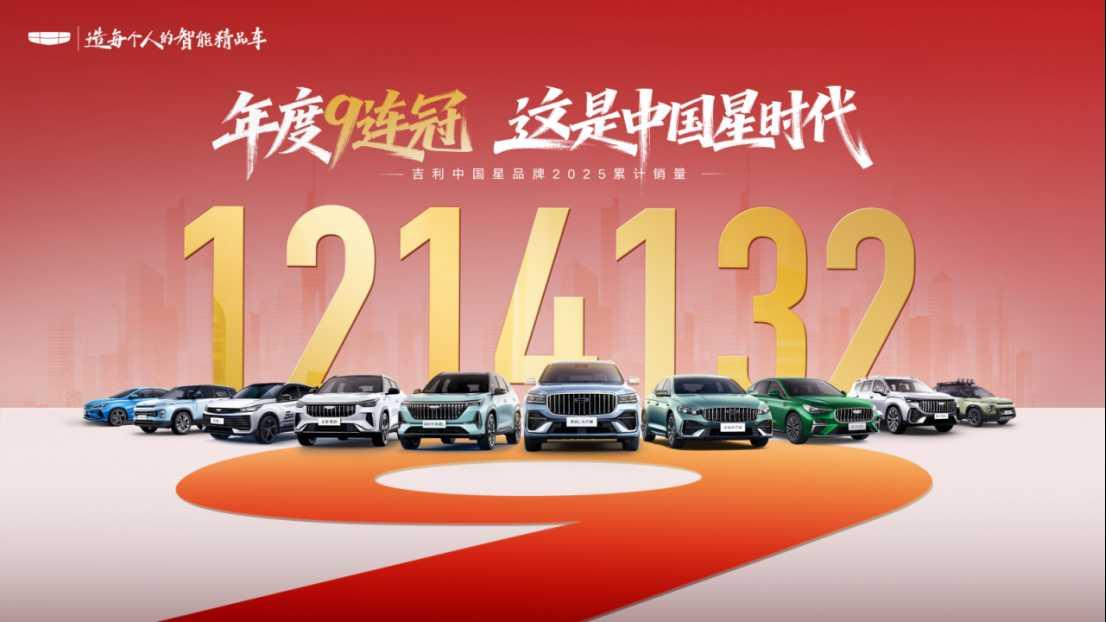
Core Insights - In 2025, Geely Auto achieved an annual total sales of over 3,024,567 vehicles, marking a 39% year-on-year increase and exceeding the adjusted target of 3 million vehicles [1][23]. - The Geely China Star matrix, consisting of popular models like Xingrui, Xingyue L, Boyue, Emgrand, and Bin Yue, sold a total of 1,214,132 units, securing the title of the best-selling Chinese brand fuel passenger car for nine consecutive years [1][23]. - Geely's strong performance in the fuel vehicle market sets a new benchmark for the development of Chinese brand fuel vehicles amidst the accelerating penetration of new energy vehicles [1][23]. Sales Performance - The high-end series of the Geely China Star sold over 420,000 units in 2025, becoming the core engine for the high-end fuel vehicle market [4][25]. - The flagship SUV, Xingyue L, was the best-selling fuel SUV of 2025, while the flagship sedan, Xingrui, led the A-class fuel sedan segment for Chinese brands [4][25]. - The Boyue model achieved annual sales of 300,000 units, driven by continuous product expansion and iteration [6][29]. Product Innovations - The Boyue underwent a dual-car renewal with the launch of the fourth-generation Boyue L and the new Boyue, enhancing its market value standards for family SUVs [8][28]. - The Emgrand sedan sold 180,000 units in 2025, becoming the first and only Chinese brand sedan to surpass cumulative global sales of 4.15 million units [10][30]. - The fifth-generation Emgrand, built on the new BMA Evo global modular architecture, underwent a comprehensive upgrade across five dimensions: aesthetics, comfort, safety, driving control, and intelligence [10][30]. Safety and Technology - Geely emphasizes safety as its top priority, with over 250 billion invested in R&D over the past 11 years and 1,562 safety patents, leading the industry [12][33]. - The global safety center was launched in 2025, achieving five Guinness World Records, and introduced the "Full Domain Safety 2.0" technology system to enhance safety standards [12][33]. - The Geely China Star models are designed with a focus on comprehensive safety, adhering to C-NCAP five-star standards and incorporating advanced safety features [14][36]. Intelligent Features - Geely's "Smart Geely 2025" strategy, initiated in 2021, aims to create a smart technology ecosystem through advanced computing and data capabilities [17][38]. - The introduction of the "Full Domain AI" technology system in 2025 positions Geely as the only automaker with a complete AI intelligent layout, enhancing both fuel and new energy vehicles [17][38]. - The new models feature the industry-leading "Qianli Haohang" advanced driving assistance system, providing a comprehensive perception capability [18][39]. Future Outlook - Geely aims to continue leveraging its core advantages in full-domain AI and safety to meet user demands and drive technological innovation [21][41]. - The company is committed to redefining the value standards of fuel vehicles through continuous technological iterations in safety, intelligence, energy efficiency, and comfort [21][41].
CES 2026,中国车来定义“AI+出行”丨品牌新事
吴晓波频道· 2026-01-09 00:30
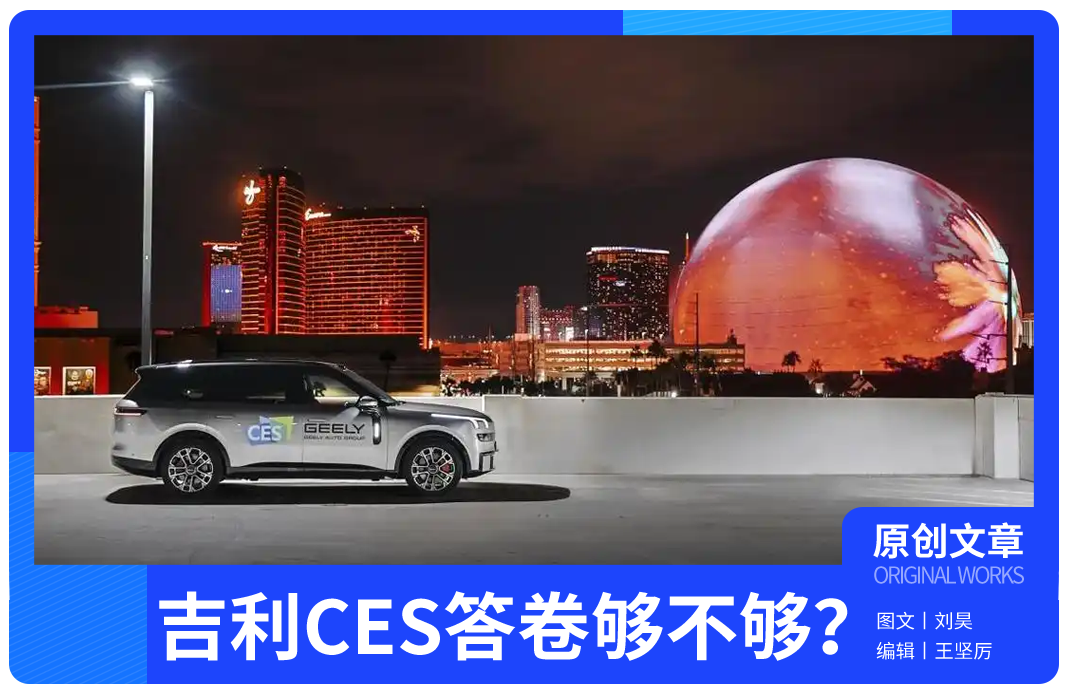
Core Viewpoint - The article emphasizes that artificial intelligence (AI) is fundamentally reshaping the automotive industry, with Chinese automakers leading this transformation at the 2026 CES [4]. Group 1: AI's Impact on the Automotive Industry - AI is expected to influence the purchasing decisions of 40 to 50 million vehicles globally by 2030, with automakers that successfully implement AI at scale potentially increasing their sales by 20% [4]. - The transition from traditional automotive functions to AI-driven capabilities is likened to the shift from feature phones to smartphones, highlighting the need for vehicles to understand user states rather than just execute commands [9][10]. - Current AI applications in vehicles are often fragmented, lacking integration across systems like driving, cabin, and chassis, which leads to a disjointed user experience [11][12]. Group 2: Challenges in AI Integration - The automotive industry faces significant technical challenges, including the need for a cohesive ecosystem that integrates chips, software, cloud services, and mapping data [15]. - AI's evolution requires vast amounts of driving data and must be built on a foundation of safety [16]. - The gap between experimental AI technologies and their real-world application remains a major hurdle, compounded by the long development cycles of vehicles compared to the rapid pace of AI advancements [17]. Group 3: Geely's AI Strategy - Geely has made significant strides in AI integration, achieving a sales volume of 3.025 million vehicles in 2025, a 39% increase year-on-year, with 1.688 million being new energy vehicles, marking a 90% growth [21]. - The company introduced its "Full-Field AI 2.0" technology at CES 2026, which enhances the integration of AI across various vehicle domains, allowing for continuous evolution and improved decision-making capabilities [22][26]. - Geely's approach combines extensive R&D investment, a comprehensive AI ecosystem, and a large dataset from over 8.5 million assisted driving vehicles, which supports ongoing optimization of its AI systems [31]. Group 4: Competitive Landscape - The article notes that different global automakers are pursuing varied technological paths, with Chinese companies like Geely adopting a systematic approach that leverages a complete supply chain for rapid AI integration [35]. - The unique "Chinese speed" allows for quick iterations of AI algorithms and vehicle products, creating a feedback loop that enhances innovation and market responsiveness [35]. - As competition in the automotive industry shifts from isolated technological advancements to a comprehensive ecosystem approach, the advantages of Chinese automakers become increasingly apparent [36].

CES 2026|吉利秀AI“大肌肉”:发布全域AI 2.0 2026年冲刺345万辆销量目标
Zhong Guo Jing Ying Bao· 2026-01-08 03:49
Core Viewpoint - Geely is advancing its position in the global automotive industry by leveraging its full-domain AI technology, marking a significant evolution in smart electric vehicles and enhancing its competitive edge through technological innovation [3][5][11]. Group 1: Full-Domain AI Technology - Geely has successfully transitioned its full-domain AI technology to version 2.0, achieving cross-domain integration that enhances the vehicle's intelligence and decision-making capabilities [3][7]. - The World Action Model (WAM) serves as the core of Geely's AI system, enabling a unified "vehicle brain" that integrates various domains such as driving, cabin, and chassis [6][7]. - The upgraded AI system introduces a multi-agent collaborative framework, allowing different AI entities to communicate and cooperate, thus improving user interaction and task execution [7][8]. Group 2: Product Launches and Innovations - Geely unveiled the Eva super-personalized emotional AI agent, which is designed to evolve into a central intelligent hub for vehicles, enhancing user experience through advanced interaction capabilities [3][8]. - The company introduced the "Qianli Haohan G-ASD" intelligent driving system, which represents a high-quality smart driving solution developed in collaboration with Qianli Zhijia [3][9]. - Geely's new models, including the Zeekr 9X and Zeekr 009, showcase the integration of advanced technologies such as satellite communication and AI-driven systems [4][3]. Group 3: Sales Performance and Future Goals - In 2025, Geely achieved sales of over 3.02 million vehicles, exceeding its targets, and set an ambitious sales goal of 3.45 million vehicles for 2026 [5][11][12]. - The company aims to deepen its "integrated mobility ecosystem" and enhance its global presence by combining innovative electric vehicle technologies with the global supply chain [5][12]. - Geely plans to launch approximately 10 new models in 2026, further solidifying its position as a leader in smart electric vehicles [12].