艾力斯

Search documents
《支持创新药高质量发展的若干措施》出台,创新药迎来高质量发展机遇
Tai Ping Yang Zheng Quan· 2025-07-02 13:52
Investment Rating - The industry investment rating is positive, with expectations of overall returns exceeding the CSI 300 index by more than 5% in the next six months [11]. Core Insights - The introduction of the "Measures to Support the High-Quality Development of Innovative Drugs" marks a significant opportunity for the innovative drug sector, addressing key challenges in research, payment, and clinical application [4][8]. - The report emphasizes a comprehensive support system for innovative drug development, including the use of national health insurance data to guide research directions and enhance innovation efficiency [5]. - The measures aim to optimize the inclusion of innovative drugs in the basic medical insurance catalog and commercial health insurance, ensuring that they meet clinical value and market conditions [6][9]. - The report highlights the potential for innovative drugs to expand their market reach, both domestically and internationally, under the Belt and Road Initiative, enhancing accessibility for patients [9]. Summary by Sections Industry Ratings - Sub-industry ratings for chemical pharmaceuticals, traditional Chinese medicine, and biopharmaceuticals are currently not rated [3]. Recommended Companies and Ratings - Companies such as Kelun-Botai, Kangfang Biotech, Lepu Biotech, Maiwei Biotech, and Ailis are expected to experience a new round of high-quality development opportunities, maintaining a "buy" rating [9].
今年上半年全球9款肺癌新药获批
Bei Ke Cai Jing· 2025-07-01 08:17
Core Insights - Lung cancer remains the leading cause of cancer-related deaths globally, with ongoing research and development of innovative drugs targeting this disease [1][2] - A total of 2813 drugs are currently in development for lung cancer indications, with a significant focus on non-small cell lung cancer (NSCLC) [2] - In the first half of this year, 9 innovative drugs for lung cancer have been approved, providing new treatment options for patients [3] Group 1: Drug Development Trends - The number of drugs in development for lung cancer has increased from 1655 in November 2022 to 2813 by July 2023, with the majority targeting NSCLC [2] - Among the 2813 drugs, small molecule drugs are the most prevalent, totaling 1028, followed by monoclonal antibodies (264), antibody-drug conjugates (ADC) (226), and bispecific antibodies (110) [2] - The most common drug targets include EGFR (66 drugs), PD-1 (42 drugs), and PD-L1 (27 drugs) [2] Group 2: Recent Drug Approvals - The 9 newly approved lung cancer drugs include products from major companies such as Johnson & Johnson, Bristol-Myers Squibb, and domestic firms like Hengrui Medicine and Hansoh Pharma [3][5] - Johnson & Johnson's Evotazumab is the first bispecific antibody approved for lung cancer, initially for second-line treatment of EGFR exon 20 insertion mutations [4] - The domestic drug Luconisumab, developed by Kelun-Biotech, is the second globally and the first in China ADC targeting TROP2, approved for treating advanced NSCLC [5] Group 3: Emerging Treatment Strategies - The approval of new drugs is addressing rare mutations such as EGFR exon 20 insertion, which accounts for 4%-10% of EGFR mutations and has poor prognosis with existing treatments [3] - The PD-1/VEGF bispecific antibody Ivosidenib has been approved for first-line treatment of PD-L1 positive NSCLC, marking a significant advancement in immunotherapy [7] - The introduction of drugs targeting KRAS mutations, previously considered "undruggable," indicates a shift in treatment possibilities for advanced NSCLC [6]
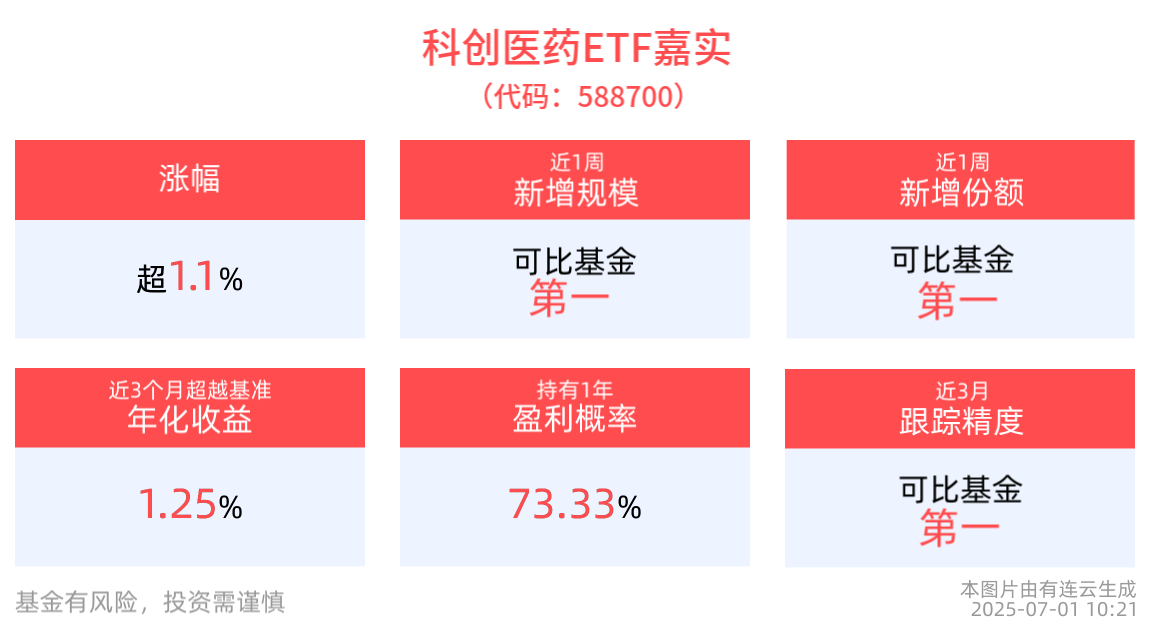
支持医保数据用于创新药研发!科创医药ETF嘉实(588700)上涨1.17%,近一周新增规模同类第一
Sou Hu Cai Jing· 2025-07-01 02:46
Group 1 - The core viewpoint highlights the strong performance and growth of the Kexin Pharmaceutical ETF, which has seen significant trading volume and asset growth, indicating investor interest in the sector [3] - As of June 30, the Kexin Pharmaceutical ETF has achieved a net value increase of 27.37% over the past year, with a maximum monthly return of 23.29% since inception [3] - The top ten weighted stocks in the Shanghai Stock Exchange Science and Technology Innovation Board Biopharmaceutical Index account for 50.3% of the index, with leading companies including United Imaging Healthcare and BeiGene [3][5] Group 2 - Recent measures from the National Healthcare Security Administration and the National Health Commission support the use of medical insurance data for innovative drug development, enhancing collaboration among healthcare, insurance, and pharmaceutical sectors [5] - East China Securities emphasizes the importance of innovative drugs as a core investment theme, suggesting investors focus on companies with differentiated product offerings and strong potential for growth [6] - The global pharmaceutical investment landscape is recovering, positively impacting the CXO and upstream life sciences sectors, leading to improved order and financial performance [6]

科创生物医药ETF(588250)上涨近1%,药品追溯码全面应用
Sou Hu Cai Jing· 2025-07-01 02:12
Group 1 - The Shanghai Stock Exchange Sci-Tech Innovation Board Biopharmaceutical Index (000683) increased by 0.93% as of July 1, 2025, with notable gains from stocks such as Rongchang Biopharmaceutical (688331) up 7.21% and Shanghai Yizhong (688091) up 3.61% [1] - Starting July 1, 2025, a new policy mandates that all drug sales must include a verification code for medical insurance reimbursement, with full traceability of drug codes required by January 1, 2026, which is expected to enhance drug circulation regulation and impact the entire pharmaceutical industry chain [1] - The current bull market in innovative drugs is driven by the improvement of China's pharmaceutical innovation capabilities, with a trend towards international collaboration in new drug development expected to enhance profitability and market potential for Chinese pharmaceutical companies [2] Group 2 - As of June 30, 2025, the top ten weighted stocks in the Shanghai Stock Exchange Sci-Tech Innovation Board Biopharmaceutical Index accounted for 50.3% of the index, including companies like United Imaging Healthcare (688271) and BeiGene (688235) [3] - The Sci-Tech Biopharmaceutical ETF closely tracks the performance of the Shanghai Stock Exchange Sci-Tech Innovation Board Biopharmaceutical Index, which includes 50 large-cap companies in various biopharmaceutical sectors [2]


艾力斯(688578):伏美替尼赋能,成功转型Biopharma
Changjiang Securities· 2025-07-01 01:20
Investment Rating - The report initiates coverage with a "Buy" rating for the company [10][12]. Core Viewpoints - The company, Ailis, is a representative enterprise in the Biotech sector, focusing on innovative cancer drug development, particularly with its core product, Fumetinin, which shows significant clinical data advantages for treating EGFR-sensitive mutation NSCLC [3][6]. - Fumetinin is expected to enhance its market penetration due to its excellent efficacy and safety profile, with sales projected to reach 3.506 billion yuan in 2024, accounting for over 99% of the company's total revenue [7][28]. - The company is expanding its product pipeline through a dual strategy of "self-research + introduction," focusing on high-barrier targets like KRAS G12C and RET, which broadens its growth potential [6][9]. Summary by Sections Company Overview - Ailis has successfully transitioned from a Biotech to a Biopharma company, leveraging the commercial potential of Fumetinin, which was approved for clinical trials in 2016 and launched in 2022 [20][28]. Product and Market Potential - Fumetinin has shown superior efficacy and safety in treating EGFR mutation-positive NSCLC, with ongoing clinical trials aimed at expanding its indications to include brain metastases and rare mutations [7][8]. - The company is collaborating with ArriVent to advance global clinical studies for rare mutations, which could significantly enhance its market presence [8]. Financial Performance - The company reported a revenue of 3.558 billion yuan in 2024, a 76% year-on-year increase, with a net profit of 1.424 billion yuan, reflecting a 121% growth [28][30]. - Revenue forecasts for 2025-2027 are projected at 4.987 billion yuan, 5.768 billion yuan, and 6.896 billion yuan, respectively, with corresponding net profits of 1.737 billion yuan, 2.105 billion yuan, and 2.521 billion yuan [10]. Research and Development - The company maintains a strong focus on innovation, with increasing R&D investments that are expected to remain stable relative to revenue, ensuring a balance between innovation and sustainable growth [32][34].

6月30日工银医疗保健股票净值增长1.16%,今年来累计上涨14.61%
Sou Hu Cai Jing· 2025-06-30 12:52
Group 1 - The core viewpoint of the news is the performance and holdings of the Industrial and Commercial Bank of China Healthcare Stock Fund, which has shown a recent net value increase and varying returns over different time frames [1] - As of June 30, 2025, the fund's latest net value is 2.6120 yuan, reflecting a growth of 1.16%. The fund has a one-month return of -1.55%, a six-month return of 14.61%, and a year-to-date return of 14.61% [1] - The fund's top ten holdings account for a total of 39.79%, with significant positions in companies such as Heng Rui Pharmaceutical (8.90%), WuXi AppTec (5.12%), and Aier Eye Hospital (4.94%) [1] Group 2 - The Industrial and Commercial Bank of China Healthcare Stock Fund was established on November 18, 2014, and as of March 31, 2025, it has a total scale of 2.724 billion yuan [1] - The fund is managed by Zhao Bei and Ding Yang, both of whom have extensive experience in the healthcare sector and investment management [2]
商保目录首次纳入调整方案,医疗保障法征求意见发布
ZHONGTAI SECURITIES· 2025-06-29 14:27
Investment Rating - The report maintains an "Overweight" rating for the pharmaceutical and biotechnology sector, indicating a positive outlook for the industry over the next 6 to 12 months [2][45]. Core Insights - The pharmaceutical sector has shown a 1.60% increase, following the broader market trend, with the Shanghai Composite Index rising by 1.95%. The sector ranks 23rd among 31 primary sub-industries [5][13]. - All sub-sectors within the pharmaceutical industry experienced growth, with notable increases in medical services (2.92%), medical devices (2.10%), and pharmaceutical commerce (2.08%) [5][13]. - The report emphasizes that innovative drugs remain the most promising sub-sector within the pharmaceutical industry, with a clear growth trajectory expected to continue despite short-term adjustments [5][13]. - The National Healthcare Security Administration has initiated discussions on the 2025 National Basic Medical Insurance and commercial health insurance drug directory adjustments, which are expected to catalyze innovation in the sector [5][13]. - The introduction of the Medical Security Law is anticipated to enhance the regulatory framework and support the long-term development of the pharmaceutical industry [5][13]. Summary by Sections Market Performance - The pharmaceutical sector's return is 6.2% year-to-date, outperforming the Shanghai Composite Index, which has a return of -0.3% [14]. - The report notes that the pharmaceutical sector's valuation is currently at 23.2 times PE based on 2025 earnings forecasts, which is a 24.2% premium over the overall A-share market [17]. Key Company Recommendations - The report recommends increasing allocations to innovative drug companies, particularly those transitioning from biotech to biopharma, such as I-Mab, Junshi Biosciences, and BeiGene [5][13]. - Traditional pharmaceutical companies that are innovating, such as 3SBio and Changchun High & New Technology, are also highlighted as strong investment opportunities [5][13]. Company Dynamics - The report includes updates on key companies, such as the approval of clinical trials for various drugs by companies like Hengrui Medicine and the positive opinion from the European Medicines Agency for a new treatment by Baiyue Pharmaceutical [30].
私募股权投资手册(221页)
梧桐树下V· 2025-06-28 03:50
Core Viewpoint - The article emphasizes the practicality and value of the "Private Equity Investment Handbook," which covers essential aspects of due diligence, risk management, investment agreements, and dispute resolution in private equity investments [3][19]. Summary by Sections Chapter 1: Due Diligence - The first chapter introduces the main processes and methods of due diligence in equity investment, focusing on the "Four Cores" of business due diligence, "Five Definitions" of financial due diligence, and "Six Dimensions" of legal due diligence [6][8]. - It details the "Four Cores" of business due diligence, which include business and product, target company's industry segmentation, R&D capabilities, and core competitiveness [6]. - The chapter provides practical examples, such as the "Seven Axes" of due diligence used by Muddy Waters, which includes reviewing documents, checking related parties, on-site research, and supplier investigations [6]. Chapter 2: Risk Management - The second chapter outlines three common business risks, four financial risks, ten legal risks, and valuation risks, along with risk mitigation strategies [8]. - It includes numerous case studies to illustrate practical applications, particularly focusing on the coherence of business logic and addressing shareholder verification issues through real-world examples [8]. Chapter 3: Investment Agreements - The third chapter discusses the types and functions of investment agreements, detailing nearly 30 key clauses across eight categories [10]. - It highlights the importance of valuation adjustment clauses, which can help manage issues arising from short-term performance pressures while maintaining long-term interests [10]. Chapter 4: Betting Clauses - The fourth chapter elaborates on betting clauses, covering aspects such as the parties involved, conditions, buyback periods, and methods of betting [11][12]. - It raises questions about the legal effectiveness of buyback claims triggered by betting conditions and the necessity of disclosing betting agreements before an IPO [12]. Chapter 5: Disputes in Betting and Buyback - The fifth chapter focuses on seven types of disputes related to betting and buyback, analyzing numerous cases to clarify judicial reasoning in such matters [14][16]. - It discusses how ambiguities in betting conditions can lead to conflicting interpretations and how courts resolve these disputes [14][16].

创新药持续走高,如何把握上车机会?
Sou Hu Cai Jing· 2025-06-25 06:36
Core Viewpoint - The innovative pharmaceutical sector is experiencing a resurgence, driven by improved fundamentals, supportive policies, and increased market interest, particularly in the A-share and Hong Kong markets [1][3][12]. Group 1: Market Performance - The pharmaceutical sector has shown strong performance this year, with a notable rebound starting from April 9, despite recent pullbacks [1]. - The innovative drug segment in A-shares and Hong Kong stocks has continued to strengthen, indicating a recovery after four years of adjustment [1][3]. - The total amount of business development (BD) transactions for innovative drugs is projected to rise significantly, from $8.4 billion in 2020 to $51.9 billion in 2024 [4]. Group 2: Policy and Industry Trends - The policy environment has shifted from cost control to encouraging innovation, providing strong support for the development of innovative drugs [3]. - The number and quality of innovative drug products in China have significantly improved, leading to increased interest from foreign pharmaceutical companies [3][5]. - The penetration rate of innovative drugs in China is expected to rise, with current levels at around 20%, compared to 70%-80% in the U.S. [5]. Group 3: Investment Opportunities - Fund managers are optimistic about the future of innovative drugs, emphasizing the importance of technology and growth attributes in the sector [6]. - Investment strategies include focusing on high-quality companies, innovative drug leaders, and traditional pharmaceutical companies transitioning to innovative drugs [7][8][9]. - Investors can consider actively managed pharmaceutical funds or industry-themed ETFs to gain exposure to the innovative drug market [10][12]. Group 4: Fund Performance - Several funds managed by 工银瑞信 have demonstrated strong performance, ranking highly in their respective categories over various time frames [13][15]. - The 工银港股通创新药ETF has seen significant inflows, reflecting market preference for innovative drug companies [11].



上会确定!第五套标准重启后首单!
天天基金网· 2025-06-25 03:18
Core Viewpoint - Wu Yuan Bio is the first company to be reviewed under the newly established fifth set of standards for the Sci-Tech Innovation Board, following the announcement of support for unprofitable companies to list [1][7]. Company Overview - Wu Yuan Bio, established in 2006, focuses on innovative drug research and development, with its core product HY1001 (recombinant human albumin injection) having completed Phase III clinical trials and included in the priority review process by the National Medical Products Administration [3][4]. - The company has not yet generated revenue from its core innovative drug products, with current income primarily from pharmaceutical excipients and research reagents [3][6]. - Cumulative R&D investment from 2022 to 2024 is projected to reach 386 million yuan, with a workforce of 178 employees, 122 of whom are dedicated to R&D, indicating a strong focus on innovation [3][6]. Product Development - HY1001 aims to supplement or enhance the levels of human serum albumin in the blood, potentially replacing plasma-derived human serum albumin, which is currently the most widely used blood product in clinical settings [3][4]. - The company has achieved breakthroughs in increasing the expression and purity of recombinant human albumin, reducing production costs, and enhancing clinical safety, earning a second-class National Technology Invention Award for its related technology [4]. Industry Context - As of 2024, 20 companies have been listed under the fifth set of standards, primarily consisting of innovative biopharmaceutical firms, with a combined revenue exceeding 14 billion yuan, reflecting a growth of over 40% from 2023 [6][7]. - In the first quarter of 2025, these companies collectively achieved a revenue of 3.78 billion yuan, marking a year-on-year growth of 29.27% [7]. - The fifth set of standards has facilitated the listing of 17 first-class new drugs, accounting for approximately 12% of the total number of domestically approved innovative drugs from 2018 to the first quarter of 2025, establishing itself as a backbone of China's pharmaceutical innovation [7].