迈瑞医疗

Search documents
迈瑞医疗股价跌近60%董事长拟2亿增持 营收净利首双降连续三季分红累计49亿
Chang Jiang Shang Bao· 2025-12-01 00:53
公司还公告,未来6个月内,李西廷将继续增持公司股份,增持金额2亿元(含本次增持金额)。 截至目前,李西廷及其一致行动人合计控制公司51.48%的股权。 这是迈瑞医疗自2018年A股上市以来的李西廷首次增持。2021年2月18日,迈瑞医疗股价涨至巅峰503.51 元/股,目前的股价较巅峰时刻下跌接近60%。 董事长罕见出手增持,有投资者解读称,"股价到底部了!" 迈瑞医疗的经营业绩罕见下降。2025年前三季度,公司实现的营业收入、归母净利润分别为258.34亿 元、75.70亿元,同比下降12.38%、28.83%。主要原因是市场需求自然放缓,客观经济规律所致。 迈瑞医疗积极分红。2025年前三季度,公司每个季度都进行了分红,合计分红49.35亿元。李西廷及其 一致行动人将获得红利超过20亿元。 长江商报消息●长江商报记者 沈右荣 股价跌跌不休,实际控制人、董事长出手了。 11月27日晚,"国产医疗器械一哥"?迈瑞医疗(300760.SZ)发布公告 ,当日,公司董事长李西廷增持公 司股份15.23万股,增持金额接近3000万元。 净利超20%增长神话不再 迈瑞医疗股价跌幅较大,与经营业绩表现有一定关系。 董事长 ...

中国医疗独家调研:DRG 后时代的布局 -AI 与国产替代加速推进-China Healthcare Proprietary Survey Navigating a Post-DRG World AI and Domestic Substitution Accelerate-China Healthcare
2025-12-01 00:49
Summary of China Healthcare Conference Call Industry Overview - The conference call focused on the **China healthcare market**, highlighting significant transformations driven by DRG/VBP policies, domestic product substitution, and AI adoption in clinical workflows [1][4][5]. Key Insights AI Adoption - **AI Integration**: 86% of surveyed professionals are using AI-enabled medical devices or software, with hospitals budgeting an average of **Rmb6 million** for AI in 2025, expected to increase in 2026 [2][9][14]. - **Primary Applications**: The main uses of AI are in medical imaging and clinical decision support, enhancing diagnostic accuracy and saving time [10][12]. Hospital Procurement and Stimulus - **Procurement Recovery**: 64% of hospitals received stimulus funds, with a median expectation of **Rmb20 million** per hospital for equipment trade-ins in 2025 [3][51]. - **Stimulus Growth**: 48% of respondents expect an increase in stimulus funds compared to 2024, indicating ongoing governmental support for medical equipment procurement [51][53]. DRG Impact - **Stabilization of DRG Effects**: Approximately 90% of respondents expect the impact of DRG to stabilize by the first half of 2026, with clinical labs being the slowest to adapt [4][23][24]. - **IVD Sector Challenges**: The In-Vitro Diagnostics (IVD) sector is facing a "double-hit" in 2025, with expectations of recovery starting from 1H26 [37][38]. Domestic Substitution - **Cost Reduction**: Surgery costs have decreased by **13% year-over-year**, primarily due to increased use of domestic products and price reductions in medical consumables [30][35]. - **Market Dynamics**: Leading domestic manufacturers like Mindray, United Imaging, and MicroPort MedBot are gaining market share and challenging multinational corporations (MNCs) on quality and physician preference [1][5][47]. Brand Preference and Market Competition - **Domestic Brand Growth**: The survey indicates a significant shift towards domestic brands in imaging and IVD, with Mindray emerging as a leader in hematology analyzers and total lab automation solutions [45][47]. - **Competitive Landscape**: While MNCs maintain dominance in high-end niches, domestic players are rapidly closing the gap, particularly in high-volume segments [44][47]. Operational Dynamics - **Generics Usage**: 74% of prescriptions are for generics when available, indicating limited room for cost savings through switching from branded drugs [56]. - **Multi-Site Practices**: 14% of surgeons have increased multi-site practice activities, with 76% expecting this trend to continue, potentially benefiting private hospitals [66][69]. Financial Metrics - **Accounts Receivable Days**: The average receivable days for public medical insurance payments have decreased to **57 days** in 2025 from **61 days** in 2024, with notable improvements in Tier 1 and Tier 2 cities [71][72]. Conclusion - The China healthcare market is experiencing a transformative phase characterized by the integration of AI, a shift towards domestic products, and stabilization of DRG impacts. The ongoing support from the government and the evolving competitive landscape suggest a promising outlook for domestic manufacturers and healthcare providers in the coming years [1][5][47].

医疗器械和医疗服务行业2026年展望:行业持续复苏,长线布局机会显现
2025-12-01 00:49
Summary of Medical Device and Healthcare Services Industry Conference Call Industry Overview - The medical device and healthcare services industry is expected to continue its recovery, with long-term investment opportunities emerging for 2026. [1][2] - The impact of centralized procurement is gradually diminishing, with some demand expected to be delayed until 2025. [1][2] Key Insights and Arguments - **Growth Drivers**: The industry is projected to experience steady growth in 2026 due to inventory clearance, new product launches, and growth in overseas markets. [1][2] - **Cautious Outlook from Leading Companies**: Some leading companies have provided cautious performance guidance for the upcoming periods. [1][2] - **Focus Areas**: Specific segments such as orthopedics (e.g., Spring Medical) and e-commerce connections (e.g., New Pulse Medical) are highlighted as areas of interest. [1][3] - **RVD Sector**: The RVD sector is expected to perform well in 2026, driven by a high proportion of overseas revenue (40%). [1][3] - **Electrophysiology**: Companies like Huatai are noted for their cost-effective valuations, with expectations of significant growth driven by new products. [1][5] - **IVD Sector**: The IVD sector is anticipated to face challenges in 2025 but is expected to gradually recover starting in Q4. [1][10] Company-Specific Developments - **Huatai**: Despite recent stock price adjustments, Huatai is expected to see a profit growth rate of over 25% in 2026, supported by the launch of its innovative product TFA. [5] - **Aohua Endoscopy**: The company is expected to see revenue growth due to improved bidding data and the introduction of competitive new products. [6] - **Mindray**: Aiming to penetrate over 2,000 key hospitals in the IVD sector, with potential market share growth due to acquisitions. [11] - **New Industry**: Expected to maintain over 20% growth in overseas markets despite domestic pricing pressures. [11] Investment Opportunities - **Current Market Position**: Many medical device companies, including Mindray and Huatai, are viewed as having long-term value and low valuation opportunities. [7][8] - **Potential High-Growth Companies**: Companies like Microelectrophysiology and Ruimaite are highlighted as having potential for exceeding expectations in business growth. [8] - **2026 Performance Expectations**: The medical device sector is expected to accelerate in 2026, with companies like Mindray and Kaidiya projected to improve performance due to better bidding trends and reduced inventory pressure. [9] Challenges and Risks - **IVD Sector Challenges**: The IVD sector is facing price pressures and a decline in volume in 2025, but is expected to stabilize in 2026. [10] - **High-Value Consumables**: The sector is experiencing challenges due to centralized procurement policies, but opportunities for valuation recovery exist in segments where risks have not fully cleared. [13][14] Future Outlook - **Serious Medical vs. Consumer Medical**: Serious medical is under pressure but expected to recover in the long term, particularly in oncology. Consumer medical is seen as having significant growth potential due to low penetration rates. [19] - **International Expansion**: Domestic companies are increasingly focusing on international markets, with various strategies being employed to enhance their global presence. [17][18] This summary encapsulates the key points discussed in the conference call regarding the medical device and healthcare services industry, highlighting growth prospects, company-specific developments, investment opportunities, and potential challenges.



私募超44000次调研,去了哪些行业?
中国基金报· 2025-11-30 15:06
Core Insights - The article highlights that private equity firms have conducted over 44,000 research activities on A-share listed companies in China this year, with a strong focus on hard technology sectors such as electronics, biomedicine, and machinery [2][4]. Group 1: Research Activities - A total of 2,579 private equity firms participated in A-share research activities, covering 2,184 stocks across 30 primary industries, with 44,702 total research instances [4]. - The top three industries by research frequency are electronics (8,732 times), biomedicine (6,341 times), and machinery (5,437 times) [4]. - Notable stocks in the electronics sector include Luxshare Precision, which was researched 335 times, and other prominent companies in the biomedicine sector such as United Imaging Healthcare and Mindray Medical [4][5]. Group 2: Investment Focus - Private equity firms are increasingly interested in sectors like artificial intelligence, innovative pharmaceuticals, and new consumption trends, as well as structural opportunities arising from "anti-involution" policies [2][9]. - The electronics industry is leading due to accelerated domestic semiconductor replacement and the initiation of a consumer electronics innovation cycle [7]. - The biomedicine sector is favored for its diverse stock options and the rapid approval of innovative drugs, while the power equipment sector benefits from the continuous growth of new energy installations [7]. Group 3: Market Outlook - The article suggests that the market is transitioning from valuation-driven to performance-driven, with a focus on high-growth sectors such as AI, innovative pharmaceuticals, and machinery [9]. - There is an expectation that individual stock performance will become more significant than sector performance in the future, with a focus on areas that show structural growth potential [9]. - Investment strategies are being adjusted to account for market corrections and style rebalancing, with an emphasis on sectors that can maintain profitability without relying on overall economic recovery [9].


兴证全球基金田大伟:种下ETF“第一颗种子”探索被动投资特色化之路
Shang Hai Zheng Quan Bao· 2025-11-30 14:10
Core Insights - The article discusses the growth and differentiation strategies in the ETF market, highlighting the launch of the Xingzheng Global CSI 300 Quality ETF, which focuses on quality stocks based on profitability metrics [1][2]. ETF Market Growth - The total market size of ETFs has surpassed 5 trillion yuan, with the number of stock ETFs exceeding 1,000, indicating a thriving market [1]. - The rapid growth of the ETF market is noted, with each trillion yuan milestone being reached in shorter time frames, suggesting ample opportunities for investors [2]. Investment Strategy - The Xingzheng Global CSI 300 Quality ETF aims to provide long-term value by focusing on high-quality stocks selected based on profitability, stability, and quality [1][2]. - The ETF is designed to minimize tracking deviation and error, aligning closely with the CSI 300 Quality Index [2]. Performance Metrics - The CSI 300 Quality Index has shown significant long-term outperformance, with a 72.19% increase over the past decade and an annualized return of 5.75%, compared to the CSI 300 Index's 31.31% increase and 2.84% annualized return [3]. - The annualized volatility of the CSI 300 Quality Index is 18.3%, which is lower than the CSI 300's 24.67%, indicating a more stable investment option [3]. Differentiation Strategy - The ETF represents an extension of the company's "boutique strategy," focusing on differentiation to build competitive advantages in the market [4]. - The company plans to adopt a dual approach in passive investment, combining broad-based products with enhanced index products to leverage its active equity investment strengths [4]. Quality Factor Focus - The choice of the quality factor for the ETF is based on the profitability of constituent stocks, particularly the Return on Equity (ROE) metric, which is emphasized as a key indicator of a company's profitability [4]. - The top ten constituents of the CSI 300 Quality Index account for 48.57% of the index, featuring leading companies with strong growth potential [5]. Market Positioning - There are relatively few ETF products that focus on the CSI 300 Quality factor, providing a unique investment opportunity with long-term value and scarcity [6]. - The current economic recovery phase is seen as a favorable time for quality factors to outperform, as historical data suggests core assets tend to show strength during early recovery periods [6].
医药行业周报:本周申万医药生物指数上涨2.7%,关注医保与创新药动态-20251130
Shenwan Hongyuan Securities· 2025-11-30 13:43
Investment Rating - The report maintains a positive outlook on the pharmaceutical industry, indicating an "Overweight" rating, suggesting that the industry is expected to outperform the overall market [28]. Core Insights - The report highlights a 2.7% increase in the Shenwan Pharmaceutical and Biological Index, outperforming the Shanghai Composite Index, which rose by 1.4% [3][5]. - The report emphasizes the importance of monitoring changes in flu epidemics and their impact on the pharmaceutical sector, particularly regarding vaccine and treatment demand [2]. - Key domestic developments include the approval of new indications for innovative drugs and significant stock purchases by company executives, indicating confidence in the sector [12][13]. Market Performance - The Shenwan Pharmaceutical and Biological Index rose by 2.7% this week, ranking 17th among 31 Shenwan first-level sub-industries [3][5]. - The overall valuation of the pharmaceutical sector stands at 29.5 times earnings, placing it 10th among 31 Shenwan first-level industries [5][10]. Recent Key Events Domestic Developments - The State Council meeting discussed enhancing the basic medical insurance system, which is expected to improve the efficiency of fund management and healthcare resource allocation [11]. - Major companies like Mindray Medical and Huyuan Bio are making significant moves, such as stock buybacks and new product approvals, which are seen as positive indicators for the industry [12][13]. International Developments - The report notes the approval of groundbreaking drugs, including the first siRNA drug for treating familial chylomicronemia syndrome, and highlights the challenges faced by other drugs in clinical trials [15][16][17]. Investment Recommendations - The report suggests focusing on innovative drug sectors and companies with strong performance metrics, including Heng Rui Pharmaceutical, Changchun High-tech, and Mindray Medical, among others [2][12]. - It also recommends monitoring companies involved in flu vaccines and treatments as flu activity increases [2].


行业首只沪深300质量ETF提前结募
Sou Hu Cai Jing· 2025-11-30 09:44
Core Insights - The ETF issuance market is experiencing a significant surge, with the first quality ETF tracking the CSI 300 index, launched by Xingzheng Global, announcing an early closure of its fundraising period due to high demand [1][5] - As of November 28, 2025, a total of 332 ETFs have been issued this year, with a combined issuance volume of 2,538.97 billion shares, surpassing the entire issuance volume of 2024 [5][6] - The CSI 300 Quality ETF aims to track a selection of 50 companies with strong operational stability and profitability from the CSI 300 index, reflecting the overall performance of high-quality stocks [2] ETF Market Dynamics - The recent approval of seven AI-themed ETFs marks a rapid expansion in the ETF market, with significant initial subscription volumes, indicating strong investor interest [3][4] - The market is expected to continue seeing structural trends in 2026, with AI and other technology sectors identified as key investment themes [4] - The growth in the ETF market is supported by favorable policies and a shift towards index-based investment strategies, appealing to both institutional and retail investors [6]
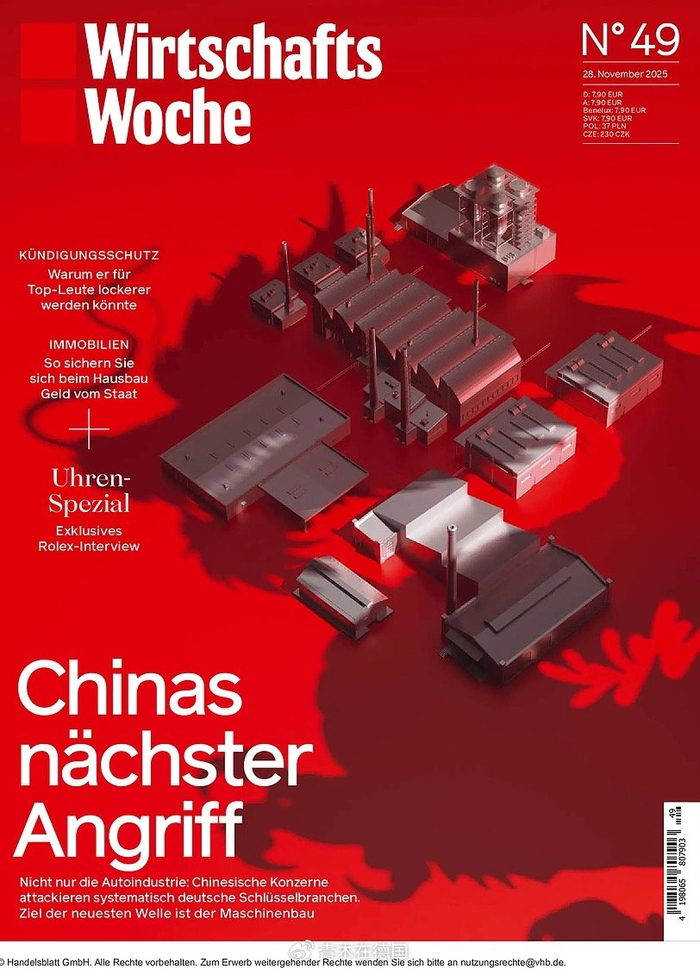
德媒:中企正攻击德国工业的最后堡垒
Xin Lang Cai Jing· 2025-11-30 09:25
Core Insights - The article discusses the strategic challenge posed by Chinese companies to Germany's mechanical engineering sector, which is considered the last major stronghold of German industry [1][4]. Group 1: Competitive Landscape - A study by Infront reveals that over 60% of European mechanical manufacturers feel they have lost or will lose their technological, quality, or brand advantages by the end of this decade [4]. - 75% of European mechanical manufacturers view competition from Chinese rivals as the "most pressing strategic challenge" globally [4]. - Chinese competitors are increasingly replacing German products in various sectors, such as Sany's forklifts overtaking Jungheinrich's models and Mindray's medical equipment competing with Siemens Healthineers [7]. Group 2: Industry Dynamics - The competitive edge of German mechanical engineering is declining due to late product launches, high prices, and insufficient user focus, leading to a loss of value associated with high-end European products [5][10]. - The COVID-19 pandemic has accelerated the shift, allowing Chinese manufacturers to capture market share as German companies cut production [10]. - Chinese executives perceive the current state of European mechanical engineering as lacking practicality, speed, and scalable innovation [10]. Group 3: Strategic Recommendations - German companies need to adopt more flexible business models and continuously adjust their product range and quality to compete effectively [12]. - Decisions aimed at the Chinese market may increasingly need to be made within China, as exemplified by Volkswagen's ability to independently develop and produce vehicles for the Chinese market [12]. - The value of the "Made in Germany" label is diminishing, while "Made in China" is becoming synonymous with innovation, cost-effectiveness, and new designs [12].
行业首只沪深300质量ETF提前结募
券商中国· 2025-11-30 09:24
Core Viewpoint - The ETF issuance market is experiencing a significant surge, with the launch of the first CSI 300 Quality ETF by Xingzheng Global, which has seen rapid fundraising and strong investor interest [1][2][3]. Group 1: ETF Market Overview - As of November 28, 2025, a total of 332 ETFs have been issued this year, with a combined issuance of 2538.97 billion shares, surpassing last year's figures of 177 ETFs and 1217.31 billion shares [1][6]. - The recent approval of seven AI-related ETFs marks a notable trend, with substantial initial fundraising, such as over 9 billion for the Yongying CSI Innovation and Entrepreneurship AI ETF on its first day [4][5]. Group 2: CSI 300 Quality ETF Details - The Xingzheng Global CSI 300 Quality ETF was initially set to close on December 5, 2025, but was advanced to December 1, 2025, due to high demand [2][3]. - This ETF tracks the CSI 300 Quality Index, which selects 50 companies from the CSI 300 based on stability and profitability metrics, reflecting high-quality stocks within the index [3]. Group 3: Market Trends and Future Outlook - Industry insiders believe that the surge in ETF products is a strategic move in anticipation of a structural market in 2026, with AI and related sectors expected to be key investment themes [5]. - The growth of the ETF market is attributed to policy support, rapid approval processes, and the appeal of ETFs for both institutional and retail investors seeking diversified and cost-effective investment options [6].

研判2025!中国音圈电机行业分类、产业链及市场规模分析:制造业智能化升级推动应用场景持续深化,行业迎来广阔增长空间[图]
Chan Ye Xin Xi Wang· 2025-11-30 01:09
Core Insights - The voice coil motor (VCM) market in China is projected to reach approximately 2.231 billion yuan in 2024, reflecting a year-on-year growth of 9.52% driven by the increasing demand in various sectors such as smartphones, industrial automation, and medical devices [1][9][10]. Industry Overview - VCM operates based on the Lorentz force principle, converting electrical energy directly into linear mechanical energy without the need for gears or screws, making it suitable for high-precision positioning and rapid linear motion [2][4]. - The VCM technology encompasses three main types: linear, swing, and multi-axis, each designed for specific applications ranging from autofocus in cameras to complex movements in semiconductor equipment [4][5]. Industry Supply Chain - The upstream supply chain includes raw materials such as magnetic materials, coil materials, and electronic components, while the midstream focuses on the manufacturing of VCMs, and the downstream applications span consumer electronics, automotive electronics, and medical devices [6]. Key Components - The core components of VCM include the permanent magnet assembly, the moving coil, and the guiding mechanism, which collectively ensure rapid response and precise control [7][8]. Market Dynamics - The demand for VCMs in smartphones is expected to remain stable, with the number of VCMs per device increasing from 2-3 to 5-8 due to the trend of multi-camera setups and higher pixel counts [9]. - The penetration of high-end smartphone models is driving the increase in VCM prices and profit margins [9]. Key Companies - Shenzhen Xinyi Chang focuses on semiconductor equipment and has achieved over 90% yield in its VCM applications, while Jiangsu Leili specializes in medical and automotive applications, with its VCMs being used in ventilators and laser radars [10][11]. Industry Trends 1. The application of new materials, such as high-temperature superconducting coils and neodymium iron nitrogen magnets, is reshaping performance boundaries and cost structures, particularly in high-demand sectors like automotive and medical [12]. 2. The integration of AI algorithms and edge computing is transitioning VCMs from passive execution to autonomous decision-making, leading to new business models that combine hardware and software services [13]. 3. The trend towards multi-dimensional integration is transforming VCMs from standard components to comprehensive system solutions, enhancing product value and profit margins [14][15].