
抖音

Search documents
历经月余,16家披露!
Jin Rong Shi Bao· 2025-11-19 09:18
Core Points - The implementation of the "Notice on Strengthening the Management of Internet Loan Business by Commercial Banks" has established a "whitelist" system for financial institutions involved in internet lending, requiring banks to disclose and manage their partner institutions [1] - The new regulations have prompted at least 16 trust companies to publicly disclose their cooperation lists, indicating a shift towards greater transparency in the industry [1][2] - The focus of the regulations is not only on compliance but also on encouraging trust companies to enhance their active management capabilities and transition from a "light capital, high turnover" model to a "heavy capability, high value-added" model [2][3] Summary by Sections Section 1: Regulatory Changes - The "Notice" mandates that commercial banks manage platform operators and credit enhancement service providers through a whitelist system, prohibiting partnerships with non-listed entities [1] - The implementation has led to a significant number of trust companies publicly announcing their cooperation lists, enhancing market clarity [1] Section 2: Industry Impact - Major internet companies and fintech firms are the primary partners listed by banks and trust companies, indicating a concentration of collaboration among leading players in the market [2] - Less than 30% of companies in the consumer finance sector have disclosed their cooperation lists, reflecting a varied approach to compliance within the industry [2] Section 3: Future Directions - The "Asset Management Trust Management Measures" draft emphasizes the need for improved information disclosure, risk management, and a return to core asset management practices [3] - Experts suggest that the trust industry is moving towards a more regulated, transparent, and market-oriented development phase, marking the end of the old channel-based business model [3]
QuestMobile2025年双十一洞察报告:内容互动量、快递业务量、下单量飙升,平台间用户争夺战激烈
3 6 Ke· 2025-11-19 02:29
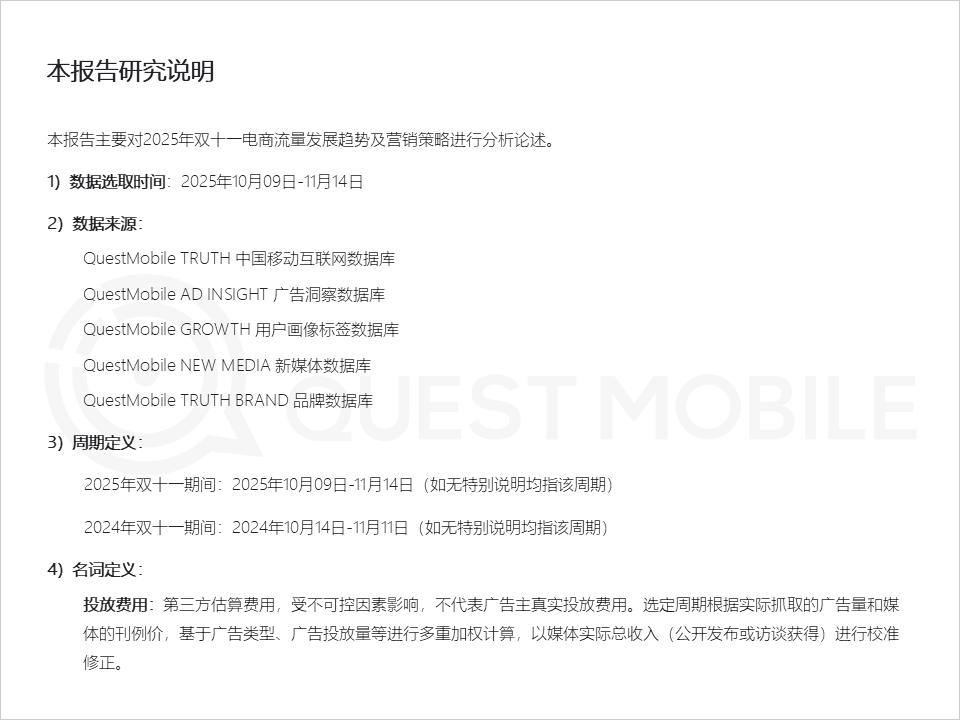
Core Insights - The 2025 "Double Eleven" shopping festival shows a significant increase in mobile shopping penetration and user engagement, indicating a shift towards a more mature consumer behavior in e-commerce [1][8][11]. Industry Insights - The active penetration rate of the mobile shopping industry reached 87.5% in October 2025, a 0.6% increase from the previous year [8]. - The content interaction volume during "Double Eleven" experienced explosive growth, reaching 1.12 times the peak of the 618 shopping festival [1]. - The logistics sector saw a year-on-year increase of 8% in collection volume and 6.6% in delivery volume during the promotional period [1]. - Major e-commerce platforms like Taobao, Tmall, JD.com, and Pinduoduo saw daily active user growth on "Double Eleven," with Taobao reaching 508 million users, a 4.2% increase year-on-year [23]. Platform Strategies - E-commerce platforms are shifting from "traffic dividends" to "retention operations," focusing on deepening user engagement and simplifying promotional rules [6][27]. - The overlap of users among Taobao, Pinduoduo, and JD.com exceeded 50 million, marking a 19.9% year-on-year increase [2]. - Platforms are utilizing diverse marketing strategies, including media advertising, content preheating, and brand collaborations to attract users [2][36]. User Behavior - The user base is expanding to include more male, middle-aged, and lower-tier market consumers, with notable growth in users over 41 years old on Taobao [1][2]. - The competition for users is intensifying, with platforms like Douyin and Xiaohongshu attracting younger demographics, while comprehensive e-commerce platforms are focusing on retaining existing users [2][46]. Brand Marketing - Brands are adjusting their marketing strategies to focus on conversion, with significant differences in marketing rhythms across industries [50]. - The beauty and personal care sector continues to rely heavily on hard advertising, while the food and beverage sector balances hard and soft advertising for effective marketing [57][61]. - The home appliance industry is increasingly investing in hard advertising to drive direct conversions, with top brands like Midea and Haier dominating ad exposure during the festival [68].




QuestMobile2025年双十一洞察报告:内容互动量、快递业务量、下单量飙升,平台间用户争夺战激烈
QuestMobile· 2025-11-19 02:02
Core Insights - The report highlights the increasing penetration of mobile shopping, reaching 87.5% in October 2025, a 0.6 percentage point increase from the previous year [15] - The "Double Eleven" shopping festival continues to be a significant marketing event, with a shift from "traffic-driven" to "value-driven" strategies in e-commerce [19][12] Industry Insights - The logistics sector saw a year-on-year increase of 8% in collection volume and 6.6% in delivery volume during the "Double Eleven" period [4] - Major e-commerce platforms like Taobao, Tmall, JD, and Pinduoduo experienced user growth on "Double Eleven," with active users reaching 508 million, 414 million, and 227 million respectively, marking increases of 4.2%, 2.5%, and 9.8% [32] - The user base is expanding, particularly among male, middle-aged, and lower-tier market consumers, with notable growth in users aged 41 and above on Taobao [4][6] Platform Strategies - E-commerce platforms are simplifying promotional rules to enhance user experience and are increasingly utilizing AI technologies to improve transaction efficiency [37][39] - Marketing strategies are shifting towards integrated approaches, focusing on user retention and engagement through various channels, including short videos and search engines [44][48] - The competition among platforms is intensifying, with overlapping user bases exceeding 50 million, a 19.9% increase year-on-year [6] Brand Marketing - Brands are adjusting their marketing strategies to focus on conversion, with significant differences in marketing rhythms across industries [65] - The beauty and personal care sector relies heavily on hard advertising, while the food and beverage sector emphasizes broad exposure strategies [72][79] - The home appliance industry is increasingly investing in hard advertising to drive direct conversions, with top brands like Midea and Haier leading in advertising exposure [87]


电商进入出清期
3 6 Ke· 2025-11-19 00:13
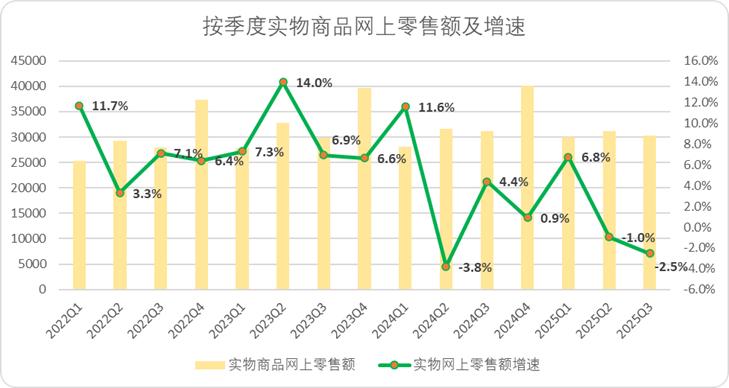
Core Insights - The e-commerce industry is experiencing significant growth pressure, with major players like JD.com and Pinduoduo facing declining profit margins despite revenue growth, indicating a shift towards a clearing phase in the market [2][11]. Group 1: Industry Overview - The e-commerce sector is entering a period of oversupply, where supply growth has outpaced demand growth, leading to intensified competition and profit declines among leading platforms [2][10]. - The overall online retail sales of physical goods grew by 6.5% in the first three quarters of the year, primarily driven by subsidy policies, but growth has slowed significantly in subsequent quarters [3][5]. - The online penetration rate for physical goods has stabilized between 24% and 27% since 2021, indicating a bottleneck in potential growth for e-commerce [6][8]. Group 2: Demand Side Analysis - Demand growth has been largely driven by subsidies, with natural growth showing signs of weakness, particularly as the incremental growth is concentrated in the first quarter of the year [3][5]. - The demand side is facing a stagnation period, with both existing business demand and potential for online retailing reaching a developmental bottleneck [8]. Group 3: Supply Side Analysis - The supply side is characterized by a surge in the number of players, particularly with the rise of content platforms, leading to increased homogeneity in offerings and intensified price competition [9][10]. - The market is witnessing a structural shift from a few monopolies to a "hammer-shaped" monopoly, where smaller players are being diluted, and larger players are increasingly competing for market share [13][15]. - Data shows that the concentration ratio (CR2) in the e-commerce sector has decreased from 60% in 2022 to 57% in early 2023, while the CR5 has increased from 84% to 93%, indicating a shift towards a more concentrated market [13]. Group 4: Profitability Challenges - Despite revenue growth, the overall profitability of the e-commerce industry is under significant pressure, with many companies experiencing a "growth without profit" scenario [11][15]. - For instance, JD.com reported a profit reduction of over 50% due to high subsidies in its delivery business, while Alibaba's commercial segment saw a 21% decline in adjusted EBITA [11][15]. - The overall trend indicates that as competition intensifies, profit margins are being squeezed, leading to a decline in operational profitability across the sector [11][15]. Group 5: Merchant Challenges - Merchants are facing a dilemma of increasing costs without corresponding revenue growth, leading to a decline in return on investment (ROI) for marketing expenditures [16][19]. - Many merchants have reported poor performance from new marketing models, resulting in significant losses despite initial revenue boosts [16][19]. - The data indicates that companies that reduced marketing expenses have seen improvements in long-term profitability, while those that increased spending have experienced declines [18][19]. Group 6: Strategic Recommendations - To navigate the clearing phase, platforms should focus on the essence of trade, minimizing friction in supply-demand matching, rather than pursuing aggressive expansion strategies [21][25]. - Historical examples from successful companies demonstrate that maintaining focus on core business operations and avoiding distractions from market trends can lead to sustained growth [22][24]. - The e-commerce industry must return to its roots of enhancing transaction efficiency and creating real value, rather than relying on superficial growth strategies [25][26].
别再等便宜茅台了,抖音“飞天”重回1700元
阿尔法工场研究院· 2025-11-19 00:07
Core Viewpoint - The confrontation between the liquor giant Moutai and the e-commerce platform Douyin has intensified, particularly regarding the unauthorized sale of Moutai products on the platform [3][4]. Group 1: Douyin's Actions - On November 15, Douyin announced the shutdown of unauthorized Moutai stores, leading to the removal of numerous third-party product links, with only official flagship store products remaining visible [4]. - Following the initial shutdown, some affected liquor specialty stores began to restore their links, although the popular 53-degree Flying Moutai remained sold out [4]. - Douyin's crackdown on low-priced Moutai sales was prompted by complaints from consumers about false advertising and the sale of suspiciously low-priced products [6][7]. Group 2: Pricing Dynamics - During the "Double 11" shopping festival, some merchants on Douyin sold Flying Moutai at prices as low as 1288 yuan, significantly below the market wholesale price [7]. - The price of 53-degree Flying Moutai on Douyin stabilized at around 1700 yuan after the platform's intervention, halting a previous trend of declining prices [4][10]. - The overall market price for Flying Moutai has fluctuated, with wholesale prices dropping below 2000 yuan earlier in the year, and recent data showing a price of 1655 yuan per bottle [11]. Group 3: Moutai's Strategic Response - Moutai's new chairman, Chen Hua, emphasized the importance of maintaining a stable channel ecosystem and price system during his recent meetings [11]. - The company has been actively tightening control over its distribution channels, with a significant increase in authorized online stores, while also cleaning up unauthorized ones [12]. - Moutai has postponed its November release plan and reduced offline quotas, indicating a strategy to tighten supply ahead of the upcoming Spring Festival, which may lead to price increases [12].


双十一卖不动了?23年销售额1.13万亿,24年1.44万亿,25年太意外
Sou Hu Cai Jing· 2025-11-18 15:42
Core Insights - The 2025 Double Eleven shopping festival experienced a significant increase in total transaction volume, reaching 1.6 trillion yuan, up from 1.44 trillion yuan the previous year, despite a noticeable decline in consumer engagement and enthusiasm [1][19]. Group 1: Consumer Behavior Changes - The current consumer mindset reflects a shift towards rational consumption, with 72% of consumers prioritizing practical value over price discounts during this year's event [3][5]. - Consumers are increasingly willing to invest in durable and high-quality products rather than opting for cheaper, low-quality items, indicating a growing preference for long-term value [5][15]. - The complexity of promotional rules and the extended duration of sales events have led to consumer fatigue, with over 60% of respondents opting out due to cumbersome processes [7][9]. Group 2: Platform Strategies - E-commerce platforms are evolving their strategies from "invitation-based purchasing" to "intelligent guidance," utilizing AI for personalized shopping experiences [9][15]. - The integration of online and offline shopping experiences has become more pronounced, with physical stores promoting online discounts, contributing to over 20% of sales during the event [11][15]. - Platforms are investing significantly in service enhancements, with a 40% increase in service-related expenditures compared to the previous year, marking a transition from price competition to value competition [15][17]. Group 3: Market Evolution - The regulatory environment has improved, with measures against unfair practices like "price inflation" and "data discrimination," ensuring a more transparent market [17]. - The transformation of the Double Eleven event from a simple promotional activity to a foundational element of the commercial ecosystem reflects its maturation, with sales growing from tens of millions in 2009 to trillions today [17][19]. - The case of Sangpo Village illustrates the challenges faced by traditional e-commerce models in adapting to the current consumer landscape, highlighting the need for businesses to evolve [13][15].
21社论丨强大创新生态不断催生“商业新物种”
21世纪经济报道· 2025-11-18 04:08
Core Insights - The article highlights the unique phenomenon of Chinese companies expanding globally, with international chains selling stakes in their Chinese operations to local firms, while Chinese brands like Mixue Ice City, Pop Mart, and Miniso establish their presence in various overseas markets [1] Group 1: Chinese Companies' Global Expansion - Chinese chain businesses are leveraging their accumulated advantages to expand internationally, showcasing a distinctive global outreach [1] - The rise of Chinese companies in the global market is attributed to the long-term accumulation of unique advantages, including a large domestic market and a culture of entrepreneurship [2] Group 2: Digital Infrastructure and Innovation - China's commitment to building a digital society has resulted in advanced infrastructure that supports various market needs, such as communication, mobile payments, logistics, and e-commerce [2] - The large pool of programmers and a young workforce provide cost advantages and human resource support for digital business development [2] Group 3: Manufacturing and Supply Chain - As the world's largest manufacturing country, China offers diverse manufacturing services, allowing entrepreneurs to efficiently combine smart manufacturing and flexible supply chains with consumer brands [2] - The robust supply chain system supports innovation and enables companies to produce high-quality, cost-effective products [2] Group 4: Market Size and Consumer Culture - China's vast market size and consumer culture that embraces new ideas create a large "application testing ground" for business innovations [2] - The digitalization of businesses allows for rapid expansion at low costs, with the ability to optimize products quickly based on user feedback and data [2] Group 5: Competitive Advantage in Global Markets - Compared to many countries, China possesses a unique combination of advanced digital economic infrastructure, a complete manufacturing system, and a large market, giving Chinese companies a competitive edge when expanding abroad [3] - Chinese companies like Douyin and Kuaishou have defined the global short video era, influencing social media trends and consumer behavior worldwide [3] Group 6: Integration of Manufacturing and Internet - China is the only country capable of deeply integrating super manufacturing capabilities with a highly developed internet, achieving large-scale commercialization [4] - This integration challenges companies to enhance supply chain efficiency and user insight while continuously evolving through trial and error [4] Group 7: New Business Ecosystem - The emergence of "new business species" is rooted in a new digital and integrated innovation ecosystem, resulting from the combination of proactive government policies and effective market dynamics [5]

抖音整顿低价白酒,飞天茅台重回1700元
3 6 Ke· 2025-11-18 04:06
Core Viewpoint - The confrontation between major liquor brands and e-commerce platforms, particularly between Moutai and Douyin, has intensified as Douyin shuts down unauthorized Moutai stores, impacting pricing and distribution channels in the liquor market [1][2]. Group 1: Douyin's Actions and Market Response - Douyin has begun shutting down unauthorized stores selling Moutai products, particularly those using the "Moutai" name, and has requested merchants to remove all products related to Moutai [1]. - Following the shutdown, many affected liquor specialty stores have started to restore their links, although some Moutai products remain out of stock [1]. - The price of Moutai on Douyin has stabilized at around 1700 yuan and above, halting a previous trend of lower pricing [1]. Group 2: Pricing Issues and Market Dynamics - Prior to the shutdown, there were rumors that selling Moutai below market price would result in penalties, leading to a crackdown on merchants selling Moutai at prices as low as 1288 yuan [2][3]. - During the "Double 11" shopping festival, some merchants sold Moutai at prices significantly below wholesale, causing concern among authorized distributors [5]. - The price fluctuations of Moutai have created a negative cycle affecting distributor confidence, with prices dropping to as low as 1499 yuan during promotions [5][7]. Group 3: Moutai's Strategic Response - Moutai's new leadership under Chen Hua has emphasized the importance of maintaining channel stability and pricing integrity, indicating a proactive approach to managing distribution channels [4][6]. - Moutai has been tightening control over its online sales channels, with a significant increase in authorized online stores while simultaneously removing unauthorized ones [8]. - The company has delayed its release plans and reduced quotas in response to market conditions, suggesting potential price increases leading up to the Spring Festival [9].
一夜关停,隔日复活?抖音“关停”茅台店铺后续:大量店铺已恢复
Sou Hu Cai Jing· 2025-11-18 03:48
Core Insights - The news highlights the sudden shutdown of unauthorized Moutai stores on Douyin's e-commerce platform, followed by a rapid restoration of many links, indicating a deep collaboration between Moutai and Douyin [2][3] Group 1: Incident Overview - Douyin's e-commerce team announced a special governance notice on November 10, addressing complaints about malicious marketing of "overseas version" liquor, particularly during the "Double 11" shopping festival [2] - The price of overseas Moutai dropped significantly from 1419 yuan to as low as 1288 yuan per bottle, prompting Douyin to take action against over 100 abnormal price listings and restrict 52 merchants [2][4] Group 2: Mutual Benefits - The crackdown on low-priced Moutai benefits both Moutai and Douyin, as it helps Moutai regain control over pricing and prevents Douyin from facing potential counterfeit risks [3][4] - Moutai's recent actions, including delaying its release plan and reducing offline quotas, aim to stabilize prices and regain market control [4] Group 3: Channel Innovation - Moutai's collaboration with Douyin is part of its ongoing channel transformation, emphasizing the need for a resilient channel ecosystem and modern market management [5] - Moutai has been preparing for online channel expansion since April, recruiting operators for its products on Douyin [5] Group 4: Industry Impact - Douyin's actions reflect a broader restructuring of the liquor e-commerce ecosystem, indicating that channel compliance will become a long-term governance direction for major e-commerce platforms [7][8] - The crackdown on unauthorized sales is expected to stabilize prices and alleviate inventory depreciation pressures for offline liquor merchants [8] Group 5: Future Outlook - Following the implementation of the governance measures, Moutai's retail price is expected to rise slightly as the Spring Festival approaches, with the average retail price of 53-degree Moutai reaching 1841 yuan [9][10] - The market signals indicate a gradual return to stability in Moutai's pricing system, with consumers likely facing fewer opportunities for "super low prices" but benefiting from safer transactions [10]

电商税收合规重塑行业生态公平竞争让"良币"脱颖而出
Zheng Quan Shi Bao· 2025-11-18 00:09
Core Viewpoint - The introduction of new tax regulations for e-commerce platforms marks a significant shift towards compliance, leveling the playing field for businesses and allowing them to compete based on product and service quality rather than tax evasion tactics [1][2][3]. Group 1: Tax Evasion Issues - The Chinese e-commerce industry, valued at over 10 trillion yuan, has faced systemic tax evasion issues, with small merchants creating false transactions and concealing real sales to avoid taxes [2][3]. - High-profile cases, such as that of a well-known streamer who concealed 301 million yuan in income, highlight the sophisticated methods used to evade taxes [2]. - Tax evasion has created an unfair competitive advantage, undermining market order and leading to a distorted business environment [2]. Group 2: Regulatory Changes - The new tax reporting regulations require e-commerce platforms to report identity and income information of operators quarterly, significantly increasing regulatory oversight [3][4]. - Platforms that fail to comply with these regulations face penalties, including fines and potential shutdowns, enhancing the accountability of e-commerce businesses [3]. - The regulations aim to eliminate hidden income practices and ensure a fairer tax environment, shifting the focus back to product quality and service [6]. Group 3: Impact on the Industry - The compliance wave is expected to reshape the e-commerce landscape, with low-quality, tax-evading businesses likely to be pushed out of the market due to increased compliance costs [3][4]. - The majority of compliant businesses, particularly small and micro-enterprises, will not face increased tax burdens, as they are often already benefiting from tax incentives [4]. - New market opportunities may arise, including the growth of compliance consulting firms and tax-related service providers, as businesses seek to navigate the new regulations [5]. Group 4: Long-term Implications - The shift towards tax compliance is anticipated to foster a healthier brand ecosystem, encouraging businesses to invest in product development and customer experience rather than solely competing on price [6][7]. - A transparent tax environment will provide better data for macroeconomic decision-making, enhancing resource allocation efficiency across the economy [7]. - The integration of e-commerce with the real economy is expected to deepen, promoting efficient distribution models and accelerating the digital transformation of supply chains [7].