阳光电源

Search documents
解码基金“擒牛术”:布局十倍股的三大核心逻辑
Zheng Quan Shi Bao· 2026-01-11 17:00
Core Insights - The article highlights the exceptional performance of the Yongying Technology Smart Selection A fund, managed by Ren Jie, which achieved a record annual return of 233.29% in 2025, driven by significant holdings in stocks like New Yisheng and Shenghong Technology, both of which saw cumulative increases exceeding 10 times during the 2024-2025 period [1] - The analysis of A-shares over the past decade reveals that public funds have consistently played a crucial role in the rise of "tenfold stocks" during three major bull markets, with deep involvement in stocks like Tonghuashun and Yiyuan Lithium Energy [1] Group 1: Tenfold Stock Logic - Each bull market is characterized by distinct themes, with public funds aligning their investment strategies closely with policy directions and industrial changes [2] - During the "Leverage Bull" from 2014 to 2015, public funds focused on stocks benefiting from financial innovation and military reform, such as Tonghuashun and Guangqi Technology, which saw significant increases in fund holdings [2] - The "Core Asset Bull" from 2019 to 2021 emphasized high-growth and strong barrier stocks, with public funds investing in sectors like electronics and power equipment, leading to substantial returns [3] Group 2: Recent Market Trends - In the 2024-2025 market, public funds concentrated on technology companies with core competencies, reflecting a "hard technology + high performance" stock selection logic, with New Yisheng and Shenghong Technology showing remarkable profit growth [4] - The article notes that funds displayed caution towards stocks influenced by external factors, such as Upwind New Materials and Tianpu Shares, indicating a preference for performance-driven investments [4] Group 3: Investment Strategies - Public funds have consistently demonstrated three core investment strategies: aligning with prevailing market themes, focusing on high-growth sectors, and maintaining significant holdings in promising stocks [5] - The evolution of stock selection strategies among public funds has progressed from short-term trend capturing to long-term value exploration, showcasing a clear trajectory of improvement in selection capabilities [6][7] Group 4: Practical Insights for Investors - The interaction between public funds and tenfold stocks offers valuable insights for investors, emphasizing the importance of assessing fund positioning in core sectors [8] - Investors should prioritize funds that maintain long-term holdings in high-performing stocks, as these are more likely to yield sustainable returns [9] - Maintaining a diversified investment portfolio is crucial for risk management, as concentrated funds may face significant risks during industry rotations [9]


《掘金ETF》周报:商业航天“一飞冲天” AI主线多点开花 如何“高抛低吸”?
Di Yi Cai Jing· 2026-01-11 14:48
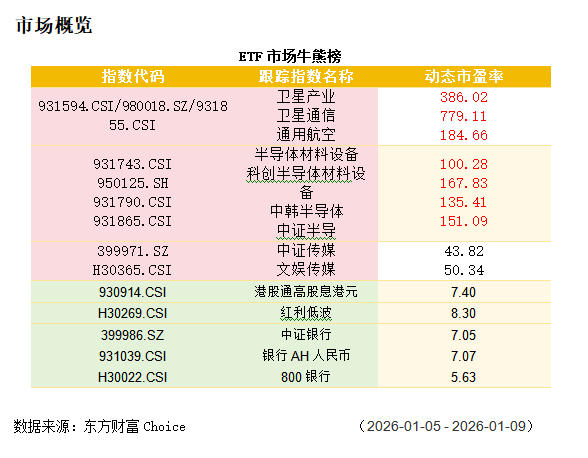
Core Insights - The ETF market has shown significant performance in technology growth styles, particularly in sectors like brain-computer interfaces, AI applications, commercial aerospace, and semiconductors, with notable market profitability [1][2]. Group 1: Commercial Aerospace ETFs - The commercial aerospace theme ETF, specifically the Yongying National Satellite Communication Industry ETF (159206.SZ), saw a net inflow of 35.89 billion yuan, leading the market in ETF fund inflows [2]. - The Zhaoshang Zhongzheng Satellite Industry ETF (159218.SZ) recorded a net inflow of 13.79 billion yuan, tracking the satellite industry index with major components including China Satellite and Aerospace Electronics [2]. - The funding logic is driven by policy catalysts, technological breakthroughs, and order placements, indicating a high prosperity cycle for the sector [2]. Group 2: Brain-Computer Interface ETFs - The Yongying Zhongzheng All-Index Medical Device ETF (159883.SZ) experienced a net inflow of 14.41 billion yuan, with over 23% of its components related to brain-computer interfaces [2]. - The funding logic is supported by announcements from Neuralink regarding large-scale production of brain-computer interface devices and the inclusion of brain-computer interfaces in China's 14th Five-Year Plan [2]. Group 3: AI Application ETFs - The GF Zhongzheng Media ETF (512980.SH) saw a net inflow of 8.73 billion yuan, focusing on gaming applications related to brain-computer interfaces [3]. - The Huaxia Zhongzheng Animation Game ETF (159869.SZ) also reported a net inflow of 8.23 billion yuan, benefiting from AI cost reduction and efficiency improvements [3]. Group 4: Semiconductor ETFs - The Guotai Zhongzheng Semiconductor Material Equipment Theme ETF (159516.SZ) had a net inflow of 23.18 billion yuan, focusing on AI computing power upstream core targets [4]. - There is a structural differentiation within the semiconductor theme ETFs, with inflows into material equipment and outflows from chip sectors [3]. Group 5: Overall ETF Market Trends - The industry theme ETFs had a net inflow of 138.27 billion yuan over the past week, while broad-based index ETFs experienced a significant net outflow of 129.01 billion yuan, indicating a preference for sector-specific investments [5][9]. - The market is witnessing a divergence in valuations, with major broad-based indices at historical highs while certain sectors, like Hong Kong stocks, are attracting inflows due to lower valuations [7][9].

——电新环保行业周报20260111:重点关注国产算力、氢能、储能上游-20260111
EBSCN· 2026-01-11 12:10
Investment Ratings - The report maintains a "Buy" rating for both the power equipment and environmental protection sectors [1]. Core Insights - The report highlights several recent developments in the new energy supply side, including a meeting by four ministries to regulate competition in the power and energy storage battery industries, a significant drop in polysilicon futures prices, and the planned cancellation of export tax rebates for photovoltaic products starting April 1, 2026 [3]. - The report emphasizes that the "anti-involution" efforts in the new energy sector are complex and challenging, with the government aiming to maintain international competitiveness while balancing market and policy adjustments [3]. - Investment recommendations include focusing on domestic computing power, hydrogen energy, and energy storage upstream sectors, with specific companies suggested for investment based on their market positioning and growth potential [3]. Summary by Sections New Energy Supply Side - Recent events include a meeting to regulate competition in the power and energy storage battery industries, a decline in polysilicon futures, and adjustments to export tax rebates for photovoltaic products [3]. - The report suggests that the direction of "anti-involution" in the photovoltaic industry will remain unchanged, focusing on execution and coordination [3]. Investment Recommendations - The report advises caution in pursuing high-flying stocks in commercial aerospace and related sectors due to significant price increases detached from fundamental performance [3]. - It recommends focusing on companies like Sifang Co., Shenghong Co., and others in the AI power sector, as well as those involved in hydrogen energy and energy storage [3]. - The report highlights the importance of monitoring the domestic energy storage market and the upcoming bidding situation for energy storage projects [5][6]. Wind Power - The report notes that the newly installed capacity for onshore wind power in 2024 is expected to reach 75.8 GW, a year-on-year increase of 9.68%, while offshore wind power is projected to decline by 40.85% [7]. - The report indicates a significant increase in domestic wind power installations, with a total of 82.50 GW added from January to November 2025, representing a year-on-year growth of 59.42% [7]. Lithium Battery Sector - The report discusses the impact of the cancellation of export tax rebates on lithium batteries, which is expected to create pressure on smaller battery manufacturers while benefiting larger firms [19]. - It highlights the anticipated demand for lithium batteries in 2026, with a total production estimate of approximately 210 GWh in China, despite a seasonal decline [20]. - The report emphasizes the importance of monitoring supply chain dynamics and pricing trends in lithium battery materials, particularly lithium carbonate and other components [21].
兴业证券:如何看待A股本轮开门红的结构与延续性?
智通财经网· 2026-01-11 10:36
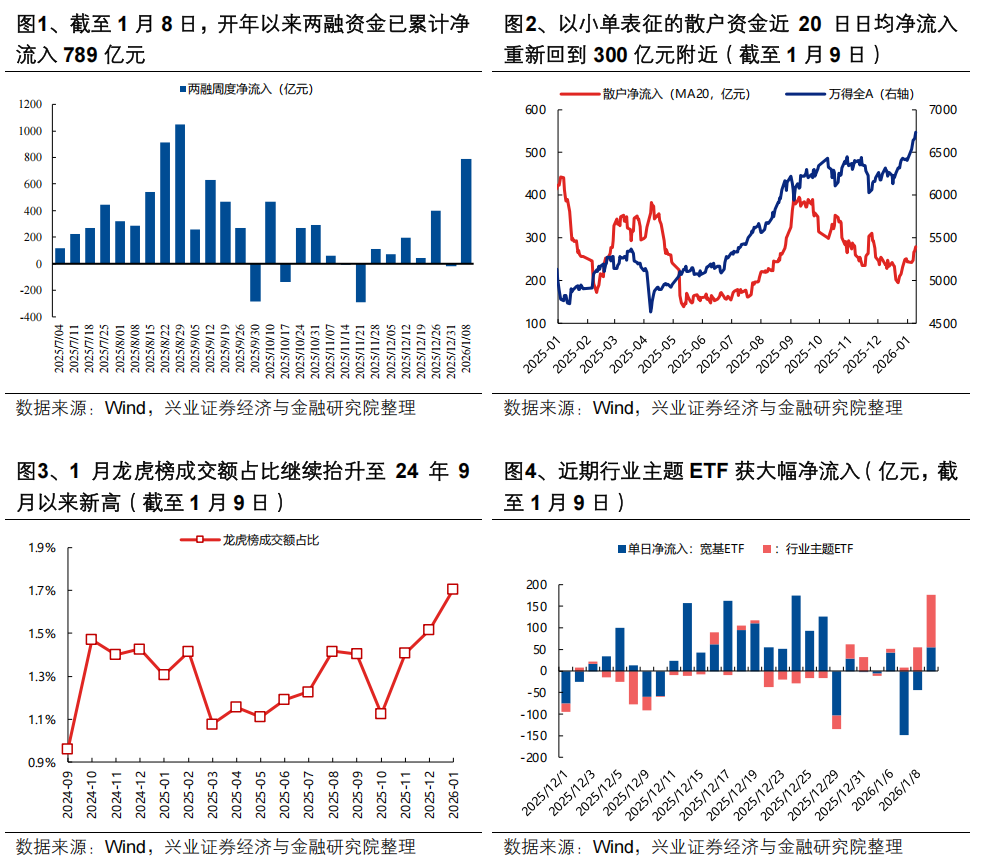
Core Viewpoint - The recent "opening red" in the A-share market reflects a favorable macroeconomic environment and abundant liquidity, which supports market risk appetite and attracts incremental capital inflow, creating a positive feedback loop between capital inflow and market rise [2][18]. Group 1: Market Dynamics - The A-share market has experienced a strong start with the Shanghai Composite Index breaking key levels and achieving a "sixteen consecutive days" rise, exceeding many investors' expectations [1][19]. - Historical data indicates that after a single-day trading volume exceeds 3 trillion yuan, there is typically at least a monthly-level market rally [19]. - Various types of trading funds have shown signs of accelerated entry, including a net inflow of 78.9 billion yuan in margin financing since the beginning of the year and a return of retail investor net inflow to around 30 billion yuan daily [2][5]. Group 2: Structural Characteristics - The inflow structure of different funds shows a strong consensus on key themes, primarily focusing on TMT (storage, AI applications), military industry (commercial aerospace), non-ferrous metals, new energy (controlled nuclear fusion), machinery (robots), and pharmaceuticals (innovative drugs, brain-machine interfaces) [5][36]. - The global stock market has also seen a strong start in 2026, driven by macroeconomic and industrial narratives, with A-shares reflecting similar trends [13][18]. Group 3: Future Directions - As companies begin to disclose annual reports, earnings will become a key factor driving market dynamics, leading to a structural adjustment where previously hot sectors face performance validation, while some low-performing sectors may attract new capital inflows [36]. - Industries with significant upward revisions in profit forecasts since November include technology (consumer electronics, computing), advanced manufacturing (new energy, military), cyclical sectors (building materials, non-ferrous metals), and consumer sectors (food processing, retail) [37][38].

兴证策略:如何看待本轮开门红的结构与延续性?
Xin Lang Cai Jing· 2026-01-11 10:28
Group 1 - The current market rally, referred to as "开门红," is supported by improving macroeconomic data and ample liquidity, which enhances market risk appetite and attracts new capital inflows [1][9][40] - Various types of trading funds have shown accelerated entry into the market, including a net inflow of 78.9 billion yuan in margin financing since the beginning of the year and an average daily net inflow of retail funds returning to around 30 billion yuan [1][9][40] - The structural consensus among different types of funds is strong, focusing on sectors such as TMT (storage, AI applications), military (commercial aerospace), non-ferrous metals, new energy (controlled nuclear fusion), machinery (robots), and pharmaceuticals (innovative drugs, brain-machine interfaces) [2][35][38] Group 2 - The global stock market is experiencing a strong start in 2026, driven by expectations of loose liquidity, geopolitical changes, and emerging industrial trends, with A-shares reflecting this global narrative [5][38] - Key events such as the International Consumer Electronics Show (CES) and geopolitical developments are catalyzing themes in the market, enhancing the strategic value of resource products and driving structural similarities across global markets [5][38] - The market is currently in a favorable position with limited downside risk and significant potential for upward movement, supported by improved PMI and price data, as well as a high percentage of stocks still below their previous highs [11][44] Group 3 - The recent surge in the commercial aerospace sector has raised concerns about its current crowding and sustainability, with trading volume indicating a potential for further upward movement [16][51] - As the earnings forecast disclosure period approaches, the correlation between stock prices and earnings will increase, necessitating a focus on structural adjustments based on performance [21][57] - Industries with significant upward revisions in profit forecasts since November include technology (consumer electronics, computing), advanced manufacturing (new energy, military), and cyclical sectors (building materials, non-ferrous metals) [26][58]
年度榜单丨2025年全球工商业储能系统集成TOP15发布!
起点锂电· 2026-01-11 09:58
Group 1: Core Functions of Commercial and Industrial Energy Storage - Commercial and industrial users face a dual pricing system for electricity, which includes both energy charges based on actual consumption and capacity charges based on transformer capacity or peak demand [2] - Energy storage systems provide two clear profit paths: peak shaving and demand management, allowing users to reduce electricity costs by taking advantage of price differences between peak and off-peak hours [2] Group 2: Global Commercial and Industrial Energy Storage Market - The global commercial and industrial energy storage market has seen rapid growth, with shipments increasing from 2.0 GWh in 2021 to a projected 25.4 GWh in 2024, supported by favorable policies and market conditions [3] - By 2025, the market is expected to experience explosive growth, with shipments reaching 60.5 GWh, driven by advancements in storage technology and expanding price differentials [3] Group 3: Impact of AI Data Centers on Energy Storage Demand - The exponential growth in demand for AI Data Centers (AIDC) is expected to significantly increase the need for commercial energy storage, as these centers require high power and rapid response capabilities [4] - The energy storage revenue model is anticipated to evolve from single arbitrage to multi-faceted revenue streams, including power regulation and emergency backup services for AIDC [4] Group 4: Technological Developments in Energy Storage - Diverse energy storage technologies are emerging, with sodium-ion and lithium-ion batteries gaining traction due to their high power and fast response characteristics, while flow batteries are becoming important for long-duration storage [5] - By 2030, global commercial energy storage shipments are projected to reach 669.6 GWh, with AIDC applications driving significant market growth [5] Group 5: Future Outlook for Energy Storage - By 2035, commercial energy storage is expected to transition from a cost control tool to a profit-generating center, deeply integrated into industrial operations and energy management systems [6] - The projected shipment volume for global commercial energy storage by 2035 is 1,486.0 GWh, with AIDC applications accounting for a substantial portion of this growth [6] Group 6: Leading Companies in Energy Storage - The top 15 companies in global commercial energy storage system integration for 2025 include Singularity Energy, Sungrow Power, and others, indicating a competitive landscape [7][8]

光伏产品取消出口退税,江苏超800MW海上风电项目获核准
GOLDEN SUN SECURITIES· 2026-01-11 05:56
证券研究报告 | 行业周报 gszqdatemark 2026 01 11 年 月 日 电力设备 光伏产品取消出口退税,江苏超 800MW 海上风电项目获核准 光伏:两部门宣布取消光伏等产品增值税出口退税,硅料电池组件价格上涨。近 日财政部、税务总局发布关于调整光伏等产品出口退税政策的公告:自 2026 年 4 月 1 日起,取消光伏等产品增值税出口退税。自 2026 年 4 月 1 日起至 2026 年 12 月 31 日,将电池产品的增值税出口退税率由 9%下调至 6%;2027 年 1 月 1 日 起,取消电池产品增值税出口退税。适时降低或取消光伏产品的出口退税,有助于 推动国外市场价格理性回归,降低我国面临的贸易摩擦的风险。据安泰科统计,本 周多晶硅 n 型复投料成交价格区间为 5.0-6.3 万元/吨,成交均价为 5.92 万元/吨, 周环比上涨 9.83%。n 型颗粒硅成交价格区间为 5.0-6.4 万元/吨,成交均价为 5.58 万元/吨,环比涨幅为 10.5%。据 Infolink,本周 N 型电池片价格如下:183N、 210RN 与 210N 均价再度上调,本周上升至每瓦 0.39 元人民 ...
2025年中国储能BMS行业产业链、SWOT、市场规模、产值、竞争格局及发展趋势研判:行业技术成熟度和标准化程度显著提升,带动储能BMS规模扩张[图]
Chan Ye Xin Xi Wang· 2026-01-11 01:03
Core Insights - The energy storage Battery Management System (BMS) is a critical component for safety in energy storage systems, transitioning the industry from "passive protection" to "active safety" [1][3] - The market for new energy storage systems in China is expected to grow significantly, with the BMS market projected to reach 3.448 billion yuan in 2024 and 2.475 billion yuan in 2025, despite a decline in overall value due to price reductions [1][3] Industry Definition and Classification - Energy storage BMS is the core control component of energy storage systems, responsible for real-time data collection, state diagnosis, and safety protection [2] - BMS can be classified based on enterprise type, application field, and technology architecture [2] Current Industry Status - The global energy storage BMS market is expected to reach 6.252 billion yuan in 2024, with the Asia-Pacific region accounting for 62.01% of the market share [3] - In China, the BMS market is projected to grow from 275 million yuan in 2020 to 3.448 billion yuan in 2024, with a potential decline to 2.475 billion yuan in 2025 due to pricing pressures [3] Industry Value Chain - The energy storage BMS industry value chain includes upstream suppliers of key materials and components, midstream hardware production and software development, and downstream system integrators [4] SWOT Analysis - The energy storage BMS industry is supported by national policies aimed at promoting new energy storage, positioning it as a core component of the new power system [5] Competitive Landscape - The domestic energy storage BMS market features three main types of participants: self-developed BMS by battery companies, system integrators with self-development capabilities, and third-party specialized manufacturers [6][7] - Leading self-developed BMS companies include CATL, BYD, and Guoxuan High-Tech, which leverage their technology to enhance product competitiveness [6] - Comprehensive manufacturers like Sungrow and Haibo Innovation develop BMS products tailored to their systems [7] - Specialized third-party BMS manufacturers focus on technological differentiation and cost optimization [7] Development Trends - The energy storage market in China is expected to maintain rapid growth, driven by the dual carbon goals and the construction of new power systems [8] - The maturity and standardization of BMS technology are anticipated to improve, leading to further industry expansion [9] - Future trends indicate a shift towards integration, intelligence, openness, and scalability in the BMS industry [9]





涨价,涨价!新能源替代潮来袭,下一个“苹果级”回报就在眼前?
券商中国· 2026-01-10 23:31
Core Viewpoint - The article discusses the ongoing supercycle in resource prices driven by the explosive demand in the new energy sector, highlighting the transition from traditional industries to new energy companies and the potential for high returns on investment in this sector [2][6]. Group 1: Resource Price Increases - Since 2025, prices for copper, lithium, nickel, cobalt, aluminum, and even sulfur have risen, indicating a significant shift not solely attributed to economic recovery or monetary phenomena, as other resource sectors like cement and steel remain stagnant [1]. - The prediction made by BYD's chairman in 2016 about the tightening of lithium resources and the potential shortage of copper is now becoming a reality, driven by the growth in electric vehicle demand [2][6]. Group 2: Investment Opportunities in New Energy - The penetration rate of new energy vehicles in the domestic passenger car market has approached 60% this year, marking a significant shift towards high profitability and shareholder returns for leading new energy companies [2]. - Investment in leading new energy companies is compared to historical investments in Apple, suggesting that the current market conditions present a similar opportunity for substantial returns [3][5]. Group 3: Valuation and Profitability - A leading new energy battery company's stock price was at 140 yuan per share with a market cap of 580 billion yuan, and projected profits for 2025 could reach 100 billion yuan, indicating a low valuation of around 6 times earnings [3]. - The core principle of value investing remains unchanged: buying a company worth 1 yuan for 0.4 yuan, emphasizing the importance of purchasing undervalued assets [3]. Group 4: Market Trends and Future Projections - The current market for new energy vehicles is expected to grow from a 10% penetration rate to 100%, similar to the rapid adoption of smartphones, which will likely lead to significant returns for investors in this sector [5][7]. - The domestic new energy vehicle retail penetration rate reached 62.2% in early December 2025, indicating a strong consumer preference shift towards electric vehicles [6].



4年半亏了165亿,百亿基金经理被告上法庭
凤凰网财经· 2026-01-10 13:50
Core Viewpoint - The article discusses a significant legal case involving Guotou Ruijin Fund and its star fund manager Shi Cheng, highlighting issues of investment style deviation and potential breaches of fiduciary duty in the public fund industry [2][5][13]. Group 1: Legal Case Overview - A court hearing is scheduled for January 13, 2026, where investor Li Zhihua has filed a lawsuit against Guotou Ruijin Fund and Shi Cheng for a "financial trust contract dispute" [2][5]. - It is rare for a fund manager to be named as a co-defendant in such cases, indicating the seriousness of the allegations against Shi Cheng [5][4]. Group 2: Investment Style and Performance Issues - The case centers on two main issues: whether the suitability obligations were adequately fulfilled and whether there was a significant deviation from the agreed investment style [5]. - Shi Cheng's management of the Guotou Ruijin New Energy Fund has come under scrutiny for drastically reducing its investment in renewable energy stocks from a contractual commitment of at least 80% to only 5.95% by Q3 2025, shifting focus to AI and robotics [5][6]. - Despite the fund's significant shift in investment strategy, it achieved a 72.24% return in 2025, raising questions about the appropriateness of the strategy and the implications for investors who expected a focus on renewable energy [5][6]. Group 3: Shi Cheng's Career Trajectory - Shi Cheng's career has seen dramatic highs and lows, with his rise closely tied to the booming renewable energy sector, achieving returns of 101.52% and 60.03% in 2020 and 2021, respectively [9][10]. - However, since 2022, the renewable energy sector has faced severe downturns, leading to significant losses for the funds he managed, with cumulative losses reaching 164.72 billion yuan from 2021 to mid-2025 [10][12]. - The management scale of his funds plummeted from over 200 billion yuan to below 100 billion yuan due to poor performance, despite continued management fee collection [12][13]. Group 4: Industry Implications - The case serves as a warning for the public fund industry regarding the boundaries of fund managers' fiduciary duties and the implications of deviating from established investment strategies [13]. - Following this case, the Asset Management Association of China issued guidelines to regulate theme-based investment styles, aiming to prevent similar issues in the future [13][16]. - The outcome of the trial could set a precedent for defining the boundaries of "diligence and responsibility" for fund managers, influencing future compliance and investment decision-making in the industry [13].