中国长城

Search documents
这家银行控股权花落谁家?监管正式批复
Jin Rong Shi Bao· 2025-07-21 10:57
Core Viewpoint - The control of Changcheng Huaxi Bank will be transferred to Sichuan Bank, which will become its largest shareholder after acquiring a 40.92% stake for 4.332 billion yuan, enhancing both banks' competitive advantages and supporting the development of a pillar financial institution in Sichuan province [1][2]. Group 1 - Sichuan Bank's acquisition of Changcheng Huaxi Bank will allow both institutions to maintain their independent legal status while achieving resource integration and collaborative development [2]. - The acquisition will enable Sichuan Bank to enhance its asset scale, local economic resources, capital efficiency, and network layout, with the group's asset scale expected to exceed 600 billion yuan, surpassing its five-year target of 500 billion yuan [2]. - As a leading bank in Deyang, Changcheng Huaxi Bank holds a 13% market share in corporate loans, with 10.1% of its corporate loan clients in the manufacturing sector, primarily from Deyang [3]. Group 2 - The partnership will allow Sichuan Bank to access Changcheng Huaxi Bank's client resources in Deyang, improving its service radius and enhancing its corporate loan negotiation capabilities [3]. - The collaboration is expected to optimize branch layouts, improve operational efficiency, and strengthen management systems, thereby boosting Changcheng Huaxi Bank's operational performance and profitability [3]. - This acquisition marks a significant step for Sichuan province in consolidating financial resources and transitioning from smaller financial institutions to a pillar institution, aligning the scale of leading financial entities with the province's economic development needs [3].
黄仁勋发声!
天天基金网· 2025-07-21 05:54
Core Viewpoint - Huang Renxun, CEO of Nvidia, emphasizes the uniqueness and vitality of the Chinese market, highlighting its innovation capabilities and the scale of its consumer base [2][3]. Group 1: Nvidia's Market Perspective - Huang Renxun describes China as a one-of-a-kind market with unparalleled vitality, innovation, and development momentum [2]. - He notes that Nvidia has been in China for 30 years, recognizing the country's exceptional engineering talent and large consumer base [2]. - Huang warns that not participating in the Chinese market could lead to unpredictable and potentially negative long-term consequences [2]. Group 2: AI Development Insights - Huang states that AI is a complex system requiring innovation at all levels, and Nvidia's chips are just the foundation of this system [2]. - He praises DeepMind's R1 model for its innovative approach to AI, which showcases the adaptability of researchers and developers in China [2]. - Huang expresses optimism about China's innovation capabilities, stating that even with limited resources, Chinese engineers can adapt and excel [2]. Group 3: Global Supply Chain Commentary - Huang highlights China's supply chain as one of the best in the world, noting its scale, complexity, and diversity [2]. - He mentions that China not only operates its own supply chain but also develops technology and products to assist other countries in building their supply chains [2]. - Huang asserts that a complete decoupling of global supply chains is impossible due to their inherent complexity and interdependence [2]. Group 4: Collaborations and Competitions - Huang discusses his long-standing collaboration with Lei Jun of Xiaomi, working together on various projects including AI and autonomous driving software [3]. - He acknowledges Huawei's significant innovation and capabilities, viewing them as both a competitor and a respected entity in the industry [3]. - Huang indicates that regardless of Nvidia's presence, the AI market in China will continue to progress, with or without the company [3]. Group 5: Stock Transactions - Following Nvidia's stock price reaching a new high, Huang executed a plan to sell 75,000 shares, valued at approximately $12.94 million [3]. - Earlier in the year, he had disclosed a plan to sell 6 million shares under a 10b5-1 trading plan to ensure transparency and avoid insider trading allegations [3].


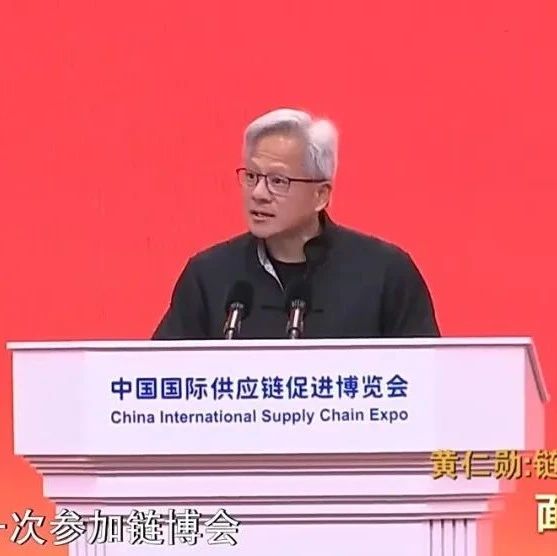
eVTOL订单创纪录!高端装备ETF(159638)整固蓄势,近5日合计“吸金”超2200万元
Sou Hu Cai Jing· 2025-07-21 05:39
Core Viewpoint - The high-end equipment sector is experiencing mixed performance, with notable developments in the defense and aerospace industries, supported by increasing military expenditure and significant contracts. Group 1: Market Performance - As of July 21, 2025, the CSI High-End Equipment Sub-Index decreased by 0.17%, with stocks showing varied performance, including a 5.81% increase in Feiliwa and a 2.33% rise in Hongdu Aviation [1] - The High-End Equipment ETF (159638) saw a turnover of 2.56% and a transaction volume of 32.22 million yuan, with an average daily transaction volume of 55.38 million yuan over the past month [3] - The latest scale of the High-End Equipment ETF reached 1.255 billion yuan, with a total inflow of 22.62 million yuan over the last five trading days [3] Group 2: Financial Metrics - The High-End Equipment ETF has achieved a net value increase of 32.27% over the past year, with the highest single-month return recorded at 19.30% since its inception [3] - The ETF's longest consecutive monthly gains reached two months, with a maximum increase of 29.39% and an average monthly return of 6.55% [3] Group 3: Industry Developments - On July 16, 2025, UAE company Autocraft signed a $1 billion order with Chinese company "Shide Technology" for 350 units of the E20 eVTOL, marking a record single order for China's eVTOL sector [3] - National defense spending in China is expected to grow steadily, providing a solid foundation for the stable development of the defense and military industry, with industry scale and profits likely to continue rising [3] - China's global competitiveness in shipbuilding, aerospace, and satellite navigation has been improving, positioning the defense and military industry as a crucial area for new productivity breakthroughs [3]


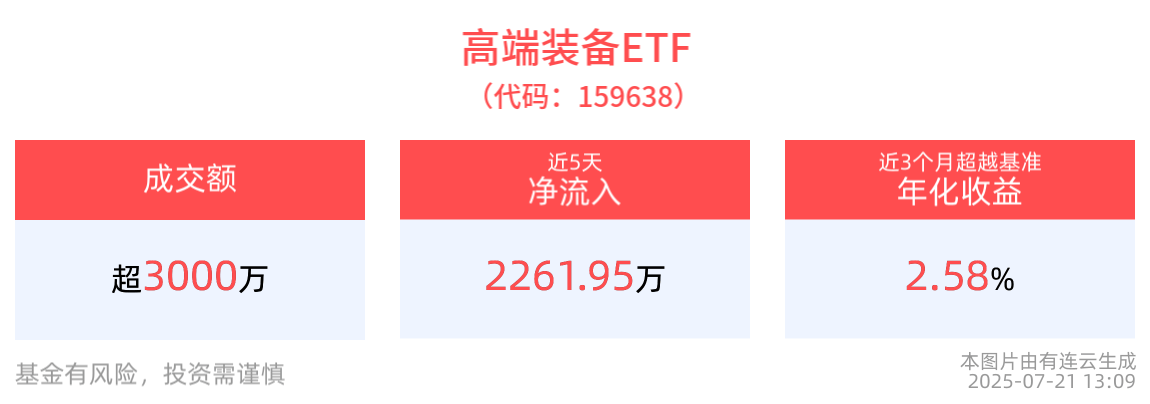
黄仁勋发声
Zheng Quan Shi Bao Wang· 2025-07-21 00:41
Core Insights - Nvidia's CEO Jensen Huang highlighted the uniqueness and vitality of the Chinese market during his appearance at the China International Supply Chain Promotion Expo, emphasizing its innovation capabilities and the scale of its consumer base [1][3] - Huang expressed optimism about China's AI development, stating that the country's innovation pace is unstoppable and that Nvidia aims to contribute significantly to this progress [3] - Huang acknowledged the impressive capabilities of Chinese companies like Huawei and their potential to advance AI solutions independently of Nvidia [4] Market and Industry Analysis - The Chinese market is described as unparalleled in terms of its dynamism, innovation, and the number of skilled engineers, with a consumer base that is one of the largest globally [3] - Huang noted that the global supply chain system, in which China plays a crucial role, is complex and interconnected, making complete decoupling unlikely [3] - The collaboration between Nvidia and Xiaomi has been ongoing for years, focusing on AI and autonomous driving software, indicating strong partnerships within the Chinese tech ecosystem [4] Company Actions - Following Nvidia's stock price reaching a new high, Huang sold 75,000 shares worth approximately $12.94 million as part of a pre-planned stock sale under the 10b5-1 rule, which aims to prevent insider trading [4]
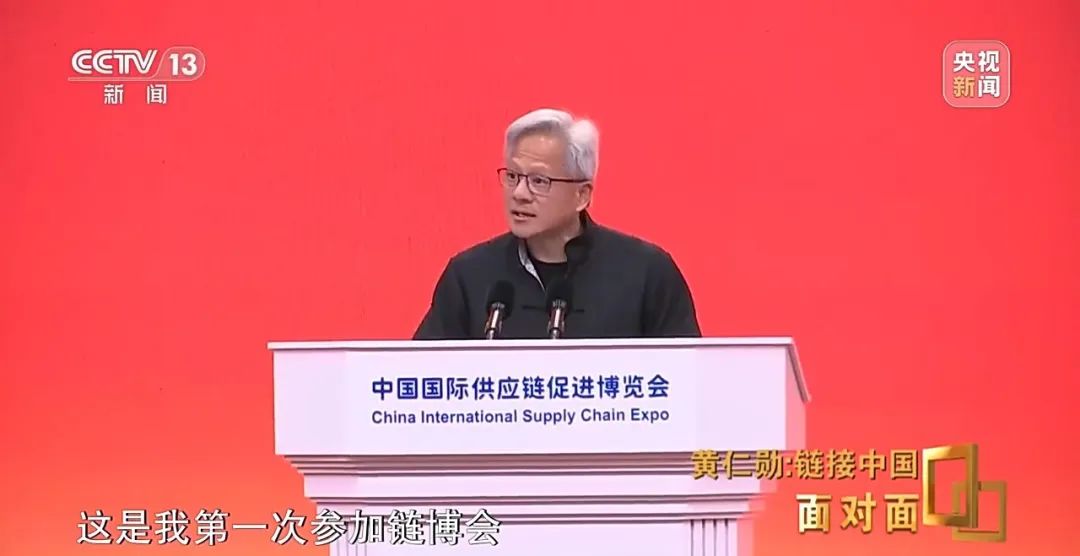
黄仁勋发声!
证券时报· 2025-07-21 00:22
Core Viewpoint - Nvidia's CEO Jensen Huang emphasizes the uniqueness and vitality of the Chinese market, highlighting its innovation capabilities and the scale of its consumer base, which he believes is crucial for technology suppliers [3][4]. Group 1: Nvidia's Market Perspective - Huang describes China as a one-of-a-kind market with unparalleled vitality, innovation, and development momentum, stating that it is not just another market but a unique opportunity for technology suppliers [3]. - He notes that Nvidia has been in China for 30 years, long before many high-tech companies entered, and acknowledges the significant number of talented engineers and computer scientists in the country [3][4]. - Huang warns that not participating in the Chinese market could have unpredictable but likely negative long-term consequences for companies [3]. Group 2: AI Development Insights - Huang discusses the complexity of AI systems, likening them to a multi-layered cake, where Nvidia's chips form the base layer, and innovation is required at every level to drive progress [4]. - He expresses optimism about China's innovation capabilities, citing the impressive advancements made by companies like DeepMind and their ability to adapt technologies to leverage different technical characteristics [4]. Group 3: Global Supply Chain Commentary - Huang praises China's supply chain system as one of the best in the world, noting its scale, complexity, and diversity, which he considers a global marvel [4]. - He emphasizes that China not only operates its own supply chain but also develops technologies and products to assist other countries in building their supply chains, presenting a significant opportunity for global expansion [4]. - Huang asserts that complete decoupling from global supply chains is impossible due to their inherent complexity and interdependence [4]. Group 4: Collaborations and Competitions - Huang mentions his long-standing collaboration with Lei Jun of Xiaomi, highlighting joint projects in AI and autonomous driving software [5]. - He acknowledges Huawei's significant innovation and capabilities, stating that the Chinese AI market will progress regardless of Nvidia's presence, and expresses respect for Huawei as a competitor [5]. Group 5: Stock Transactions - Following Nvidia's stock price reaching a new high, Huang sold 75,000 shares valued at approximately $12.94 million as part of a pre-planned stock sale under the 10b5-1 rule, which aims to prevent insider trading [5]. - Earlier in the year, he had already disclosed a plan to sell 6 million shares, indicating a strategic approach to stock transactions [5].
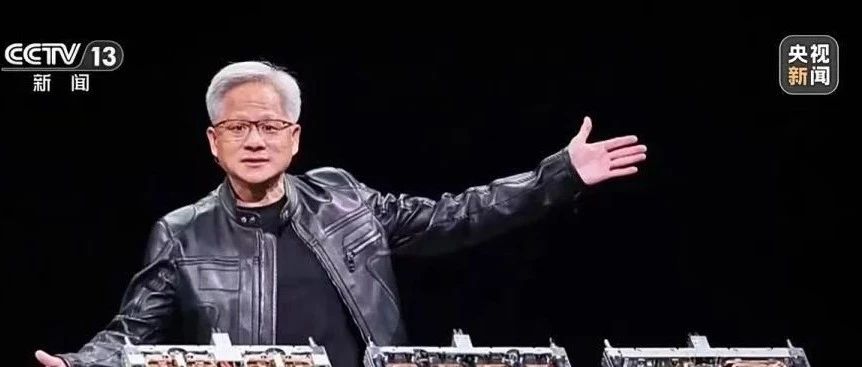
黄仁勋谈中国市场:既有活力 又有创新能力
news flash· 2025-07-20 17:51
Core Viewpoint - The CEO of Nvidia, Jensen Huang, emphasizes that China is a unique market with unparalleled vitality, innovation, and development momentum, highlighting its significance for technology suppliers [1] Group 1: Market Characteristics - China is described as not just another market, but a unique one with exceptional vitality and innovation capabilities [1] - The development speed of the industry in China is noted to be unmatched globally [1] - The scale of the consumer base in China is extremely large, making it a critical market for technology companies [1] Group 2: Historical Context - Nvidia has been operating in China for 30 years, predating many other high-tech companies entering the market [1] - In the early days, the only notable tech companies in China were Lenovo and Great Wall [1] Group 3: Talent Pool - China is recognized for having one of the largest numbers of computer scientists globally, rivaling only the United States [1] - The presence of outstanding engineers in China contributes to its unique market position [1] Group 4: Strategic Implications - The CEO warns that not participating in the Chinese market could lead to unpredictable and potentially negative long-term consequences for technology suppliers [1]
半年业绩预报密集披露!军工ETF龙头(512680)午后涨超2%,成分股应流股份、建设工业10cm涨停!
Xin Lang Cai Jing· 2025-07-17 06:11
Group 1 - The military industry sector is experiencing significant growth, with the China Securities Military Industry Index (399967) rising by 2.33% as of July 17, 2025, and key stocks such as Shenyang Aircraft Corporation (600760) increasing by 9.35% [1] - The leading military ETF (512680) has reached a new high in scale at 5.74 billion, ranking among the top two comparable funds, with a recent net inflow of 1.60 billion over three days [1][2] - The top ten weighted stocks in the China Securities Military Industry Index account for 35.55% of the index, with notable companies like China Shipbuilding (600150) and Shenyang Aircraft Corporation (600760) leading the list [2] Group 2 - Recent earnings forecasts from military companies indicate substantial profit growth, with Aerospace Science and Technology predicting a net profit of 68 million to 95 million for the first half of 2025, a significant increase from 393.33 thousand in the same period last year [2] - The military industry is expected to benefit from both external pressures and internal growth dynamics, driven by the changing global military technology competition landscape and China's strong planning in the military sector [3]

A股中报行情来袭,哪些板块景气度更高?布局宽基,中证A500指数ETF(563880)为何受关注?数据说话!
Xin Lang Cai Jing· 2025-07-17 02:17
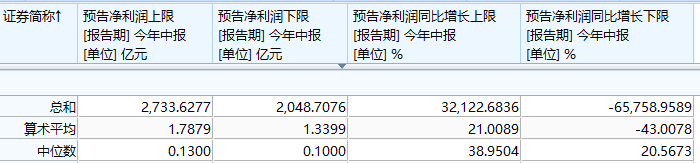
Core Viewpoint - The overall performance of A-share listed companies in the first half of the year is better than the same period last year, with a higher rate of profit growth and positive earnings forecasts [1][2]. Group 1: Earnings Forecasts - As of July 15, 2023, 1,529 listed companies have disclosed earnings forecasts, with 873 companies expecting profits and 847 companies anticipating year-on-year net profit growth, representing 57% and 55% respectively [1]. - The average expected net profit for the first half of the year is estimated to be between 1.34 billion and 1.79 billion yuan [1]. - The total expected net profit for all companies is projected to be between 2,048.71 million and 2,733.63 million yuan, with a year-on-year growth range of -65.76% to 32,122.68% [2]. Group 2: Sector Performance - The 中证A500 Index ETF (563880) has shown significantly better performance compared to the overall market, with 126 constituent stocks having disclosed earnings forecasts, of which 91 expect profits and 83 anticipate year-on-year net profit growth, accounting for 72% and 65% respectively [4][6]. - The average expected net profit for the constituent stocks of the 中证A500 Index ETF is estimated to be between 10.52 million and 12.27 million yuan [4]. Group 3: Market Trends - The market is expected to shift towards core assets as macroeconomic fundamentals improve and company earnings are disclosed, suggesting a focus on "new" assets as a strategic investment opportunity [8]. - The 中证A500 Index ETF is highlighted for its low management fees (0.15%) and custodian fees (0.05%), along with a monthly evaluation of dividend distribution, providing investors with predictable returns [8].
长城资产“清仓”退出长城华西银行 新入主方落定
Zheng Quan Ri Bao Wang· 2025-07-16 13:04
Core Viewpoint - The article discusses the ongoing trend of financial asset management companies (AMCs) divesting their equity stakes in small and medium-sized banks, with Sichuan Bank acquiring a 40.92% stake in Changcheng Huaxi Bank, marking a significant shift in ownership and strategy for both institutions [1][2][4]. Group 1: Company Developments - Sichuan Bank has received approval to acquire 9.4259 billion shares of Changcheng Huaxi Bank, resulting in a 40.92% ownership stake [1][2]. - The transaction reflects a broader industry trend where AMCs, like Changcheng Asset Management, are divesting from non-core banking operations to focus on their primary business of managing bad debts [1][4]. - The acquisition will enhance Sichuan Bank's market presence and network in the region, particularly in areas where it previously lacked a foothold [3][5]. Group 2: Financial Performance - As of the first quarter of 2025, Changcheng Huaxi Bank reported total assets of 156.261 billion yuan, with a net asset book value of 10.064 billion yuan and an assessed value of 10.567 billion yuan [2]. - Sichuan Bank's asset scale exceeded 430 billion yuan by the end of 2024, reflecting a year-on-year growth of 28.24%, with a non-performing loan rate of 1.38% [3]. - In 2024, Sichuan Bank achieved revenue and net profit of 7.916 billion yuan and 2.031 billion yuan, respectively, both showing growth [3]. Group 3: Industry Trends - Regulatory bodies have imposed stricter requirements on AMCs, pushing them towards a more specialized operational focus and away from diversified investments [4]. - The trend of regional financial resource consolidation is evident, with state-owned entities increasingly acquiring stakes in local banks, as seen in recent transactions involving other banks in Sichuan [5]. - The shift in ownership from a central enterprise to a local entity signifies a strategic move towards localized management and service models, enhancing the ability to cater to regional economic needs [5].
自主可控,坚定不移——计算机行业最新投资策略
2025-07-16 06:13
Summary of Conference Call Notes Industry Overview - The macroeconomic environment is influenced by multiple factors including national economic development, new productivity advancements, and national security concerns, with the ongoing US-China rivalry being a significant theme for the foreseeable future [1] - The focus on domestic autonomy and control is expected to create new opportunities in both software and hardware sectors, driven by national policies [1] Key Points on Software Sector - The software sector includes major areas such as large AI models, basic software (operating systems, databases), and industrial software (ERP, EDA, CAD) which have potential for domestic replacement [2][3] - Current domestic production of CPUs and GPUs is heavily reliant on foreign suppliers, with estimates indicating that 70-80% of server CPUs are sourced from Intel and AMD [2][3] - The domestic AI chip market is led by companies like Shenwei and Haiguang, with significant contributions from domestic models in the AI sector [3][4] Key Points on Hardware Sector - The hardware sector is primarily focused on core components like CPUs and GPUs, with a strong emphasis on domestic production capabilities [2][3] - The domestic CPU market is projected to have a substantial replacement space, with a market size exceeding 100 billion RMB [27] - The GPU market is also seeing potential for domestic alternatives, especially in light of US export controls affecting companies like NVIDIA and AMD [28][30] Policy and Market Dynamics - The US has intensified sanctions against China, particularly in advanced technology sectors, which has led to a tightening of export controls and tariffs [6][7][8] - The Chinese government is pushing for self-sufficiency in technology, with policies aimed at achieving autonomy in core technologies, including software and hardware [9][10] - The domestic market for AI servers is expected to grow significantly, with projections indicating that over 60% of AI server purchases will come from domestic sources by 2024 [10][11] Emerging Trends - The development of domestic operating systems, such as HarmonyOS, has gained traction, becoming the second-largest mobile OS in China, with a growing ecosystem of applications [12][18] - The shift towards distributed databases and cloud-based solutions is evident, with domestic companies like Alibaba and Tencent leading the market [21] - The industrial software sector is also evolving, with domestic firms capturing significant market shares in ERP and EDA solutions [23][24] Risks and Challenges - Potential risks include macroeconomic impacts on business demand, slower-than-expected development of large models and industries, and escalating US-China tensions [34] - The ongoing tariff and sanction environment poses uncertainties for the domestic technology sector, particularly in the CPU and GPU markets [15][16] Conclusion - The drive for self-sufficiency in technology is a critical aspect of the ongoing US-China rivalry, with significant implications for the software and hardware industries in China [33]