
五粮液

Search documents
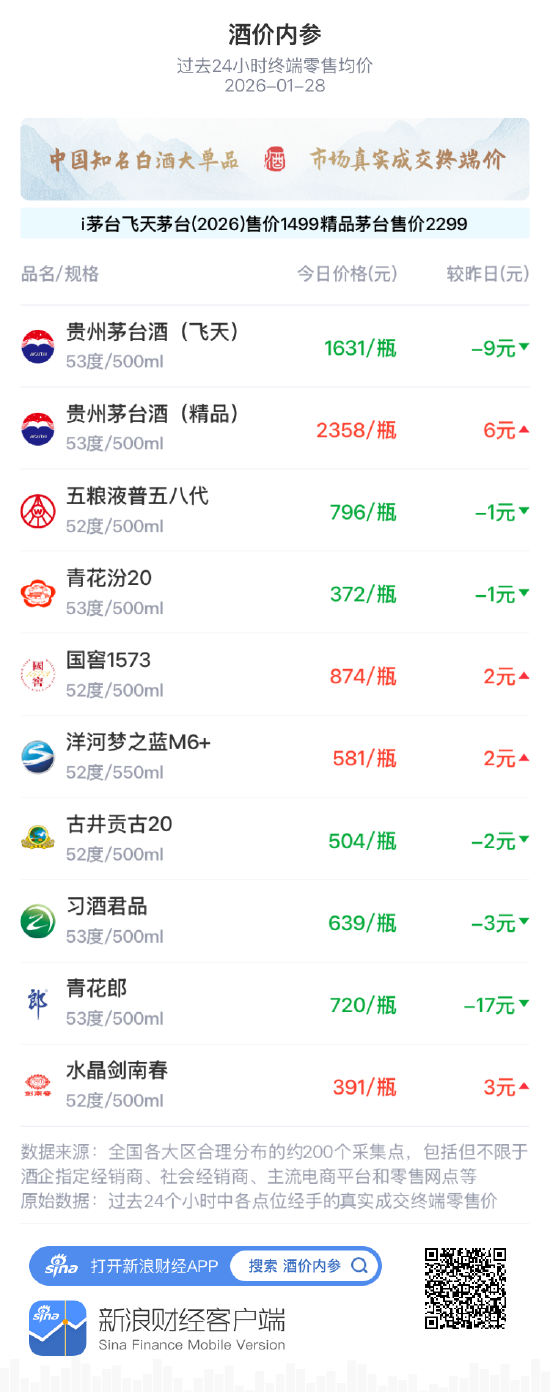
酒价内参1月28日价格发布 精品茅台领涨6元/瓶
Xin Lang Cai Jing· 2026-01-28 01:17
Core Viewpoint - The "Wine Price Reference" by Sina Finance has launched, providing real-time data on the retail prices of major Chinese liquor brands, indicating a mixed market trend with a slight overall decline in prices [1][5]. Price Trends - The average retail price of the top ten liquor products in China on January 28 was 8,866 yuan, down 20 yuan from the previous day, marking a new low in the past five days [1][7]. - The market showed four price increases and six decreases: - Increases: Premium Moutai up 6 yuan/bottle, Crystal Jian Nan Chun up 3 yuan/bottle, Guojiao 1573 and Dream Blue M6+ each up 2 yuan/bottle [1][7]. - Decreases: Qinghua Lang down 17 yuan/bottle, Feitian Moutai down 9 yuan/bottle, Xijiu Junpin down 3 yuan/bottle, and Gu Qingong Gu 20 down 2 yuan/bottle [1][7]. Market Analysis - The A-share liquor sector has seen a decline, with the China Securities Liquor Index dropping to 8,293.16 points, the lowest since September 19, 2024, and marking six consecutive years of annual declines [5][9]. - Among 20 stocks in the liquor sector, the average decline over the past 11 trading days was approximately 8.5%, with a median decline of 6.6% [5][9]. - Six stocks experienced declines of over 10%, accounting for nearly 30% of the sector, including Shanxi Fenjiu, Yanghe Brewery, and Gujing Gongjiu [5][9]. Financing Activity - Despite the market downturn, there has been an increase in financing activity, with Guizhou Moutai seeing a net purchase of 3.166 billion yuan over the past ten trading days, reaching a financing balance not seen in a year and a half [5][9]. - Shanxi Fenjiu and Wuliangye also saw net increases of 250 million yuan and 120 million yuan, respectively [5][9].






大消费行业2025Q4基金持仓分析:大消费板块重仓比例连续7个季度回落,远低于历史均值水平
Wanlian Securities· 2026-01-28 00:24
证券研究报告|商贸零售 [Table_Title] 大消费板块重仓比例连续 7 个季度回落,远 低于历史均值水平 [Table_ReportType] ——大消费行业 2025Q4 基金持仓分析[Table_ReportDate] [投资要点: Table_Summary] ⚫ 大消费板块重仓比例持续回落,多数消费子板块重仓比例均环比 下降,只有轻工制造、商贸零售和社会服务三个板块略有上升。 2025Q4 大消费板块基金重仓比例延续了 7 个季度以来的下降趋 势,环比下降 0.28pcts 至 4.41%,目前处于历史低位,远低于 2018 年以来的历史重仓比例平均值 10.94%。 ⚫ 分个股:全市场个股持仓 TOP20 中大消费板块占据 2 个席位,与 Q3 季度席位数持平,大消费板块个股重仓比例分化明显。2025Q4 全市场基金重仓比例 TOP20 个股中大消费板块占据 2 个席位,食 品饮料(贵州茅台)和家用电器(美的集团)各占据 1 席。大消 费板块基金重仓比例提升幅度前 10 个股包括 3 只家用电器个股 (美的集团、格力电器、海尔智家)、2 只食品饮料个股(伊利股 份、口子窖)、2 只轻工制造个 ...

食品饮料行业2025Q4基金持仓分析:食饮重仓比例持续下降,除酒类外的细分板块重仓比例回升
Wanlian Securities· 2026-01-28 00:24
Investment Rating - The industry investment rating is "stronger than the market," indicating an expected relative increase of over 10% in the industry index compared to the broader market within the next six months [29]. Core Insights - The food and beverage sector's heavy holding ratio continues to decline, dropping to 2.61% in Q4 2025, down 0.20 percentage points from the previous quarter, and significantly below the historical average of 6.77% since 2018 [1][10]. - Within the sector, the heavy holding ratio for sub-segments, excluding alcoholic beverages, has seen a rebound, with notable increases in categories such as seasoning and fermented products, dairy beverages, and snacks [2][13]. - The top ten heavy holdings in the food and beverage sector are dominated by liquor stocks, which occupy seven positions, with a total heavy holding ratio of 2.37% [3][19]. Summary by Sections 1. Heavy Holding Ratios - The food and beverage industry's heavy holding ratio has decreased to 2.61%, ranking sixth among 31 primary industries, down from fifth in the previous quarter [1][10]. - The liquor segment's heavy holding ratio has dropped to 2.26%, while other sub-segments like seasoning and fermented products, dairy beverages, snacks, and food processing have shown slight increases [2][13]. 2. Liquor Segment Analysis - The liquor segment remains a dominant force in the food and beverage industry, accounting for over 86% of the heavy holdings, although it has decreased by 1.76 percentage points [16]. - The top three liquor stocks by heavy holding ratio are Guizhou Moutai, Shanxi Fenjiu, and Wuliangye, with significant fluctuations in their rankings [19][20]. 3. Investment Recommendations - The report suggests that the liquor industry is in a bottoming phase, with low valuations and high dividends providing strong support for stock prices. The inventory destocking cycle is expected to continue until mid-2026, with potential investment opportunities emerging in the second half of 2026 [25]. - For the broader consumer goods sector, growth is anticipated from product upgrades, particularly in beer and dairy, while the seasoning industry is expected to benefit from low raw material costs and the rise of customized solutions [4][27].


五粮液:2025年公司实施了2024年度分红及2025年中期分红
Zheng Quan Ri Bao Wang· 2026-01-27 14:17
Group 1 - The core point of the article is that Wuliangye (000858) announced on January 27 that it will implement the 2024 annual dividend and the mid-year dividend for 2025 [1]
食品饮料行业点评报告:2025Q4食品饮料持仓回落,布局窗口渐行渐近
KAIYUAN SECURITIES· 2026-01-27 13:43
Investment Rating - The industry investment rating is "Positive" (maintained) [1] Core Insights - The food and beverage sector is currently at a low position in terms of valuation and fundamentals, presenting significant layout value. The CPI in December 2025 increased by 0.8%, indicating a mild recovery trend. The policy focus on expanding domestic demand and promoting consumption is becoming clearer, signaling a potential bottoming out of industry demand. The current valuation and policy bottom are resonating, gradually releasing pessimistic expectations and providing a safety margin for investment [7][35] - The upcoming Spring Festival is expected to catalyze performance in the sector, with resilient demand for consumer goods and a continuous upward trend in the snack sector. The mismatch in the timing of the Spring Festival is anticipated to lead to a concentrated release of stocking demand. The sector is expected to achieve rapid growth in Q1 2026 [7][35] Summary by Sections Fund Positioning - In Q4 2025, the allocation ratio for food and beverage in the overall market funds dropped to a new low of 6.1%, down from 6.4% in Q3 2025. The allocation ratio for active equity funds was 4.0%, slightly down from 4.1% in the previous quarter, indicating a continued reduction in food and beverage allocations by active equity funds [4][13] - The overall number of shares held by funds in the food and beverage sector decreased in Q4 2025, with a general trend of reduced allocation to food and beverage companies. Notably, companies like Yurun Agriculture, Yili, and West Wheat Food saw an increase in market value held by funds, while companies like Wuliangye, Shanxi Fenjiu, and Kweichow Moutai experienced significant decreases [6][29][32] Investment Recommendations - The report suggests focusing on two main lines for investment: first, consider companies like Shede Liquor that have undergone sufficient adjustments and possess high elasticity; second, allocate to industry leaders such as Kweichow Moutai and Shanxi Fenjiu, which have strong performance stability and risk resistance. The Spring Festival stocking is expected to be a core catalyst for the sector's performance [7][34] - Specific investment opportunities are highlighted in three sub-sectors: raw milk/dairy products, the snack sector, and the catering supply chain. Companies such as Wei Long, Gan Yuan Food, Yan Jin Pu Zi, West Wheat Food, and Yili are identified as key investment targets, with beneficiaries including Yurun Agriculture, Mengniu Dairy, Anjixin Food, and Guoquan [7][38]
五粮液:推出的马年生肖产品均可在主流电商平台查看
Zheng Quan Ri Bao Wang· 2026-01-27 13:40
证券日报网讯1月27日,五粮液(000858)在互动平台回答投资者提问时表示,公司推出的马年生肖产 品均可在主流电商平台查看,欢迎购买。 ...
食品饮料行业2025Q4基金持仓分析:板块重仓占比回落,白酒减配、大众品加仓
Guolian Minsheng Securities· 2026-01-27 13:33
Investment Rating - The report maintains a recommendation rating for the food and beverage industry [1] Core Insights - The heavy allocation in the food and beverage sector has decreased, with a reduction in liquor allocation and an increase in consumer staples [1] - The public fund heavy holding ratio for the food and beverage industry is 4.69%, down 0.13 percentage points from the previous quarter, while the overweight ratio has increased to 0.58%, up 0.18 percentage points [10][12] - The report highlights a continued reduction in liquor holdings, particularly in white liquor, while there has been an increase in allocations to snack foods, frozen foods, and dairy products [26] Summary by Sections 1. Fund Holdings Analysis - The public fund heavy holding ratio for the food and beverage sector is 4.69%, with an overweight ratio of 0.58%, indicating a slight decrease in heavy allocations [10] - The liquor heavy holding ratio has decreased to 3.52%, with an overweight ratio of 0.79% [10][12] - The top five heavy holdings in the food and beverage sector include Kweichow Moutai, Shanxi Fenjiu, Luzhou Laojiao, Wuliangye, and Dongpeng Beverage [40] 2. Changes in Sector Allocations - The report notes that the allocation to white liquor has decreased by 0.49 percentage points, while allocations to snack foods, frozen foods, and dairy products have increased by 0.05, 0.04, and 0.04 percentage points respectively [26] - The sub-industry allocations for Q4 2025 show that white liquor, beer, and other liquor holdings are at 3.52%, 0.08%, and 0.04% respectively, with snack foods and frozen foods showing the most significant increases [26] 3. Northbound Capital Flow - By the end of Q4 2025, northbound capital had a net outflow from the food and beverage sector, with total holdings amounting to 126.87 billion yuan, and liquor holdings at 96.59 billion yuan [47] - The proportion of northbound capital in the food and beverage sector decreased by 0.27 percentage points to 2.77% [47]
五粮液:公司高度重视市值
Zheng Quan Ri Bao Wang· 2026-01-27 13:12
Group 1 - The company emphasizes the importance of market capitalization and acknowledges that its stock price is influenced by various factors including macroeconomic environment, market sentiment, consumer demand, and industry conditions [1]
五粮液:29度一见倾心五粮液获年轻群体好评
Zheng Quan Ri Bao Wang· 2026-01-27 13:02
证券日报网讯1月27日,五粮液(000858)在互动平台回答投资者提问时表示,公司去年推出的29度一 见倾心五粮液,获得年轻群体好评,欢迎购买品鉴。 ...
AI原生数字人落地年货节 京东数字人大规模商业化再下一城
Zhong Guo Jin Rong Xin Xi Wang· 2026-01-27 12:26
Core Insights - JD.com has officially launched its annual New Year goods festival on January 25, featuring significant discounts and promotions, including direct price cuts of up to 50% and additional subsidies of up to 3,000 yuan [1][2] - The introduction of AI-native digital humans marks a technological upgrade, transitioning from traditional digital tools to a more interactive and personalized shopping experience [2][8] Group 1: AI Native Digital Humans - The new generation of AI-native digital humans, powered by JD's JoyAI model, allows for real-time generation of various personas, enhancing consumer engagement and providing a more immersive shopping experience [2][6] - These digital humans can perform complex tasks and create personalized content, moving beyond their previous role as mere cost-saving tools [2][5] Group 2: Creative Engagement Strategies - Over 100 brand presidents will appear as customized digital avatars during the festival, promoting popular products with significant discounts [3][4] - The character "Ma Honghong" will randomly appear in various brand live streams, offering chances to unlock substantial cash rewards, enhancing consumer interaction [3][4] Group 3: Technological Advancements - The JoyAI model enables digital humans to generate long-duration live streams with high expression fidelity and natural interaction, addressing industry challenges such as hand illusion [6][7] - JD.com has introduced a "digital human live room replication" feature, allowing merchants to upload real live stream content for accurate replication, enhancing the quality and fluidity of digital interactions [7] Group 4: Market Positioning - JD.com is leading the commercialization of AI-native digital humans, with plans to launch over 300 such digital personas during the New Year festival, covering various scenarios from product promotion to brand activation [8] - The shift from "tool-based" to "native" digital humans is redefining the boundaries of live streaming and driving the next evolution in live commerce [8]

