
微软

Search documents
美股遭遇 “股债汇三杀”:纳指跌超2%科技股领跌,黄金白银创历史新高,特朗普关税威胁搅动全球市场
Jin Rong Jie· 2026-01-21 00:20
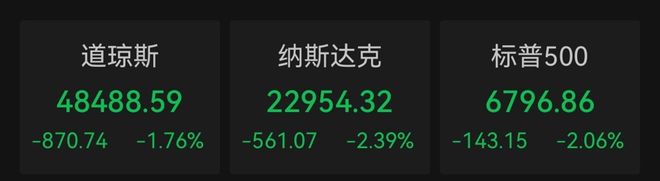
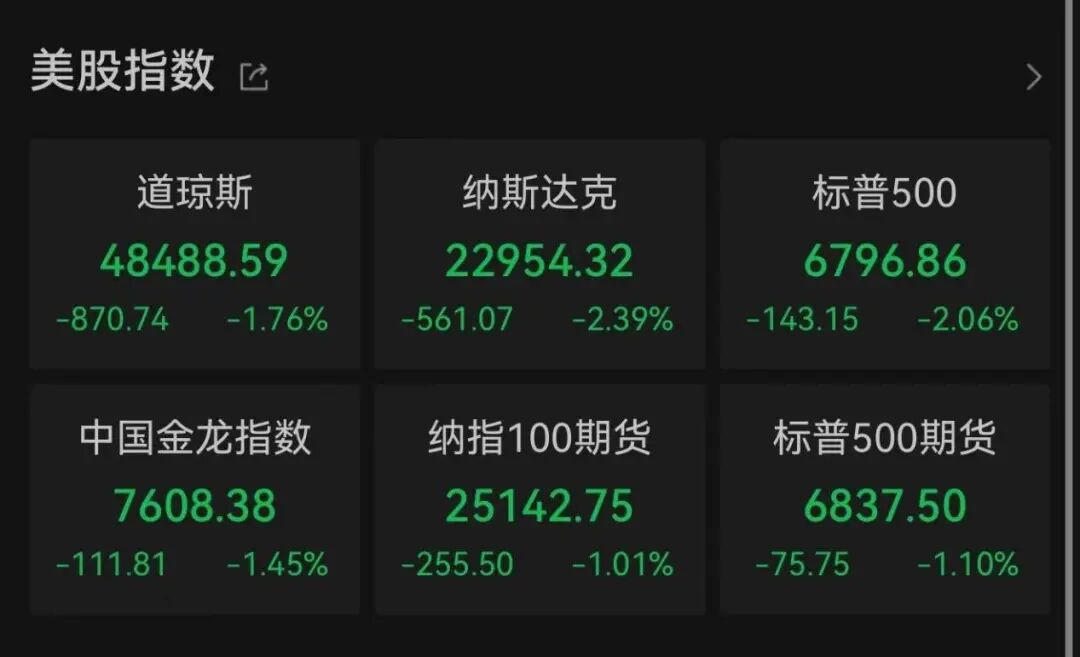
Market Overview - The global market is experiencing heightened risk aversion due to renewed tariff threats from U.S. President Trump, leading to significant sell-offs in U.S. stocks on January 20, with the Dow Jones Industrial Average dropping 870.74 points (1.76%) to 48,488.59 points, the Nasdaq Composite falling 2.39%, and the S&P 500 declining 2.06% [1][2] Technology Sector Impact - The technology sector has been particularly hard hit, with the VIX index rising over 6% and surpassing the 20 mark, indicating deep investor concerns over escalating trade tensions. The index tracking the seven major U.S. tech companies fell by 3.06%, with Nvidia and Tesla both dropping over 4%, and Apple and Amazon declining more than 3% [2] Chinese Stocks Performance - Chinese stocks are also under pressure, with the Nasdaq Golden Dragon China Index falling 1.45% to 7,608.38 points. Notable declines include JinkoSolar down 12.46% to $25.825, and CenturyLink down 10.18% to $9.480. Several other Chinese stocks, including Bilibili and EHang, saw declines exceeding 5% [3][4] Precious Metals Surge - There is a significant influx of capital into the precious metals market, with gold prices rising above $4,760 per ounce and silver futures surpassing $95, both reaching historical highs. Analysts attribute this surge to increased demand for political risk hedging and a weakening dollar [6][7] Bond Market Dynamics - The U.S. dollar index fell by 0.41% to 98.642, marking its worst two-day performance in about a month, reflecting weakened confidence in dollar assets. Concurrently, the yield on the 10-year U.S. Treasury bond rose to 4.287%, the highest since late August, contributing to a challenging environment for both stocks and bonds [7][8] Geopolitical Tensions - The market turmoil is largely driven by Trump's recent statements regarding Greenland and the imposition of tariffs on imports from several European countries, which are set to increase from 10% to 25%. The potential for a G7 summit proposed by French President Macron is under scrutiny, as Trump's participation remains uncertain, which could influence future trade discussions [9]

深夜“风暴”,集体大跌!金银双双狂飙
Zhong Guo Ji Jin Bao· 2026-01-21 00:19
【导读】受关税和地缘政治影响,美股收跌,避险资产受资金关注 受关税和地缘政治影响,隔夜美股收跌,美债美元同样下跌。避险情绪高涨,黄金白银双双创下新高。 三大指数大幅下挫 美东时间1月20日(周二),美国总统特朗普要求控制格陵兰,并以加征关税作为威胁,再度点燃全球贸易战担忧。 美股三大指数大幅下挫,纳斯达克指数跌超2%。截至收盘,道琼斯指数跌1.76%,报48488.59点;标普500指数跌2.06%,报6796.86点;纳斯达克指数跌 2.39%,报22954.32点。 特朗普在"真实社交"发文称,将对8个欧洲国家(均为北约成员国)的美国进口商品实施阶梯式加征关税,直至"达成全面收购格陵兰岛的协议"。 关税将 于2月1日从10%起步,并在6月1日升至25%。 此外,特朗普还威胁对法国葡萄酒和香槟征收200%的关税,有报道称法国总统马克龙不愿加入他所谓的"和平委员会"。 欧洲领导人已将特朗普最新的关税威胁形容为"不可接受"。 股债汇三杀 中概股方面,纳斯达克中国金龙指数下跌1.45%。中概互联概念股近乎均收跌。百度上涨0.33%;小米集团下跌4.62%,腾讯控股、美团、拼多多分别下跌 3.23%、2.88%、2 ...
GDP增长将取决于Tokens数量?微软CEO纳德拉达沃斯对话信息量太大了……
3 6 Ke· 2026-01-21 00:09
Core Insights - The dialogue between Microsoft CEO Satya Nadella and BlackRock CEO Larry Fink at the World Economic Forum in 2026 focused on the transition of AI from an experimental technology to a foundational infrastructure for society, emphasizing the need to measure, manage, and redefine competition rules in this new landscape [1][12]. Group 1: AI as a Transformative Force - Nadella described the current AI wave as a "platform shift," viewing it as a natural evolution of computing technology over the past 70 years, with AI representing a significant breakthrough in software's reasoning and self-transformative capabilities [1][13]. - The rapid evolution of AI capabilities, from code completion tools to fully autonomous agents, is positioning AI as an "infinite mind" for knowledge workers, fundamentally changing how work is conducted [2][14]. Group 2: Economic Implications of AI - Nadella introduced a new macroeconomic metric: "tokens per dollar per watt," suggesting that future GDP growth will depend on this measure, which reflects the efficiency of producing intelligent tokens with energy [3][21]. - The integration of energy and computing networks is deemed essential for countries to enhance their competitiveness in the global economy, with a focus on creating a seamless infrastructure for token production [3][25]. Group 3: Redefining Sovereignty in the Digital Age - The discussion highlighted a shift from traditional "data sovereignty" to "enterprise sovereignty," emphasizing the importance of controlling model weights and internal knowledge to maintain competitive advantage [4][7]. - Companies that rely solely on external AI models without embedding their unique knowledge into proprietary models risk losing their core value [7][39]. Group 4: Organizational Transformation - Nadella proposed a "triad" for corporate transformation: mindset, skillset, and dataset, stressing the need for leaders to rethink workflows, employees to upgrade their skills, and organizations to ensure that AI is fed with contextually relevant data [9][31]. - The emergence of a "barbell effect" indicates that startups can leverage AI tools more effectively than larger organizations, which face greater challenges in transformation [9][32]. Group 5: Global AI Diffusion and Accessibility - The conversation addressed the need for equitable AI diffusion across different economies, with a focus on ensuring that AI benefits are distributed widely to avoid societal polarization [22][24]. - Nadella noted that the existing infrastructure for mobile networks allows for a more uniform distribution of AI capabilities compared to previous technological waves, emphasizing the importance of capital investment and local demand [24][25]. Group 6: Future of AI Models - Nadella predicted a "multi-model world" where organizations will need to orchestrate various AI models, combining proprietary data with external models to achieve desired outcomes [40][41]. - The ability to integrate and leverage diverse models will become a key competitive advantage for companies in the evolving AI landscape [40][41].

微软AI CEO苏莱曼预言:五年内人人将拥有亲密的专属AI伴侣
Sou Hu Cai Jing· 2026-01-20 15:20
Group 1 - The core viewpoint is that top AI laboratories are entering a new development phase, with Microsoft AI CEO Mustafa Suleyman predicting that everyone will have an AI companion within the next five years [1][3] - Suleyman emphasizes that humans will form personal and intimate connections with these AI companions, treating them as if they are living alongside them [3] - He believes that AI chatbots have the potential to evolve into true friends, marking a transformative era that society must embrace [3] Group 2 - Suleyman asserts that within five years, each individual will have a dedicated AI companion that understands their preferences, motivations, and life experiences [3] - Microsoft’s Copilot is making significant strides towards this goal, having undergone major upgrades that include features like Copilot Avatar, Copilot Vision, and enhanced search and memory capabilities [3]

美股科技股,全线下跌
Di Yi Cai Jing Zi Xun· 2026-01-20 15:09
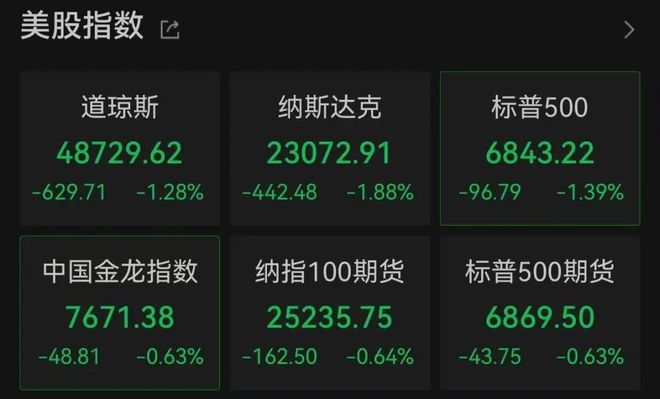
Core Viewpoint - The U.S. stock market experienced significant declines on January 20, with major indices falling sharply, indicating a bearish sentiment among investors. Group 1: Market Performance - The Dow Jones Industrial Average fell by 629.71 points, or 1.28%, closing at 48729.62 [1] - The S&P 500 index decreased by 96.79 points, or 1.39%, ending at 6843.22 [1] - The Nasdaq Composite dropped by 442.48 points, or 1.88%, closing at 23072.91 [1] Group 2: Sector Performance - Major technology stocks saw widespread declines, with Broadcom falling over 3%, and Tesla, NVIDIA, Amazon, META, and Microsoft each dropping more than 2% [2] - Other notable declines included Google, Apple, and TSMC, which also experienced losses [2] Group 3: Chinese Stocks - Chinese stocks mostly fell, with Bilibili dropping over 4%, and both Canadian Solar and Century Internet declining by more than 3% [4] Group 4: Gold Market - Gold stocks surged against the market trend, with Kinross Gold rising over 7%, Harmony Gold increasing by more than 6%, and Barrick Gold gaining nearly 3% [5] - Spot gold prices broke above $4750 per ounce, marking a new historical high with a daily increase of 1.67% [5]
美股科技股,全线下跌
第一财经· 2026-01-20 15:01
Group 1 - NVIDIA stock price is at 181.140, down 2.73% [1] - Tesla stock price is at 425.925, down 2.65% [1] - AppLovin stock price is at 546.640, down 3.89% [1] - Alphabet stock price is at 323.490, down 1.97% [1] - Alibaba stock price is at 164.340, down 0.64% [1] - Pinduoduo stock price is at 104.111, down 2.48% [1] - Apple stock price is at 254.685, down 0.33% [1] Group 2 - TSMC stock price is at 340.960, down 0.42% [2] - Microsoft stock price is at 449.360, down 2.28% [2] - Meta Platforms stock price is at 602.920, down 2.79% [2] - AMD stock price is at 231.115, down 0.31% [2] - Broadcom stock price is at 340.620, down 3.15% [2] - Oracle stock price is at 185.055, down 3.16% [2] - Chinese concept stocks mostly declined, with Bilibili dropping over 4% and Canadian Solar and Century Internet falling over 3% [2] - Gold stocks rose against the trend, with K92 Mining up over 7%, Harmony Gold up over 6%, and Barrick Gold up nearly 3% [2] - Spot gold broke above $4750 per ounce, reaching a new historical high with a daily increase of 1.67% [2]
施贵宝与微软合作利用AI技术加速肺癌的早期检测
Ge Long Hui A P P· 2026-01-20 14:18
Core Viewpoint - Bristol-Myers Squibb announces collaboration with Microsoft to leverage artificial intelligence for accelerating early detection of lung cancer [1] Group 1: Collaboration Details - The partnership aims to deploy FDA-approved radiology AI algorithms through Microsoft's precision imaging network [1] - This network is currently utilized by over 80% of hospitals in the United States [1] Group 2: Technology Application - The technology is designed to automatically analyze X-ray and CT images [1] - It assists in identifying lung diseases and detecting hard-to-find lung nodules [1]

中金公司:中美AI投资的“差异”
Ge Long Hui· 2026-01-20 14:01
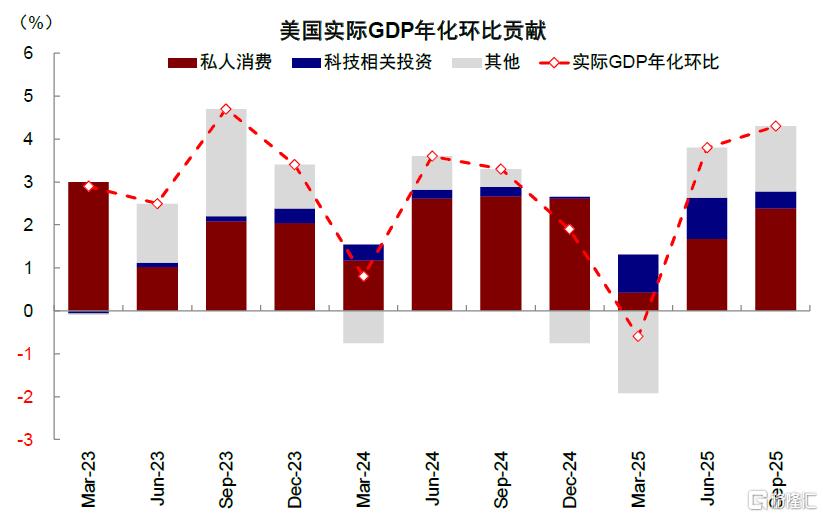
Core Insights - The article emphasizes the significant impact of AI on global economic growth and stock market performance, particularly in the U.S. and China, highlighting the importance of AI investments in driving GDP growth and stock returns [1][11]. Economic Contribution - U.S. technology hardware and software investments are projected to contribute 0.8 percentage points to the annualized GDP growth of 2.5% in the first three quarters of 2025 [2]. - Since 2023, U.S. non-farm business sector labor productivity has increased by 7.2% [4]. Stock Market Performance - Since the launch of ChatGPT at the end of 2022, the "Magnificent Seven" stocks in the U.S. contributed 45 percentage points to the S&P 500 index returns, accounting for over half of the total returns [1]. - In Hong Kong, seven leading tech stocks contributed 14 percentage points to the Hang Seng Index returns, representing 40% of the total returns since the launch of DeepSeek in early 2025 [7]. AI Industry Dynamics - The U.S. has a first-mover advantage in AI infrastructure, models, and talent, while China is rapidly catching up, particularly in open-source models [16][19]. - The global cloud computing market is expected to reach $692.9 billion in 2024, with North America holding a 54.3% market share and China at 16.8% [20]. Investment Landscape - U.S. nominal investment in AI technology hardware and software is approximately $1.05 trillion, accounting for 3.4% of nominal GDP, while China's investment is around $650 billion, also about 3.3% of nominal GDP [42]. - The AI investment landscape shows that the U.S. is primarily driven by private sector investments, while China's investments are significantly supported by government funding [52]. Funding Sources - U.S. AI investments are predominantly led by the private sector, with a total investment of $552 billion, compared to China's $900 billion, which includes substantial government support [52]. - The Chinese government has invested approximately $750 billion in AI, significantly higher than the U.S. government's $110 billion [57]. Investment Focus - U.S. investments are heavily focused on data centers and supporting infrastructure, while China is investing more in chip development and AI models [58]. - In 2025, U.S. leading companies are expected to invest $4 billion in the foundational layer, with 88% directed towards infrastructure [59]. Talent and Research - The number of AI researchers in China has grown significantly, with Chinese researchers holding three times as many AI patents as their U.S. counterparts [41]. - The rapid increase in AI talent in China is enhancing its research capabilities, narrowing the gap with the U.S. [41]. Future Outlook - The article suggests that the U.S. will continue to invest heavily in data centers and energy equipment, which will drive demand for related supply chains in China [88]. - China's ongoing need for chips and AI infrastructure indicates a sustained demand and policy support in the semiconductor sector [88].

微软CEO纳德拉预警:AI若不能广泛落地,终将沦为投机泡沫
Hua Er Jie Jian Wen· 2026-01-20 13:55
Group 1 - The core viewpoint is that the long-term success of AI depends on its adoption across a wider range of industries and regions beyond wealthy economies, as warned by Microsoft's CEO Satya Nadella [1][2] - Nadella emphasized that for AI to avoid becoming a bubble, the benefits of the technology must be distributed more evenly across different sectors and regions [2] - There is a significant disparity in global AI adoption rates, with productivity gains and applications primarily concentrated in wealthier developed countries, raising concerns about the sustainability of AI investment returns [1][2] Group 2 - Nadella reiterated that the market will not rely on a single dominant model provider, which has led Microsoft to collaborate with several leading AI companies, including Anthropic, xAI, and OpenAI [3] - Microsoft has gained a significant first-mover advantage in AI through a $14 billion investment in OpenAI, securing exclusive access to the technology behind ChatGPT and priority in data center collaborations [3] - Companies will be able to utilize multiple models, including open-source ones, and leverage techniques like "distillation" to create smaller, cost-effective proprietary models, which will be crucial for maintaining competitive advantage [3]
TD Cowen下调微软目标价至625美元
Ge Long Hui A P P· 2026-01-20 05:05
Group 1 - TD Cowen has lowered Microsoft's target price from $655 to $625 [1]