
长安汽车

Search documents
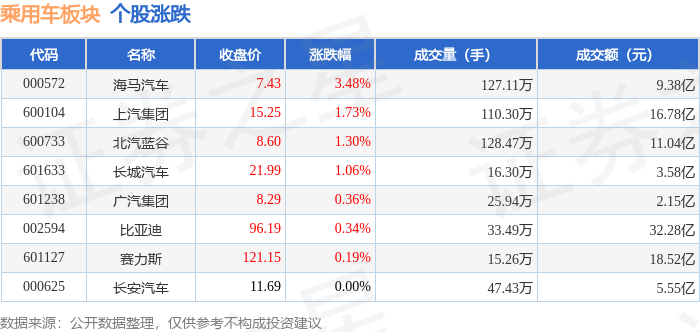
乘用车板块1月19日涨0.68%,海马汽车领涨,主力资金净流入6355.93万元
Zheng Xing Xing Ye Ri Bao· 2026-01-19 08:52
Group 1 - The passenger car sector increased by 0.68% on January 19, with Haima Automobile leading the gains [1] - The Shanghai Composite Index closed at 4114.0, up 0.29%, while the Shenzhen Component Index closed at 14294.05, up 0.09% [1] - Key stocks in the passenger car sector showed varied performance, with notable increases in stocks like Haima Automobile (3.48%) and SAIC Motor (1.73%) [1] Group 2 - The net inflow of main funds in the passenger car sector was 63.56 million yuan, while retail investors experienced a net outflow of 45.99 million yuan [1] - Haima Automobile had a significant main fund net inflow of 73.46 million yuan, while retail investors saw a net outflow of 86.47 million yuan [2] - BYD experienced a net outflow of 88.17 million yuan from main funds, indicating a negative trend in investor sentiment [2]







11家车企今年销量目标总和猛增19%
新华网财经· 2026-01-19 07:38
Core Viewpoint - The automotive industry is setting ambitious sales targets for 2026, with a total of 11 major companies aiming for 23.8 million units, reflecting a year-on-year increase of approximately 19% compared to 20 million units in 2025 [1][2]. Group 1: Sales Targets of Major Companies - Major companies have set aggressive sales targets for 2026, with a total of 2,380,240 units aimed, which is an 18.96% increase from the 2,000,904 units sold in 2025 [3]. - Great Wall Motors has the most ambitious target, aiming for 1.8 million units, a nearly 36% increase from 1.32 million units in 2025 [5]. - Dongfeng plans to increase its target from 250,000 units in 2025 to 325,000 units in 2026, representing a growth of over 30% [5]. - Changan aims for 3.3 million units, a 13.3% increase, while Chery targets 3.2 million units, a 14.03% increase [5]. - BYD, SAIC, GAC, and Li Auto have not disclosed their targets, but collectively sold 1.167 million units in 2025, indicating potential for significant contributions to the overall market [1]. Group 2: Conservative Institutional Predictions - The China Association of Automobile Manufacturers (CAAM) forecasts total automotive sales in 2026 to be around 34.75 million units, reflecting only a 1% year-on-year growth [2][8]. - UBS predicts a slight decline in wholesale sales, while retail sales may see a mid-single-digit drop [2][8]. - Deutsche Bank and JPMorgan forecast a decline of 3% to 5% in total automotive sales for 2026 [8]. Group 3: New Energy Vehicle Growth - New energy vehicle sales targets are significantly higher than overall sales growth targets, with companies like Geely aiming for a 32% increase in new energy vehicle sales [8]. - The focus on new energy vehicles is seen as a key growth driver for the automotive market, with companies adjusting their strategies accordingly [8]. Group 4: Global Market Challenges - Global electric vehicle sales are expected to grow by 20% to 20.7 million units in 2025, but growth is projected to slow to 15.7% in 2026, with North America facing a significant decline of 23% [9]. - Factors such as changing policies and increased competition in Europe are contributing to a cooling global electric vehicle market [9]. Group 5: Industry Consolidation - The automotive market is expected to see a clearer division between leading, mid-tier, and numerous smaller companies, with a need for consolidation due to increased competition and market saturation [11]. - Only about 10% of Chinese electric vehicle brands are predicted to be profitable in the next five years, leading to the exit of brands with low sales volumes [11].

订单直签327辆!江淮1卡2026款收割机运输车发布即热销
第一商用车网· 2026-01-19 07:02
Core Viewpoint - Jianghuai Commercial Vehicles aims to establish the Jianghuai 1 Card as a leading brand in high-end intelligent trucks, aspiring to become a global leader in the industry [2]. Group 1: Event Highlights - The Jianghuai Commercial Vehicles Central Plains User Conference and Harvester Industry Customer Annual Meeting was successfully held on January 16, 2026, in Zhumadian, Henan, gathering over 1,000 attendees to promote rural revitalization and modern agricultural development [3]. - At the event, the 2026 models of Jianghuai 1 Card Junling harvesters were launched, including models A9, V7, Q8, and V8, featuring significant technical upgrades tailored for harvesting scenarios, resulting in 327 orders being placed on-site [5]. Group 2: Industry Insights - Agriculture is fundamental to the nation, and the evolution of the "wheat customer" group reflects the modernization of Chinese agriculture, emphasizing the importance of agricultural machinery transportation in ensuring food security [7]. - Jianghuai Commercial Vehicles has been committed to serving the agricultural sector for 19 years, providing comprehensive service support to over 30,000 harvester users, thus contributing significantly to the mechanization of agriculture and stable grain production [8]. Group 3: User-Centric Innovations - Jianghuai 1 Card has transitioned from being a mere product provider to a partner in wealth creation for wheat customers, developing the "Wheat Customer No. 1" series of specialized transport vehicles that address core user needs such as efficiency, load capacity, and ease of use [11]. - The company has introduced the "Smart Chain • Co-creation" user lifecycle solution, establishing a nationwide service network with over 1,600 service points, and collaborating with financial institutions to lower vehicle purchase barriers for users [12]. Group 4: Customer Testimonials - Users have expressed satisfaction with the Jianghuai 1 Card Junling, highlighting features such as spacious cabins and customized cargo boxes that enhance operational efficiency during the harvest season [13]. - Positive experiences with the company's 24/7 service support have reinforced user confidence, allowing them to focus on their harvesting tasks without worry [14]. Group 5: Future Aspirations - Jianghuai 1 Card is committed to continuing its partnership with users as an "efficient wealth creation partner," leveraging technological innovation to empower rural revitalization and contribute to the agricultural sector's growth [14].

11家车企今年销量目标总和猛增19%
第一财经· 2026-01-19 06:45
Core Viewpoint - The automotive industry is setting ambitious sales targets for 2026, with a total of 11 major companies aiming for 23.8 million units, reflecting a year-on-year increase of approximately 19% compared to 20 million units sold in 2025 [3][4]. Group 1: Sales Targets and Growth - Major automakers have disclosed their sales targets for 2026, with a combined goal of 23.8 million units, indicating a significant increase from the previous year's total of 20 million units [3][5]. - If all leading manufacturers achieve their targets, the total sales for 2026 could reach 35.47 million units, representing a growth of about 12% [3]. - Notable ambitious targets include Great Wall Motors aiming for 1.8 million units (up 36%), Dongfeng targeting 3.25 million units (up over 30%), and Chery setting a goal of 3.2 million units (up 14.03%) [10][11][12]. Group 2: Market Predictions and Challenges - The China Automotive Industry Association forecasts total vehicle sales in 2026 to be around 34.75 million units, with a modest growth of 1% [4][17]. - UBS predicts a low single-digit decline in wholesale vehicle sales and a mid-single-digit drop in retail sales for 2026 [18]. - The automotive market is facing challenges, including a reduction in tax incentives and a potential slowdown in electric vehicle sales growth globally [20]. Group 3: Industry Dynamics and Consolidation - The automotive industry is experiencing increased pressure for consolidation, with the top 15 automotive groups accounting for 92.3% of the market share, a slight decrease from the previous year [22]. - The market is expected to see a clearer division between leading, mid-tier, and smaller companies, with many struggling electric vehicle manufacturers facing significant challenges [23]. - Analysts suggest that only about 10% of Chinese electric vehicle brands are likely to be profitable in the next five years, indicating a potential exit of brands with low sales volumes [23].

长安汽车发布关于广西南宁15辆车连撞交通事故的声明
Xin Lang Cai Jing· 2026-01-19 06:41
Core Viewpoint - Changan Automobile's misinformation reporting center has issued a statement addressing the spread of false information regarding a traffic accident involving 15 vehicles in Nanning, Guangxi, which has been inaccurately linked to the "Aviator driving assistance system malfunction" [1] Group 1 - The company emphasizes that the dissemination of unverified information has severely distorted facts and misled the public, causing significant harm to the Aviator brand's reputation [1] - Aviator Technology released a statement on January 17 to clarify the situation surrounding the incident [1] - The company asserts that the online space is not beyond the law and will take legal action against any defamatory behavior that harms its legitimate rights and interests [1] Group 2 - The company encourages the public to report any entities spreading false information through its misinformation reporting center's official account [1] - The statement highlights the importance of maintaining a clear online environment and fair market competition order [1]
汽车行业周报:低增长之年,追寻高质量发展
Guoyuan Securities· 2026-01-19 05:45
Investment Rating - The report maintains a "Recommended" investment rating for the automotive industry, indicating that the industry index is expected to outperform the benchmark index by more than 10% [6]. Core Insights - The automotive industry is entering a phase of low growth, with a focus on high-quality development opportunities. Key areas of interest include high-growth automotive companies and structural opportunities within the supply chain, particularly in commercial vehicles and automotive technology [4][34]. - The China Association of Automobile Manufacturers (CAAM) forecasts that total vehicle sales in China will reach 34.75 million units in 2026, representing a year-on-year growth of 1%. Passenger vehicle sales are expected to grow by 0.5%, while commercial vehicle sales are projected to increase by 4.7% [3][35]. - New energy vehicles (NEVs) are anticipated to play a crucial role in driving industry growth, with expected sales of 19 million units in 2026, reflecting a significant year-on-year growth of 15.2% [3][35]. Summary by Sections 1. Weekly Market Review (January 10-16, 2026) - The automotive sector index increased by 0.49%, outperforming the Shanghai and Shenzhen 300 index by 1.06 percentage points. The automotive services sector saw the highest growth at 4.51% [12][15]. 2. Weekly Data Tracking (January 10-16, 2026) - From January 1-11, 2026, retail sales of passenger vehicles in China totaled 328,000 units, a 32% decrease year-on-year. Wholesale figures were 381,000 units, down 40% year-on-year [20][21]. 3. Industry News (January 10-16, 2026) - Significant developments include partnerships for advanced driving technologies and the introduction of new vehicle models by major manufacturers, indicating ongoing innovation in the sector [25][29][31]. 4. Key Manufacturer Sales Rankings (2025) - BYD led the passenger vehicle market with sales of 4.55 million units, followed by Geely and Chery. In the NEV segment, BYD also dominated with a market share of 29.7% [23][24]. 5. Future Outlook - The report emphasizes the importance of macroeconomic policies and industry governance in sustaining growth. The focus will be on maintaining competitive advantages in electric and intelligent vehicle technologies [34][36].




汽车行业周报:低增长之年,追寻高质量发展-20260119
Guoyuan Securities· 2026-01-19 05:23
Investment Rating - The report maintains a "Recommended" investment rating for the automotive industry, indicating a positive outlook for certain segments within the sector [6]. Core Insights - The automotive industry is expected to experience low growth in 2026, with total vehicle sales projected to reach 34.75 million units, reflecting a year-on-year increase of 1%. Passenger vehicle sales are anticipated to grow by 0.5%, while commercial vehicle sales are expected to rise by 4.7%. The new energy vehicle (NEV) segment is projected to grow significantly, with sales expected to reach 19 million units, a 15.2% increase year-on-year, highlighting its role as a key growth driver [3][35]. - The report emphasizes the importance of macroeconomic policies and GDP growth targets in influencing vehicle sales, particularly in the passenger vehicle segment. The report suggests that sustained policy support is crucial for maintaining sales momentum [3][35]. Summary by Sections 1. Weekly Market Review (January 10-16, 2026) - The automotive sector index increased by 0.49%, outperforming the Shanghai Composite Index by 1.06 percentage points. The automotive services sector saw the highest gains, with a 4.51% increase [12][15]. 2. Weekly Data Tracking (January 10-16, 2026) - Retail sales of passenger vehicles from January 1-11 totaled 328,000 units, a 32% decrease year-on-year. Wholesale figures showed a similar trend, with 381,000 units sold, down 40% year-on-year. The NEV market also faced declines, with retail sales of 117,000 units, down 38% year-on-year [20][21]. 3. Industry News (January 10-16, 2026) - Key developments include partnerships for advanced driving technologies and initiatives to promote autonomous vehicle testing in regions like Hong Kong. Additionally, the report highlights the ongoing negotiations between China and the EU regarding electric vehicle trade, which could stabilize market conditions [25][28][30]. 4. Investment Recommendations - The report suggests focusing on structural opportunities within the automotive sector, particularly high-growth companies and regions, as well as the recovery of commercial vehicles and advancements in automotive technology [4].
长安汽车人工智能基础与应用副总经理梁锋华:以天枢智能绘就未来出行新图景
Zhong Guo Qi Che Bao Wang· 2026-01-19 03:23
Core Insights - Changan Automobile is transitioning from a traditional car manufacturer to a smart low-carbon mobility technology company, showcasing its commitment and capabilities through the "Beidou Tianshu" strategy [1][3] Group 1: Strategic Development - Since the launch of the "Beidou Tianshu" strategy in 2018, Changan has completed the 1.0 phase, achieving significant breakthroughs in intelligent technology and improving market performance, with vehicle sales increasing from 1.76 million in 2019 to 2.91 million projected for 2025, marking a continuous growth over seven years [3] - The company has established a central integrated software and hardware architecture (SDA platform) and seven core technology systems, focusing on intelligent driving, intelligent cockpit, and intelligent chassis, utilizing over 2,500 key technologies to implement more than 500 functional scenarios, including 48 industry-first features [3] Group 2: Technological Achievements - Changan has made significant advancements in intelligent driving, achieving 17 milestone results, including the first domestic 2,000-kilometer intelligent driving test and the continuous iteration of APA 5.0-7.0, establishing a technological advantage [3] - The company received a level 3 autonomous driving permit from the Ministry of Industry and Information Technology and the first official license plate for level 3 autonomous driving in China, marking a transition from technical validation to mass production and compliant commercial use [4] Group 3: Future Plans - The "Beidou Tianshu 2.0" strategy, announced in February 2025, aims to build a smart architecture centered around the Tianshu model, enhancing intelligent driving from "rule-based" to "flexible response," and creating a cockpit that provides emotional security [5] - Changan plans to explore level 3 autonomous driving for consumers in 2026, scale up level 3 and demonstrate level 4 Robotaxi in 2027, achieve partial level 4 applications in 2028, and reach complex scenario level 4 goals by 2030 [5] Group 4: Industry Perspective - The company emphasizes that the scaling of autonomous driving is a test of ecological collaboration, requiring the establishment of standards, data sharing, and risk-sharing to transform China's scene advantages into industrial strengths [6] - Changan is constructing a future mobility paradigm of "1+N+X," which includes one core brain, multiple diverse carriers (cars, humanoid robots, flying cars), and various service agents, promoting the evolution of mobility towards safety, intelligence, three-dimensionality, and sharing [6]
招行、中信、兴业密集落子:起底股份行AIC的生存哲学
Hua Er Jie Jian Wen· 2026-01-18 23:51
几乎同期,招商银行旗下的招银投资现身深蓝汽车的C轮融资名单,豪掷5亿元现金; 作为兴业银行旗下AIC,兴银投资则在开业45天内,密集扫货盛新锂能、金发科技、东阳光三家上市公 司的核心子公司,累计投放超60亿元。 随着兴业、招商、中信三家股份行AIC密集开业,"5+0"的国有行垄断格局宣告终结。 三家股份行急切的起手式,透露了一种与国有大行不同的生存哲学—— 它们已不甘做政府母基金身后的"金主",选择直接现身被投企业的股东名单中。 岁末年初,当一级市场的GP们还在为募资寒冬瑟瑟发抖,三张来自银行系的巨额支票,已经悄无声息 地划向了新能源与硬科技赛道。 2025年12月末,仅开业一周的中信银行旗下信银金投火速完成首单,一举拿下深圳港华顶信清洁能源 49%的股权; 三张新面孔 虽同持AIC牌照,但在首批落地的项目中,三家股份行已经拿出了不同的剧本。 在三家新晋AIC中,招商银行旗下的招银投资注册资本高达150亿元,比兴业和中信高出整整50%,这 多出的50亿是资本金,亦是招行在股权投资战场上的底气。 招银投资的首秀选择了深蓝汽车,在深蓝汽车刚刚完成的61.22亿元C轮融资中,招银投资拿下约2.42% 的股权,成为该 ...



资与治 西南F4拓新局
Zhong Guo Zheng Quan Bao· 2026-01-18 20:44
——上市公司质量和投资价值进一步提高。全省上市公司累计实施并购重组136家次、交易金额813亿 元,累计实施股份回购增持283家次、总金额298亿元,累计实施现金分红超2300亿元。全省科创板、创 业板和北交所上市公司数量占比提升至44%。 对于"十五五"时期,四川证监局表示,将继续按照证监会党委和省委、省政府部署,充分发挥资本市场 功能作用,助力地方经济社会高质量发展。主要从四方面发力:聚焦科技创新,更好助力四川新质生产 力发展;凝聚发展合力,推动上市公司做优做强;强化功能发挥,服务区域发展战略;提高监管精准有 效性,守牢风险底线。 拓面增质 辖区资本市场亮点多 过去五年,四川资本市场发展环境和生态体系持续优化,各类市场主体搭乘政策东风,加速发展。 资本市场亮蜀光 资本市场亮 光 星奔川骛,岁聿云暮。回看"十四五"时期,四川资本市场交出了一份"高分答卷": ——直接融资效能进一步提升。全省新增46家A股上市公司、首发募集资金超360亿元,省内各类市场 主体通过资本市场实现直接融资超2.1万亿元,支持企业发行科创债、绿色债、乡村振兴债等创新品种 债券168只,募集资金超1000亿元。 上市公司总量稳增、赛道更 ...