阿里云

Search documents
亚马逊计划用机器人代替60万岗位,实现75%运营自动化;OpenAI设立秘密项目,训练AI接手初级银行家的繁琐工作丨AIGC日报
创业邦· 2025-10-23 00:10
Group 1 - Yushu Technology has received a patent for a method and system that maps human movements to robot joint control, enhancing robot flexibility and enabling natural human-robot interaction [2] - OpenAI is training AI to take over tedious tasks traditionally performed by junior bankers, utilizing over 100 former investment bankers from major firms like JPMorgan and Goldman Sachs in a secret project called "Mercury" [2] - Alibaba Cloud's Tongyi Qwen has expanded its Qwen3-VL family by adding two new dense model sizes, bringing the total to 24 open-source models available for commercial use [2][3] Group 2 - Amazon plans to automate 75% of its operations, aiming to replace over 600,000 jobs in the U.S. by 2033, while also expecting to double its product sales during this period [3] - The automation initiative is projected to save Amazon approximately $12.6 billion from 2025 to 2027, with each item’s picking, packing, and delivery costs reduced by about $0.30 [3]



特朗普称取消与普京在布达佩斯会面;美国国债总额首超38万亿美元;特斯拉Q3净利降29%;京东“国民好车”001号拍出7819万元丨每经早参
Mei Ri Jing Ji Xin Wen· 2025-10-22 21:51
Market Overview - US stock indices collectively declined, with the Nasdaq down 0.93%, Dow Jones down 0.71%, and S&P 500 down 0.53% [4] - Major tech stocks mostly fell, with Netflix dropping over 10%, marking its largest single-day decline since April 2020 [4] - International oil prices surged, with WTI crude oil rising 3.74% to $59.38 per barrel and Brent crude oil increasing 3.54% to $63.49 per barrel [6] Economic Indicators - China's foreign exchange revenue and expenditure reached a record high of $11.6 trillion in the first three quarters, a year-on-year increase of 10.5% [10] - The Ministry of Industry and Information Technology emphasized the importance of maintaining stable industrial economic operations and proposed targeted policies to stimulate market vitality [9] Corporate Developments - Huawei officially launched HarmonyOS 6, enhancing performance by 15% and extending battery life by over 35 minutes [14] - Honor and BYD signed a strategic cooperation agreement to enhance technology sharing and ecosystem development in the smart automotive sector [17] - JD.com’s auction of the "National Good Car" attracted over 27,000 participants, with the final bid exceeding 78.19 million yuan, indicating strong consumer interest [22] Financial Performance - Tesla reported third-quarter revenue of $28.1 billion, a 12% year-on-year increase, but net profit fell 29% to $1.77 billion [23] - Apple's iPhone Air launch faced weak market demand, with the second-hand market showing a decline in prices [24] Regulatory and Compliance - Douyin e-commerce initiated a campaign against false advertising related to down jackets, addressing material misrepresentation and ensuring consumer protection [20] - The China Securities Investment Fund Industry Association is set to release a draft for public comment regarding performance benchmarks for public funds [10]




苹果、奈飞等:产品计划调整,Q3业绩有喜有忧
Sou Hu Cai Jing· 2025-10-22 13:21
Market Overview - US stock index futures showed mixed results, with Nasdaq futures down 0.14%, S&P 500 futures up 0.07%, and Dow futures up 0.05% [1] - Major European indices declined, with Germany's DAX down 0.13%, France's CAC down 0.22%, and the Europe Stoxx 50 down 0.15%, while the UK FTSE 100 rose by 0.94% [1] Company Developments - OpenAI launched a new browser, ChatGPTAtlas, featuring an integrated Agent mode [1] - Google is in talks with Anthropic to provide cloud computing services, with a contract value potentially reaching several billion dollars [1] - Apple is facing delays with its foldable iPad project, which may be postponed until 2029 or later, and has reduced production orders for iPhone Air while increasing orders for other iPhone 17 models [1] - Meta is collaborating with Blue Owl Capital on a $27 billion AI data center project, planning to invest $150 billion in the US over the next five years [1] - Alibaba Cloud expanded its Tongyi Qianwen Qwen3 - VL family, adding two new model sizes [1] - Rio Tinto is evaluating a potential asset swap with China Aluminum Group [1] Financial Performance - Netflix reported Q3 net profit of $2.547 billion, below expectations, and lowered its operating margin guidance for the year to 29% [1] - Texas Instruments Q3 revenue grew 14% year-over-year to $4.742 billion, but Q4 outlook fell short of expectations [1] - Intuitive Surgical's Q3 revenue increased by 22.9% year-over-year to $2.505 billion, with adjusted earnings per share of $2.40, exceeding expectations [1] - Mattel's Q3 sales declined by 6% year-over-year to $1.74 billion, with adjusted earnings per share of $0.89, falling short of expectations [1] - Vale's Q3 iron ore production rose by 3.8% year-over-year to 94.4 million tons, with sales increasing by 5.1% to 86 million tons [1] Industry News - Japan warned that the ban on electric bicycles in Hanoi, Vietnam, could impact Honda's business and potentially lead to job losses [1] - Charter Communications, a major US cable company, is laying off nearly 1,200 employees to streamline operations [1] - Beyond Meat's stock surged for two consecutive days as the company expanded its partnership with Walmart to increase product availability in more US stores [1]

美股盘前要点 | 美国政府停摆22天,创史上第二长纪录!OpenAI推出新浏览器
Ge Long Hui· 2025-10-22 12:38
Market Overview - US stock index futures show mixed performance, with Nasdaq futures down 0.14%, S&P 500 futures up 0.07%, and Dow futures up 0.05% [1] - European stock indices mostly decline, with Germany's DAX down 0.13%, UK's FTSE 100 up 0.94%, France's CAC down 0.22%, and the Euro Stoxx 50 down 0.15% [1] Company Developments - OpenAI launches a new browser, ChatGPT Atlas, featuring an integrated Agent proxy mode [3] - Google is reportedly negotiating with Anthropic to provide cloud computing services, with a contract value potentially reaching several billion dollars [4] - Meta collaborates with Blue Owl Capital on a $27 billion AI data center project [8] - IBM plans to invest $150 billion in the US over the next five years [9] - Alibaba Cloud expands its Tongyi Qianwen Qwen3-VL family, adding two new model sizes [10] - Rio Tinto is evaluating the possibility of a share swap with China Aluminum Group [11] Financial Performance - Netflix reports Q3 net profit of $2.547 billion, below expectations, and lowers its full-year operating margin guidance to 29% [12] - Texas Instruments sees Q3 revenue increase by 14% to $4.742 billion, but Q4 outlook falls short of expectations [13] - Intuitive Surgical reports Q3 revenue growth of 22.9% to $2.505 billion, with adjusted earnings per share of $2.40, exceeding expectations [14] - Mattel's Q3 sales decline by 6% to $1.74 billion, with adjusted earnings per share of $0.89, falling short of expectations [15] - Vale's Q3 iron ore production increases by 3.8% to 94.4 million tons, with sales up 5.1% to 86 million tons [16] Industry Impact - Japan warns that the ban on electric bikes in Hanoi, Vietnam, could impact Honda's business and lead to job losses [17] - Charter Communications, a major US cable company, is laying off nearly 1,200 employees to streamline operations [18] - Beyond Meat experiences a two-day surge in stock price as the company expands its partnership with Walmart to increase product availability in more US stores [19]
机器人公司融资疯了:各地国资大手笔打钱,有一家刚融资就停摆了?
3 6 Ke· 2025-10-22 12:05
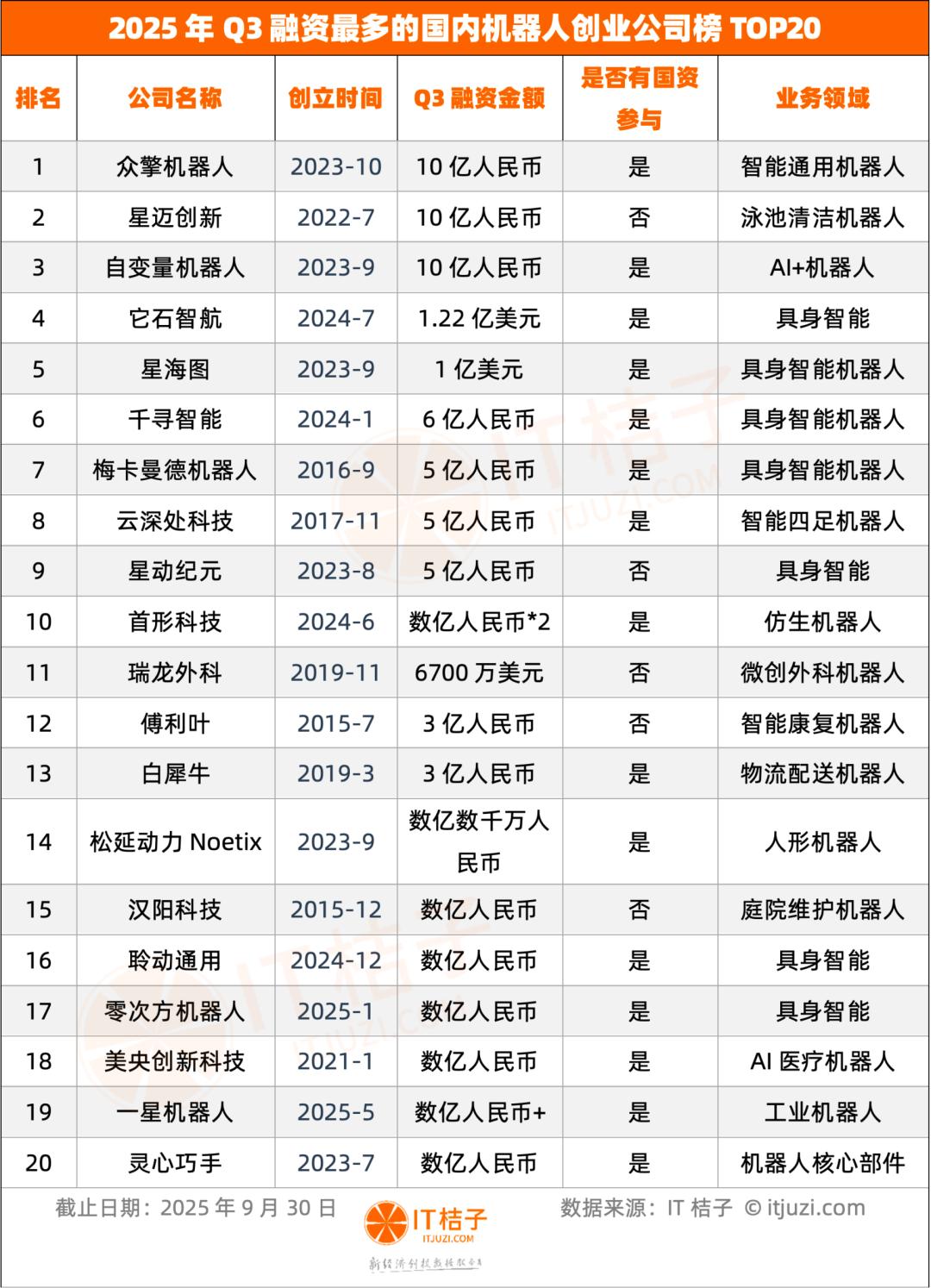
Core Insights - The domestic robotics sector in China has seen a significant increase in financing events, with 243 investment incidents in Q3 2025, representing a 102% year-on-year growth, and a total estimated financing amount of 19.813 billion RMB, up 172% year-on-year [1][2][3] - 26 robotics startups secured over hundreds of millions in financing, accounting for 63% of the total financing in the primary market for the sector [1] - 75% of the top 20 funded robotics companies received investments from state-owned enterprises (SOEs), indicating a strong trend of government support in the industry [1][2] Financing Trends - The top three companies that received approximately 1 billion RMB each in Q3 2025 are Zhongqing Robotics, Xingmai Innovation, and Ziwang Robotics [3] - Notable investments include Mechaman Robotics receiving funding from Xiong'an Fund and other companies like Zongqing Robotics and Lingxin Qiaoshou also attracting significant investments from various SOEs [1][2][3] Investment Motivations - SOEs are investing in local robotics companies to support local industry innovation and attract established companies from other regions to set up operations locally [1] - The investment strategy reflects a dual logic of supporting local industries while also enhancing regional competitiveness through attracting external firms [1][16] Sector Focus - The majority of the top 20 funded robotics companies focus on "embodied intelligence" and "industrial robotics," showcasing a policy-driven investment direction towards core technology fields [1][16] - The "embodied intelligence" segment has emerged as a major attraction for capital, with nearly half of the top 20 companies in this category [16] Market Comparison - Chinese robotics unicorns generally have valuations between 1 billion to 3 billion USD, while US counterparts like Figure AI have reached valuations as high as 39 billion USD, highlighting a significant valuation gap [18][19] - The difference in valuation logic between Chinese and US markets is attributed to the latter's focus on high-risk, high-reward investments based on founder credibility and market expectations [19][20]

广交会遇上AI新叙事:中企出海抢抓技术普惠化新风口
21世纪经济报道· 2025-10-22 10:39
Core Viewpoint - The forum emphasized the transformative role of artificial intelligence (AI) in global trade, particularly in cross-border e-commerce, highlighting the necessity for businesses to adopt AI technologies to remain competitive in the evolving market landscape [2][4]. Group 1: AI Integration in Trade - The forum showcased the integration of AI technologies in various aspects of international trade, including cross-border payments, intelligent customer service, and supply chain optimization, reflecting a significant shift towards AI-driven solutions [2][4]. - A report presented at the forum indicated that most foreign trade enterprises are actively utilizing AI to enhance operational efficiency, marking a period of explosive growth for AI in China's foreign trade sector [2][4]. Group 2: Trends in AI and Trade - Three major trends were identified for the future of AI in trade: deeper technological integration, closer ecological collaboration, and more inclusive value creation [4]. - The global AI and trade ecosystem is expected to evolve from being China-led to a more collaborative global framework, with Chinese companies working alongside international partners to establish rules and share technologies [4]. Group 3: AI's Impact on E-commerce - The number and scale of Chinese AI companies have been growing, producing competitive general and industry-specific models, with domestic models leading in global open-source community downloads [5]. - AI is enhancing productivity and product capabilities in cross-border e-commerce, with a robust ecosystem of AI service providers emerging across the entire supply chain [5]. Group 4: Future Directions and Innovations - AI technologies are increasingly penetrating various fields such as text, image, audio, and video, empowering cross-border e-commerce across multiple operational stages including insight generation, design, product selection, operations, customer service, marketing, and supply chain management [5]. - The evolution of AI video content creation is expected to enable autonomous innovation and automated publishing, indicating a shift towards more sophisticated content production capabilities [6]. Group 5: Collaborative Ecosystem Development - A consensus emerged during the roundtable discussion on the need to build a competitive ecosystem that integrates technology, quality, and service, emphasizing the importance of collaboration among government, enterprises, academia, and research institutions [8]. - The integration of resources from the Canton Fair's supply chain and e-commerce platforms is seen as a critical breakthrough for advancing the development of AI in international trade [8].

三大头部互联网企业交锋,AI时代可观测边界出现了吗?
3 6 Ke· 2025-10-22 09:31
Core Insights - The evolution of observability technology is significantly influenced by AI, particularly through the capabilities of large language models (LLMs) [1][2][3] - AIOps is transitioning from experimental phases to practical applications, highlighting the dual empowerment between AI and observability technology [1][2] Group 1: AI's Impact on Observability - AI enhances observability by automating data extraction and analysis, achieving accuracy rates of 80%-90% in generating SQL queries from clear context [1][2] - The shift from manual to AI-driven analysis allows engineers to focus on complex problem-solving rather than routine tasks [2][3] - AI introduces new observability requirements, such as the need for efficient storage of trace data generated by AI systems [2][3] Group 2: Observability's Role in AI - Observability systems must evolve to diagnose AI model performance issues, such as identifying errors in document retrieval during workflows [2][3] - The integration of LLMs provides a foundational capability that accelerates the development of observability solutions [3][4] - Future observability systems are expected to create a complete feedback loop from discovery to resolution, enhancing operational efficiency [4][5] Group 3: Challenges and Opportunities - The reliance on high-quality data is critical, as poor data quality can significantly impair AI's analytical capabilities [25][28] - The relationship between traditional algorithms and LLMs is collaborative, with each serving distinct roles in observability [12][14] - Achieving "semi-autonomous" operations within three to five years is feasible, but full autonomy remains a long-term goal [37][36] Group 4: Trust and Implementation - Building trust in AI systems requires extensive practical testing and validation to ensure reliability in real-world applications [15][16] - The transition to AI-driven observability necessitates a cultural shift within organizations, emphasizing collaboration between AI and human expertise [20][21] - Effective data governance and standardization are essential for maximizing the potential of AI in observability [28][29]
IDC:中国AI基础设施市场爆发式增长,阿里云第一
Cai Jing Wang· 2025-10-22 08:20
Core Insights - The Chinese AI Infrastructure as a Service (IaaS) market is projected to grow by 122.4% year-on-year, reaching 19.87 billion by the first half of 2025, driven by the demand for AI capabilities across various industries [1][2] - Alibaba Cloud leads the market with a 24.7% share, excelling in both Generative AI IaaS and Other AI IaaS segments [1] - The Generative AI IaaS segment is expected to account for over 80% of the AI IaaS market, with a staggering growth of 219.3% year-on-year [1] Market Dynamics - The demand for AI services is robust across multiple sectors, including internet, automotive, mobile manufacturing, finance, and government, with automotive companies intensifying competition for smart driving solutions [2] - Alibaba Cloud has established partnerships with major Chinese automotive manufacturers, such as FAW, BYD, Geely, NIO, and Xpeng, to enhance their smart capabilities [2] Future Projections - The importance of inference infrastructure, necessary for running AI agents, is expected to significantly increase, becoming a core component of AI cloud services [2] - The overall AI infrastructure market is anticipated to approach 150 billion by 2029 [2]
全面拥抱全球化!OceanBase CEO,最新发声!
券商中国· 2025-10-22 05:30
Core Viewpoint - A group of Chinese companies with core technologies in cloud computing and distributed databases is beginning to seek a more significant role in international markets [1]. Group 1: OceanBase's Globalization Strategy - On October 22, Ant Group's domestic database company OceanBase announced an accelerated globalization strategy, launching the "GO GLOBAL GO Program" [2]. - CEO Yang Bing emphasized that globalization is a necessary path for OceanBase, stating that the company will continue to deepen its presence in the Chinese market while expanding overseas [3]. - OceanBase has already established a presence in key overseas markets, including Hong Kong, Macau, and Southeast Asia, and plans to enter the technologically advanced Japanese market by September 2025 [3]. Group 2: Challenges and Responses in Global Expansion - Yang Bing acknowledged the challenges of going global, including language and cultural differences, and the need to adapt quickly to new business environments [4]. - The challenges for technology companies in international markets include technical adaptability, market competition, and cultural and talent management [4]. - The "GO GLOBAL GO Program" includes organizational support and welfare guarantees to address employees' concerns about cultural adaptation, language communication, career development, and living costs [4]. Group 3: Broader Context of Chinese Technology Going Global - The global digitalization wave presents a vast market space for databases as a core component of IT infrastructure [5]. - OceanBase's accelerated globalization reflects a broader trend of Chinese technology companies, such as Alibaba Cloud, Tencent Cloud, and Huawei Cloud, expanding into international markets through local data centers and services [6]. - Unlike traditional manufacturing, technology exports carry higher added value and influence, potentially granting Chinese companies greater voice in global technology governance [6]. - The competition in the global technology market is fundamentally about ecosystems, requiring Chinese companies to navigate strong international competitors and complex geopolitical environments [6].

当前Agent赛道:热度之下隐现落地难题,如何破局?
雷峰网· 2025-10-22 00:51
Core Viewpoint - The article discusses the rapid development and challenges of the Agent application market, highlighting the divergence of leading players into two distinct paths: full-stack AI service providers and specialized players focusing on vertical markets [1][4][11]. Group 1: Market Overview - The Agent application market is predicted to reach $27 billion in China by 2028 according to IDC [3]. - The current landscape shows a surge in investment and competition among companies eager to adopt Agent technology [2]. Group 2: Player Strategies - Major players in the Agent space include AI giants and cloud service providers, who are lowering the barriers for enterprises to adopt Agent technology [6][7]. - AI giants like OpenAI leverage their foundational model capabilities to gain a first-mover advantage, while cloud providers like Google and AWS are focusing on comprehensive solutions for enterprise Agent development [8][9]. Group 3: Application Scenarios - The primary application scenarios for Agents in enterprises include processing complex multi-modal content, interactive scenarios like chatbots, and high-value intelligent inspection and risk control [15]. - The consumer electronics industry has been the first to adopt Agent technology, with traditional sectors like agriculture gradually following suit [15]. Group 4: Technical Challenges - There are significant technical challenges in the deployment of Agents, including issues with model hallucination, multi-modal integration, and memory management [16]. - The integration of Agents with existing enterprise systems like ERP and CRM is complex, and the need for multi-Agent collaboration is becoming increasingly important [17][18]. Group 5: Solutions for Implementation - To overcome the challenges of Agent deployment, continuous technological innovation is essential, focusing on enhancing model capabilities and system engineering [22]. - The industry is exploring new development paradigms to improve the breadth and depth of Agent tasks, with protocols like MCP and A2A being tested to facilitate communication between different Agents [23][24]. Group 6: Industry Collaboration - Collaboration between vendors and enterprises is crucial for successful Agent implementation, with a focus on aligning business needs with Agent technology [25]. - The sharing of experiences and best practices among developers is encouraged to address complex scenarios and improve Agent development [26].