平安银行

Search documents
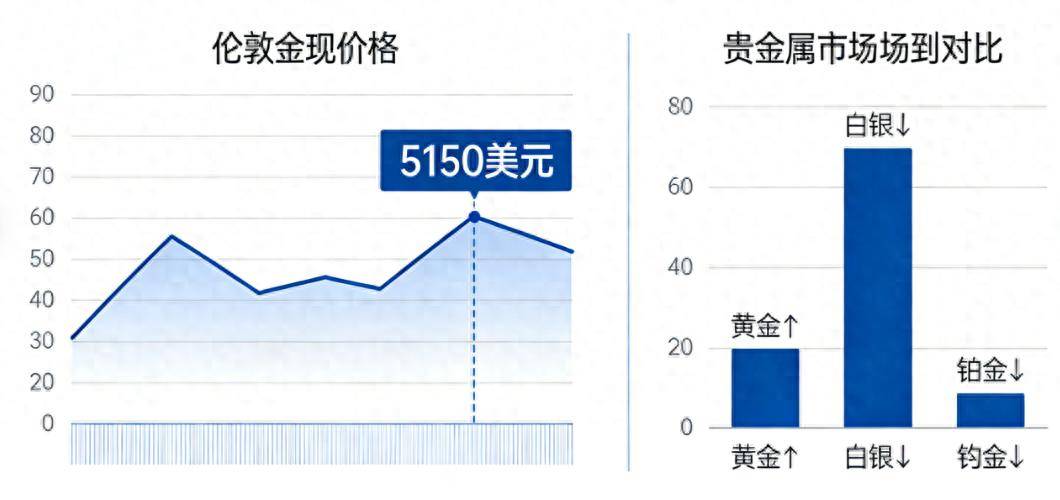
高位震荡!2月23日伦敦金现站稳5150美元,贵金属市场涨跌互现
Sou Hu Cai Jing· 2026-02-23 13:07
Group 1 - The global precious metals market is experiencing high volatility with gold prices stabilizing above $5,150 per ounce and silver showing slight corrections, influenced by Federal Reserve policy signals and geopolitical risks [1][3] - As of February 23, gold was reported at $5,152.02 per ounce, down $12.61, with a daily high of $5,164.63, while silver was at $86.797 per ounce, down $0.196, with a peak increase of 2.22% during the day [3] - The domestic physical gold market shows a clear divergence, with major retailers like Chow Tai Fook and Chow Sang Sang maintaining gold prices at 1,560.0 CNY per gram, while other retailers like Chow Sang Sang and King Fook experienced price declines [4] Group 2 - The futures market is underperforming compared to the spot market, with significant declines in futures prices attributed to strong signals from the Federal Reserve indicating no interest rate cuts in the short term, leading to profit-taking in precious metal futures [3][5] - The price of gold T+D in the domestic market was reported at 1,108.5 CNY per gram, down 16.55 CNY, while silver T+D was at 19,270 CNY per kilogram, down 649 CNY, reflecting a downward trend [3] - Experts indicate that the core logic behind the high volatility in the precious metals market is the interplay between risk aversion and Federal Reserve policies [5]

黄金跌价,金条降价,2026年02月19日,国内黄金最新价格,各大银行黄金金条最新价格
Sou Hu Cai Jing· 2026-02-21 06:02
Core Viewpoint - The domestic gold market experienced slight fluctuations on February 19, 2026, with gold prices showing a minor decline, impacting the prices of gold bars and various gold products [1] Group 1: Gold Purity Standards and Prices - Gold products with a gold content greater than 990‰ are classified as "foot gold," with various purity levels available in the market, including ≥990‰, ≥999‰, ≥99.99%, and ≥99.999% [1] - High-purity gold, such as 99.99% and 99.999%, is ideal for high-end jewelry due to its excellent color and malleability, while 9999 gold is favored by investors for its higher value retention [1] - The latest prices for various gold products are as follows: - Domestic gold 9995: 1103.80 CNY/gram - Domestic gold 9999: 1103.80 CNY/gram - Domestic 9999 foot gold: 1110.40 CNY/gram - Domestic foot gold: 1124.00 CNY/gram - Domestic gold: 1108.50 CNY/gram - Domestic investment gold bars: 1122.00 CNY/gram [1] Group 2: Bank Gold Bar Quotes - The latest gold bar prices from various banks are as follows: - Industrial and Commercial Bank of China: 1105.14 CNY/gram for Ru Yi gold bars [2] - China Construction Bank: 1109.80 CNY/gram for Long Ding gold bars [3] - Minsheng Bank: 1127.50 CNY/gram for gold bars [4] - Bank of Communications: 1129.20 CNY/gram for gold bars [5] - Ping An Bank: 1129.50 CNY/gram for He Xie Ping An gold bars [6] - The gold bar prices from banks are subject to real-time fluctuations, and it is recommended to consult the respective banks for the most accurate pricing [7][8]

黄金一夜变天!26年2月18日最新报价,全国价差竟这么大?
Sou Hu Cai Jing· 2026-02-21 01:53
2026年2月18日,黄金价格较昨日大跌18元/克,全国金饰报价在1288至1558元区间,品牌店与批发渠道价差惊人,既有紧盯国际行情的精明买家,也有冲着 工艺与售后去的刚需族。 银行金条对比方面,建设银行龙鼎金条1137.6元/克,工商银行如意金条1134.48元/克,农业银行传世之宝1144.92元/克,平安银行和谐平安金条1129.5元/克, 浦发银行投资金条却达1204元/克。 这一轮比下来,最高与最低相差74.5元,浦发明显贵出一截,平安最划算,差价足够让大额投资者多掂量几次,若跟上海黄金交易所金条1104.95元相比,银 行系普遍加价在25至100元不等,溢价来源主要是加工、运输与保管成本。 这次"一夜变天"源于国际金价大幅下探,伦敦金现跌破5000美元关口,带动国内大盘跟跌,渠道成本差异放大了零售与批发的价差,品牌店要承担门店、人 工、设计与营销等高额开支,批发则靠走量与低毛利运转,旅游区还要叠加场景溢价,于是出现国际跌、品牌缓调、批发快跟、景区反涨的复杂局面。 看似都在1515至1529元之间,算上工费与促销差异,实际到手价可能再高十几元,像老庙黄金1538元、六福珠宝1527元等,也在这个高 ...
黄金跌价了,26年2月20日,金条降价,各大银行黄金金条最新价格
Sou Hu Cai Jing· 2026-02-20 18:41
2026年2月20日,国内黄金价格较前日下跌17元/克,品牌金饰克价区间1284至1518元,水贝黄金价格低至1284元/克,周大福等主流品牌报价1499元,周生 生达1500元,银行金条1122元/克,白银19.1元/克。 一、国内金价行情总体走势 黄金价格较前日下跌17元/克,品牌金饰克价稳定在1284元至1518元区间。 中国黄金投资金条报价1131元/克,中钞国鼎金条1125元/克,多家机构如中国印钞造币总公司推出的世博系列金条统一标价1110元/克,梅兰竹菊金条亦同 价。 二、珠宝品牌黄金价格 珠宝品牌价格差异,水贝黄金作为批发源头,克价低至1284元/克,显著低于零售品牌。 周大福、六福珠宝、谢瑞麟及潮宏基等主流品牌报价集中于1497-1499元/克区间;周生生以1500元/克居高位;老凤祥达1518元/克,为市场最高点,各地金 店价格与品牌标准一致,未出现区域性大幅波动。 周大福40克手串约59960元,周生生25克手串约37500元,老凤祥55克手串约83490元,水贝市场因价格优势吸引大量消费者,商户反馈节假日期间交易活 跃。 三、金融机构金条价格 银行及交易所金条价格区间为1105元至12 ...

近30家银行,一夜消失
商业洞察· 2026-02-20 09:29
Core Viewpoint - The rapid dissolution of village banks in China, with nearly 30 banks disappearing in the first two months of 2026, indicates an accelerating trend in the consolidation and exit of these financial institutions, which have largely completed their historical mission [2][4][7]. Group 1: Current Status of Village Banks - As of early 2026, 30 village banks have been deregistered, surpassing the 231 banks that exited in the entirety of 2025, suggesting a faster pace of consolidation [2]. - Major commercial banks, particularly the 12 large joint-stock banks, are leading the integration efforts, with some banks like Everbright Bank completely exiting the village banking sector [4][6]. - The majority of village banks are now under the control of larger banks, with significant reductions in their numbers, such as Shanghai Pudong Development Bank reducing its village banks from 28 to 13 [6][7]. Group 2: Reasons for Consolidation - The consolidation is driven by the completion of the village banks' original roles, as modern banking systems like postal savings and rural credit cooperatives have taken over their functions [7]. - A significant factor in the accelerated exit of village banks is the 400 billion yuan crisis involving five village banks in Henan five years ago, which severely impacted public trust and highlighted the risks associated with these institutions [8][10]. - The operational failures of village banks, where they became akin to "personal ATMs" for their owners, have led to a loss of confidence among depositors, prompting a need for swift action from regulators [10][11]. Group 3: Overall Reform Landscape - Currently, there are approximately 1,624 village banks in China, with 1,173 (72.2%) still operational, while 451 (27.8%) have exited the market [14]. - The provinces with the highest rates of bank exits include Jilin (80.6%), Inner Mongolia (79.5%), and Hunan (62.2%), indicating regional disparities in the reform process [14]. - The ongoing reforms suggest that over half of the remaining village banks may not survive the next two years, reflecting a critical phase in the banking sector's evolution [14].

创东方投资高宇辉:马年的投资机遇将孕育在四个“确定性”之中
Zhong Guo Ji Jin Bao· 2026-02-20 06:45
新春肇启,万象更新。值此甲辰马年春节来临之际,创东方投资全体员工,向您及家人致以最诚挚的祝 福!祝愿您在新的一年里,龙马精神、万事顺遂、阖家安康、事业腾达! 过去一年,中国经济在复杂严峻的外部环境和国内转型压力下,展现出了强大的战略定力和发展韧性。 投资人和创业者与我们一同见证了市场的波澜起伏,也共同分享了结构性机遇带来的惊喜。创东方始终 秉持"稳健投资、创新发展"的理念,在先进制造、人工智能、生物医药、新能源、新材料等关键领域实 现深度布局与价值共创。 2025年,创东方在科技领域的长期布局迎来丰硕成果,多家被投企业成功IPO,行业覆盖新材料、创新 药等高壁垒赛道。截至目前,创东方累计管理规模已近300亿元人民币,累计投资企业超过350家,其中 超已有40余家已通过上市方式退出,持续在硬科技与医疗健康领域构建产业生态。 资本市场向好的确定性:中国经济的稳定增长及高可预期性,使中国成为世界经济发展的压舱石;中国 才是世界正常经贸秩序、正常资本市场秩序维护者的身份,越来越成为全球共识;经济向东、牵手中 国,成为越来越多国家的一致行动。在此大背景下,中国资本市场将迎来更好的发展,进而带动一级市 场迎来新的发展机遇 ...
年内近30家村镇银行注销解散
21世纪经济报道· 2026-02-18 07:53
Core Viewpoint - The article highlights the accelerated pace of integration and exit of village banks by joint-stock banks, marking a shift from rapid expansion to a focus on high-quality development in the industry [1][6]. Group 1: Recent Developments in Village Bank Exits - As of the end of January 2026, Everbright Bank has completed the exit of its three village banks, achieving a total "zero" status for its village banking operations [1][3]. - Shanghai Pudong Development Bank (SPDB) is also actively pursuing the "village to branch" model, with two of its village banks exiting in early February 2026, making it one of the most active banks in this regard [1][5]. - Nearly 30 village banks have been deregistered since the beginning of 2026, significantly higher than the same period last year [1][6]. Group 2: Integration and Exit Strategies - The exit actions by Everbright Bank are characterized as a "proactive application + compliance approval" model, with the bank inheriting all rights and obligations of the exited banks [3][4]. - The trend indicates a shift towards a more specialized and high-quality development phase for village banks, as the government emphasizes risk management and transformation of local financial institutions [6][10]. - The restructuring of over 230 village banks in 2025 through mergers, acquisitions, and exits reflects a deep reshaping of the industry, driven by both state-owned and joint-stock banks [6][9]. Group 3: Differentiated Approaches Among Joint-Stock Banks - SPDB has notably accelerated its exit process, reducing its village banks from 28 to approximately 13, with significant exits occurring between July 2025 and February 2026 [8][9]. - In contrast, Minsheng Bank has retained a broader network of village banks, exiting only two out of 28, indicating a different strategic focus [9]. - Other banks like Huaxia Bank and several others have completed their exits, while some banks have not engaged in village banking at all, highlighting varied strategies across the sector [7][9]. Group 4: Implications for Industry Personnel - The integration and exit of village banks signal a transition for employees, potentially moving from subsidiary roles to formal positions within parent banks, which may offer better resources and processes [9][10]. - However, this transformation also poses challenges, including changes in job roles and assessment systems, as well as potential impacts on existing business structures and client relationships [9][10].



股份制银行差异化竞争,头部效应显著
Xin Lang Cai Jing· 2026-02-18 05:56
Core Insights - The mobile banking user base in China is expected to peak in 2025, shifting the industry focus from acquiring new users to enhancing existing user engagement [1] - Financial institutions must achieve extreme efficiency and precision in their ecosystems to survive in this new environment [1] Industry Overview - According to an iResearch report, joint-stock banks are adopting differentiated survival strategies, leading to significant head effects [1] - China Merchants Bank leads joint-stock banks with 71.854 million monthly active users (MAU), surpassing some state-owned banks due to its focus on wealth management and intelligent interaction [1] - Ping An Bank and CITIC Bank form the second tier, maintaining MAUs between 20 million and 30 million, with Ping An Bank leveraging AI to reconstruct service chains and CITIC Bank integrating consumer ecosystems [1] Competitive Landscape - Third-tier institutions, such as Minsheng Bank and Everbright Bank, have seen their MAUs drop to between 10 million and 20 million, indicating a tightening survival space [1] - Local banks are experiencing growth by focusing on their local markets, with city commercial banks like Jiangsu Bank and Beijing Bank maintaining MAUs above 3 million [1] - Among rural commercial banks and rural credit cooperatives, Fujian Rural Credit has surpassed 4.5 million MAUs, capturing traffic in county and rural areas [1] Challenges for Private Banks - The situation for private banks is dire, with the top 50 list for 2025 nearly extinct due to a lack of physical branches, local living ecosystems, and high customer acquisition costs, leading to a loss of competitiveness in the mobile banking sector [1] - In the era of stock competition, ecological and regional capabilities are becoming the key to success [1]




国有大行主导手机银行市场,生态嵌入构筑护城河
Jing Ji Guan Cha Wang· 2026-02-18 05:47
Core Insights - The Chinese mobile banking market is entering a stage of stock competition in 2025, with monthly active users (MAU) stabilizing between 648 million and 739 million [2] - State-owned commercial banks dominate the market due to their ecological embedding advantages, with Agricultural Bank of China leading at 249 million MAU, followed by Industrial and Commercial Bank of China (194 million) and China Construction Bank (109 million) [2] - Private banks are expected to collectively exit the top 50 MAU rankings in 2025 due to a lack of offline branch support and local living ecosystems [2] Group 1: Major Players - Agricultural Bank of China has the highest MAU at 249 million, followed by Industrial and Commercial Bank of China with 194 million and China Construction Bank with 109 million, forming the first tier of banks [2] - China Bank and Postal Savings Bank have MAUs exceeding 50 million, constituting the second tier [2] - China Merchants Bank leads the joint-stock banks with 71.85 million MAU, while Ping An Bank and CITIC Bank form the second tier, with other joint-stock banks generally below 20 million MAU [2] Group 2: Market Dynamics - The core advantage of state-owned banks lies in their "full-scenario integration" capabilities, embedding services deeply into high-frequency life scenarios such as government affairs, social security, healthcare, and education [2] - Agricultural Bank of China extends its services to rural areas through intelligent service matching and customer customization, while Industrial and Commercial Bank of China utilizes its "Gong Xiao Zhi" model for interactive service [2] - Regional banks like Jiangsu Bank, Beijing Bank, and Ningbo Bank show stable performance by focusing on local markets, with some rural commercial banks like Fujian Rural Credit exceeding 4.5 million MAU, indicating the sustainability of localized operations in the stock market [2]



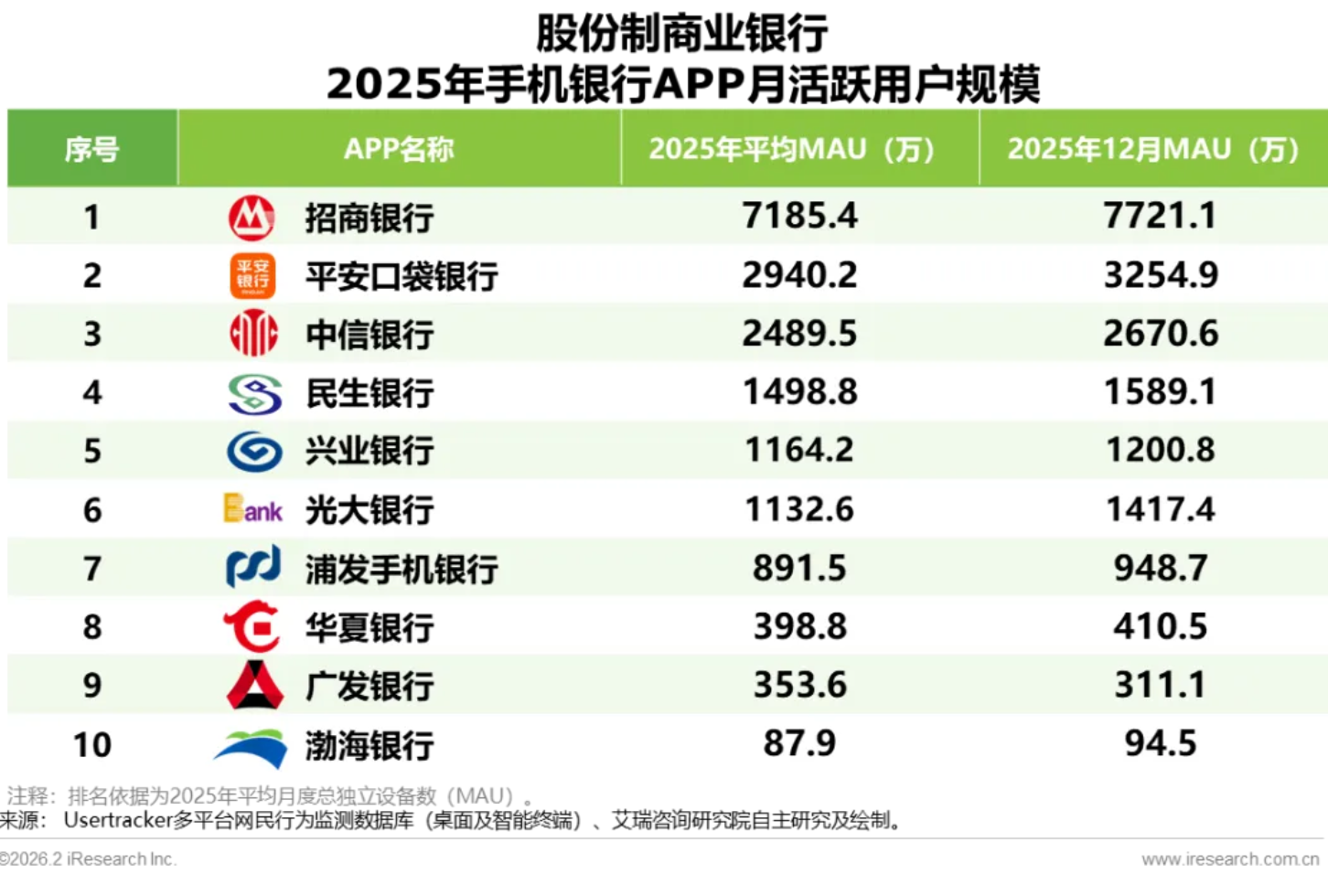
手机银行TOP50再无民营 生态壁垒高筑草根绝迹
Jing Ji Guan Cha Wang· 2026-02-18 05:47
Core Insights - The monthly active users (MAU) of mobile banking apps in China have stabilized between 648 million and 739 million, indicating that user growth has reached a ceiling, marking the end of a decade-long traffic dividend period [2] - User behavior has shifted significantly, with average session duration decreasing from 4.9 minutes in 2023 to approximately 2.7 minutes by mid-2025, reflecting a preference for high-frequency, short-duration, and function-oriented usage [2] - Major state-owned banks have solidified their market dominance, with all six major state-owned banks ranking in the top ten for MAU, led by Agricultural Bank of China with 249 million MAU [2] Industry Dynamics - The core competitive advantage of state-owned banks lies in their "full-scenario integration" capabilities, providing financial services deeply embedded in public services such as government, social security, healthcare, and education [3] - Joint-stock banks are adopting specialized development strategies, with China Merchants Bank leading its peers with 71.85 million MAU, while Ping An Bank and Citic Bank are leveraging AI technology to enhance service processes and maintain user engagement [3] - Local banks are experiencing polarization, with some city commercial banks maintaining MAU above 3 million due to their deep understanding of local markets, while private banks like WeBank and MYbank have fallen out of the top 50 due to challenges in customer acquisition and retention [3] Future Trends - As the industry standard for single-session usage time becomes 3 minutes, banks must rethink their value creation strategies [4] - AI-driven service process optimization, real-time risk control systems, and multi-device collaboration within ecosystems are reshaping the competitive landscape [4] - Key factors for institutional success in the future will include precise user insights, prudent risk management, and robust ecosystem integration capabilities [4]