海富通基金

Search documents
2026年度固收类基金经理TOP50
点拾投资· 2026-01-27 11:38
Core Viewpoint - The article discusses the launch of the 2026 TOP50 fixed income fund manager ranking, highlighting the growth and stability of fixed income products, particularly in the "fixed income +" category, which is expected to see significant expansion in 2025 [1]. Summary by Sections Performance Metrics - The average performance of various fund categories for 2025 shows that the "Point Pick & Zero City" funds outperformed their respective benchmarks across different categories, with notable figures such as: - Money Market Average: 1.61% vs. 1.30% benchmark [2] - Short-Debt Average: 1.29% vs. 1.40% benchmark [2] - Conservative Income Average: 1.86% vs. 0.83% benchmark [2] - Steady "Fixed Income +" Average: 4.75% vs. 4.58% benchmark [2] - Active "Fixed Income +" Average: 7.78% vs. 6.53% benchmark [2] - Equity-Debt Balanced Average: 20.41% vs. 16.77% benchmark [2] Fund Manager Selection Criteria - The selection of fund managers for the ranking is based on multiple factors including: - Performance since inception, five-year performance, excess return stability, maximum drawdown, Sharpe ratio, Calmar ratio, volatility, and qualitative analysis [3]. - Consideration of fund manager's management scale, holder structure, strategy capacity, management fees, number of funds managed, position, and influence [3]. Fund Classification Methodology - A unique classification method for fixed income funds is introduced, categorizing them into: 1. Cash Alternative 2. Conservative Income 3. Steady "Fixed Income +" 4. Active "Fixed Income +" 5. Equity-Debt Balanced [5]. Ranking Characteristics - The ranking focuses on experienced fund managers, excluding those with less than five years of tenure, emphasizing risk control over aggressive yield chasing [7]. - The average management tenure of selected fund managers is 10.43 years, with an average management scale of 32.38 billion [7]. - Only 50 fund managers are selected to avoid excessive homogeneity, with rankings not indicating preference [7]. Fund Manager Diversity - The ranking includes multi-manager configurations to leverage diverse asset classes, recognizing that single managers may not excel across all areas [7]. - The list excludes dollar-denominated bond funds and money market funds, while including mixed-asset FOFs due to the increasing importance of asset allocation [8]. Conclusion - The article acknowledges the dynamic nature of the fund management industry, inviting feedback and suggestions for potential fund managers to consider for future rankings [19].


《公募基金业绩比较基准指引》发布【国信金工】
量化藏经阁· 2026-01-27 00:08
Market Review - The A-share market showed a mixed performance among major indices, with the CSI 500, CSI 1000, and Sci-Tech 50 indices leading with returns of 4.34%, 2.89%, and 2.62% respectively, while the CSI 300, ChiNext, and Shanghai Composite indices lagged with returns of -0.62%, -0.34%, and 0.84% respectively [5][11] - The construction materials, oil and petrochemicals, and steel sectors performed well, with returns of 9.18%, 7.76%, and 6.98% respectively, while the banking, telecommunications, and food and beverage sectors underperformed with returns of -2.69%, -1.68%, and -1.57% respectively [17][18] Fund Issuance - A total of 42 new funds were established last week, with a total issuance scale of 444.54 billion yuan, showing an increase compared to the previous week [3] - 58 funds were reported for issuance last week, including 5 FOFs and 17 ETFs, indicating an increase in the number of applications [4][5] Fund Performance - The median returns for active equity, flexible allocation, and balanced mixed funds were 1.51%, 1.37%, and 1.37% respectively last week [29] - Alternative funds have shown the best performance this year, with a median return of 13.14%, while active equity, flexible allocation, and balanced mixed funds had median returns of 7.52%, 6.27%, and 5.09% respectively [29][37] Regulatory Updates - The China Securities Regulatory Commission (CSRC) issued guidelines for the performance comparison benchmarks of public funds, effective from March 1, 2026, to enhance investor protection and ensure the stability of performance benchmarks [7][8] New Market Entrants - Mizuho Securities (China) Co., Ltd. was officially established with a registered capital of 2.3 billion yuan, marking the third Japanese securities firm in China [9]

量化指增基金超额呈现边际修复
HTSC· 2026-01-26 03:05
证券研究报告 金工 量化指增基金超额呈现边际修复 2026 年 1 月 24 日│中国内地 量化投资周报 本月以来估值因子偏弱,成长因子相对走强 本月以来估值因子整体偏弱,月初的回撤影响较大;波动率、换手率等防御 性量价因子同样表现不佳,仅在沪深 300 成分股票池取得正收益。成长、 盈利、小市值及反转因子相对走强,在中证 500 以外的成分股票池均呈现 正收益。预期类因子中,超预期因子在沪深 300 以外的股票池呈现正收益; 预期估值因子在沪深 300 和全 A 股股票池取得正收益,在其余股票池回撤; 预期增速因子则呈现普遍回撤。 本月以来小市值因子多空表现靠前,量价因子承压 从平均多空收益来看,本月以来小市值因子表现靠前,平均取得较明显的正 收益,但主要源于在沪深 300 成分股票池中的收益优势;预期增速和超预 期因子紧随其后;成长因子同样呈现正向的平均多空收益。反转、波动率和 换手率等量价因子整体承压,平均呈现较大回撤。 本月以来指增超额呈现边际修复,300 指增超额领先 我们重点跟踪以沪深 300、中证 500、中证 1000 和中证 A500 指数为基准 的量化指数增强基金。基于公募指增基金的复权净 ...
基金早班车丨有色金属ETF规模破千亿,供需共振引公募密集加码
Jin Rong Jie· 2026-01-26 00:52
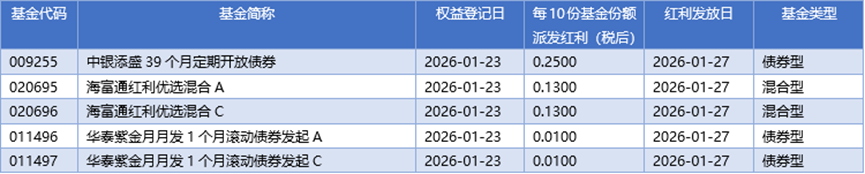
Group 1 - The core viewpoint of the articles highlights significant capital inflow into the non-ferrous metals sector, with related ETFs (excluding gold) seeing a net inflow exceeding 36 billion yuan this year, pushing the total scale beyond 100 billion yuan [1][2] - The demand-supply mismatch, coupled with the needs for new energy and grid upgrades, has led to notable price elasticity in copper, aluminum, and rare earths, prompting funds to quickly position through ETFs [1][2] - Multiple public funds are actively applying for new products, indicating a continuous increase in the toolization of investment strategies, which has become a key focus for institutions during the recovery phase of the year [1][2] Group 2 - As of January 23, 2026, there were no new fund launches, but five funds announced dividends, primarily bond funds, with the highest dividend being 0.25 yuan per 10 fund shares from the Bank of China’s 39-month regular open bond fund [2][4] - Data shows that seven private equity firms have either newly entered or returned to the 10 billion yuan tier this year, indicating a growing trend in the private equity sector, with stock long strategies being particularly popular [2] - Foreign investment firms, including BlackRock and Fidelity, reported that several of their products had net value increases exceeding 50%, with a strong focus on high-quality technology assets expected to lead value reassessment in the upcoming year [3]
行业费率改革持续深化 基金公司密集宣布降费
Sou Hu Cai Jing· 2026-01-24 12:36
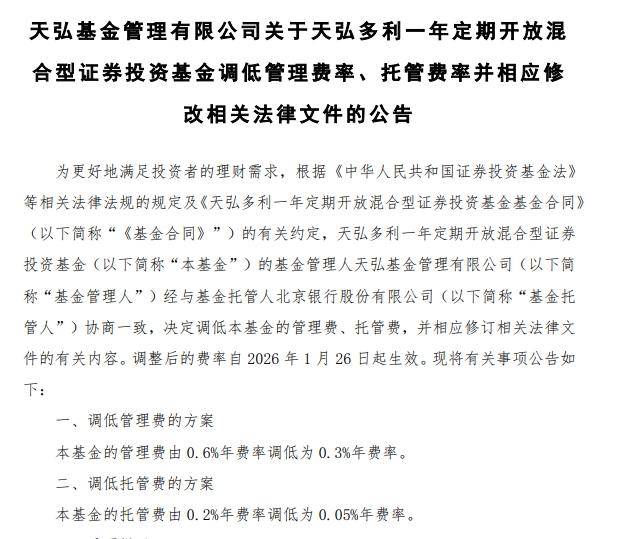
Core Viewpoint - The recent trend in the fund industry shows a significant reduction in management and custody fees by various fund companies, driven by regulatory reforms aimed at lowering overall industry costs and enhancing investor benefits [1][4][7]. Group 1: Fee Reductions by Fund Companies - Tianhong Fund announced a reduction in management fees from 0.6% to 0.3% and custody fees from 0.2% to 0.05%, effective January 26, 2026 [1]. - Prior to this, Tianhong Fund also reduced fees for another fund, lowering management fees from 0.7% to 0.3% and custody fees from 0.15% to 0.05% [3]. - Huaxia Fund reduced management fees for its financial technology ETF from 0.50% to 0.15% and custody fees from 0.10% to 0.05%, effective January 22, 2026 [4]. - Haifutong Fund lowered management fees for its bond fund from 0.5% to 0.4%, effective January 21, 2026 [6]. Group 2: Industry Context and Regulatory Changes - The China Securities Regulatory Commission (CSRC) initiated a fee reform plan for the public fund industry in July 2023, aiming to lower comprehensive fee levels through a structured approach [7]. - As of January 1, 2023, the new regulations on sales fees for publicly offered securities investment funds were implemented, marking a smooth transition in the fee reform [7]. - The CSRC's action plan for promoting high-quality development in public funds, released in May 2025, emphasizes optimizing fund operation models and establishing a floating management fee mechanism linked to fund performance [7]. Group 3: Market Impact and Future Outlook - As of January 24, 2023, nearly 1,200 funds have management fees at or below 0.15%, and over 2,400 funds have custody fees at or below 0.05% [8]. - Research indicates that the fund industry previously relied on a "high scale, high fee, high profit" model, which deviated from the principle of prioritizing investor interests [8]. - Future developments in the public fund industry will increasingly depend on quality improvements, focusing on value creation for investors through product innovation, research, and customer service [8].
FOF最新“购物车”曝光!大举扫货这些基金
券商中国· 2026-01-24 11:09
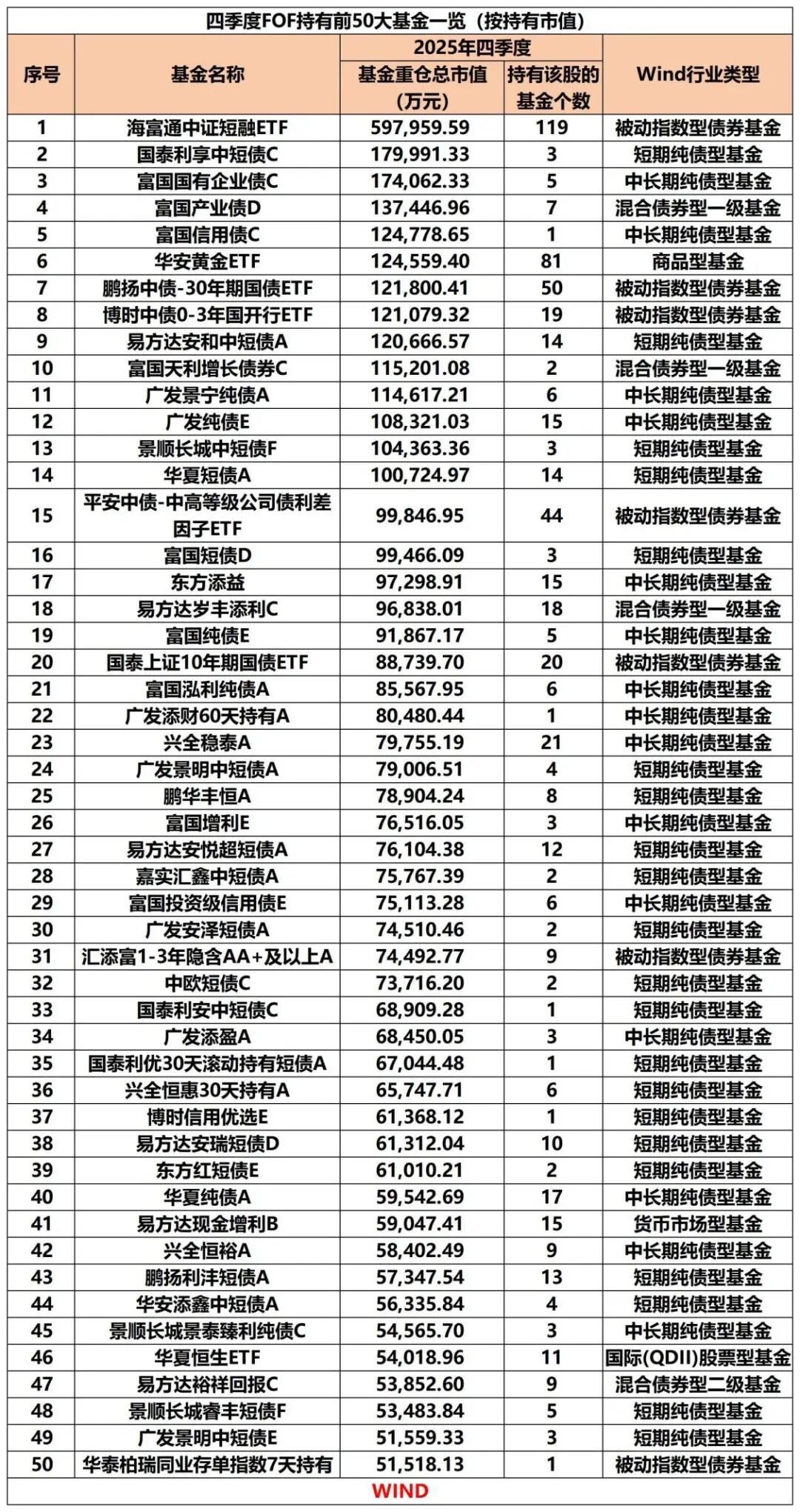
Core Viewpoint - The article highlights the latest trends in FOF (Fund of Funds) investments, indicating a preference for low-risk products and a strategic shift from gold ETFs to gold stock ETFs amidst rising international gold prices [1][4]. Group 1: FOF Investment Trends - In Q4 2025, FOFs favored low-risk products, with short-term bond ETFs being the most heavily weighted, particularly the Hai Fu Tong Short Bond ETF, held by 95 FOFs with a total market value of approximately 4.17 billion [3]. - The Guotai Li Xiang Medium and Short Bond C fund saw significant increases in holdings, with a quarterly change of about 1.49 billion shares, indicating a strategic shift in FOF allocations [3]. Group 2: Gold Investment Strategy - Despite rising international gold prices, FOFs reduced their holdings in gold ETFs, with a total reduction of 40.68 million shares in the Huaan Gold ETF alone, while simultaneously increasing their investments in gold stock ETFs [4][5]. - The increase in gold stock ETFs was notable, with FOFs adding 50.74 million shares in Yongying Gold Stock ETF and 24.03 million shares in Huaxia Gold Stock ETF, reflecting a shift in strategy towards higher potential returns in gold equities [4][5]. Group 3: FOF Market Growth - The overall scale of FOFs has surpassed 250 billion, driven by strong support from banking channels such as China Merchants Bank and China Construction Bank, which have launched successful asset allocation programs [2][7]. - As of the end of 2025, the total scale of FOFs reached 252.11 billion, marking a significant milestone in the market [7].
25Q4主动权益基金季报分析:主动权益四季度加仓周期减持科技,永赢主动权益规模突破千亿
Shenwan Hongyuan Securities· 2026-01-24 09:14
1. Report Industry Investment Rating No relevant content provided. 2. Report's Core View - In Q4 2025, active equity funds decreased their scale, with the scale dropping from about 4 trillion yuan in Q3 to about 3.85 trillion yuan, a decline of 4.14%. Meanwhile, the scale of index funds slightly increased. [10] - The performance of active equity funds in Q4 2025 significantly declined compared to the previous quarter, with about 42.8% of the funds achieving positive returns, and the median return rate was -1.02%. [15] - Active equity funds reduced their holdings in technology and pharmaceutical sectors in Q4 2025 and increased their positions in cyclical sectors. [1] 3. Summary According to Relevant Catalogs 3.1 Fund Four - Quarter Report Investment Outlook Keywords - Technology, consumption, and computing power were the key areas of focus for active equity fund managers in Q4. The trend keywords included "repair", "recovery", and "resilience"; industry - related keywords were "technology", "consumption", and "electronics"; theme - related keywords were "computing power", "robotics", and "new energy"; and event - related keywords were "interest rate cuts", "exports", and "tariffs". [7] 3.2 Performance and Scale Dimension - **Scale Change**: The scale of active equity funds decreased in Q4 2025, while the scale of index funds slightly increased. Fund companies such as Yongying and Guojin saw significant growth in their active equity management scale, with Yongying's active equity scale exceeding 100 billion yuan. [10][14] - **Performance**: The overall performance of active equity funds in Q4 2025 declined significantly. About 42.8% of the funds achieved positive returns, and the median return rate was -1.02%. The top - performing funds in Q4 mainly focused on industries such as military, non - ferrous metals, and communications. [15][17] - **Position and Heavy - Holding Stock Allocation**: The overall position of active equity funds decreased in Q4 2025, with the average stock position dropping to 87.70% (-1.05%), and the Hong Kong stock position also significantly decreasing. The heavy - holding stocks in Hong Kong decreased, while the allocation ratios of heavy - holding stocks in CSI 300, CSI 500, and CSI 1000 increased. [18][19] - **Large - Scale Funds**: The scale of some large - scale active equity funds decreased in Q4 2025, but some funds such as Yongying Ruixin and Yongying Technology Smart Selection saw an increase in their shares. [24] - **New Issuance and Continued Management**: Among active equity products, Yongying Pioneer Semiconductor Smart Selection and Yongying High - end Equipment Smart Selection had the highest estimated net subscription amounts. The new - issue fund Guangfa Quality Selection had the largest issuance scale this quarter. [25] 3.3 Fund Company Dimension - **Performance**: Among active equity fund management companies with a management scale of over 10 billion yuan, Caitong Fund had the best average performance in Q4 2025, with an average return rate of 4.22%. Other companies with good performance included Western Lide, Yongying Fund, and Huashang Fund. [27] - **Scale**: E Fund remained the largest active equity management company in Q4 2025, although its scale decreased slightly compared to the previous quarter. Yongying Fund saw significant growth in its active equity scale in Q4 2025. [30] - **Heavy - Holding Stock Allocation**: Caitong Fund, the top - performing company in Q4, under - allocated non - ferrous metals and other industries and over - allocated electronics, communications, and other industries. Leading fund companies generally over - allocated non - ferrous metals and chemicals and under - allocated pharmaceutical biology. [32] - **Industry Allocation of Leading Fund Companies**: Leading active equity fund management companies' industry over - and under - allocations were mainly concentrated in several popular industries. For example, E Fund significantly over - allocated communications and food and beverages and significantly under - allocated power equipment and pharmaceuticals. [34] - **Market Value and Valuation Style of Heavy - Holding Stocks**: Companies with a relatively large - market - value style in their holdings included Ruiyuan, Morgan, and Huifutianfu; those with a relatively small - market - value style included Yongying, Dacheng, and Nuoyan; companies with relatively high PE in their holdings included Yongying, Huashang, and E Fund; and those with relatively low PE included Ruiyuan, Dacheng, and ABC Fortune. [37]
“专业买手”,持仓曝光
Zhong Guo Ji Jin Bao· 2026-01-24 08:04
Core Viewpoint - The latest quarterly report reveals that bond funds remain the primary focus for public FOFs, with significant investments in ETFs as well. The top five funds favored by FOFs in Q4 2025 include various bond and ETF products, indicating a strong preference for fixed-income investments [1]. Group 1: FOF Holdings Overview - As of the end of Q4 2025, bond funds dominate the top 50 holdings of public FOFs, with 40 out of 50 being bond-related [1]. - The top fund held by FOFs is the Hai Fu Tong Zhong Zheng Short Bond ETF, with a market value exceeding 5.98 billion yuan, held by 119 FOFs [2]. - Other notable funds include Guotai Li Xiang Short and Medium Bond C and Fu Guo State-Owned Enterprise Bond C, each with holdings exceeding 1.7 billion yuan [2]. Group 2: Active Equity Fund Holdings - The top active equity fund held by FOFs is Xing Quan Commercial Model Preferred A, with a total holding value of 406.73 million yuan, held by 16 FOFs [4]. - Following closely is Yi Fang Da Information Industry Selected C, with a holding value of 365.40 million yuan, held by 10 FOFs [5]. - Other significant active equity funds include Yi Fang Da Ke Rong and Yi Fang Da Supply Reform, each with holdings above 300 million yuan [4]. Group 3: Fund Increases in Q4 - The fund with the highest increase in holdings during Q4 2025 is the Hai Fu Tong Zhong Zheng Short Bond ETF, which saw an increase of 2.69 billion yuan, bringing its total holding value to 5.98 billion yuan [6]. - Guotai Li Xiang Short and Medium Bond C also experienced a significant increase of 1.14 billion yuan, with a total holding value of 1.80 billion yuan [7]. - Other funds with notable increases include Jing Shun Chang Zhong Short Bond F and Fu Guo State-Owned Enterprise Bond C, each with increases exceeding 600 million yuan [7]. Group 4: Investment Strategies and Focus Areas - FOF managers express confidence in the A-share market, with increased allocations in technology, resources, and non-bank financial sectors during Q4 2025 [8]. - Specific strategies include focusing on gold and silver stocks, rare earths, and other metals, as well as exploring opportunities in the tourism sector [8]. - Long-term asset allocation strategies remain a priority, with a focus on consumer sectors and non-bank financials, alongside participation in overseas bond markets and REITs [8].
“专业买手” 持仓曝光!
Zhong Guo Ji Jin Bao· 2026-01-24 05:35
Core Viewpoint - The latest disclosures of public fund of funds (FOF) reveal a strong preference for bond funds and ETFs, indicating a strategic focus on stable income and passive investment strategies in the current market environment [1][3][10]. Group 1: FOF Holdings - As of the end of Q4 2025, bond funds dominate the FOF holdings, with 40 out of the top 50 funds being bond-related [3][4]. - The top five funds held by FOFs include Hai Fu Tong Zhong Zheng Short Bond ETF with a market value exceeding 5.98 billion yuan, followed by Guotai Li Xiang Short and Medium-term Bond C and Fu Guo State-owned Enterprise Bond C, each with over 1.7 billion yuan [3][4]. - The total market value of the top 50 funds held by FOFs reflects a significant investment in passive index products, highlighting a shift towards index-based strategies [3][10]. Group 2: Fund Increases - The most increased fund in Q4 2025 was Hai Fu Tong Zhong Zheng Short Bond ETF, which saw an increase of 2.69 billion yuan, bringing its total market value to 5.98 billion yuan [8][9]. - Other notable increases include Guotai Li Xiang Short and Medium-term Bond C, which was increased by 1.14 billion yuan, and several other funds with increases exceeding 600 million yuan [8][9]. - The trend of increasing holdings in bond funds suggests a cautious approach by FOF managers in the current economic climate [10]. Group 3: Manager Insights - FOF managers express confidence in the A-share market, with a focus on sectors such as technology, resources, and non-bank financials for future growth [10][11]. - Specific strategies include investing in precious metals and rare earths, as well as exploring opportunities in the tourism sector, indicating a diversified approach to asset allocation [10][11]. - The emphasis on long-term asset allocation strategies reflects a commitment to maintaining positions in high-value sectors while adapting to market conditions [10][11].
两市ETF两融余额减少15.51亿元丨ETF融资融券日报
2 1 Shi Ji Jing Ji Bao Dao· 2026-01-23 05:40
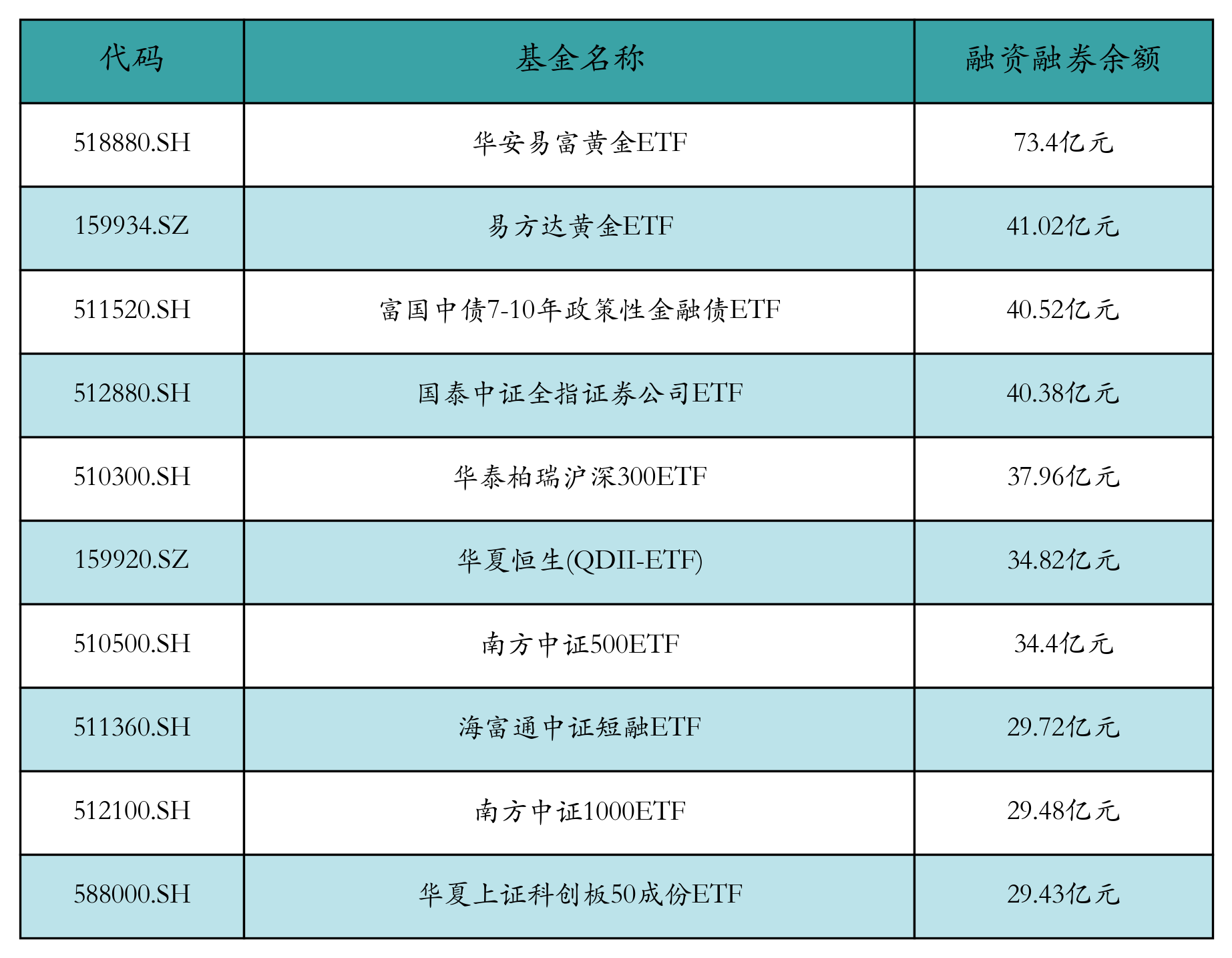
Market Overview - As of January 22, the total ETF margin balance in the two markets is 123.947 billion yuan, a decrease of 1.551 billion yuan from the previous trading day [1] - The financing balance is 116.303 billion yuan, down by 1.503 billion yuan, while the securities lending balance is 7.6444 billion yuan, a decrease of 47.2885 million yuan [1] - In the Shanghai market, the ETF margin balance is 87.505 billion yuan, a decrease of 1.171 billion yuan, with a financing balance of 80.803 billion yuan, down by 1.119 billion yuan [1] - In the Shenzhen market, the ETF margin balance is 36.442 billion yuan, a decrease of 379 million yuan, with a financing balance of 35.5 billion yuan, down by 385 million yuan [1] Top ETF Margin Balances - The top three ETFs by margin balance on January 22 are: - Huaan Yifu Gold ETF (7.34 billion yuan) - E Fund Gold ETF (4.102 billion yuan) - Fortune China Bond 7-10 Year Policy Financial Bond ETF (4.052 billion yuan) [2] Top ETF Financing Amounts - The top three ETFs by financing amount on January 22 are: - Hai Fu Tong Zhong Zheng Short Bond ETF (6.068 billion yuan) - Bosera Zhong Zheng Convertible Bonds and Exchangeable Bonds ETF (1.047 billion yuan) - E Fund Zhong Zheng Hong Kong Securities Investment Theme ETF (763 million yuan) [4] Top ETF Net Financing Amounts - The top three ETFs by net financing amount on January 22 are: - Hai Fu Tong Zhong Zheng Short Bond ETF (134 million yuan) - Hua Xia Zhong Zheng Electric Grid Equipment Theme ETF (84.3793 million yuan) - E Fund Hu Shen 300 Medical and Health ETF (34.3428 million yuan) [5] Top ETF Securities Lending Amounts - The top three ETFs by securities lending amount on January 22 are: - Huatai Bairui Hu Shen 300 ETF (23.7919 million yuan) - Southern Zhong Zheng 1000 ETF (6.9137 million yuan) - Hua Xia Zhong Zheng 1000 ETF (5.8598 million yuan) [6]