大疆

Search documents
十大概念板块,去伪存真,一个是历史性机会!
Sou Hu Cai Jing· 2025-12-02 10:00
Market Overview - The market is currently experiencing weakness, with major indices falling below the 60-day moving average, indicating a lack of upward momentum [1] - Despite a favorable monetary environment, there are signs of weakness in the real economy, leading to cautious investor sentiment [1][2] Investment Strategy - Investors are advised to stabilize their positions and avoid leveraging, focusing instead on technology and new economy sectors rather than cyclical stocks [2] - The emphasis should be on long-term opportunities in leading AI companies, as the AI and computing chip sector is seen as a historic opportunity despite potential short-term valuation risks [4][5] Technology Sector Insights - AI and computing chips are identified as transformative technologies that could significantly enhance productivity over the next 20 years [4] - Brain-computer interfaces are viewed as a bubble, with current technology only providing limited functionality for disabled individuals [5][6] - Satellite internet is recognized as a genuine opportunity due to its proven technology and demand in remote areas, particularly in China [7][8] Emerging Technologies - Blockchain is considered a bubble, with concerns over the security of cryptocurrencies like Bitcoin, which may lead to a collapse in their valuation [8] - Human-like robots and low-altitude electric manned flying vehicles are also categorized as bubbles, with significant regulatory and technical challenges hindering their development [9][10] - Quantum communication and quantum computing are still uncertain, with significant technical hurdles to overcome [10][11] Established Technologies - 3D printing is seen as having potential for growth, especially as AI lowers design barriers, making it more accessible for home use [11] - Lithium batteries, particularly solid-state batteries, are viewed as having opportunities, although traditional lithium battery technology is reaching maturity [11]


清华成立具身智能与机器人研究院
具身智能之心· 2025-12-02 09:30
编辑丨 量子位 点击下方 卡片 ,关注" 具身智能之心 "公众号 >> 点击进入→ 具身 智能之心 技术交流群 更多干货,欢迎加入国内首个具身智能全栈学习社区: 具身智能之心知识星球(戳我) ,这里包含所有你想要的! 具身智能,火得有些过分, 就在昨天,清华大学宣布成立 具身智能与机器人 研究院。 这是今年3月底,清华开设 具身智能系统北京市重点实验室 以来,围绕具身智能的又一次大动作。 这并非孤例——清华的布局,恰好踩中了国内高校整体加快具身智能布局的节点上。 这一年,国内高校几乎清一色地围着 "具身智能" 出牌: 从研究院、实验室、研究中心到本科专业;从密集的demo演示,到一场场揭牌仪式、行业对谈、学术论坛与专题会议…… 毫不夸张地说,具身智能硬是用一年时间,走完了大模型三年的发展路程。 清华成立具身智能与机器人研究院 11月30日,清华大学 具身智能与机器人研究院 正式揭牌成立。 清华大学校长 李路明 院士等校领导出席揭牌仪式,新晋中国科学院院士、清华大学 刘云浩 教授也在现场发表致辞。 据悉,新研究院由清华大学自动化系主任、信息科学技术学院副院长 张涛 教授出任院长。 智能技术与系统国家重点实验室副 ...

低空经济:“空中丝绸之路”建设最后1000米
Feng Huang Wang Cai Jing· 2025-12-02 08:50
Core Viewpoint - The seventh Silk Road International Cooperation Summit highlighted the importance of low-altitude economy in enhancing regional economic development and addressing challenges in infrastructure, airspace coordination, and capital introduction [1][3]. Group 1: Low-altitude Economy Development - The low-altitude economy is increasingly recognized as a key driver for regional economic growth, particularly in county-level areas, which are seen as vital for the "Silk Road in the Sky" initiative [1]. - Experts discussed the integration of low-altitude economy with county-level economic development, emphasizing the need for policy opportunities, technological support, and international pathways [1][3]. Group 2: Infrastructure and Policy Challenges - Common challenges faced by counties in developing low-altitude economies include difficulties in infrastructure implementation, airspace coordination, and capital attraction [1]. - The construction of a suitable low-altitude operation management system is essential to overcome existing bottlenecks, rather than solely focusing on airspace restrictions [4]. Group 3: Industry Practices and Innovations - Companies are actively exploring low-altitude applications, with one firm developing a comprehensive service system to lead in intelligent networking and platform services [3]. - The rapid growth of drone training institutions, nearing 4,000 nationwide, raises concerns about quality and safety, necessitating a focus on regulatory compliance and sustainable development [5]. Group 4: Internationalization and Collaboration - There is potential for China’s low-altitude economy to serve as a model for neighboring regions, with successful county-level practices being exportable to Southeast Asia and Central Asia [5]. - The summit initiated a "Hundred Counties, Hundred Stations, Hundred Scenarios" action plan to promote high-quality development of low-altitude economies through collaboration among government, enterprises, and educational institutions [7].

大疆旁边咖啡馆挤满了投资人
投资界· 2025-12-02 08:36
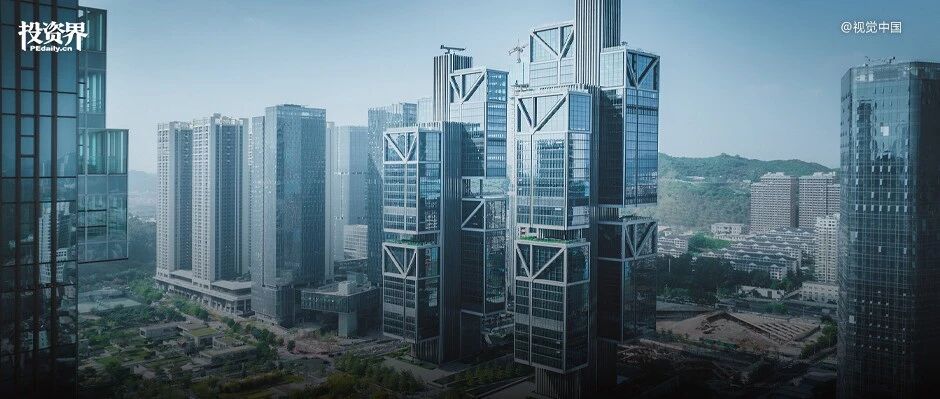
Core Insights - The article highlights the emergence of Shenzhen as a hub for AI hardware innovation, driven by former DJI engineers who have founded various startups in close proximity to DJI's headquarters [2][4][12] - The trend of "FOMO" (Fear of Missing Out) among investors regarding the "DJI ecosystem" is noted, with many venture capitalists eager to invest in startups founded by ex-DJI employees [8][10] Investment Landscape - Several startups founded by former DJI employees have gained significant traction, including: - LiberLive, founded by Tang Wenxuan, a former DJI engineer, which has completed two rounds of financing [3] - Zhenghao Innovation, founded by Wang Lei, former head of battery R&D at DJI, which is located 400 meters from DJI [3] - Songling Robotics, founded by Wei Jidong, a former DJI executive, which has secured substantial funding [6][7] - The article lists a variety of startups and their founders, emphasizing the strong presence of ex-DJI talent in the hardware sector [7] Ecosystem Development - Shenzhen's hardware ecosystem is described as thriving, with a notable increase in venture capital interest in AI hardware investments [4][10] - The article mentions that many venture capital firms are actively seeking AI hardware investors based in Shenzhen, reflecting the city's growing importance in the tech landscape [4][10] - The local supply chain and proximity to manufacturing resources are highlighted as key advantages for hardware startups in Shenzhen [9][12] Historical Context - DJI is portrayed as a pivotal player in reshaping the perception of Chinese manufacturing, moving away from the "copycat" image to one of innovation and quality [12] - The article notes that Shenzhen has become a breeding ground for a new generation of entrepreneurs who are more globally minded and tech-savvy, contrasting with previous generations focused on traditional manufacturing [12][13] Future Outlook - The article suggests that the trend of hardware innovation in Shenzhen is likely to continue, with a strong emphasis on AI integration and global market reach [10][12] - The presence of major venture capital firms and the establishment of new startups indicate a robust investment climate in Shenzhen's hardware sector [11][12]
500亿存储器牛股年涨超370%
2 1 Shi Ji Jing Ji Bao Dao· 2025-12-02 06:11
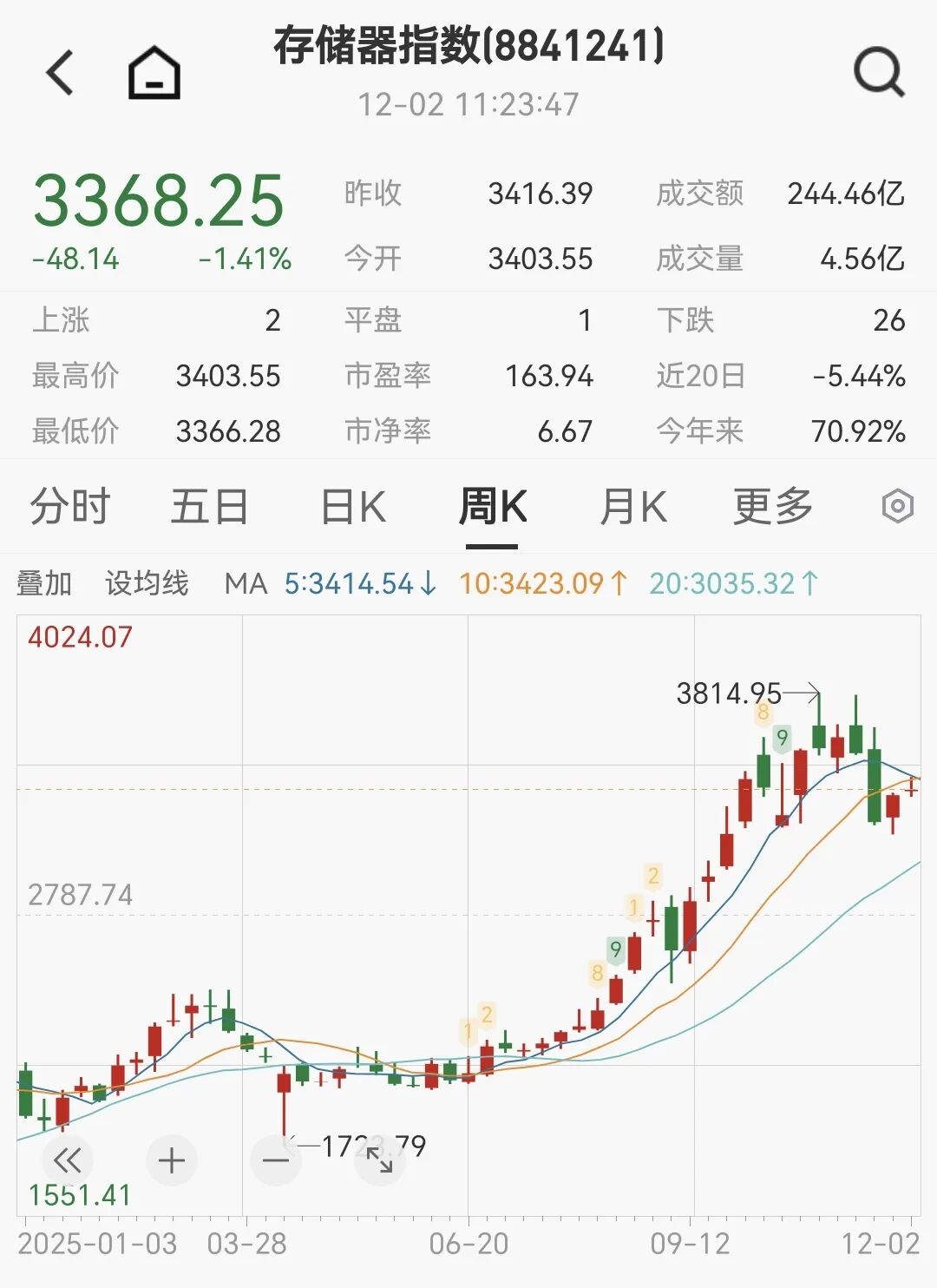
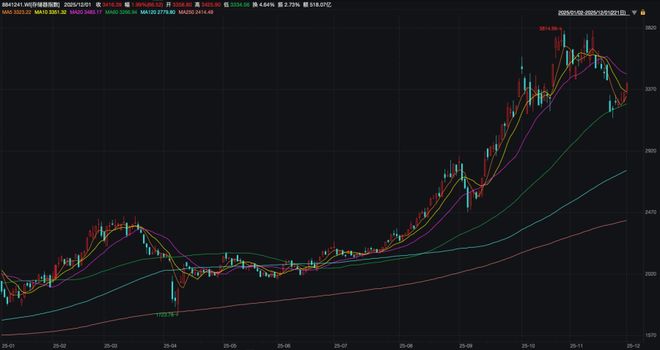
Core Viewpoint - The storage market experienced a significant downturn in late November due to concerns over the AI bubble, but has shown signs of recovery as of December 1, with a notable increase in the storage index and individual company performances [1][2]. Market Performance - As of December 1, the storage index (8841241.WI) closed at 3416.39 points, marking a daily increase of 1.99% and a consecutive four-day rise [2]. - Year-to-date, the storage sector has seen a remarkable increase of 97.7% in market capitalization weighted average, with leading companies like Dongxin Co. (688110.SH), Demingli (001309.SZ), and Jiangbolong (301308.SZ) achieving gains of 382.73%, 244.60%, and 189.63% respectively [2]. Industry Dynamics - The market's volatility is attributed to concerns over the mismatch between accelerated capital expenditures and delayed revenue recovery in the AI sector, although analysts argue that fears of an AI bubble are unfounded [5]. - The demand for high-bandwidth memory (HBM) is surging, driven by major companies like NVIDIA and OpenAI securing significant contracts, which has led to a squeeze on consumer-grade NAND Flash and DRAM production [5][6]. Structural Changes - The semiconductor industry is undergoing a strategic shift, with companies like SK Hynix expanding production to meet the demands of large tech firms, indicating a focus on high-margin products [6]. - The storage industry is experiencing a supply-demand imbalance, with prices for DDR4 memory doubling and supply constraints affecting DDR5 and SSD pricing [7]. Regional Development - Guangdong province is solidifying its dominant position in the storage and AI hardware industry, with a significant number of storage index component companies based in the region [9]. - The industrial layout in Guangdong is evolving towards a multi-polar development model, with companies like Jiangbolong expanding their manufacturing bases beyond Shenzhen to optimize costs and leverage regional advantages [9][10]. Market Demand - The demand for storage is expected to remain robust, driven by increasing requirements in mobile devices and data centers, with projections indicating that relief from supply constraints may not occur until late 2026 [7][8]. - Major tech firms in Guangdong, including Huawei and OPPO, contribute to a diverse market demand that supports the region's supply chain advantages [11][12]. Conclusion - The storage industry is poised for a prolonged upward cycle driven by AI advancements and regional industrial collaboration, with Guangdong's strategic advantages providing a solid foundation for companies to navigate market fluctuations [12][13].

3D打印风口突至,大湾区抢占产业高地
2 1 Shi Ji Jing Ji Bao Dao· 2025-12-02 05:09
Core Insights - The 3D printing industry is experiencing rapid growth, with major companies like DJI and Meituan accelerating their investments in this sector. The global market is projected to reach $115 billion by 2030, driven by technological advancements, expanded applications, and policy support [1][2]. Industry Growth and Market Dynamics - The global shipment of entry-level 3D printers is expected to exceed 1 million units in Q1 2025, marking a 15% year-on-year increase, with Chinese suppliers contributing 95% of this market share, predominantly from Guangdong Province [1]. - In the first three quarters of this year, China's 3D printing equipment production increased by 40.5% year-on-year, indicating a significant shift towards industrialization [2]. Technological Advancements - Key technological breakthroughs, such as multi-material printing and AI-driven design optimization, are facilitating the transition from prototype manufacturing to mass production, resulting in a 60% reduction in average prices of consumer-grade 3D printing devices over the past three years [2]. - The average price of entry-level devices has fallen below 2000 yuan, making them more accessible to ordinary consumers [2]. Applications in Various Sectors - 3D printing is expanding its applications in industries such as automotive and biomedical, enhancing production efficiency and enabling smart, digital, and flexible manufacturing processes [3]. - The successful flight of a 3D-printed simplified turbojet engine by China Aviation Engine Corporation marks a significant milestone in the direct manufacturing capabilities of 3D printing technology [3]. Policy Support and Strategic Initiatives - The Chinese government is actively promoting the 3D printing industry through various policies, including the "Green Low-Carbon Development Action Plan for Manufacturing Industry (2025-2027)" and the "Action Plan for Promoting Large-Scale Equipment Updates and Consumer Goods Replacement," which support the adoption of additive manufacturing technologies [3][4]. - Guangdong Province has been a pioneer in the additive manufacturing sector since the "12th Five-Year Plan," with strategic initiatives aimed at fostering innovation and industrial growth [4][5]. Regional Development and Industry Clusters - The Guangdong-Hong Kong-Macao Greater Bay Area is emerging as a key hub for the 3D printing industry, with a focus on building a complete ecosystem from upstream core components to downstream high-end applications [5]. - The establishment of the Guangzhou Laser and Additive Manufacturing Industrial Park aims to attract leading domestic enterprises and institutions, further solidifying the region's position in the 3D printing landscape [1][5]. Local Initiatives and Market Potential - The Liwan District in Guangzhou is leveraging its commercial foundation to promote 3D printing technology, particularly in consumer applications, to revitalize its traditional industrial base and address challenges related to industrial hollowing [5][6]. - The district's rich cultural heritage and active commercial channels provide a strong support system for the growth of 3D printing in creative products and customized consumer goods [6].
破解AI泡沫论:存储器指数回暖背后的风向标
2 1 Shi Ji Jing Ji Bao Dao· 2025-12-02 02:02
Core Viewpoint - The storage market experienced a significant downturn in late November due to concerns over the AI bubble, but has shown signs of recovery as of December 1, with the storage index rising 1.99% and a year-to-date increase of 97.7% [1][3] Market Trends - The storage sector is benefiting from the increasing demand for high-bandwidth memory (HBM) driven by AI applications, with major companies like OpenAI and NVIDIA securing substantial contracts for memory chips [3][4] - The supply chain dynamics have shifted, with a notable increase in prices for DDR4 memory and a halt in pricing for DDR5 and SSDs due to supply constraints [5] Regional Development - Guangdong has solidified its dominant position in the storage and AI hardware industry, with a significant number of storage index constituents based in the region, showcasing a multi-polar and deepened industrial layout [7][9] - Companies like Jiangbo Long are expanding their operations from Shenzhen to Zhongshan, indicating a strategic shift towards leveraging regional advantages [7] Industry Collaboration - The collaboration between various companies and local governments in Guangdong is fostering a robust ecosystem for the storage industry, with significant investments in advanced manufacturing and data center infrastructure [8][9] Future Outlook - The demand for storage is expected to remain strong, with projections indicating that supply constraints may not ease until at least the end of 2026, driven by both natural demand growth and supply-side reductions [5][6] - The structural changes in the storage industry, propelled by AI, are anticipated to create a prolonged upward cycle, supported by regional industrial collaboration [10][11]
硬核突围-中国硬件的全球时刻与未来想象 | 36氪 WISE2025 商业之王大会
3 6 Ke· 2025-12-01 11:29
Group 1 - The WISE 2025 conference in Beijing is described as an immersive experience rather than a traditional industry summit, focusing on trends in technology and business practices [1] - The conference aims to dissect the underlying logic of emerging business trends and practices, highlighting the potential of the commercial landscape in 2025 [1] Group 2 - The discussion emphasizes the resurgence of China's venture capital and startup ecosystem, particularly following the successful IPO of a company, which has invigorated investor confidence [3][4] - The speaker notes that the hardware industry in China is entering a "golden era," driven by advancements in supply chains, technology, and marketing strategies [4][8] Group 3 - Key factors contributing to the success of Chinese hardware companies include a robust supply chain, a large pool of engineers, and evolving marketing strategies that leverage social media influencers [5][6][7] - The shift in marketing from traditional methods to influencer-driven strategies has significantly impacted brand awareness and consumer trust [6][7] Group 4 - The conversation highlights the trend of diversification among companies in the smart hardware sector, with firms expanding into new product categories as they achieve success [9][10] - Companies are encouraged to leverage their existing capabilities and methodologies to explore new markets, although the depth of expertise required varies by product category [10][11] Group 5 - The future of the industry is expected to see a mix of comprehensive giants and specialized brands, with the potential for both types to coexist based on their market strategies and consumer perceptions [16][17] - The discussion suggests that brands focusing on niche markets may maintain a clearer identity and stronger consumer loyalty compared to those that diversify too broadly [17] Group 6 - The importance of fostering a culture of innovation and continuous learning within companies is emphasized, encouraging employees to pursue interests that align with the company's goals [20][21] - The speaker advocates for developing multifaceted talents among employees, as this enhances their market value and adaptability in a rapidly changing industry [20][21]

清华成立具身智能与机器人研究院
量子位· 2025-12-01 09:26
Core Viewpoint - The establishment of the Tsinghua University Institute of Embodied Intelligence and Robotics marks a significant step in the rapid development of embodied intelligence in China, reflecting a broader trend among domestic universities to accelerate their focus on this field [1][5][26]. Group 1: Institutional Developments - Tsinghua University has established the Institute of Embodied Intelligence and Robotics, following the earlier creation of the Beijing Key Laboratory of Embodied Intelligence Systems [2][5]. - The new institute is led by Professor Zhang Tao, with a core team covering key areas such as intelligent control, robot navigation, and swarm intelligence [7][12]. - This institute aims to integrate interdisciplinary research, major project undertakings, and high-level talent cultivation, moving beyond the foundational research focus of previous laboratories [12][15]. Group 2: Broader Academic Trends - Many Chinese universities are actively establishing research institutes and laboratories focused on embodied intelligence, indicating a nationwide trend [4][16]. - Fudan University and Beihang University have also launched their respective institutes dedicated to embodied intelligence, emphasizing a collaborative approach across various disciplines [18][21]. - The shift from smaller laboratories to larger research institutes signifies a move towards more coordinated and large-scale efforts in embodied intelligence research [25][26]. Group 3: Educational Initiatives - Shanghai Jiao Tong University has introduced the world's first four-year undergraduate program in embodied intelligence, with other universities also applying to establish similar programs [28][31]. - The establishment of dedicated programs aims to address the urgent demand for interdisciplinary talent in the embodied intelligence sector, as traditional automation and robotics programs do not adequately prepare graduates for the comprehensive roles required in this emerging field [36][35]. Group 4: Market Potential - The market for embodied intelligence in China is projected to reach 5.295 billion yuan by 2025, with global expectations of surpassing 232.6 billion yuan by 2030 [33]. - Goldman Sachs predicts that the global humanoid robot market could reach between 38 billion to 205 billion USD by 2035, highlighting the significant growth potential in this sector [34].

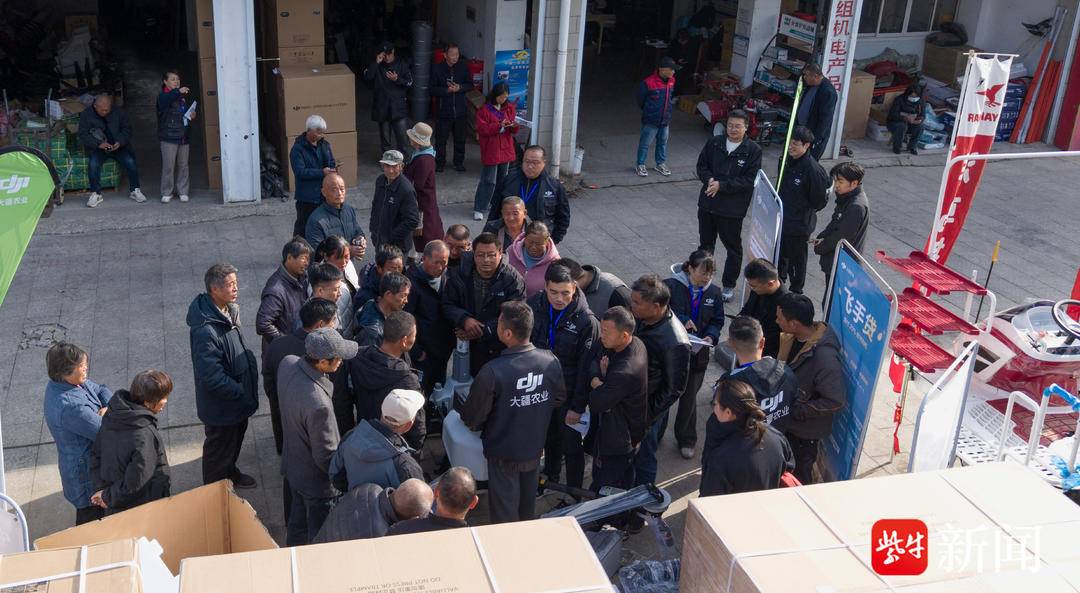
秋收忙定句容农户忙着买飞机! 农业无人机迎来采购潮智慧农机成增产“新标配”
Yang Zi Wan Bao Wang· 2025-12-01 08:46
Core Insights - The sales of agricultural drones have not slowed down after the autumn harvest, indicating a growing trend in modern agricultural technology becoming a "new standard" for farmers [1] Group 1: Sales Trends - Agricultural drone sales have seen a significant increase during the traditional off-season following the autumn harvest, with many farmers witnessing the efficiency and effectiveness of drone operations firsthand [5] - The sales volume has escalated from a few units to approximately 100 units annually in the region, reflecting a growing acceptance and demand for agricultural drones [5] Group 2: Price and Accessibility - The prices of agricultural drones have become more affordable, with new models costing about half of last year's prices, dropping from 70,000-80,000 yuan to 20,000-30,000 yuan [7] Group 3: Application and Benefits - The application scenarios for agricultural drones have expanded beyond initial pest control to include remote sensing, variable seeding, and intelligent fertilization, enhancing their utility [9] - The cost-effectiveness of drones is highlighted, as they can cover the purchase cost with just a few operations, significantly reducing labor costs for farmers [11] - Continuous support for maintenance and training is provided, contributing to the promotion of smart agricultural machinery and positively impacting agricultural modernization and farmers' income [11]