南京银行

Search documents
江苏首单“数据知识产权+数据资产”双质押融资落地南京
Xin Lang Cai Jing· 2025-12-07 02:59
Core Insights - The first "data intellectual property + data asset" dual pledge financing in Jiangsu has been successfully implemented in Nanjing's Yuhuatai District [1] - Nanjing Kaos Data Technology Co., Ltd. has been approved for the full process of data intellectual property and data asset pledge financing, securing a loan of 10 million yuan [1] - This financing model provides a new channel for technology and data-driven enterprises [1] Financing Model - The dual pledge financing combines data intellectual property and data assets, representing an innovative approach in the financing landscape [1] - The successful loan approval indicates a growing recognition of data as a valuable asset in the financial sector [1] Implications for Technology Sector - This financing model is particularly beneficial for technology-oriented and data-centric companies, enhancing their access to capital [1] - The development may encourage more companies in the sector to explore similar financing options, potentially leading to increased investment in data-driven innovations [1]
与世界各国共享机遇共同发展
Ren Min Ri Bao· 2025-12-07 02:26
Core Viewpoint - The article emphasizes that China's modernization requires an open and cooperative approach, advocating for mutual benefits and shared development in the context of a rapidly changing global landscape [1]. Group 1: Open Cooperation and Development - China maintains its commitment to an open economy, with President Xi Jinping stating that the country will continue to expand its openness [1]. - The "14th Five-Year Plan" suggests a steady expansion of institutional openness and a focus on international circulation to promote reform and development [1]. - The current international environment presents opportunities for China to strategically enhance its global presence through proactive openness [1]. Group 2: Self-Initiated Opening - The concept of self-initiated opening is highlighted as a key feature of China's high-level openness, reflecting a strategic choice that aligns with both global trends and domestic realities [2]. - Initiatives such as the China International Import Expo and zero-tariff policies for products from least developed countries demonstrate China's commitment to expanding trade with the Global South [2][5]. - The approach to openness is characterized by a structured and phased strategy that balances domestic needs with international engagement [2]. Group 3: Trade Innovation and Development - Foreign trade is identified as a crucial driver of economic growth and a key mechanism for expanding openness [6]. - China's foreign trade has shown resilience, maintaining its position as the world's largest goods trader and second-largest service trader, with expectations to exceed $1 trillion in service trade by 2024 [6]. - The "14th Five-Year Plan" outlines goals for enhancing trade quality and efficiency, emphasizing the importance of becoming a trade powerhouse [6]. Group 4: Investment and Economic Environment - The dual approach of "bringing in" and "going out" is essential for China's high-level opening, leveraging its vast market to attract foreign investment while promoting Chinese investments abroad [10]. - The competitive landscape for attracting foreign investment is intensifying, necessitating a focus on creating a transparent and stable investment environment [12]. - Measures to encourage foreign reinvestment in China are being implemented, aiming to foster a cycle of investment, profit retention, and growth [12]. Group 5: Service Trade and Digital Trade - The service trade is increasingly recognized as a vital component of global trade growth, with China focusing on expanding service exports and optimizing policies to enhance inbound tourism [8]. - Digital trade is seen as a significant area for growth, with cross-border e-commerce demonstrating remarkable activity and efficiency [9]. - The "14th Five-Year Plan" emphasizes the need for innovation in digital trade, supporting new business models and enhancing international competitiveness [9].
与世界各国共享机遇共同发展 ——扩大高水平对外开放,开创合作共赢新局面
Ren Min Ri Bao· 2025-12-07 02:19
Group 1 - The core viewpoint emphasizes that China's modernization requires open cooperation and mutual benefit, with a commitment to expanding its openness to the world [1][2] - The "15th Five-Year Plan" suggests a steady expansion of institutional openness and maintaining a multilateral trade system to promote international circulation and shared development [1][2] - China aims to proactively shape its international environment and seize opportunities for reform and development during the "15th Five-Year" period [1][2] Group 2 - The concept of "autonomous openness" is highlighted as a key feature of China's high-level opening strategy, focusing on independent and confident development [2] - The China International Import Expo showcased products from developing countries, indicating China's commitment to engaging with the global south [2] - The approach to openness is characterized by a strategic alignment with domestic needs while fostering positive interactions with the world [2] Group 3 - The deepening of reforms necessitates higher levels of openness, and vice versa, indicating a reciprocal relationship between reform and openness [3] - The Hainan Free Trade Port is set to launch full island closure operations, aiming to align with international high-standard economic and trade rules [3] - The focus will be on trade and investment liberalization, expanding market access, and creating a favorable business environment [3] Group 4 - China's openness is framed as a collaborative effort rather than a unilateral action, emphasizing mutual benefits in international projects [4] - Significant projects in countries like Serbia and Kenya demonstrate China's commitment to infrastructure and social development through the Belt and Road Initiative [4][5] Group 5 - The foreign trade sector is identified as a crucial driver of economic growth and a key mechanism for expanding openness [6] - China's foreign trade maintained its global leadership, with goods trade ranking first and service trade second globally, with expectations to exceed $1 trillion in 2024 [6] - The "15th Five-Year Plan" outlines new requirements for enhancing trade quality and efficiency, focusing on goods, services, and digital trade [6] Group 6 - The optimization of goods trade involves diversifying markets and integrating domestic and foreign trade [7] - The introduction of initiatives to promote green trade reflects a commitment to sustainable development [7] Group 7 - The service trade sector is increasingly recognized as a vital component of global trade growth, with efforts to enhance service exports [8] - The expansion of service trade is seen as both a priority and a challenge, requiring effective management reforms [8] Group 8 - Digital trade is positioned as a significant area for growth, with cross-border e-commerce showing remarkable vitality [9] - Statistics indicate a substantial increase in international cargo volume at key ports, reflecting the growth of digital trade [9] Group 9 - The dual approach of "bringing in" and "going out" is emphasized as a necessary strategy for high-level openness [10] - The focus is on creating a favorable investment environment to attract foreign investment while guiding global supply chain layouts [10][11] Group 10 - The promotion of reinvestment by foreign enterprises in China is highlighted as a strategy to enhance the investment environment [11] - Measures are being implemented to encourage foreign companies to reinvest, fostering a cycle of investment and growth [11][12] Group 11 - The need for a comprehensive overseas service system is underscored to support enterprises in navigating international markets [12] - Initiatives like the "Shenzhen Outbound E-Station" aim to provide extensive support for companies venturing abroad [12]
与世界各国共享机遇共同发展——扩大高水平对外开放 开创合作共赢新局面
Ren Min Ri Bao· 2025-12-06 22:04
Group 1 - The core viewpoint emphasizes that open cooperation and mutual benefit are essential requirements for China's modernization, especially in the context of a rapidly changing global landscape and economic challenges [1] - The "14th Five-Year Plan" suggests steadily expanding institutional openness, maintaining a multilateral trade system, and promoting international circulation to share opportunities and develop together with other countries [1][2] - China aims to proactively shape its international environment and leverage favorable conditions to enhance strategic initiatives during the "14th Five-Year" period [1] Group 2 - The concept of "autonomous openness" is highlighted as a key feature of China's high-level opening-up strategy, which includes building the Hainan Free Trade Port and high-quality cooperation in the Belt and Road Initiative [2][3] - The recent China International Import Expo showcased active trade growth from the Global South, indicating China's commitment to engaging with developing countries through favorable trade terms [2] Group 3 - The relationship between deepening reforms and increasing openness is emphasized, with a call for expanding institutional openness to promote development [4] - The Hainan Free Trade Port is set to launch full island closure operations, focusing on aligning with international high-standard economic and trade rules [4] Group 4 - China's foreign trade remains a crucial engine for economic growth, with the country maintaining the largest goods trade scale globally and the second-largest service trade scale [6] - The "14th Five-Year Plan" aims to enhance the quality and efficiency of foreign trade, establishing China as a trade powerhouse [6][7] Group 5 - The development of service trade is identified as a key area for future autonomous openness, with a focus on encouraging service exports and optimizing policies for inbound tourism [8] - The rise of digital trade and cross-border e-commerce is noted, with significant growth in international cargo volumes at key ports [9] Group 6 - The strategy of dual-direction investment cooperation is emphasized, combining "bringing in" and "going out" approaches to enhance China's open development [10] - The need to create a favorable investment environment and promote reinvestment by foreign enterprises in China is highlighted [12] Group 7 - The establishment of a comprehensive overseas service system is crucial for enhancing the global capabilities of enterprises, providing support throughout the investment process [13] - The "Shenzhen Outbound E-Station" platform aims to support enterprises in various aspects of international operations, enhancing their risk management capabilities [13]
业绩垫底!鑫元基金旗下一产品逆市下跌21%
Sou Hu Cai Jing· 2025-12-06 12:50
Core Viewpoint - The performance of the Xin Yuan Fund's actively managed equity product has significantly underperformed in a generally rising A-share market, with a year-to-date decline of approximately 21%, placing it at the bottom of the market [2][3]. Group 1: Fund Performance and Management - The Xin Yuan Consumption Selection Mixed Fund has experienced a net value decline of about 50% since its establishment on March 24, 2023, ranking 4476th and 4477th among 4477 similar products for its A and C shares respectively [3]. - The fund has undergone frequent changes in its top ten holdings, with seven out of ten stocks being replaced from the second to the third quarter, indicating a highly aggressive trading style that contrasts with its long-term consumption theme [5]. - The current fund manager, Yao Qipin, is relatively inexperienced, managing this fund as his first, which raises concerns about the fund's stability and predictability [6]. Group 2: Company Background and Challenges - Xin Yuan Fund, established in 2013, has a significant focus on fixed income, with nearly 60% of its assets in bond funds, while equity funds only account for 3.13% of its total assets [8]. - The company has seen a major overhaul in its management team, with a new general manager and three new deputy general managers appointed, reflecting a shift in strategy amid underperformance in equity funds [8][21]. - Despite the overall growth in fund management scale, the company faces profitability pressures, with revenue and net profit fluctuating significantly over the past few years [22]. Group 3: Market Context and Future Outlook - The public fund issuance market has warmed up, particularly for equity funds, with many new products being launched by Xin Yuan Fund, indicating an aggressive push to capture market share [10][11]. - The company’s mixed funds have underperformed compared to peers over various time frames, suggesting challenges in achieving competitive returns [11]. - The upcoming end of the three-year lock-up period for the Xin Yuan Consumption Selection Mixed Fund poses a risk of potential liquidation if performance does not improve [8].

DeepSeek-V3.2发布:性价比再度拉升,金融任务评测表现亮眼
SINOLINK SECURITIES· 2025-12-05 14:18
- **DeepSeek-V3.2 introduces DSA mechanism for sparse attention** DeepSeek-V3.2 incorporates DeepSeek Sparse Attention (DSA) mechanism, which reduces attention complexity from traditional full attention $O(n^2)$ to $O(nk)$, where $k$ represents the number of key tokens selected by the Indexer. This significantly improves efficiency for long-text processing, reducing computational costs while maintaining output quality[13][16][19] - **DeepSeek-V3.2 enhances RL framework for tool-use thinking** The model optimizes reinforcement learning algorithms, specifically Group Relative Policy Optimization (GRPO), and integrates multi-task training (reasoning, tool-use, human preference alignment) into a single RL phase. This improves performance across complex tasks like mathematics and programming, achieving results comparable to GPT-5 and Gemini-3.0-Pro[22][23][25] - **DeepSeek-V3.2 excels in CFLUE financial task evaluations** Using CFLUE benchmarks, DeepSeek-V3.2-reasoner and Speciale versions outperform competitors in financial knowledge assessments and application tasks, including ESG classification, financial event extraction, reading comprehension, and text generation. The Speciale version achieves the highest scores in key scenarios[26][27][30] - **National 2000 Index enhancement strategy with composite factors** The strategy combines factors such as technical, reversal, and residual volatility, neutralized by industry and market capitalization. The enhanced factor achieves an IC mean of 12.63% and a t-statistic of 12.79, demonstrating strong predictive performance[33][34][35] - **National 2000 Index enhancement strategy performance** The strategy, based on enhanced factors, delivers an annualized excess return of 13.39% and an IR of 1.74. November's excess return was 1.84%, showing recovery in performance[37][40][41] - **TSGRU+LGBM machine learning model for index enhancement** The model integrates TimeMixer's multi-scale mixing and seasonal/trend decomposition mechanisms into GRU, combined with LightGBM and traditional factors. It captures recent market trends effectively, achieving strong results across multiple indices[43][44][48] - **TSGRU+LGBM performance on CSI 300 Index** The strategy achieves an annualized excess return of 6.12% and an IR of 1.31. November's excess return was 3.49%, indicating robust recovery[45][48][49] - **TSGRU+LGBM performance on CSI 500 Index** The strategy delivers an annualized excess return of 9.87% and an IR of 2.01. November's excess return was 1.60%, showing improvement[47][52][53] - **TSGRU+LGBM performance on CSI 1000 Index** The strategy achieves an annualized excess return of 13.35% and an IR of 2.48. November's excess return was 0.99%, reflecting stable performance[50][54][55] - **Dividend style timing and stock selection for fixed-income+ strategy** Using 10 macroeconomic and liquidity indicators, the strategy constructs a dynamic event factor system for timing and AI-based stock selection within the CSI Dividend Index. The stock selection strategy achieves an annualized return of 18.81% and a Sharpe ratio of 0.90, outperforming the index[56][57][59]
险资入市再松绑 增量长期资金有望“跑步入场”
Xin Jing Bao· 2025-12-05 12:44
Core Viewpoint - The recent adjustment by the National Financial Regulatory Administration to lower risk factors for certain insurance company investments is aimed at encouraging insurance capital to enter the stock market and support strategic industries in China [1][4]. Group 1: Risk Factor Adjustments - The risk factor for insurance companies holding stocks in the CSI 300 Index and the China Securities Low Volatility 100 Index for over three years has been reduced from 0.3 to 0.27 [2][4]. - For stocks listed on the Sci-Tech Innovation Board held for over two years, the risk factor has been lowered from 0.4 to 0.36 [2][4]. - Lowering the risk factor allows insurance companies to free up capital, enhancing their investment capacity in the stock market [2][3]. Group 2: Encouragement of Long-term Investment - The adjustments encourage insurance companies to hold stocks for longer periods, which supports corporate development and aligns with national strategies [3][4]. - The focus on specific indices and stocks, such as blue-chip and technology stocks, indicates a strategic direction to bolster investments in key economic sectors [4][5]. Group 3: Increased Market Participation - As of the end of Q3 this year, insurance companies have accelerated their stock market participation, with investments in stocks and securities reaching 5.59 trillion yuan, accounting for 14.92% of their total investment [5]. - Insurance capital has been increasing its holdings in major stocks, with significant acquisitions noted in several banks and companies [5]. - The ongoing reduction in risk factors is expected to further enhance insurance capital's engagement in the stock market, driving improvements in investment efficiency and market stability [5].
重磅!险资入市再松绑,增量长期资金有望“跑步入场”
Bei Ke Cai Jing· 2025-12-05 12:33
Core Viewpoint - The National Financial Regulatory Administration has adjusted the risk factors for certain insurance company investments, aiming to encourage insurance capital to enter the stock market and support strategic industries in the country [1][3][11]. Risk Factor Adjustments - The risk factor for stocks held by insurance companies for over three years in the CSI 300 Index and the CSI Low Volatility 100 Index has been reduced from 0.3 to 0.27 [5][11]. - The risk factor for ordinary shares listed on the Sci-Tech Innovation Board held for over two years has been lowered from 0.4 to 0.36 [6][11]. Impact on Capital Allocation - Lowering the risk factors will free up capital for insurance companies, allowing them to invest more in the stock market. For example, a company with a total capital of 1 billion yuan would see a reduction in capital usage from 300 million yuan to 270 million yuan for a 100 million yuan investment in the CSI 300 stocks [7][8]. - The saved capital can be reinvested into stocks or other assets, thereby expanding the investment capacity of insurance capital [8]. Encouragement of Long-term Investment - The adjustments encourage insurance companies to hold stocks for longer periods, which supports the development of enterprises and aligns with national strategies [10][12]. - The focus on specific indices and stocks indicates a targeted approach to encourage investment in blue-chip and technology stocks, which are crucial for economic growth [11][12]. Recent Trends in Insurance Capital - As of the end of Q3 this year, the total investment by life and property insurance companies in stocks and securities investment funds reached 5.59 trillion yuan, accounting for 14.92% of their total investment balance, marking a new high since 2022 [13]. - Insurance capital has been increasing its holdings in major stocks, with significant increases observed in the first three quarters of the year [13][15]. Future Outlook - With the reduction in risk factors, insurance capital is expected to further increase its stock market investments, which may lead to enhanced resource allocation towards equity investment and research capabilities within insurance companies [16].
共绘金融服务实体经济新蓝图!第十九届“金洽会”闭幕
Guo Ji Jin Rong Bao· 2025-12-05 11:28
上海市贸促会副会长顾春霆、《国际金融报》总编辑徐冲为荣获"园区行"卓越贡献奖的交通银行上海市分行、上海市融资担保中心代表,以及荣获优秀 贡献奖的工行上海市分行、农行上海市分行、中行上海市分行、建行上海市分行、浦发银行上海分行、光大银行上海分行、上海银行、上海农商行、江苏银 行上海分行、太平洋财险航运保险事业营运中心代表颁奖。 12月4日,由上海金融业联合会、申万宏源证券、闵行区人民政府联合主办的第十九届上海金融服务实体经济洽谈会(下称"金洽会")闭幕大会暨第三 届科创金融大会在闵行区大零号湾科创大厦会议中心举行。 上海金融业联合会理事长单位代表、交通银行副行长杨涛回顾了第十九届"金洽会"园区行情况并表示,"金洽会"园区行是联合会践行"金融为民"理念、 畅通金融服务渠道的创新实践,也是金融机构贴近产业一线、倾听企业呼声的务实调研。交通银行将与广大金融机构用好用实"园区行"成果:贯彻落实党中 央战略部署,助力服务上海现代化产业体系建设;大力支持联合会发挥作用,扎实推进普惠金融顾问制度走深走实;紧密围绕实体企业关切,持续推动科技 金融服务创新。 会上举行了"全球金融机构走进中国金融市场"系列活动启动仪式。杨涛与中国 ...



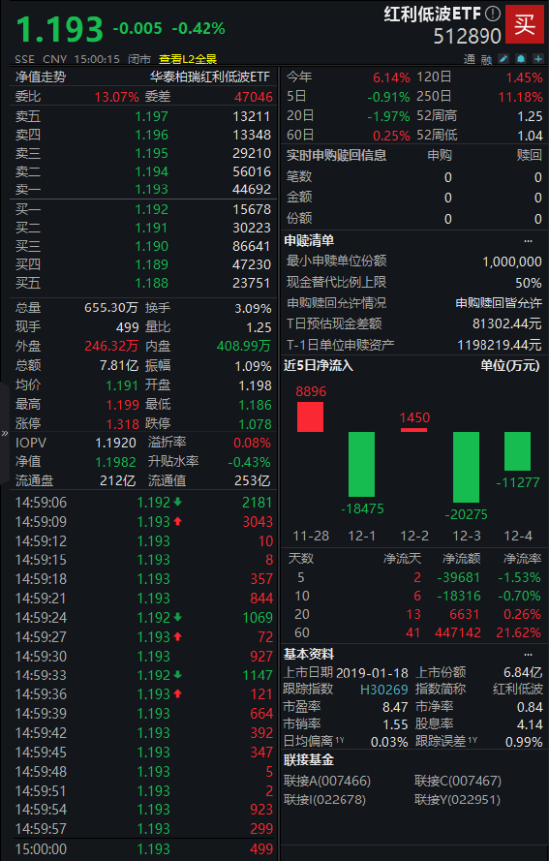
红利低波ETF(512890)年内累计成交额超千亿元,长期彰显红利资产“压舱石”属性
Xin Lang Cai Jing· 2025-12-05 07:21
数据来源:Wind 截止 最新定期报告显示,红利低波ETF(512890)前十大重仓股具体包括中粮糖业、南钢股份、成都银行、 大秦铁路、南京银行、兴业银行、农业银行、建设银行、中信银行、四川路桥,持仓占比如下: | 量仓括股 (2025-09-30) | | | | | | | | ਲਿੰਦ | | --- | --- | --- | --- | --- | --- | --- | --- | --- | | 設置名称 | 特色电脑(元) | 将在数据 | 相对上期增城 | 占鉴赏布幅比 | 古都當中國比 | 占值得版本找 利润行业 | 区间分类型 | 行业区间设置 | | 中德维亚 (D | 695,289,225,56 | 43.591.801 | | 3.47% | 3.45% | 2.04% 日前角图 | 7.5.11% | -2.68% | | 廣明露出 | 570 DE9,953.25 | 908 584,753 | | 2.85% | 2.83% | 1.76% 8794 | 26.0% | 28.34% | | 同期的行 | 567,817,070.50 | 32.916.970 | 12.0 ...