韵达股份

Search documents
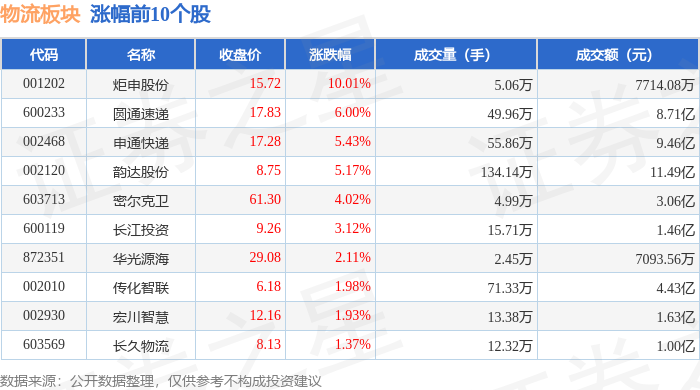
物流板块8月18日涨1.32%,炬申股份领涨,主力资金净流出9692.85万元
Zheng Xing Xing Ye Ri Bao· 2025-08-18 08:39
Market Overview - On August 18, the logistics sector rose by 1.32% compared to the previous trading day, with Jushen Co., Ltd. leading the gains [1] - The Shanghai Composite Index closed at 3728.03, up 0.85%, while the Shenzhen Component Index closed at 11835.57, up 1.73% [1] Individual Stock Performance - Jushen Co., Ltd. (001202) closed at 15.72, up 10.01% with a trading volume of 50,600 lots and a transaction value of approximately 77.14 million yuan [1] - YTO Express (600233) closed at 17.83, up 6.00% with a trading volume of 499,600 lots [1] - Shentong Express (002468) closed at 17.28, up 5.43% with a trading volume of 558,600 lots [1] - Yunda Holdings (002120) closed at 8.75, up 5.17% with a trading volume of 1,341,400 lots [1] - Milkway (603713) closed at 61.30, up 4.02% with a trading volume of 49,900 lots [1] Capital Flow Analysis - The logistics sector experienced a net outflow of 96.93 million yuan from institutional investors, while retail investors saw a net outflow of 161 million yuan [2] - Speculative funds had a net inflow of 258 million yuan into the logistics sector [2] Detailed Capital Flow for Selected Stocks - Yunda Holdings (002120) had a net inflow of 77.34 million yuan from institutional investors, but a net outflow of 79.52 million yuan from retail investors [3] - Shentong Express (002468) saw a net inflow of 46.63 million yuan from institutional investors and a net outflow of 12.27 million yuan from retail investors [3] - Jushen Co., Ltd. (001202) had a net inflow of 24.79 million yuan from institutional investors, with a significant net outflow of 13.19 million yuan from retail investors [3]


义乌、广东快递集体涨价,加盟商:“这次是来真的了
3 6 Ke· 2025-08-18 07:14
Core Viewpoint - The express delivery industry is undergoing a significant transformation aimed at countering "involution" competition, with companies in regions like Guangdong and Zhejiang announcing price increases to promote rational development [1][3][11]. Group 1: Price Adjustments - Starting from August 5, 2025, express delivery companies in Guangdong will adjust their pricing standards, with a minimum price set at 1.4 yuan per ticket [1][3]. - In July, the Yiwu postal management authority mandated an increase in the minimum price for express delivery to 1.2 yuan, reflecting a broader trend of price hikes in key logistics areas [1][3]. - Reports indicate that the price increase in Guangdong has been confirmed by multiple leading express companies, with adjustments primarily affecting low-weight packages [3][4]. Group 2: Market Dynamics - The express delivery sector has seen a 20.1% increase in business volume in the first five months of 2025, but the average price per ticket has dropped by 8.2% to 7.5 yuan, indicating a "volume increase, price drop" trend [7][10]. - Major express companies reported a decline in average revenue per ticket in June 2025, with significant drops for companies like SF Express and Yunda [7][10]. - The competitive landscape has led to a challenging environment for franchisees and frontline workers, with profit margins being severely squeezed [8][10]. Group 3: Impact on E-commerce - E-commerce merchants are the first to feel the impact of the price increases, with reported hikes ranging from 0.2 to 1 yuan depending on the weight of the packages [6][13]. - Some e-commerce businesses are relocating their logistics operations to areas with lower express delivery costs to mitigate the impact of rising expenses [13][14]. - Merchants face limited options in response to increased logistics costs, as raising product prices could lead to decreased sales due to price sensitivity [14]. Group 4: Regulatory and Industry Response - The recent price adjustments are supported by regulatory measures aimed at preventing express companies from engaging in predatory pricing practices [4][11]. - Industry experts suggest that this round of price increases could mark a critical turning point for the express delivery sector, moving towards a more rational pricing model [11][14]. - There is a call for collaboration among e-commerce platforms, merchants, and express companies to establish a more sustainable pricing structure [14].
国泰海通:反内卷保障快递良性竞争 监管力度决定持续性
Zhi Tong Cai Jing· 2025-08-18 06:43
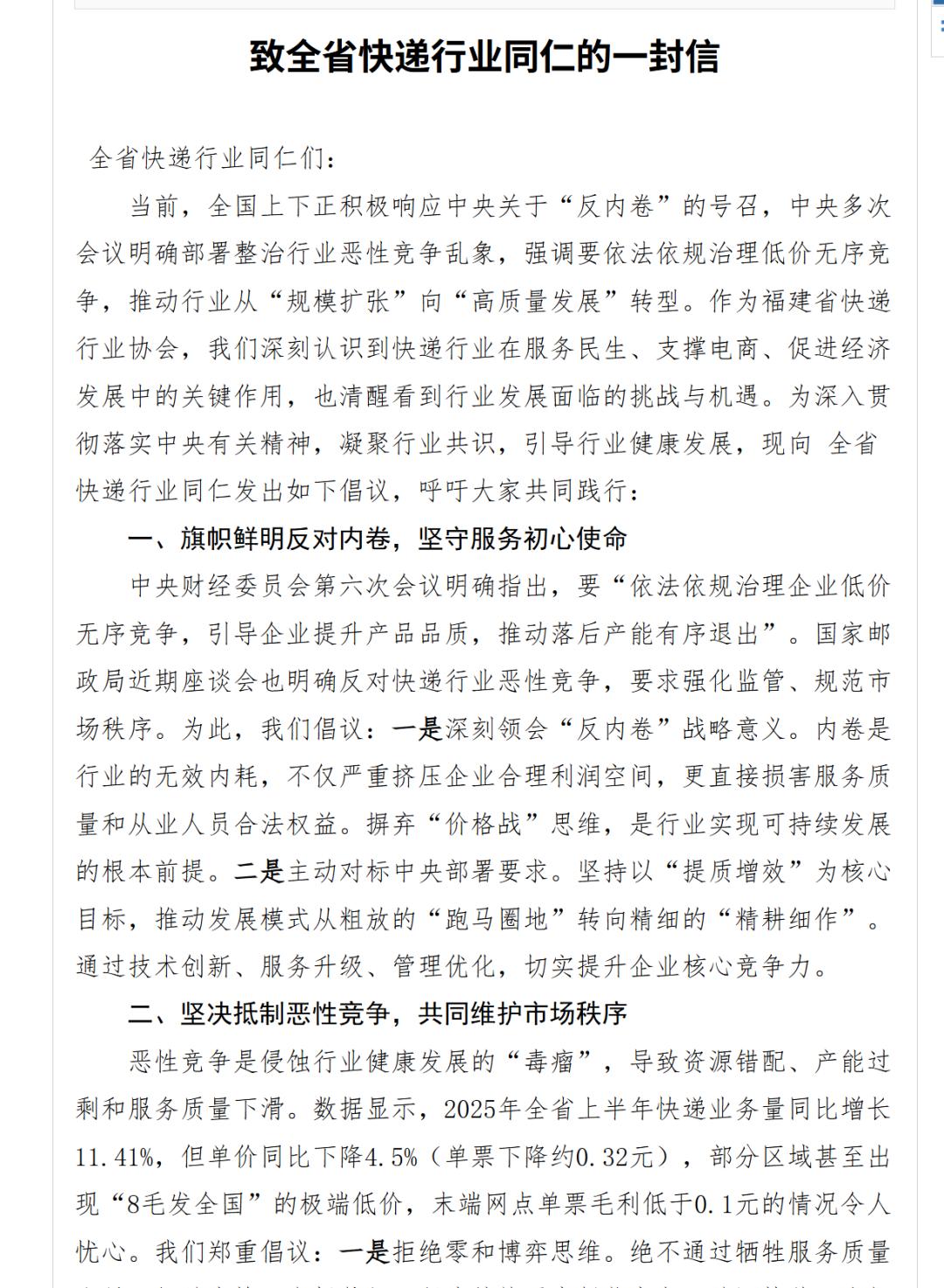
2)头部企业盈利修复目标坚定。考虑非理性价格战显著影响了加盟网点盈利与长期信心,2022年头部企 业盈利修复目标坚定,行业竞争趋缓且网络得到休养。3)快递员权益保障政策,驱动单票收入回升。 2021年6月七部委印发《关于做好快递员群体合法权益保障工作的意见》,8月底电商快递集体宣布自9 月全网派费上调0.1元/票,旨在落实政策提升快递员收入,抱团提价传导成本压力。 2025年快递"反内卷"力度超预期,短期竞争压力趋缓,中长期继续保障良性竞争 自2024下半年头部企业份额关注度再次明显提升,2025年春节后价格竞争力度继续增强。2025Q1行业 利润率同比承压,该行预计Q2降幅继续扩大,且快递网络稳定性风险再次凸显。7月上旬国家邮政局强 调将旗帜鲜明反对"内卷式"竞争,7月底召开快递企业座谈会要求确保网络平稳运行和基层网点稳定。 根据罗戈网,7月义乌底价率先要求提升约0.2元;8月广东多地跟进上调底价约0.4元,并高于义乌。该行 认为此轮"反内卷"自上而下将继续深化,后续多地或跟进治理。"反内卷"短期将缓和竞争压力,更重要 的是中长期继续保障良性竞争,有利于行业自然集中。 国泰海通发布研报称,维持快递增持评级。 ...

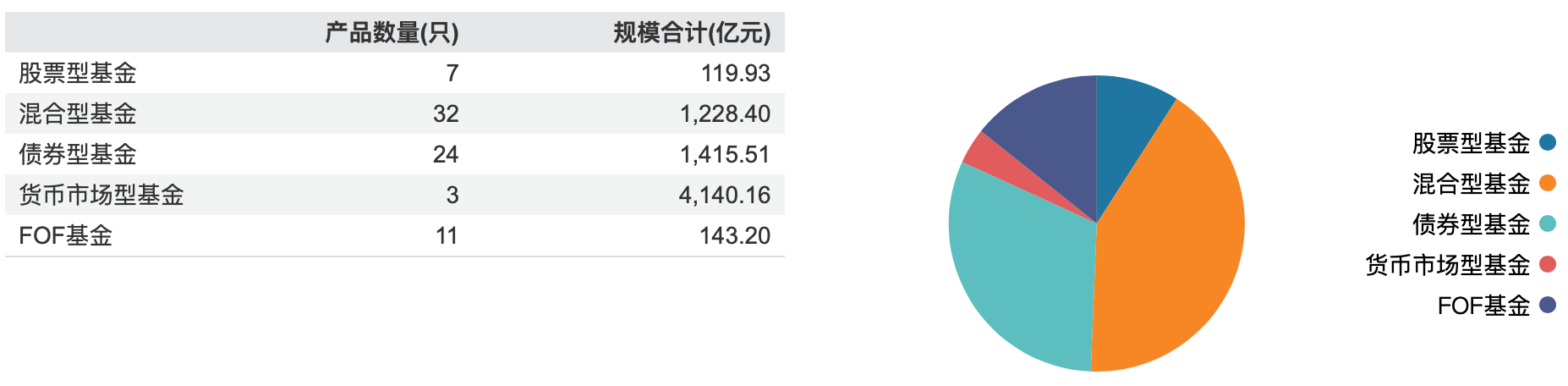
兴证全球的百亿顶流们安好?
Hu Xiu· 2025-08-18 04:09
Core Viewpoint - The article discusses the current status and challenges faced by Xingzheng Global in the mutual fund industry, highlighting the decline in its equity fund performance and the shift towards fixed-income products [1][14]. Fund Performance - As of mid-2025, Xingzheng Global ranks 20th in non-cash fund size, with a total management scale of 652.3 billion yuan, of which fixed-income funds account for 79% [1]. - Among 4846 mixed equity funds, only a few hundred billion funds remain, with Xingquan funds holding three of them [1]. - The only two billion funds that lost money this year include one from Xingzheng Global, indicating challenges in its equity fund performance [1]. Key Fund Managers - The article highlights the performance of key fund managers, particularly Xie Zhiyu, who manages three funds with varying success. His best-performing fund, Xingquan Social Value, achieved a one-year return of 58.32% [4][8]. - Xie Zhiyu's funds have faced significant losses in recent years, with Xingquan He Run losing over 11.6 billion yuan from 2022 to 2023 [7]. Market Trends and Strategies - Xie Zhiyu has expressed optimism about sectors like technology and consumer goods, particularly in smart driving and emotional consumption [8]. - The article notes that Xingquan Trend Investment, once a flagship fund, has seen its scale shrink significantly and has struggled to keep up with market trends [9][13]. Challenges and Future Outlook - The article suggests that Xingzheng Global's equity business faces difficulties due to issues like cognitive rigidity and slow portfolio adjustments among its top fund managers [14]. - There are indications that Xingzheng Global may focus on ETFs in the second half of the year, but it is unlikely to aggressively push this strategy [14].
国盛证券:快递反内卷自上而下 预计具备扩散效应和持续性
智通财经网· 2025-08-18 03:07
智通财经APP获悉,国盛证券发布研报称,本轮快递反内卷,一方面强调了快递企业作为反内卷的主 体,一方面强调了国家和地方邮管局的监管职责和执法能力,双管齐下。此次快递反内卷自上而下,且 广东省已率先落地,该行认为具有扩散效应,且在淡旺季衔接和社保新规背景下,快递反内卷具备持续 性,各主要快递上市公司业绩弹性大。 广东作为快递业务量占比较高的地区,2017年以来其快递业务量占全国业务量的份额保持在 24.33%-27.25%,其反内卷率先落地,有望对全国其他快递"产粮区"形成示范效应,从其他地方邮政局 的动作看,预计其他地区如浙江、福建等地区会一定程度的跟随涨价。 淡季涨价叠加社保新规,预计反内卷效果将在一定时期内持续 不同于以往年份的旺季涨价,今年快递行业在反内卷的推动下,淡季进行提价,而之后可以衔接旺季, 从需求端来看,此次反内卷效果具有一定持续性。最高人民法院强调依法参加社保是法定义务,新规自 9月1日起施行。该行以每人日均派件500票、按各地标准缴纳社保测算快递小哥全员缴纳社保后,对单 票的平均影响在6分钱。因此,从成本端看,若后续快递小哥全员缴纳社保后,快递加盟商的成本增 加,经营压力进一步提升,而反内 ...

中国快递业:展望竞争趋缓的一年-China Express Delivery_ Looking into a year of easing competition
2025-08-18 02:52
Summary of Key Points from the Equity Research Report on China Express Delivery Industry Overview - The A-share Express Delivery Index has increased by 18% since July, outperforming the CSI300 index which rose by 4% [3] - The profitability improvement across the express delivery industry has not been fully reflected in stock prices, particularly for major players like YTO, which saw an 80%+ improvement in PE ratios due to express price hikes in Q4 2021 [3] Core Insights - **Price Recovery and Policy Support**: The ongoing anti-involution policy and expected price floor increases in regions like Guangdong (RMB0.4-0.5 increase to RMB1.4 per parcel) are anticipated to enhance profitability and earnings visibility for delivery players in 2026 [3][5] - **ASP Trends**: Major players experienced a year-on-year increase in Average Selling Price (ASP) of 13-21% in 2022, but ASP is expected to remain flat in 2026 due to a higher mix of low-priced parcels and price sensitivity among consumers [4] - **Volume Growth**: Industrial parcel volume growth is projected to slow to approximately 10-15% year-on-year in 4Q25-2026, following a low growth of 2% in 2022 due to pandemic impacts [4] Company Ratings and Target Prices - **Upgrades**: YTO and Yunda have been upgraded to "Buy" from "Hold" due to recent policy-driven price hikes, while STO Express remains a preferred choice with a maintained "Buy" rating [6][11] - **Target Prices**: - SF Holding-A: Target price raised from RMB47.10 to RMB56.00 [7] - YTO Express: Target price raised from RMB13.70 to RMB20.40 [28] - Yunda: Target price raised from RMB7.60 to RMB10.40 [40] Financial Estimates - **Revenue and Profit Changes**: - YTO Express's revenue estimates lowered by 2% in 2025, 3% in 2026, and 5% in 2027 due to fierce price competition [24] - Yunda's net profit estimates raised by 7% in 2025, 12% in 2026, and 10% in 2027 due to improved ASP and cost management [36] - **Cost Management**: Expected unit costs to drop by 3-5% year-on-year in 2025 due to better scale effects [4] Risks and Challenges - **Price Competition**: Intensifying price competition poses a risk to ASP and could negatively impact revenue and earnings [22] - **Capacity Expansion**: Slower-than-expected capacity expansion could limit competitiveness and share price growth [22] - **Goodwill Impairment**: Risks associated with goodwill impairment could affect earnings negatively [22] Conclusion - The express delivery sector in China is poised for a recovery supported by policy changes and price adjustments, with major players like YTO and Yunda expected to benefit significantly. However, risks related to competition and operational efficiency remain critical factors to monitor.

沪指升破3700,周期机会详解?
2025-08-18 01:00
Summary of Key Points from Conference Call Records Industry Overview - **Express Delivery Industry**: Significant progress in anti-involution, with Guangdong leading price increases, followed by other provinces. Companies to watch include Shentong, YTO, Yunda, Zhongtong, and Jitu Express for their potential in emerging markets [3][3][3]. - **Aviation Industry**: Stocks showed unusual activity due to industry self-discipline notifications. Current market conditions are at a bottom, suggesting potential for recovery. Recommended stocks include major Hong Kong airlines and Huaxia Airlines in A-shares, along with Spring Airlines and Juneyao Airlines [4][4][4]. - **Coking Coal Market**: Prices are expected to rise significantly, benefiting companies like Jiayou International. Recovery in the African market, particularly with Zijin Mining's Kamoa mine, will support its operations [5][5][5]. - **Chemical Industry**: The chemical product price index (CCPI) is at 4,034 points, with a slight decline recently. However, a recovery is anticipated in Q4 2023 to Q1 2024. Key companies include Wanhua Chemical and Satellite Chemical, with the latter showing a low valuation despite a solid performance [6][6][6]. - **Refrigerant Market**: Prices are on the rise due to limited supply, enhancing manufacturers' pricing power. Companies like Juhua and Sanmei are expected to see significant growth potential [8][8][8]. - **Palm Oil Market**: Prices have increased, benefiting Zanyu Technology's operations in Indonesia, with production expected to double in the second half of the year [9][9][9]. - **Agricultural Chemicals**: Strong demand is noted, particularly for glyphosate, with prices rising significantly. Companies like Sinochem and Xingfa Group are highlighted for their growth potential [11][11][11]. - **Copper Industry**: Current valuations suggest significant upside potential for Jiangxi Copper and China Nonferrous Mining, with both companies positioned for recovery [14][14][14]. Company-Specific Insights - **China Shenhua**: Plans to acquire high-quality assets from the State Energy Group, expected to enhance asset scale and profitability. The acquisition includes multiple core assets and is projected to significantly boost net assets and profits [16][16][16]. - **Wanhua Chemical**: Reported a net profit of 3.04 billion yuan in Q2, exceeding expectations, with improvements in TDI gross margins and overall business performance [6][6][6]. - **Jiayou International**: Anticipated profit growth in coking coal trade due to rising market prices and recovery in African operations [5][5][5]. - **Zanyu Technology**: Expected profit increase from its Indonesian base, with production capacity projected to double [10][10][10]. Additional Considerations - **Market Sentiment**: The Shanghai Composite Index has surpassed 3,700 points, indicating a potential slow bull market, particularly in cyclical stocks like express delivery, aviation, and coking coal [2][2][2]. - **Policy Impact**: Anti-involution policies and other regulatory measures are expected to support price recovery in various sectors, particularly in chemicals and coal [12][12][12]. - **Investment Recommendations**: Focus on high-dividend coal companies and turnaround potential in coking companies under current market conditions [19][19][19]. This summary encapsulates the key insights and recommendations from the conference call, providing a comprehensive overview of the current market landscape and potential investment opportunities.



快递反内卷:自上而下,预计具备扩散效应和持续性
GOLDEN SUN SECURITIES· 2025-08-17 14:04
Investment Rating - The report suggests a positive outlook for the express delivery industry, indicating a potential for profit elasticity among major listed companies such as Shentong Express, YTO Express, Zhongtong Express, and Yunda Express [5][24]. Core Insights - The express delivery industry is undergoing a "de-involution" process, driven by regulatory measures from the State Post Bureau and the active participation of express companies. This initiative aims to combat low-price competition and enhance service quality [1][16]. - The initial results of this de-involution are evident in Guangdong, where the minimum express delivery price has been raised by 0.4 yuan per ticket, with an average price exceeding 1.4 yuan. This price adjustment is expected to have a ripple effect across other regions [2][18]. - The de-involution effect is anticipated to be sustained due to seasonal price increases and new social security regulations, which will likely lead to increased operational costs for delivery personnel [3][20]. Summary by Sections Regulatory Framework - The de-involution framework emphasizes a dual approach where express companies take the lead, supported by regulatory oversight from postal authorities. This was reinforced by a series of meetings and policy announcements aimed at curbing irrational price competition [1][16][19]. Initial Outcomes - Guangdong's price increase serves as a model for other regions, with expectations that provinces like Zhejiang and Fujian will follow suit. The region has maintained a significant share of national express delivery volume, ranging from 24.33% to 27.25% since 2017 [2][19]. Profitability Analysis - The express delivery companies are characterized by low per-ticket profits but high business volumes, leading to significant profit elasticity. For instance, Zhongtong, YTO, Shentong, and Yunda are projected to handle 340.10 billion, 265.73 billion, 227.29 billion, and 237.83 billion packages respectively by the end of 2024, with per-ticket profits of 0.30, 0.15, 0.05, and 0.08 yuan [4][24]. Investment Recommendations - The report recommends focusing on companies with high profit elasticity, particularly Shentong Express, YTO Express, Zhongtong Express, Yunda Express, and Jitu Express, which have unique advantages in overseas operations [5][25].
招商交通运输行业周报:航空国内票价跌幅持续收窄,关注油运9月货盘进场-20250817
CMS· 2025-08-17 09:34
Investment Rating - The report maintains a recommendation for the transportation industry, highlighting potential investment opportunities in various sectors such as aviation, shipping, infrastructure, and express delivery [2][3]. Core Insights - The report emphasizes the recovery of passenger traffic in the aviation sector, with domestic ticket price declines narrowing. It also notes the potential for valuation recovery in the express delivery industry due to reduced price competition [2][7][24]. - The shipping sector is under observation for the impact of geopolitical events and market dynamics, particularly regarding oil transportation and the upcoming cargo market in September [7][16]. - Infrastructure investments are seen as attractive due to stable dividend yields and the potential for valuation increases in port assets [19]. Summary by Sections Shipping - The report indicates a decline in shipping rates, with the SCFI for the East America route at $2719/FEU, down 2.6%, and the West America route at $1759/FEU, down 3.5% [11]. - It highlights the need to monitor the progress of U.S.-China trade negotiations and the impact of geopolitical tensions on shipping rates [12][16]. Infrastructure - The report notes that in June 2025, highway passenger volume decreased by 4.0% year-on-year, while port cargo throughput increased by 4.8% [17][57]. - It suggests that major highway stocks have become attractive for investment due to stable earnings and dividend expectations [19]. Express Delivery - In July 2025, express delivery volume reached 16.4 billion items, a year-on-year increase of 15.1%, with revenue growth of 8.9% [20][66]. - The report discusses the impact of "anti-involution" policies on price competition, suggesting a potential recovery in industry valuations [23][24]. Aviation - The report shows a 2.0% week-on-week increase in passenger volume, with domestic ticket prices declining by 3.7% year-on-year [24][25]. - It emphasizes the importance of monitoring the effects of "anti-involution" on industry valuations and the potential for recovery in earnings as travel demand increases [25][26]. Logistics - The report notes a slight decrease in daily traffic at the Ganqimaodu port, with an average of 978 vehicles, and an increase in short-haul freight rates [26][89]. - It highlights the importance of tracking chemical price indices and air freight rates for logistics investments [90].
快递巨头集体涨价,网购包邮时代渐行渐远
36氪· 2025-08-17 09:07
Core Viewpoint - The express delivery industry is transitioning from a focus on market share to sustainable profitability, as evidenced by recent price increases in response to rising logistics costs and changing market dynamics [4][16]. Price Increase and Its Implications - Starting August 4, express delivery prices in Guangdong Province were raised by 0.4 yuan per ticket, with the average ticket price exceeding 1.4 yuan [5]. - This price increase may significantly impact low-margin businesses that rely on low-cost shipping, potentially erasing their profits [5][6]. - The cost increase will be distributed across the e-commerce ecosystem, affecting sellers and ultimately consumers, who may experience indirect cost increases through higher product prices or reduced service quality [7][9]. Industry Dynamics and Profit Redistribution - The price hike is expected to trigger a reallocation of profits within the industry, particularly affecting franchise operators who have been under financial strain due to previous price wars [9][12]. - The express delivery sector has been characterized by intense competition and price wars, leading to a significant decline in average ticket prices over the past five years, with a 32% drop [13]. Shift in Market Focus - The express delivery industry is moving towards a model that prioritizes profitability over market share, as capital markets are no longer willing to support unprofitable growth strategies [16][18]. - Companies are expected to enhance service quality, operational efficiency, and technological innovation to create competitive advantages, rather than relying solely on low prices [16][17]. Consumer Behavior and Market Changes - Consumers accustomed to "free shipping" may need to adjust to a new reality where shipping costs are more transparent, leading to clearer choices between low-cost, standardized delivery and premium, personalized services [18][21]. - The rise in logistics costs may also accelerate the growth of instant retail, which offers faster delivery options and could capture market share from traditional e-commerce [17][18].