
奇瑞汽车

Search documents
全固态电池产业化,迈入关键验证期
DT新材料· 2026-02-12 16:04
Core Viewpoint - The solid-state battery industry is advancing rapidly, with multiple companies outlining their technological paths and industrial plans for commercialization by 2026 and beyond [1][2][3]. Group 1: Company Developments - Geely has established three technological routes for solid-state batteries, focusing on polymer, sulfide, and halide composite solutions, with a goal to launch prototype vehicles by 2026 and achieve small-scale production by 2027 [1]. - Chery plans to produce a 0.5GWh pilot line and commence continuous production of 60Ah solid-state battery cells by 2026, with vehicle demonstration work starting in 2027 [2]. - China FAW has successfully developed a prototype of its Hongqi solid-state battery, achieving significant breakthroughs in key performance metrics [2]. - BYD is focusing on sulfide solid-state batteries, aiming for small-scale production by 2027, while Sunwoda has announced plans for mass production of solid-state batteries by the same year [2]. Group 2: Policy and Industry Standards - The development of national standards for solid-state batteries is underway, with a draft expected to be completed by December 2025 and formal publication planned for July 2026 [3]. - The Ministry of Industry and Information Technology emphasizes enhancing the self-controllable capabilities of the supply chain and accelerating breakthroughs in core technologies, including solid-state batteries [3]. Group 3: Industry Challenges and Future Outlook - Despite the promising outlook for solid-state batteries, challenges remain, including unclear material systems and engineering difficulties that could impact safety and lifespan [4]. - The industry is expected to evolve from semi-solid to small-scale and then to mid-to-high-end solid-state battery production between 2026 and 2030, with potential risks related to technology iteration and raw material supply [4].





全固态电池产业化,迈入关键验证期
财联社· 2026-02-12 12:06
Core Viewpoint - The solid-state battery industry is advancing rapidly, with multiple companies outlining their technological paths and industrial plans for commercialization by 2026 and beyond [1][2][3]. Group 1: Company Developments - Geely has established three technological routes for solid-state batteries, focusing on polymer, sulfide, and halide composite solutions, with a goal to launch prototype vehicles by 2026 and achieve small-scale production by 2027 [1]. - Chery plans to produce a 0.5GWh pilot line and commence continuous production of 60Ah solid-state cells by 2026, with vehicle demonstration work starting in 2027 [2]. - FAW's Hongqi brand has successfully developed a solid-state battery prototype, achieving significant breakthroughs in key areas such as sulfide electrolyte performance and cell testing [2]. - BYD is focusing on sulfide solid-state batteries, aiming for small-scale production by 2027, while Sunwoda has already achieved mass production of its first and second-generation semi-solid batteries [2]. Group 2: Policy and Standards - The development of national standards for solid-state batteries is underway, with a draft expected to be completed by December 2025 and formal publication planned for July 2026 [3]. - The Ministry of Industry and Information Technology emphasizes enhancing the self-controllability of the supply chain and accelerating breakthroughs in core technologies, including solid-state batteries [3]. Group 3: Industry Challenges and Future Directions - Despite the recognized potential of solid-state batteries, challenges remain, including unclear material systems and engineering difficulties that could affect safety and lifespan [4]. - The domestic solid-state battery market is expected to evolve from semi-solid scale production to small-scale full solid-state production and then to mid-to-high-end large-scale production between 2026 and 2030 [4].

1月我国乘用车零售销量约154.4万辆 乘联分会:预期内的短期波动,不代表长期走势
Mei Ri Jing Ji Xin Wen· 2026-02-12 12:05
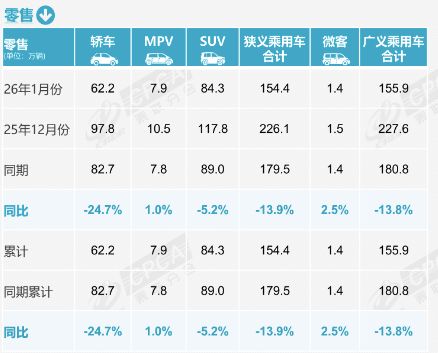
Core Viewpoint - The retail sales of passenger cars in China experienced a significant decline in January 2026, with a total of approximately 1.544 million units sold, representing a year-on-year decrease of 13.9% [1][2]. Retail Performance - In January 2026, retail sales for different vehicle categories were as follows: sedans at 622,000 units (down 24.7%), MPVs at 79,000 units (up 1.0%), SUVs at 843,000 units (down 5.2%), and microvans at 14,000 units (up 2.5%) [2]. - The total retail sales for narrow passenger vehicles were 1.544 million units, down 13.9% compared to the same month last year [2]. Market Analysis - The decline in the passenger car market is viewed as a short-term fluctuation rather than a long-term trend, attributed to the expiration of the new energy vehicle purchase tax exemption policy at the end of 2025 [3]. - The market is expected to face a low point in February 2026 due to the post-holiday consumption slowdown, which may help alleviate retail inventory pressure [3]. Brand Performance - In January 2026, retail sales for domestic brands were 890,000 units (down 18%), while mainstream joint venture brands sold 470,000 units (down 4%), and luxury vehicles sold 180,000 units (down 15%) [4]. - Major domestic brands like Geely, BYD, Changan, and Chery saw significant declines in retail sales, with Geely down 12.6%, BYD down 53%, Changan down 33.5%, and Chery down 41% [4][6]. Joint Venture Brands - Joint venture brands showed relatively stable performance, with FAW-Volkswagen down 3.5%, SAIC Volkswagen down 9.3%, and BMW Brilliance down 3.9% [6]. - Some joint venture brands, such as FAW Toyota and GAC Toyota, experienced year-on-year growth of 8.3% and 0.3%, respectively [6]. New Energy Vehicle Market - In January 2026, retail sales of new energy vehicles (NEVs) were 596,000 units, down 20% year-on-year, while wholesale sales were 864,000 units, down 3.3% [9]. - The A00-class pure electric vehicle segment saw a drastic decline, with wholesale sales dropping 62%, significantly impacting the overall performance of the new energy vehicle market [11]. Export Performance - New energy vehicles have become a major force in China's passenger car exports, with 139,000 units exported in January 2026, marking a year-on-year increase of 29.4% [13]. - The export of pure electric vehicles accounted for 66% of new energy vehicle exports, with A0 and A00-class vehicles making up 38% of the total new energy vehicle export volume [13]. Future Outlook - The market is expected to enter a recovery phase in February 2026, driven by the gradual implementation of vehicle replacement policies [16]. - However, rising costs due to increased prices of raw materials like lithium and copper may pressure automakers, potentially leading to cautious consumer behavior and affecting demand [16].

乘联分会:1 月全国乘用车市场零售 154.4 万辆,同比下降 13.9%
Xin Lang Cai Jing· 2026-02-12 07:27
Core Viewpoint - In January, the retail sales of passenger cars in China reached 1.544 million units, representing a year-on-year decline of 13.9% [1][7]. Group 1: Market Performance - The January retail sales decline is part of a historical trend where January sales have shown significant fluctuations, with previous years experiencing similar declines [3][9]. - The penetration rate of new energy vehicles (NEVs) in the overall passenger car market was 38.6%, down 3 percentage points from the previous year [3][9]. - Among domestic retail sales, the penetration rate of NEVs for independent brands was 61.7%, while luxury brands had a penetration rate of 16.1%, and mainstream joint venture brands only reached 4.3% [3][9]. Group 2: New Energy Vehicle Sales - In January, the retail share of NEVs for independent brands was 60.1%, a decrease of 12 percentage points year-on-year, while the share for mainstream joint venture brands increased to 3.9%, up 2 percentage points [3][9]. - The new forces in the market, including brands like Xpeng, Leap Motor, and Xiaomi, saw their share increase by 10 percentage points year-on-year, reaching 31.2% [3][9]. - Tesla's market share fell to 3.1%, a decrease of 1.5 percentage points compared to the previous year [3][9]. Group 3: Export Performance - In January, NEV exports reached 286,000 units, marking a year-on-year increase of 103.6%, accounting for 49.6% of total passenger car exports, up 12.5 percentage points from the previous year [4][10]. - Pure electric vehicles constituted 65% of NEV exports, while A00 and A0 class pure electric vehicles made up 50% of pure electric exports [4][10]. - The growth of NEV exports is attributed to the increasing recognition of Chinese brands in international markets, despite some external challenges [4][10]. Group 4: Manufacturer Performance - Leading manufacturers in NEV exports for January included BYD (96,859 units), Tesla China (50,644 units), and Geely (32,117 units) [5][11]. - The overall performance of NEV manufacturers remained strong, with 16 companies achieving monthly wholesale sales exceeding 10,000 units, accounting for 90.3% of total NEV sales [6][12]. - BYD led the market with 205,518 units sold, followed by Geely (124,252 units) and Tesla China (69,129 units) [6][12]. Group 5: Market Outlook - The outlook for February indicates a potential decline in sales due to the shorter effective production and sales time caused by the extended Spring Festival holiday [7][13]. - The rising costs of raw materials, driven by increased demand for electric power storage, are putting pressure on manufacturers [7][13]. - The anticipated decrease in promotional capabilities for NEV manufacturers may lead to a cautious consumer sentiment, potentially suppressing normal car purchase demand in the short term [7][13].


1月重卡销10.5万辆增46%,重汽斩2026首冠,解放超2万辆,东风/福田大涨8成 | 头条
第一商用车网· 2026-02-12 07:11
Core Viewpoint - The heavy-duty truck market in China achieved a strong start in January 2026, with sales reaching 105,400 units, representing a year-on-year growth of 46%, marking the tenth consecutive month of growth [1][2][12]. Group 1: Market Performance - In January 2026, the total truck market (including chassis and tractors) sold 323,500 units, showing a month-on-month decline of 10% but a year-on-year increase of 28% [3]. - The heavy-duty truck segment sold 105,400 units in January, with a month-on-month increase of 3% and a year-on-year increase of 46%, which is a significant improvement from the 22% growth in December 2025 [7][12]. - The January 2026 sales figure of 105,400 units is the fourth highest in the past decade and the highest in the last five years, indicating a strong market recovery [5][12]. Group 2: Company Performance - In January 2026, five companies sold over 10,000 units, with the top two being Heavy Truck (29,100 units) and Jiefang (20,500 units) [6][7]. - The top five companies accounted for 90.8% of the market share, with Heavy Truck leading at 27.6%, followed by Jiefang at 19.5%, and others like Shaanxi Automobile, Dongfeng, and Foton [9]. - Notably, companies like Dongfeng and Foton saw significant year-on-year growth rates of 83% and 86%, respectively, outperforming the overall market growth [9][11]. Group 3: Market Dynamics - The heavy-duty truck market's competitive landscape saw changes in rankings, with Chery returning to the top ten, and Jiefang moving up to second place [11]. - The market dynamics in January 2026 were characterized by intense competition, with several companies making significant gains in their rankings compared to December 2025 [11]. - The overall market sentiment remains positive, with expectations for continued strong performance in the coming months [12].




乘联分会:1月全国乘用车市场零售154.4万辆 新能源车渗透率为38.6%
智通财经网· 2026-02-12 06:41
Core Insights - The overall retail sales of passenger cars in January decreased by 13.9% year-on-year, with a total of 1.544 million units sold. The retail sales of new energy vehicles (NEVs) reached 596,000 units, representing a penetration rate of 38.6%, down 3 percentage points from the previous year [1][11]. Retail Market Overview - In January, the retail sales of self-owned fuel passenger cars were 250,000 units, up 17% year-on-year, while self-owned NEVs sold 226,000 units, marking a significant increase of 115%. NEVs accounted for 47.5% of self-owned exports, indicating growing international influence [2]. - The retail sales of self-owned brands totaled 890,000 units, down 18% year-on-year, with a domestic market share of 57.5%, a decrease of 3.5 percentage points [2]. - Mainstream joint venture brands sold 470,000 units, down 4% year-on-year, with German brands increasing their market share to 19.8%, up 1.4 percentage points [2]. Production and Wholesale Analysis - In January, the production of passenger cars was 2.003 million units, down 4.4% year-on-year. The wholesale volume was 1.973 million units, a decrease of 6.2% year-on-year [4]. - The wholesale of self-owned brands was 1.326 million units, down 8%, while luxury car wholesale increased by 4% to 228,000 units [4]. - The overall wholesale landscape is changing, with some mid-tier companies showing strong performance, such as SAIC-GM-Wuling and NIO [4]. New Energy Vehicle Insights - The production of NEVs reached 938,000 units, a slight decrease of 0.6% year-on-year, while wholesale sales were 864,000 units, down 3.3% [5][6]. - NEV retail sales were 596,000 units, down 20% year-on-year, with conventional fuel vehicles selling 948,000 units, down 10% [7]. - NEV exports reached 286,000 units, a remarkable increase of 103.6%, accounting for 49.6% of total passenger car exports [11][12]. Market Trends and Future Outlook - The new energy vehicle market is expected to face challenges in February due to the impact of the Spring Festival, which may lead to lower sales volumes [16]. - The transition from merely selling cars to exporting entire industrial chains is anticipated, indicating a shift towards quality growth in the automotive export sector [17].



乘联分会:1月新能源乘用车出口28.6万辆,同比增长103.6%
Xin Lang Cai Jing· 2026-02-12 06:19
2月12日,乘联分会数据显示,1月新能源乘用车出口28.6万辆,同比增长103.6%。占乘用车出口 49.6%,较去年同期增长12.5个百分点;其中纯电动占新能源出口的65%(去年同期67%),作为核心焦 点的A00+A0级纯电动车占纯电动出口的50%(去年同期41%)。伴随着中国新能源车的规模优势显现 和市场扩张需求,中国制造的新能源品牌产品越来越多地走出国门,在海外的认可度持续提升。其中插 混占新能源出口的33%(去年同期32%),虽然近期受到外部国家的一些干扰,但自主插混出口发展中 国家增长迅猛,前景光明。 1月厂商新能源出口方面优秀的企业是:比亚迪汽车(96,859辆)、特斯拉中国(50,644辆)、吉利汽车 (32,117辆)、奇瑞汽车(27,033辆)、零跑汽车(14,523辆)、上汽乘用车(13,071辆)、上汽通用五 菱(11,097辆)、东风汽车(6,745辆)、长城汽车(6,102辆)、长安汽车(4,952辆)、光束汽车 (3,713辆)、长安马自达(3,391辆)、沃尔沃亚太(3,316辆)、小鹏汽车(3,204辆)、极星汽车 (2,758辆)、赛力斯汽车(湖北)(2,108辆)、智马达 ...
【月度分析】2026年1月份全国乘用车市场分析
乘联分会· 2026-02-12 06:06
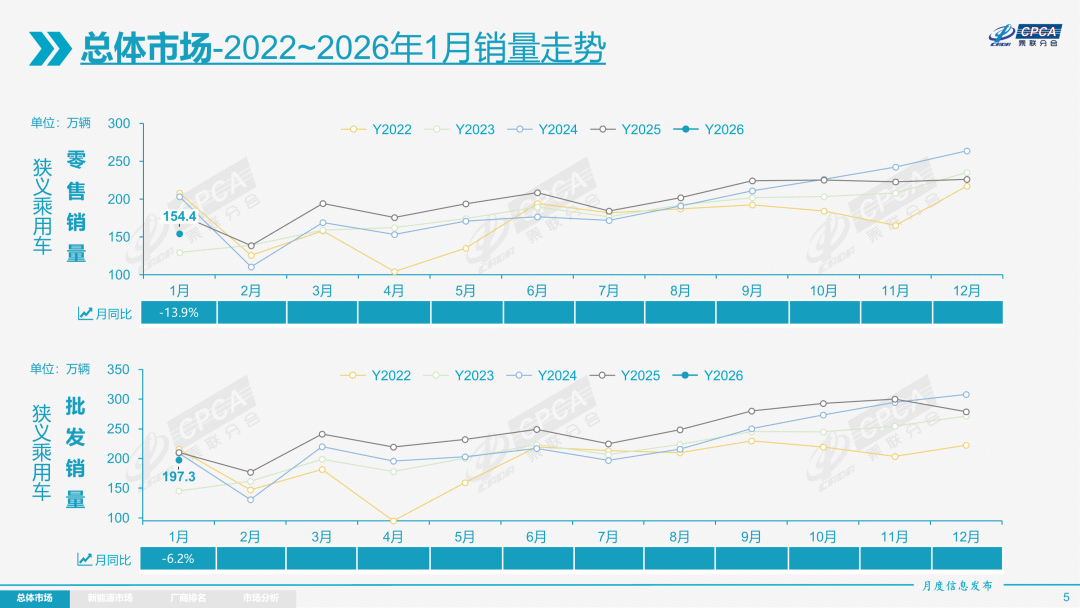
Overall Market - In January 2026, the retail sales of passenger cars reached 1.544 million units, a year-on-year decrease of 13.9% [14] - The decline in retail sales is attributed to complex market factors and a historical pattern of fluctuating sales in January [14] - The end of the new energy vehicle purchase tax exemption in December 2025 has led to a recovery period for the new energy vehicle market, with some consumers having made purchases in December to take advantage of the policy [14] - January 2026 saw a significant increase in exports, with passenger car exports reaching 576,000 units, a year-on-year increase of 52.0% [16] - The production of passenger cars in January 2026 was 2.003 million units, a year-on-year decrease of 4.4% [16] - The wholesale volume for January 2026 was 1.973 million units, a year-on-year decrease of 6.2% [17] New Energy Market - In January 2026, retail sales of new energy vehicles (NEVs) totaled 596,000 units, down 20.0% year-on-year [18] - The penetration rate of NEVs in the domestic market was 38.6%, while the export penetration rate was 49.6% [15] - The production of NEVs reached 938,000 units, a slight decrease of 0.6% year-on-year [18] - The wholesale volume of NEVs was 864,000 units, down 3.3% year-on-year [18] - The export of NEVs reached 286,000 units, a significant increase of 103.6% year-on-year, accounting for 49.6% of total passenger car exports [22] Company Performance - BYD, Geely, and Chery are leading in the new energy vehicle market, with BYD's sales reaching 205,518 units in January 2026 [24] - The market share of domestic brands in the new energy sector is increasing, with a notable rise in the export of new energy vehicles to Europe and Southeast Asia [15][22] - The new energy vehicle market is characterized by a shift towards higher quality products, with an increase in the proportion of high-end NEVs [15] Market Outlook - February 2026 is expected to see lower sales due to the shorter working days caused by the extended Spring Festival holiday [27] - The market is anticipated to stabilize post-holiday, with potential recovery in the entry-level electric vehicle segment [28] - The overall sentiment in the consumer market remains cautious, influenced by high costs and economic factors [28]


今年首月汽车市场总体运行平稳 出口延续高增长态势
Zheng Quan Ri Bao Wang· 2026-02-12 04:30
Core Viewpoint - In January 2026, China's automotive industry experienced a stable overall operation, with a slight increase in production but a decline in sales, influenced by policy changes and consumer demand shifts [1][2][3]. Group 1: Production and Sales Data - In January, China's automotive production reached 2.45 million units, a year-on-year increase of 0.01%, while sales totaled 2.346 million units, reflecting a year-on-year decrease of 3.2% [1]. - Domestic sales of automobiles were 1.665 million units in January, down 14.8% year-on-year and 33.9% month-on-month [2]. - Passenger car sales were 1.988 million units, a year-on-year decline of 6.8% and a month-on-month decline of 30.2% [2]. Group 2: Market Segmentation - The passenger car market saw a decrease in sales, with Chinese brand passenger cars selling 1.329 million units, down 8.9% year-on-year [2]. - Commercial vehicles showed positive growth, with sales of 359,000 units in January, a year-on-year increase of 23.5% [2]. - New energy vehicle (NEV) sales remained stable, with 945,000 units sold, a slight year-on-year increase of 0.1% [3]. Group 3: Export Performance - In January, automobile exports reached 681,000 units, a year-on-year increase of 44.9%, with passenger car exports at 589,000 units, up 48.9% [4]. - NEV exports were particularly strong, with 302,000 units exported, reflecting a year-on-year growth of 100.5% [4]. - The top ten exporting companies showed positive growth, with Chery and Geely leading in export volumes [4][5]. Group 4: Future Outlook - The automotive industry is expected to stabilize as new policies are implemented, enhancing market vitality [5]. - The transition to high-quality development during the 14th Five-Year Plan period is crucial for the automotive sector [3].
1月车市燃油车销量“抬头”多款车型价格降幅高于30%
Mei Ri Jing Ji Xin Wen· 2026-02-12 02:35
Core Viewpoint - The domestic automotive market is witnessing a shift as fuel vehicles are increasingly adopting intelligent features to compete with electric vehicles, driven by consumer demand for smart driving capabilities and the rising market share of electric vehicles [1][5]. Group 1: Market Trends - Consumers are showing a preference for fuel vehicles equipped with advanced intelligent configurations, leading to a notable change in purchasing behavior [1]. - The new Honda Fit, dubbed the "people's supercar," sold out its initial 3,000 units within 20 days, indicating a strong demand for competitively priced fuel vehicles [2]. - Many fuel vehicle models have seen price reductions of 30% to 40%, with some luxury models experiencing even greater discounts [2][3]. Group 2: Sales Performance - In January, fuel vehicle sales showed significant growth, with SAIC Group selling 242,000 units, a year-on-year increase of 19.19% [6]. - Geely's fuel vehicle sales reached 134,400 units in January, with over 100,000 units coming from the "Chinese Star" series [6]. - GAC Toyota also reported positive sales growth in January, with the Camry model achieving a 17% year-on-year increase [6]. Group 3: Strategic Initiatives - The "Oil-Electricity Co-Intelligence" strategy has been adopted by major automakers, aiming to enhance the competitiveness of fuel vehicles by integrating smart technologies [5][6]. - Companies like FAW-Volkswagen plan to launch multiple new models equipped with intelligent cockpit and driving assistance systems by 2026, showcasing the potential for fuel vehicles to be equally intelligent [6][7]. - The top five brands in the fuel vehicle market have increased their market share from 29% in 2020 to 37% in 2025, indicating a strengthening of leading brands in the sector [7].
