
汇丰银行

Search documents
银行业“瘦身”
Xin Lang Cai Jing· 2025-12-26 13:11
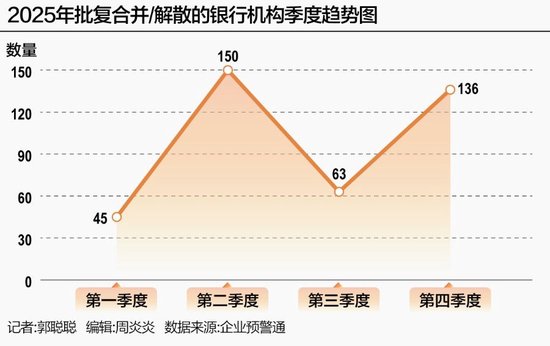
Core Insights - The wave of mergers and restructuring among China's small and medium-sized banks has progressed with unexpected intensity and speed, focusing on financial risk prevention and high-quality industry development in 2025 [1][19] - A total of 394 banking institutions were approved to exit the market through mergers and dissolutions by December 26, 2025, doubling the total from 2024 [1][19] - The restructuring involved 550 banking institutions over 2024 and 2025, surpassing the total from the previous seven years [1][19] Regional and Institutional Analysis - The restructuring covered 28 provinces, with Inner Mongolia leading by integrating 139 institutions, followed by Shandong (33), Henan (26), and Sichuan (25) [1][7][26] - Village banks were the primary focus of the restructuring, with 231 banks involved, followed by rural commercial banks (81) and rural credit cooperatives (71) [1][12][27] Characteristics of the Restructuring - The 2025 restructuring is characterized by two significant trends: the entry of state-owned banks into the "village to branch" transformation and the acceleration of provincial-level reforms in the rural credit system [1][11] - State-owned banks have begun acquiring city commercial banks, marking a new phase in the restructuring process [1][11] Policy and Regulatory Framework - The central government emphasized the need for a systematic approach to risk management in small and medium-sized banks, aligning with the broader economic strategy [3][21] - The "14th Five-Year Plan" has prioritized the resolution of financial risks, particularly in small financial institutions, as a core responsibility of regulatory bodies [3][22] Achievements and Future Outlook - Significant progress has been made in risk resolution, with over 40% more non-performing assets disposed of compared to the previous five-year period, and total capital and provisions exceeding 50 trillion yuan [4][23] - The restructuring is expected to continue into 2026, focusing on quality improvement and effective integration, with a clear directive from regulatory authorities [17][36]

华尔街强势回归:2025年六大行市值激增逾1/3 监管放松与投行业务成增长引擎
Zhi Tong Cai Jing· 2025-12-25 07:05
Group 1 - The total market capitalization of the six major U.S. banks has increased by $600 billion, reaching $2.37 trillion, a growth of over one-third in less than 12 months, attributed to the regulatory relaxation under President Trump and a recovery in investment banking [1] - The European banks' total market capitalization stands at $1 trillion, highlighting a significant disparity resulting from years of uneven regulations [1] - U.S. banks have finally shed the constraints imposed after the 2008 financial crisis, outperforming the broader S&P 500 index for the second consecutive year [1] Group 2 - The Trump administration has allowed major lending institutions to increase leverage by modifying annual stress test requirements and eliminating guidelines that restrict high-risk lending [2] - Analysts note that the regulatory changes are crucial for stock prices, as banks had previously seen profitability decline due to increased capital requirements following the financial crisis [2] - Major banks have accumulated excess capital, which can now be utilized for stock buybacks, dividends, and business growth rather than merely being held as a safety net [3] Group 3 - Citigroup's stock has surged nearly 70%, the best performer among the six banks, due to significant internal restructuring and cost-cutting measures [4] - Goldman Sachs' stock has risen by 60%, benefiting from a resurgence in large investment banking transactions and setting historical highs in 2025 [4] - Record revenues are anticipated in stock trading at $92 billion and fixed income trading at $163 billion, surpassing previous records [4] Group 4 - Concerns have been raised by Senator Elizabeth Warren regarding the extent of regulatory relaxation and the potential risks for banks [4] - Despite these concerns, investors remain optimistic, with analysts suggesting that banks have room to take on more risk given the modest growth in their balance sheets [4] - The current positive sentiment in the market is noted to feel almost unreal, with a solid fundamental backdrop, although questions remain about how much of this has already been priced in [4]


三重浪潮驱动提速,人民币国际化深度演进
Xin Hua Cai Jing· 2025-12-25 02:13
Core Insights - The internationalization of the Renminbi (RMB) is accelerating, with a 14.0% year-on-year increase in cross-border RMB payments in the first half of the year, making it the second-largest trade financing currency and the third-largest payment currency globally [1] - The inclusion of RMB in the International Air Transport Association's (IATA) clearing system marks a significant milestone in the functional recognition of RMB in international financial clearing [1] - The transformation of RMB from a payment tool to an operational currency is evident, particularly among European companies deeply engaged in the Chinese market [2] Group 1: RMB's Role in Global Trade - RMB is increasingly embedded in global industrial division and multinational corporate operations, transitioning from a foreign exchange currency to an operational currency for European enterprises [2] - The local procurement, production, and sales cycles established by companies like Volkswagen and BMW in China create a natural demand for RMB as a key currency for pricing, settlement, and asset-liability management [2] Group 2: Corporate Adoption of RMB - The core motivation for multinational companies to adopt RMB has shifted from merely saving on exchange costs to enhancing risk management and optimizing global liquidity structures [3] - By integrating RMB into their internal settlement systems as a functional currency, companies achieve valuable natural hedging against financial risks from exchange rate fluctuations [3] Group 3: Institutional and Market Developments - The RMB internationalization process has made significant progress in institutional frameworks and market product innovation, transitioning from a regional payment method to a global trading and reserve network [4] - The establishment of offshore RMB market cooperation in bilateral mechanisms indicates a shift from spontaneous market behavior to coordinated policy efforts [4] Group 4: Global Currency System Diversification - The diversification of the global currency system, driven by changes in the global economic landscape and geopolitical factors, presents a "window of opportunity" for RMB [5] - A report indicates that 59% of sovereign institutions plan to increase their holdings of Chinese assets over the next five years, with North American sovereign funds showing a 73% willingness to invest [5] Group 5: Central Bank Perspectives - For central banks like the European Central Bank and the German Central Bank, the rationale for allocating RMB assets lies in achieving diversification of reserve assets [6] - RMB government bonds exhibit low correlation with Western assets, providing strategic hedging value and independent attributes in investment portfolios [6]

【财经分析】三重浪潮驱动提速 人民币国际化深度演进
Xin Hua Cai Jing· 2025-12-24 14:43
Core Viewpoint - The internationalization of the Renminbi (RMB) is accelerating, with significant growth in cross-border payments and recognition in global financial systems, marking a pivotal shift in its role in international trade and finance [1][2][4]. Group 1: RMB's Role in Global Trade - The RMB has become the second-largest trade financing currency and the third-largest payment currency globally, with a 14.0% year-on-year increase in cross-border payments in the first half of the year [1]. - The International Air Transport Association (IATA) has officially included the RMB in its clearing system, indicating a growing functional recognition of the currency in international financial infrastructure [1][4]. Group 2: RMB as an Operational Currency - The RMB is transitioning from a mere payment tool to an operational currency for multinational corporations, particularly in high-end manufacturing sectors, as companies establish local supply chains and financing mechanisms [2]. - Major European companies, such as Volkswagen and BMW, are increasingly using the RMB for local procurement, production, and sales, creating a stable demand for the currency [2]. Group 3: Risk Management and Liquidity - Multinational corporations are adopting the RMB not only to save on exchange costs but also for risk management and optimizing global liquidity structures, effectively using it as a functional currency [3]. - This shift is seen as part of the RMB's third upward cycle, supported by China's economic fundamentals and its transition from a capital-importing to a capital-exporting country [3]. Group 4: Institutional and Market Developments - The RMB's internationalization is supported by institutional frameworks and market innovations, with significant progress in offshore RMB market cooperation being recognized in bilateral policy agendas [4]. - The China Bank Frankfurt branch has become the first RMB clearing bank in the Eurozone, facilitating substantial RMB clearing volumes and enhancing cross-border economic flows [4]. Group 5: Diversification of the Global Currency System - The diversification of the global currency system, driven by geopolitical factors, presents a "window of opportunity" for the RMB, with a significant percentage of sovereign institutions planning to increase their holdings in Chinese assets [5][6]. - The RMB is viewed as a strategic asset for central banks, offering low correlation with Western assets, thus providing a hedge in investment portfolios [6].
迪拜机场自贸区:连接全球的战略跳板
Sou Hu Cai Jing· 2025-12-24 05:07
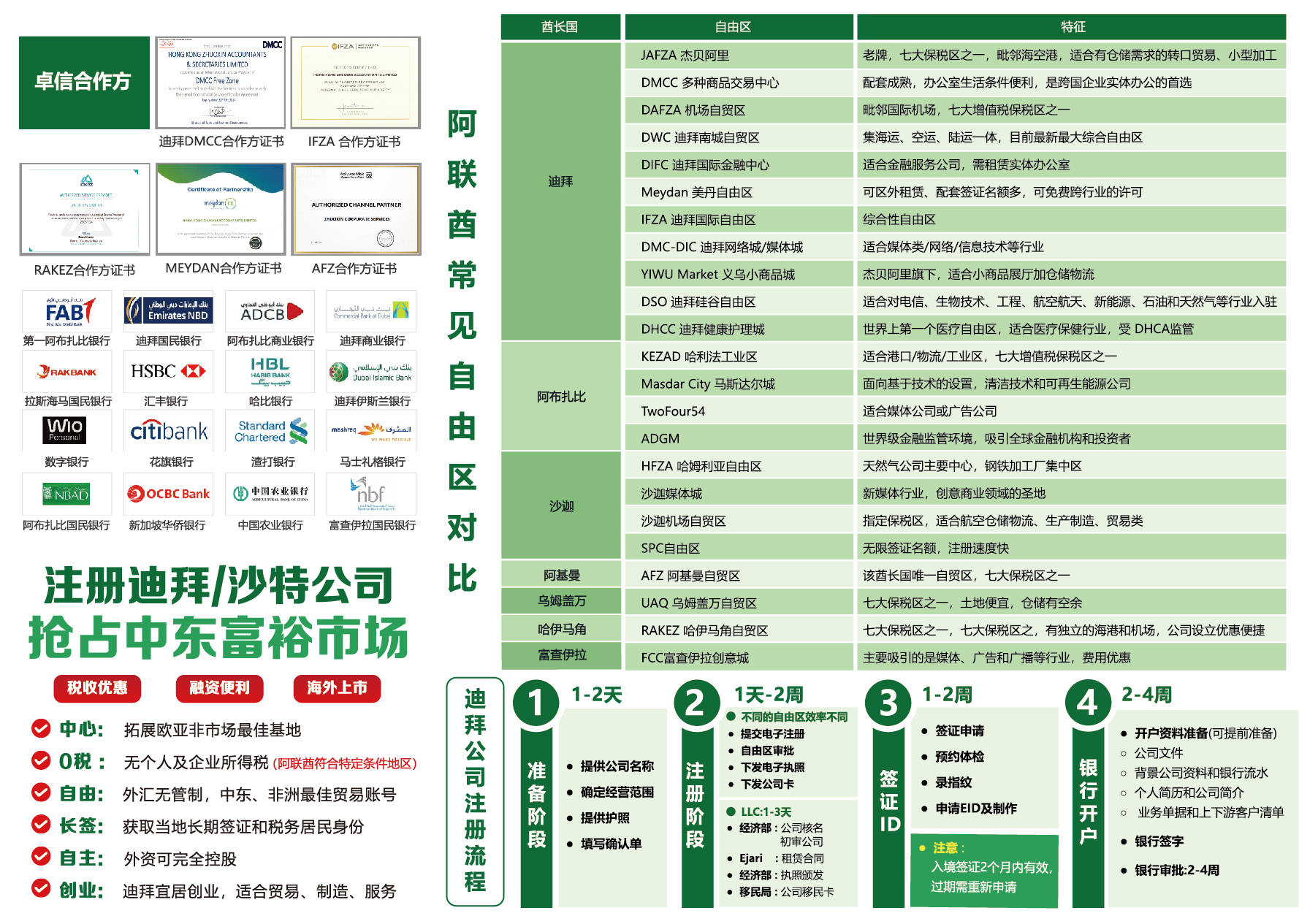
Group 1 - Dubai Airport Free Zone has developed into a core trade platform in the Middle East since its establishment in 1996, attracting over 3,000 companies across more than 20 key industries [1] - Approximately 25% of registered companies in the Dubai Airport Free Zone are concentrated in electronics, electrical appliances, and computer sectors, while 11% are from logistics and aviation industries [1] - Among the 84 registered Chinese enterprises, 12% are large multinational companies, and 49% are small and medium-sized enterprises [1] Group 2 - Companies intending to establish a presence in Dubai should focus on three aspects: type of business license, company category, and office space [1] - The Dubai Airport Free Zone offers seven types of business licenses, including general trading, service, e-commerce, and industrial licenses, to meet various business needs [1] - Businesses can choose to register as free zone companies or inland companies with the Dubai Economic Tourism Department, with the option to apply for a dual license that allows direct operations within the UAE [3] Group 3 - The Dubai Airport Free Zone provides flexible office space solutions, ranging from shared workspaces to independent offices of 50 square meters equipped with meeting rooms [3] - Two major warehousing areas are available: one adjacent to the airport runway and another within a 15-minute drive, offering various logistics solutions including multi-tenant warehouses and temperature-controlled storage [3][4] - The free zone has established a comprehensive enterprise support system, including key government institutions and banks, and offers value-added services such as halal certification and a B2B trade digital platform [4] Group 4 - Dubai's unique geographical advantages and improved business environment are making it an important strategic hub for Chinese companies looking to expand into the Middle East, Africa, and Europe [4]
年内已有226家村镇银行正式解散
Zheng Quan Shi Bao· 2025-12-24 00:42
Group 1 - The core viewpoint of the article highlights the accelerated exit of village banks, with a total of 226 banks officially dissolved in 2023, exceeding the number expected for 2024 by 1.7 times [1][2] - The main modes of merger and restructuring for village banks this year are "village to branch" and "village to division," where banks are absorbed by their parent institutions, thus avoiding direct bankruptcy risks [2][3] - The involvement of major state-owned banks and foreign banks in the restructuring process marks a shift from smaller banks leading the mergers, indicating a broader approach to risk management and resource optimization [4][5] Group 2 - The "risk mitigation" team is expanding, with state-owned banks like ICBC and several joint-stock banks actively participating in the restructuring of village banks, which is seen as beneficial for both the parent banks and the village banks [4][6] - Foreign banks are also taking action, with HSBC and ANZ opting for direct dissolution of their village banks due to continuous losses, reflecting a strategic focus on wealth management and cross-border finance instead of the village banking sector [5][6] - The central economic work conference emphasizes the need for a structured reorganization of small financial institutions, focusing on market-driven and legal methods to enhance governance and ensure a smooth reform process [7]
中原按揭:11月转按登记月环比减13% 中银香港巿占单月5连冠
智通财经网· 2025-12-23 08:32
王美凤进一步分析,转按市道持续偏淡有其结构性原因。银行曾于2023年上调新造及转按计划息率,导 致大部分早年承造按揭的业主,其现有供楼利息仍低于现时市场按息,对他们来说缺乏转按诱因。 中原按揭研究部数据显示,2025年11月银行转按登记共录得541宗,月环比跌幅为13.3%,其中,中银 香港录得150宗登记,与10月份登记宗数相同,市占率为27.7%,月环比升3.7个百分点,持续5个月领先 转按市场。至于汇丰银行录得107宗登记,月环比跌10.1%,排名第二,市占率约19.8%,月环比升0.7个 百分点。另一方面,东亚银行(00023)连升3位,以46宗登记(市占率8.5%)排行第三。恒生银行(00011)持 续排行第四,但市占率月环比跌1.5个百分点,11月市占率轻降至8.3%(45宗)。渣打银行连跌2位,宗 数(43宗)及市场占有率(7.9%)分别下跌42.7%及4.1个百分点,排行第五。工银亚洲、上海商业银行、信 银国际、大新银行(02356)及华侨银行香港分别位列第六至第十位。 智通财经APP获悉,中原按揭董事总经理王美凤表示,根据中原按揭研究部及土地注册处数据,2025年 11月银行转按登记共录得5 ...

各方分歧大 美联储明年降息路径再添迷雾
Sou Hu Cai Jing· 2025-12-23 00:42
美联储的哈马克表示,鉴于数据收集存在技术性失真,11月美国2.7%的消费者价格指数数据或许低估 了物价涨幅,中性利率水平可能高于市场普遍预期,因此要对通胀保持警惕。她更担忧居高不下的通 胀,而非潜在的劳动力市场脆弱性。哈马克认为,在过去三次连续降息后,美联储未来几个月内没必要 对利率进行任何调整,因此倾向于在2026年春季前维持利率稳定。 纽约联储主席约翰·威廉姆斯上周五也公开表示,12月的降息措施已使货币政策处于"非常有利的位 置",美联储目前并不迫切需要进一步降低利率。他强调,目前的政策立场已经平衡,并指出近期数据 中存在技术性扭曲,为判断经济形势增添了复杂性。未来需要观察更多数据才能对再次降息感到放心, 并称2026年1月底的会议是否行动将是一个艰难的决定。他同时澄清,美联储近期扩大资产负债表、购 买国库券的操作是技术性的,旨在为银行系统提供必要的准备金,而非量化宽松政策。 美联储理事米兰则表示,劳动力市场正朝着不利的方向发展,而要阻止这一进程,必须放宽相关政策以 助力劳动力市场复苏。 转自:经济参考报 新华财经北京12月23日电(记者 周武英)美联储2025年12月实施了年内第三次降息,将联邦基金利率 ...
美元定存新一轮降息来了,有银行逆势抢客,1个月定存利率达4.5%
3 6 Ke· 2025-12-22 08:12
Core Viewpoint - The article discusses the recent trend of banks lowering their USD deposit interest rates following the Federal Reserve's interest rate cut, while highlighting the ongoing appeal of USD deposits despite the risks associated with currency fluctuations. Group 1: Interest Rate Changes - Several banks have begun to lower their USD deposit rates, with Guangdong Huaxing Bank announcing a reduction of 25 basis points effective December 23, bringing the 1-year rate down to 3.65% from 3.90% [2] - Nanjing Bank has also adjusted its USD deposit rates, with a decrease from 3.55% to 3.42% for a 1-year product with a minimum deposit of $200,000 [2] - HSBC reported a decrease in rates for its USD deposits, with the 3-month rate dropping by 10 basis points to 3.50% [3] Group 2: High-Interest USD Deposit Products - Some smaller banks still offer competitive USD deposit rates above 3%, such as Xi'an Bank's 1-year rate at 3.98% [1][3] - Ant Bank (Hong Kong) has introduced a year-end promotion for USD deposits, offering a maximum annual interest rate of 4.5% for a 1-month deposit [4] Group 3: Currency Exchange Rate Considerations - The Chinese Yuan has strengthened against the USD, with the onshore and offshore rates surpassing 7.03, marking a 14-month high [1] - Analysts suggest that while USD deposit rates are attractive, investors must consider the risks associated with currency fluctuations, especially as the Yuan continues to appreciate [5][6] Group 4: Future Outlook - Analysts predict that USD deposit rates may continue to decline as banks seek to optimize their asset-liability structures following the Fed's rate cuts [5] - There is a recommendation for investors to avoid long-term, large-amount USD deposits and consider more flexible investment options [6]
港股创五年最佳:恒指涨33%创新高,南向资金破纪录,机构看好2026年前景
Jin Rong Jie· 2025-12-22 07:36
Group 1 - The Hong Kong stock market is expected to achieve its best annual performance in five years by 2025, driven by policy support, improved liquidity, and structural investment opportunities [1] - The Hang Seng Index rose by 33.25% in 2025, closing at 25,690.53 points, while the Hang Seng Tech Index increased by 25.74%, closing at 5,479.04 points [1] - Southbound capital inflow exceeded 1.38 trillion HKD, marking a historical high, with its trading volume accounting for an average of 61% of the total market turnover [1] Group 2 - The gold sector led the market, with Zhenfeng Gold achieving a remarkable increase of 1,195.45% during the year [1] - The new energy vehicle sector also performed well, with XPeng Motors rising by 64.46%, linked to the recent approval of L3 autonomous driving models [1] - The technology sector benefited from AI narratives, with significant stock price increases for companies like Alibaba and Kuaishou [2] Group 3 - The insurance and brokerage sectors showed strong performance, with New China Life and China Life increasing by 162.98% and 102.10%, respectively, driven by policy benefits and fundamental improvements [2] - Multiple institutions are optimistic about the Hong Kong stock market's outlook for 2026, with Standard Chartered predicting the Hang Seng Index to trade between 28,000 and 30,000 points [2] - Morgan Stanley forecasts that A-shares and Hong Kong stocks may rise nearly 20% next year [2] Group 4 - Emerging markets are gaining global attention, with analysts indicating a shift in sentiment as pessimism fades [3] - JPMorgan's investment strategy emphasizes holding emerging market local currency bonds, anticipating double-digit returns for hard currency emerging market bonds in 2025 [3]