赛力斯

Search documents
问界M8稳居40万级销冠 赛力斯魔方技术平台2.0展现领先技术实力
Quan Jing Wang· 2026-01-04 04:18
近日,问界M8累计交付突破15万辆,连续稳居40万级豪华车销量冠军。问界的持续热销不仅有良好的 市场与用户的口碑的发酵,更源于其对技术创新的长期坚守与投入。例如,近期发布的赛力斯魔方技术 平台2.0,正以向着"AI定义汽车"演进的前瞻架构,重塑行业技术竞争格局。 智能底盘具备随心操控、驾乘舒适、融合智能、安全冗余四大特点,可支持更高阶智能驾驶功能,通过 道路预瞄、弯道预测及多电机冗余控制,实现随心操控与安全冗余。全新升级的EEA架构全面支持大模 型,从"分散指挥"转向"中央统筹",让车辆感知更敏锐、决策更聪明、执行更高效,真正实现从软件定 义到AI定义的进化。 全景智慧方面,赛力斯魔方技术平台2.0深度整合鸿蒙生态与小艺智能体,赋予车辆"能听、会看、懂思 考"的拟人化能力,推动车辆从"出行工具"向"智慧伙伴"进化。智慧空间采用模块化设计,支持多车 型、多尺寸平台化开发,覆盖九大出行场景,满足家庭、商务与户外等多样化需求。智能安全体系涵盖 乘员保护、车身结构安全、健康环境管理及数据隐私守护,构建全方位守护体验。 在当下的新能源汽车市场,整车平台不仅是车企实现产品快速迭代的关键支撑,更是技术竞争的核心高 地。赛力 ...



12月国内销量跟踪
数说新能源· 2026-01-04 03:59
Sales Performance - BYD sold 420,398 vehicles, a year-on-year decrease of 18.3% and a month-on-month decrease of 11.5% [1] - NIO delivered 48,135 vehicles, a year-on-year increase of 54.6% and a month-on-month increase of 32.7% [1] - Li Auto delivered 44,246 vehicles, a year-on-year decrease of 24.4% but a month-on-month increase of 33.3% [1] - Xpeng delivered 37,508 vehicles, a year-on-year increase of 2.2% and a month-on-month increase of 2.1% [1] - Leap Motor delivered 60,423 vehicles, a year-on-year increase of 42.1% but a month-on-month decrease of 14.1% [1] - Lantu delivered 15,954 vehicles, a year-on-year increase of 31.5% but a month-on-month decrease of 20.2% [1] - Seres sold 57,000 vehicles, a year-on-year increase of 88.7% and a month-on-month increase of 4.9% [1] - Avita delivered 10,470 vehicles, a year-on-year decrease of 5.4% and a month-on-month decrease of 25.5% [1] - Geely sold 154,264 vehicles, a year-on-year increase of 38.7% but a month-on-month decrease of 17.9% [1] - SAIC-GM sold 11,307 vehicles, a year-on-year increase of 89.9% and a month-on-month increase of 6% [1] - Wuling sold 122,838 vehicles, a year-on-year increase of 31.2% and a month-on-month increase of 11.2% [1] - It is expected that 1.92 million electric vehicles (including commercial vehicles) will be sold in December in China, a year-on-year increase of 20.3% and a month-on-month increase of 5.32% [1] Industry Trends - The procurement of battery cells by manufacturers is focusing on balancing performance and cost [5] - BYD is expanding its presence in Southeast Asia [5] - CATL indicates that the growth in the energy storage market is outpacing that of the power market [9]





2025年1-11月中国汽车产量为3109.4万辆 累计增长10.8%
Chan Ye Xin Xi Wang· 2026-01-04 03:22
Core Viewpoint - The Chinese automotive industry is experiencing growth, with a notable increase in production figures for 2025, indicating a positive trend in the market [1]. Group 1: Industry Overview - In November 2025, China's automotive production reached 3.52 million units, reflecting a year-on-year growth of 2.4% [1]. - From January to November 2025, the cumulative automotive production in China totaled 31.094 million units, marking a cumulative growth of 10.8% [1]. Group 2: Companies Mentioned - The report highlights several key players in the automotive sector, including BYD (002594), Great Wall Motors (601633), SAIC Motor (600104), GAC Group (601238), FAW Jiefang (000800), Dongfeng Motor (600006), and Seres (601127) [1]. Group 3: Research and Analysis - The insights are derived from a comprehensive report by Zhiyan Consulting, which focuses on the market landscape and investment prospects in the Chinese automotive manufacturing industry from 2026 to 2032 [1].

2025年1-11月全国汽车制造业出口货值为9231.4亿元,累计增长7.1%
Chan Ye Xin Xi Wang· 2026-01-04 03:15
上市公司:比亚迪(002594),中集车辆(301039),东风汽车(600006),宇通客车(600066),上 汽集团(600104),长安汽车(000625),一汽解放(000800),安凯客车(000868),中国重汽 (000951),中通客车(000957),赛力斯(601127),广汽集团(601238),长城汽车(601633), 力帆科技(601777) 相关报告:智研咨询发布的《2026-2032年中国汽车制造业市场全景调查及投资前景分析报告》 知前沿,问智研。智研咨询是中国一流产业咨询机构,十数年持续深耕产业研究领域,提供深度产业研 究报告、商业计划书、可行性研究报告及定制服务等一站式产业咨询服务。专业的角度、品质化的服 务、敏锐的市场洞察力,专注于提供完善的产业解决方案,为您的投资决策赋能。 根据国家统计局数据可知:2025年11月全国汽车制造业出口货值为889.7亿元,同比增长14.9%;2025年 1-11月全国汽车制造业累计出口货值为9231.4亿元,累计同比增长7.1%。 2019年-2025年1-11月全国汽车制造业出口货值统计图 数据来源:国家统计局,智研咨询整理 ...

国博人气拉满!问界M9作为唯一入选新能源汽车 闪耀中国制造成就展
Quan Jing Wang· 2026-01-04 03:11
Group 1 - The "China Manufacturing '14th Five-Year Plan' Achievement Exhibition" showcases the significant achievements of China's manufacturing industry during the 14th Five-Year Plan, focusing on high-end, intelligent, and green transformation [1][2] - The AITO M9, as the only selected electric vehicle, gained considerable attention at the exhibition, highlighting its role as a key symbol of "China's new height in intelligent manufacturing" [2][3] Group 2 - The AITO M9 has achieved cumulative deliveries exceeding 260,000 units and has maintained its position as the best-selling luxury car in China priced over 500,000 yuan for 20 consecutive months, disrupting the dominance of foreign brands in the luxury market [3] - The AITO M9 ranks first in the "Chinese Automotive Resale Value Research Report" for domestic extended-range hybrid SUVs and has consistently held the top position in the resale value of plug-in hybrid models for four months [3] - The AITO M9 has also achieved the highest user net promoter score (NPS) among all electric vehicle brands, indicating strong brand loyalty and appeal [3] Group 3 - The exhibition featured advanced technologies from Seres, including a multi-in-one super range extension system and a highly integrated seven-in-one electric drive system, showcasing the innovation capabilities of Chinese electric vehicle companies [4] - The AITO M9 is equipped with the next-generation Seres super range extension system, which boasts industry-leading advantages in quietness, integration, and efficiency, with a thermal efficiency of 44.8% [4] - The AITO M9 represents a significant step for Chinese automotive brands in achieving technological independence and high-quality industrial development, contributing to the transition from a "big automotive country" to a "strong automotive country" [4]

赛力斯维权胜诉,侵权方杨某被限高并强制执行
Xin Lang Ke Ji· 2026-01-04 03:05
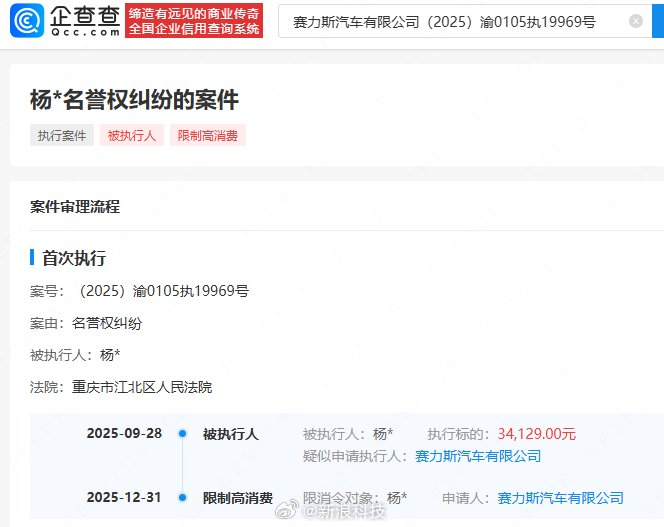
一、被告杨 立即停止在今日头条平台上发布侵害原告赛力斯汽车有限公司名誉权的言论; 二、被告杨 于于本判决生效之日起十日内删除今日头条账号"老朱真的喜欢车"中发布的与 原告赛力斯汽车有限公司相关的侵权言论; 三、被告杨 于本判决生效之日起十日内在今日头条账号"老朱真的喜欢车"主页置顶位 置,以书面方式向原告赛力斯汽车有限公司赔礼道歉(赔礼道歉内容须经本院审核),连续公示不 少于90日;若被告杨 未在判决生效之日起十五日内按照前述要求发布书面道歉的,则由本院在 重庆法治报上刊登判决的主要内容,产生的登报费用由杨 负担(登报费用由原告赛力斯汽车有 限公司先行垫付); 【#赛力斯维权胜诉#】 #赛力斯申请对侵权方限高# 企查查APP显示,近日,赛力斯汽车有限公司起诉 杨某一案更新,因被告杨某未按期履行生效法律文书确定的给付义务,法院对其采取限制消费措施。案 件流程显示,此前杨某因此案被执行34129元。据悉,涉案账号为"老朱真的喜欢车",法院判决其公开 道歉并赔偿损失。 | | 弹道有近从的商业传奇 赛力斯汽车有限公司(2025) 渝0105执19969号 国企业信用查询系统 | | --- | --- | | | ...
赛力斯维权胜诉,申请对侵权方限制高消费
Xin Lang Cai Jing· 2026-01-04 03:05
Group 1 - The core issue involves a lawsuit by Seres Automotive Co., Ltd. against an individual named Yang for failing to fulfill payment obligations as determined by a legal ruling [1] - The court has imposed consumption restrictions on Yang due to non-compliance with the court's decision [1] - Yang has been ordered to publicly apologize and compensate for losses, with a specific amount of 34,129 yuan involved in the case [1]
港股IPO“王者归来”,2025年募资登顶全球
Sou Hu Cai Jing· 2026-01-04 02:18
"含A量"飙升:A+H模式成龙头出海新范式 2025年,维多利亚港畔的上市锣声格外密集——全年117家企业敲钟登场,平均每两个交易日便有一声清脆回响。 伴随这密集的节奏,香港交易所以预计超2800亿港元的IPO募资总额,时隔多年重夺全球新股融资榜首。恰逢港 交所成立二十五周年,这场"王者归来"不仅是一次规模上的胜利,更标志着港股市场核心叙事的根本性转变:从 昔日的"估值洼地",正加速跃升为汇聚中国优质资产与新经济动能的"产业高地"。 驱动这一跃迁的,是两大结构性力量:"含A量"的显著提升与"向新力"的强劲迸发。 2025年港股IPO市场的最大亮点之一,是A股优质企业集体"南下"。据德勤预测,全年港股IPO募资额达2863亿港 元(约360亿美元),其中近半数来自A股公司——19家A股上市公司成功登陆港股,合计募资1399.93亿港元,占 比高达48.9%。 尤为引人注目的是,在募资前十大的IPO中,6家为"A+H"双上市企业:动力电池巨头宁德时代、医药龙头恒瑞医 药、调味品白马海天味业,以及三一重工、赛力斯、三花智控等行业领军者。仅这六家便贡献了1033亿港元,占 全年总额的36%以上。此外,募资第二的紫金黄 ...

新年开新局 两江新区企业生产、项目建设“火力全开”
Xin Lang Cai Jing· 2026-01-04 01:19
Group 1 - The article highlights the active production and construction efforts of various companies in the Liangjiang New Area during the New Year holiday, aiming for a strong start to the year [2][16] - Lingyun Southwest Industrial Co., Ltd. has approximately 400 employees working on the production of new energy battery shells for multiple vehicle models, primarily serving major automotive manufacturers [4][18] - The company specializes in key automotive body components, including high-strength and ultra-high-strength steel cold-formed welded parts, and is a significant player in the automotive supply chain in Southwest China [4][18] Group 2 - Huabang Pharmaceutical's production facility is operational with around 50 employees working during the holiday to meet order demands, producing various pharmaceutical products [6][22] - During the New Year holiday, a total of 86 companies in the Liangjiang New Area, including major firms like BOE and Corning, had over 17,000 employees engaged in production activities [8][22] - The construction sites in Longsheng Water Soil New City are bustling, with 173 projects continuing as planned [9][23] Group 3 - The first phase of the Automotive Electronics Industrial Park is under construction, with over 200 workers focused on advancing the project, which covers an area of 84.56 acres and aims to attract R&D and manufacturing projects in automotive electronics [10][24] - The project is currently over 90% complete, with a target completion date set for March 2026 [11][25] - The second phase of the Longxing Intelligent Manufacturing Industrial Park has over 900 workers on-site, with the project progressing through structural and finishing stages, aiming for completion by June this year [13][27]

新造车2025年复盘:零跑登顶,小鹏逆袭,理想遇挫
创业邦· 2026-01-03 10:22
Core Viewpoint - The 2025 sales data reveals a significant shift in the Chinese electric vehicle (EV) market, with new players like Leap Motor, Huawei's Homologous Intelligent Driving, and Xiaomi emerging as strong competitors against established brands like BYD and Geely [6][12]. Group 1: 2025 Sales Performance - BYD led the market with 4.6024 million units sold, achieving 100% of its target [7]. - Geely surpassed 3 million units, reaching 3.0246 million with a 39% year-on-year growth [7]. - Leap Motor emerged as the top new force with nearly 600,000 units sold, marking a 103% increase [8][12]. - Homologous Intelligent Driving ranked second among new forces with 589,100 units delivered, primarily driven by the Wanjie brand [8]. - Xiaomi entered the top five with over 400,000 units sold, leveraging its ecosystem and brand loyalty [17]. Group 2: Competitive Landscape - The competition among new forces has intensified, with Leap Motor, Homologous Intelligent Driving, and Xiaomi leading the charge, while traditional players like BYD and Geely maintain their dominance [10][12]. - The market is shifting from a focus on capturing the fuel vehicle market to a more competitive landscape where companies vie for each other's market share [10]. - The new forces are increasingly focusing on systemic capabilities rather than just product features or pricing [18]. Group 3: Strategic Insights - Leap Motor's success is attributed to its cost control and high component sharing rate, which allows it to offer competitive pricing while maintaining quality [15][18]. - Xiaomi's approach combines its consumer electronics experience with automotive production, achieving a gross margin of 26.4% in Q3 2025 [17]. - The high-end players like Ideal, Homologous Intelligent Driving, and NIO face challenges as the market shifts towards technology competition rather than just configuration [19][23]. Group 4: Future Outlook - The penetration rate of new energy vehicles is expected to exceed 60% in 2026, leading to intensified competition [10]. - Companies are setting ambitious sales targets for 2026, with Homologous Intelligent Driving aiming for 1 to 1.3 million units and Leap Motor targeting 1 million [10]. - The competition will evolve into a "value war," focusing on better battery performance, intelligent features, and overall vehicle quality [29][30].