
易方达

Search documents
本周8只新基金启动募集,全部为含“权”品种
中国基金报· 2025-12-29 04:26
Core Viewpoint - The new fund issuance in the last week of 2025 saw a decrease, with only 8 new funds launched, all of which are "equity" products, indicating a continued focus on equity funds despite a turbulent market environment [2][5]. Fund Issuance Overview - In the week of December 29 to December 31, only 8 new funds were launched, marking a decline in the number of new fund issuances [2][3]. - The issuance was concentrated on December 29, with 4 funds starting their subscription, while December 30 and 31 saw 2 funds each [4]. - The longest subscription period was for the Qianhai Kaiyuan Xinghe fund, lasting around 3 months, while some funds had a subscription period as short as 1 day [4]. Fund Types and Focus - All 8 new funds are categorized as "equity" products, with 2 being mixed secondary bond funds and the rest being equity funds [6]. - Among the new funds, 4 are index equity funds tracking specific industry indices, focusing on sectors like semiconductor and artificial intelligence [7]. - The active equity funds include the Dachen Hong Kong Stock Hengxin, a QDII mixed fund targeting the Hong Kong market, and the Shanzheng Asset Management Digital Economy fund, focusing on the digital economy sector [7]. Bond Market Trends - The bond market's profitability has weakened, leading to a continued decline in bond fund issuances; however, "fixed income +" funds are still being introduced [8]. - This week saw the launch of 2 mixed secondary bond funds, indicating some activity in the bond fund space despite the overall downturn [8].


238只ETF获融资净买入 华泰柏瑞沪深300ETF居首
Zheng Quan Shi Bao Wang· 2025-12-29 02:44
Group 1 - The total margin balance of ETFs in the Shanghai and Shenzhen markets reached 118.969 billion yuan as of December 26, a decrease of 0.451 billion yuan from the previous trading day [1] - The financing balance of ETFs was 111.602 billion yuan, down by 0.405 billion yuan, while the margin balance for securities lending was 7.367 billion yuan, a decrease of 0.046 billion yuan [1] - On December 26, 238 ETFs experienced net financing inflows, with the Huatai-PB CSI 300 ETF leading with a net inflow of 73.873 million yuan [1] Group 2 - Other ETFs with significant net financing inflows included Huatai-PB CSI A500 ETF, E Fund Gold ETF, Huaxia CSI A500 ETF, Huaxia CSI Robotics ETF, and Pengyang 30-Year Government Bond ETF [1]
[12月28日]美股指数估值数据(人民币升值,对A股港股有啥影响;全球指数星级更新)
银行螺丝钉· 2025-12-28 14:04
Group 1 - The global stock market rose by 1.4% this week, with A-shares (CSI All Share Index) increasing by 2.78%, recovering most of the declines from November [3][4]. - The Hong Kong stock market saw a slight increase due to holidays on Thursday and Friday, with expectations of a potential rebound upon resuming trading [5][6]. - Recent weeks of market declines were attributed to short-term liquidity tightening, with a recovery expected as liquidity conditions improve [7]. Group 2 - The Chinese yuan has appreciated significantly, with the exchange rate against the US dollar returning to 7.0 [8]. - The cyclical nature of exchange rates is highlighted, indicating that during a US dollar interest rate decrease cycle, the dollar tends to depreciate against other currencies [9][10]. - From 2021 to 2022, the Federal Reserve's significant interest rate hikes led to a 25-30% appreciation of the US dollar against other currencies [12]. - Following the Fed's first interest rate cut in September 2024, the US dollar is expected to continue depreciating, benefiting non-dollar assets [15][19]. Group 3 - The performance of various markets since the Fed's first interest rate cut shows that the S&P 500 index has risen approximately 30%, global non-US stock markets have increased by about 32%, and A-shares and the Hang Seng Index have surged over 50% [16]. - When accounting for the yuan's appreciation against the dollar, A-shares have increased nearly 60% when priced in USD [17]. - The last significant decline in the US dollar's interest rates and exchange rates occurred between 2019 and 2020, coinciding with a bull market for A-shares and Hong Kong stocks [18]. Group 4 - If the US dollar continues to decline in interest rates, there is likely further appreciation potential for the yuan, which would also favor A-shares and Hong Kong stocks [19]. - However, the fluctuations in exchange rates are expected to be moderate, with the yuan historically oscillating between the 6.x and 7.x range since 2012 [21]. - Interest and exchange rates exhibit cyclical fluctuations, typically spanning 3-5 years, while stock market bull and bear cycles tend to be longer [23][24]. Group 5 - A global stock market star rating chart indicates that the market was undervalued at 4-5 stars during previous periods in 2018, 2020, and 2022 [30]. - Currently, the global market is around 3.0 stars, which is considered a normal valuation, while 1-2 stars indicate overvaluation [32][33]. Group 6 - There are global stock index funds available in overseas markets, with a total scale exceeding one trillion USD, but such funds are not yet available in mainland China [35]. - The company has launched a "Global Index Advisory Portfolio" that diversifies investments across US, UK, Hong Kong, and A-share index funds to track the global stock market [36]. - Investment in overseas market funds is generally limited to small amounts, with a maximum daily purchase limit of 200 yuan [38]. Group 7 - A new edition of the book "The Intelligent Investor" has been released, which has been influential in the investment field for over 30 years and includes updated data and new chapters [41]. - The book emphasizes that, in the long term, stock assets are the best means of wealth accumulation, suggesting that households should allocate a portion of their assets to stocks [42].

突破2600亿!指增“黄金时代”正在来临,来看大厂样本
Zheng Quan Shi Bao Wang· 2025-12-28 13:32
Core Insights - The public fund industry is undergoing a transformation with the tightening of performance benchmarks, pushing all players towards a competitive landscape focused on index-enhanced strategies, which are becoming a significant structural trend in the market [1][2] - As of the end of 2025, the scale of quantitative index-enhanced funds has surpassed 260 billion, with a notable increase in new product launches, indicating a strong market response [2] Industry Trends - The introduction of the regulatory framework by the China Securities Regulatory Commission (CSRC) is establishing performance benchmarks as a new guiding principle for the public fund industry [1] - The number of newly established index-enhanced funds reached 177, with a total issuance scale exceeding 97.518 billion, surpassing the total from the previous three years [1][2] Competitive Landscape - Leading fund companies are building comprehensive index ecosystems, with firms like China Merchants Fund and Tianhong Fund leading in product offerings and market coverage [4] - Mid-tier and smaller firms are focusing on niche strategies to carve out their market share amidst competition from larger players [4] Performance Metrics - A significant 95.97% of enhanced index products achieved positive returns in the year, with the highest return reaching 85.77% [5] - 86.01% of index-enhanced products delivered positive excess returns, with nine products exceeding 20% in excess returns compared to their benchmarks [5][6] Technological Advancements - Tianhong Fund's quantitative index-enhanced business has evolved into a core area, leveraging AI to achieve systematic and scientific investment strategies [8][9] - Over 70% of the excess factors in Tianhong's quantitative index-enhanced products are derived from AI learning, showcasing a shift from traditional methods to AI-driven approaches [9][10] Operational Efficiency - The operational model at Tianhong involves a highly engineered "alpha pipeline" that integrates various data sources and models to enhance investment decision-making [11][12] - The collaborative structure within Tianhong's research and investment teams ensures a seamless execution of strategies, combining human expertise with advanced systems to achieve stable long-term excess returns [12]
中国ETF总规模首破6万亿元!7只千亿级ETF,125只ETF规模突破百亿
Xin Lang Cai Jing· 2025-12-28 07:02
Core Insights - The Chinese capital market is entering an "ETF era" by 2025, with the total market size of ETFs reaching 6 trillion yuan, a remarkable increase of 61.6% in just one year [1][3][4] Market Growth - The ETF market has shown rapid growth, breaking through significant thresholds of 4 trillion, 5 trillion, and 6 trillion yuan within 2025, indicating a clear acceleration in market expansion [3][4] - Historical data shows that the ETF market grew from 1 trillion yuan in 2020 to 2 trillion in 2023, and then to 3 trillion in 2024, culminating in a "super explosion" in 2025, where the market crossed multiple trillion thresholds in a matter of months [4][5] Market Structure - The ETF landscape has transformed, with ETFs becoming a key component of the public fund system, featuring 1,381 ETFs, including 7 flagship ETFs exceeding 100 billion yuan and 125 ETFs surpassing 10 billion yuan [5][9] - The Huatai-PB CSI 300 ETF leads the market with a size of 427.07 billion yuan, making it the only ETF to exceed 400 billion yuan [5][7] Fund Inflows - In 2025, 50 ETFs experienced net inflows exceeding 10 billion yuan, with the Hong Kong Stock Connect Internet ETF attracting the highest inflow of 57.07 billion yuan, followed by the Gold ETF with 41.70 billion yuan [17][19] - Bond ETFs have also seen significant inflows, with the Short-term Bond ETF and 30-Year Treasury Bond ETF attracting 35.05 billion yuan and 22.35 billion yuan, respectively [17][19] Competitive Landscape - The top three fund companies dominate the ETF market, holding 41% of the market share, while the top ten companies account for 75% [21] - The "ETF Billion Club" expanded from 12 to 16 members in 2025, with new entrants including Huatai-PB, Hai Fu Tong, Penghua, and Tianhong [21] Global Context - The domestic ETF market is approximately one-fourth the size of the U.S. market, indicating that the long-term trend of index-based investing is just beginning in China [27]
中国ETF总规模首破6万亿元!谁是2025年的胜者?
Xin Lang Cai Jing· 2025-12-28 07:01
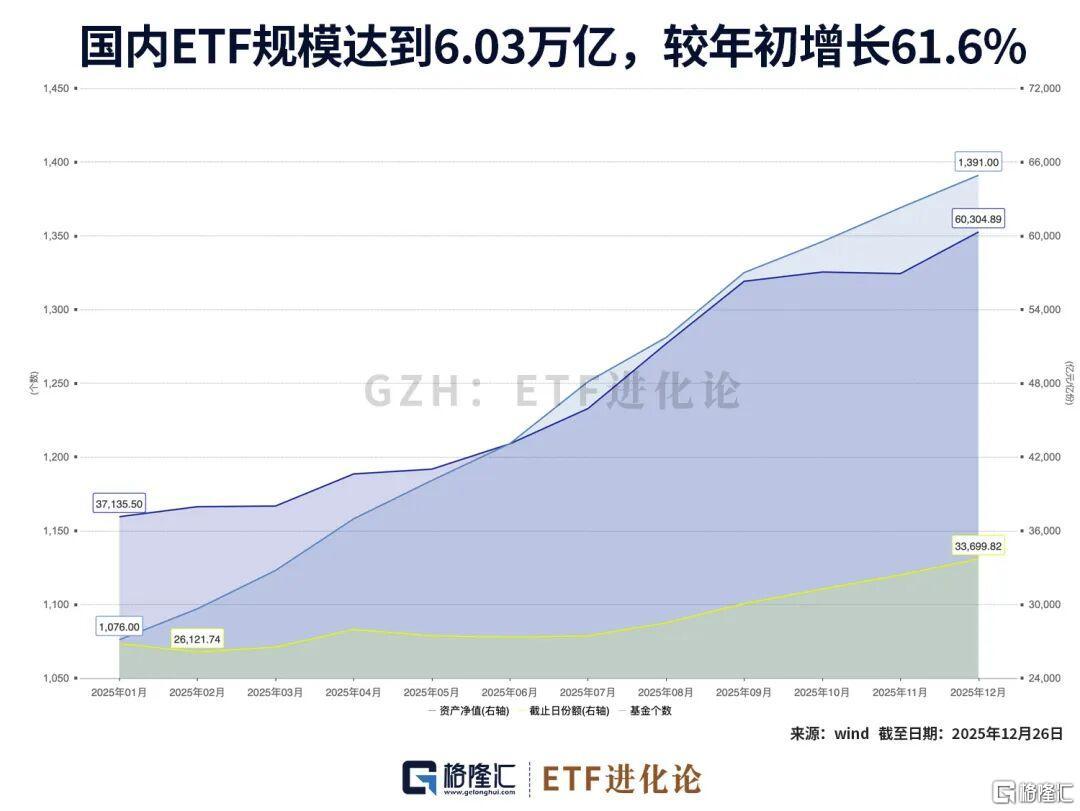
Core Insights - The Chinese capital market is entering an "ETF era" by 2025, with the total market size of ETFs reaching 6 trillion yuan, a 61.6% increase in just one year [1][3][4] Market Growth - The ETF market has shown rapid growth, breaking through 4 trillion, 5 trillion, and 6 trillion yuan in quick succession within 2025, indicating a clear acceleration in growth [3][4] - Historical data shows that the ETF market grew from 1 trillion yuan in 2020 to 2 trillion in 2023, and 3 trillion in 2024, culminating in a significant leap in 2025 [4] Market Structure Changes - The growth in ETF size has transformed the market landscape, making ETFs a key component of the public fund system, with 1,381 ETFs in total, including 7 flagship ETFs exceeding 100 billion yuan [5][9] - The Huatai-PB CSI 300 ETF leads the market with a size of 427.07 billion yuan, followed by other major ETFs from E Fund, Huaxia, and others [5][7] Fund Inflows - In 2025, 50 ETFs saw net inflows exceeding 10 billion yuan, with the Hong Kong Stock Connect Internet ETF attracting the most at 57.07 billion yuan, followed by the Gold ETF with 41.70 billion yuan [17][19] - Bond ETFs also saw significant inflows, with the Short-term Bond ETF and 30-Year Treasury Bond ETF attracting 35.05 billion yuan and 22.35 billion yuan, respectively [17] Competitive Landscape - The top three fund companies dominate the ETF market, holding 41% of the market share, while the top ten companies account for 75% [21] - The "ETF billion club" expanded from 12 to 16 members in 2025, with new entrants including Huitianfu, Haifutong, and Penghua [21] Global Context - The domestic ETF market is approximately one-fourth the size of the U.S. market, indicating that the long-term trend of indexation in China is just beginning [27]
中国ETF规模首破6万亿元,千亿级ETF数量达7只,百亿级ETF数量125只
Jin Rong Jie· 2025-12-28 06:23
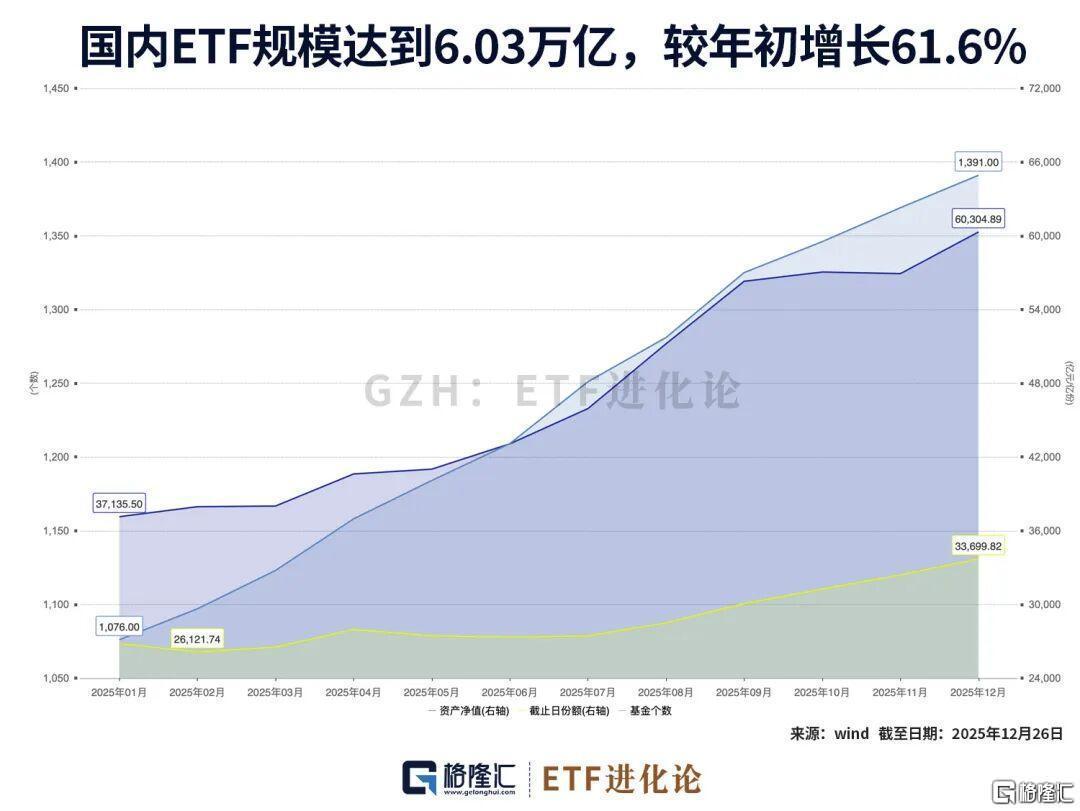
Core Insights - The total scale of China's ETFs has officially surpassed 6 trillion yuan, reaching 6.03 trillion yuan [1] - There are 1,381 ETFs in the market, with 7 flagship ETFs exceeding 100 billion yuan in size [1] - The Huatai-PB CSI 300 ETF stands out with a size of 427.067 billion yuan, making it the only ETF to exceed 400 billion yuan [1] - Other notable ETFs in the "billion club" include those from E Fund, Huaxia, and Harvest, as well as the Huaxia SSE 50 ETF, Southern CSI 500 ETF, and E Fund ChiNext ETF [1]
铂金暴涨172%远超白银,贵金属暴涨我们该怎么办?(周报327期)
Xin Lang Cai Jing· 2025-12-27 11:31
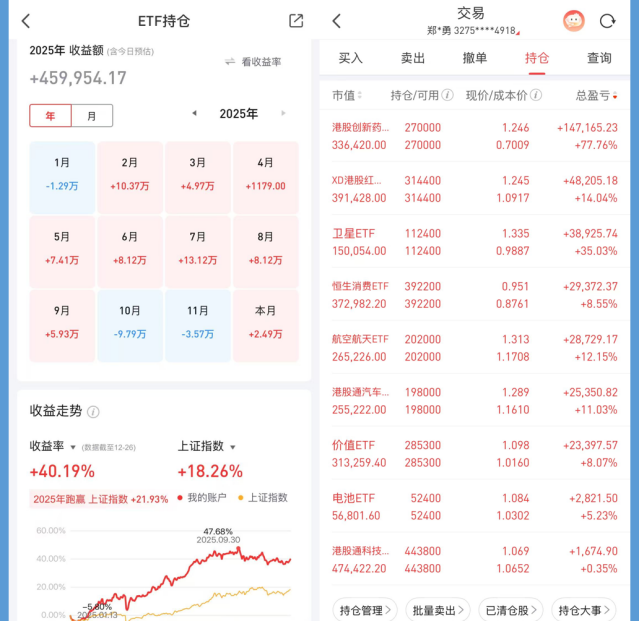
Core Viewpoint - The investment accounts managed by the company have shown a mixed performance this year, with a total profit of 1.9 million yuan, down from a peak of 2.3 million yuan earlier in the year, indicating a drawdown of 400,000 yuan [2][3]. Group 1: Account Performance - The total assets in the on-market ETF account amount to 2.6 million yuan, while the off-market fund account holds 5.4 million yuan, and the advisory portfolio has 1.2 million yuan [7]. - The on-market ETF account has a year-to-date profit of 460,000 yuan, with a current yield of 40.19% [5][6]. - The off-market fund account has a year-to-date profit of 1.338 million yuan, with a yield of 34.21% [15][16]. Group 2: Investment Strategy - The company has shifted its strategy by reducing its position in a value ETF by 100,000 yuan and reallocating that amount to the Hang Seng Consumer ETF, which has seen a decrease in floating profit from 11% to 8% [4]. - The rationale for this shift includes the belief that consumer valuations are at historical lows and that there will likely be consumption stimulus policies next year, which could improve industry sentiment [5]. - The core holdings in the on-market ETF account focus on Hong Kong stocks, with significant investments in sectors such as innovative pharmaceuticals, technology, and consumer goods [8][9]. Group 3: Market Trends - The recent downturn in the Hong Kong stock market has not changed the company's long-term investment logic, which emphasizes the valuation advantages of Hong Kong stocks compared to A-shares [10]. - The company has noted that the recent performance of aerospace and satellite ETFs has been strong, contributing significantly to this week's profits [11]. - The company adheres to a philosophy of avoiding high-risk investments and focusing on undervalued sectors for long-term gains [12]. Group 4: Precious Metals Market - The precious metals market has experienced significant price increases, with platinum prices rising over 172% year-to-date, driven by demand from the aerospace sector [24]. - The company had previously identified platinum as a valuable investment but missed the opportunity to invest heavily at lower prices [21][24]. - The company advises against chasing prices in the current market, emphasizing the importance of strategic investment rather than following trends [25].
历史一刻!ETF规模破6万亿元
Shang Hai Zheng Quan Bao· 2025-12-27 08:32
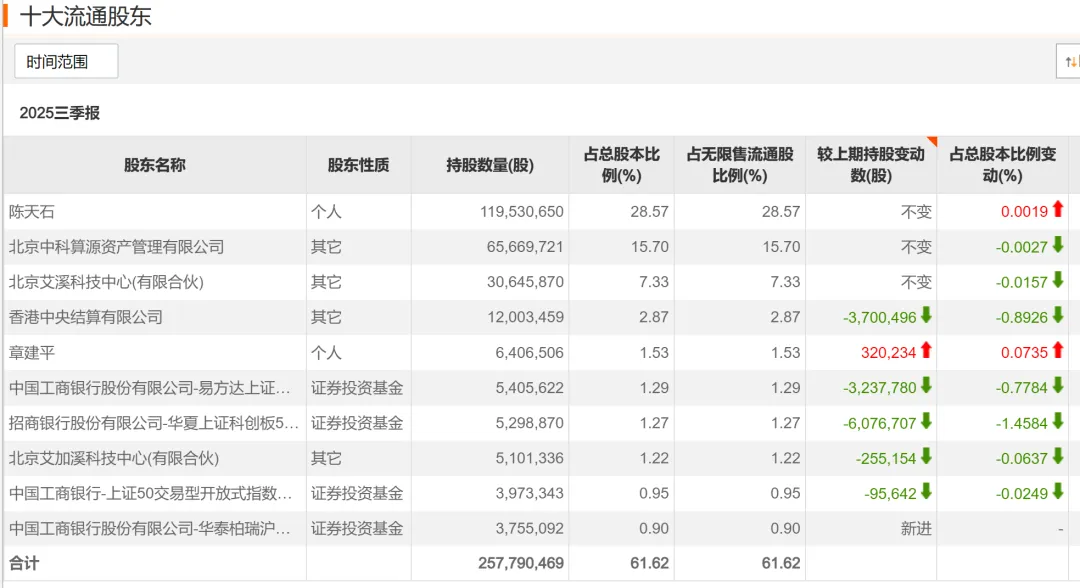
Group 1 - The core viewpoint of the article highlights that China's ETF market has officially surpassed 6 trillion yuan, reaching a total scale of 6.02 trillion yuan, which is an increase of over 2 trillion yuan since the end of last year [1][3] - The rapid growth of ETF scale is reshaping the ecology and structure of the A-share market, as stated by the director of quantitative investment at Minsheng Jianyin [1][12] - The number of ETFs exceeding 100 billion yuan has significantly increased from 66 at the end of last year to over 120 by December 26 this year, indicating a substantial expansion in the ETF market [3] Group 2 - The development of ETFs has entered a new phase, with the first ETF established in 2004 and the scale surpassing 1 trillion yuan in October 2020, followed by rapid growth in subsequent years [3] - The introduction of new ETFs has reached a historical high this year, including the first batch of Sci-Tech Innovation Board ETFs, which enhances the investment ecosystem of the Sci-Tech sector [4] - Regulatory encouragement for long-term capital to enter the market, along with the establishment of a fast approval channel for ETFs, has significantly promoted the development of index investment [4][12] Group 3 - The recent surge in investment in the CSI A500 ETF, which saw net subscriptions exceeding 48 billion yuan in just four trading days, indicates a strong market interest [6] - The CSI A500 index is recognized as the first important broad-based index compiled after the release of the new "National Nine Articles," making it a competitive new player in the ETF market [6][7] - Analysts suggest that the influx of funds into the CSI A500 ETF is influenced by seasonal factors and the index's balanced allocation across various industries, making it an attractive tool for year-end investment [6] Group 4 - The rapid growth of ETFs is beginning to impact listed companies, with several popular Sci-Tech companies appearing in the top ten shareholders of various ETFs [9] - The presence of ETFs in the shareholder lists of companies like Cambricon Technologies indicates a shift in investment dynamics, with ETFs becoming significant players in the market [9][10] - The liquidity provided by long-term capital entering the market through ETFs is enhancing market stability and pricing efficiency, while also posing challenges for active fund managers [12]
中国ETF规模达到6.03万亿元,较年初3.73万亿元大幅增长超60%
Jin Rong Jie· 2025-12-27 02:31
目前全市场ETF产品数量达到1381只,较年初增加342只。从单只产品规模看,千亿级ETF共有7只,规 模在百亿元以上的ETF数量已达125只。其中,华泰柏瑞沪深300ETF以4270.67亿元规模位居榜首;易方 达沪深300ETF规模为3030亿元,排名第二;华夏沪深300ETF、嘉实沪深300ETF紧随其后,规模分别为 2302.9亿元和1967亿元。此外,华夏上证50ETF、南方中证500ETF以及易方达创业板ETF规模也均超过 千亿元。 最新数据显示,截至当前,中国ETF市场总规模已突破6.03万亿元,较年初的3.73万亿元大幅增长超过 60%。今年以来,国内ETF规模接连实现4万亿、5万亿、6万亿元三级跨越,且每突破一个万亿关口所 用时间持续缩短。 从基金类型来看,股票型ETF规模达3.84万亿元,占全部ETF规模的64%;债券型ETF规模接近8000亿 元,跨境ETF规模也接近万亿元,两者均创下历史新高。 基金频道更多独家策划、专家专栏,免费查阅>> 责任编辑:山上 ...