中国铝业

Search documents
豪涨4.2%!有色ETF华宝(159876)续创历史新高!钛白粉行业联合涨价函引爆市场,安宁股份、钒钛股份涨停
Xin Lang Ji Jin· 2026-01-06 11:27
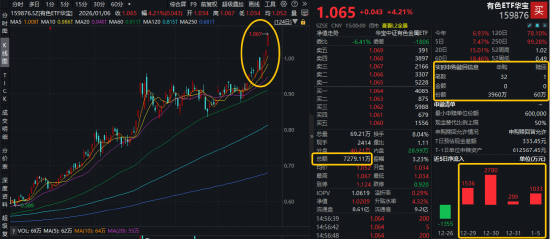
Group 1 - The non-ferrous metal sector is leading the market, with Zijin Mining's market capitalization surpassing 1 trillion yuan for the first time, and Luoyang Molybdenum reaching a historical high [1][3] - The popular non-ferrous metal ETF, Huabao (159876), saw a maximum intraday increase of 4.4%, closing up 4.21%, marking four consecutive days of gains [1] - The ETF experienced a significant increase in trading volume, with a total turnover of 72.79 million yuan, a 47% increase compared to the previous period [1] Group 2 - The titanium dioxide industry has seen a joint price increase announcement, leading to a surge in stocks such as Anning Co. and Vanadium Titanium Co. [3] - As of January 5, 2025 earnings forecasts for four leading companies in the non-ferrous metal sector predict double-digit growth in net profits year-on-year, with Zijin Mining expected to achieve a net profit of 51 to 52 billion yuan, a growth of 59% to 62% [3][4] - Longjiang Securities anticipates that the price increase and liquidity will create a favorable environment for precious metals, while industrial metals like copper and aluminum are expected to see a strong performance due to economic recovery and supply-demand optimization [4][6] Group 3 - The Huabao non-ferrous metal ETF and its linked funds cover a wide range of sectors including copper, aluminum, gold, rare earths, and lithium, allowing for better capture of the sector's beta performance [4] - The ETF has seen a net subscription of 39 million units in a single day, following a total net inflow of 56.48 million yuan over the previous four days, indicating strong market interest [1][3] - The overall sentiment in the non-ferrous metal sector is optimistic, with expectations of a "super cycle" driven by various market dynamics [4]




2026年1月6日稀土市场行情:氧化铽均价600.64万元/吨 部分产品价格小幅调整
Jin Rong Jie· 2026-01-06 10:34
Group 1: Rare Earth Market Overview - The prices of mainstream rare earth products showed slight adjustments, with praseodymium and neodymium oxide averaging 608,000 CNY/ton, down 700 CNY/ton; praseodymium and neodymium metal averaging 736,200 CNY/ton, down 1,800 CNY/ton; dysprosium oxide averaging 1,354,300 CNY/ton, up 9,700 CNY/ton; and terbium oxide averaging 6,006,400 CNY/ton, up 25,300 CNY/ton [1] - The transaction information for products like neodymium oxide, praseodymium oxide, lanthanum cerium oxide, and europium oxide was limited, indicating a cautious market [1] - The praseodymium and neodymium market is seeing increased transactions, with upstream suppliers maintaining firm pricing, although downstream demand remains slow [1] Group 2: A-Share Market Performance of Rare Earth Permanent Magnet Stocks - The latest prices and performance of select rare earth permanent magnet concept stocks were reported, with Jin Feng Technology at 24.09 CNY, up 9.99%, and a transaction volume of 1.3664 billion CNY [2] - China Aluminum Industry was priced at 13.97 CNY, up 7.37%, with a transaction volume of 764 million CNY [2] - Other notable stocks included Yujing Co. at 46.05 CNY, up 5.61%, and Jiaozuo Wanfang at 11.89 CNY, up 5.04%, with respective transaction volumes of 100 million CNY and 1.132 billion CNY [2]
山西2026省级重点工程项目:灵活储能调节38项
中关村储能产业技术联盟· 2026-01-06 09:55
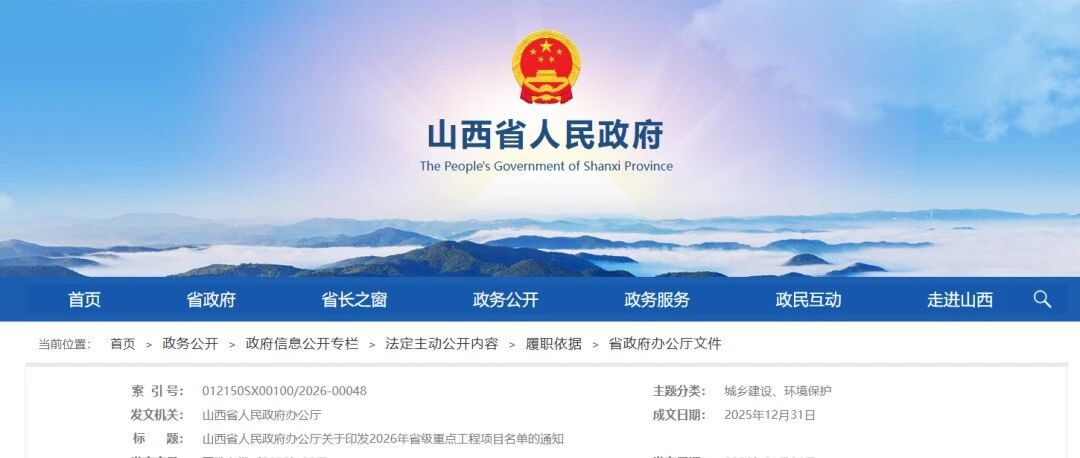
Core Viewpoint - The article outlines the list of key provincial engineering projects in Shanxi for 2026, emphasizing the focus on energy transition and sustainable development through various projects in renewable energy and advanced energy technologies [2]. Energy Transition Projects - A total of 629 major engineering projects are included in the list, with 174 projects specifically related to energy transition [2][3]. - The largest category within energy transition projects is flexible energy storage and regulation, comprising 38 projects [2][3]. - Other categories include wind and solar power (19 projects), advanced coal power (9 projects), green electricity parks (15 projects), and modern coal chemical projects (12 projects) [3][12]. Flexible Energy Storage Projects - The 38 flexible energy storage projects include various types such as pumped storage, new energy storage, battery swap stations, and ultra-high voltage projects [2][4]. - Key locations for new energy storage projects are distributed across cities including Datong, Xinzhou, Jinzhong, Yangquan, Changzhi, Jincheng, Linfen, Yuncheng, and Lüliang [2][4][5]. Green Electricity Parks - There are 15 projects dedicated to the establishment of green electricity parks, aimed at integrating renewable energy sources into local industries [6][7]. - Notable projects include the integrated green electricity direct connection pilot project in Yangquan and the green electricity park construction in various cities [6][7]. Coal Supply and Storage Projects - The list includes 22 projects focused on coal production, supply, storage, and sales, highlighting the ongoing importance of coal in the region's energy landscape [6][8]. - Projects aim to enhance the efficiency and sustainability of coal operations across Shanxi [6][8]. Advanced Energy Equipment - There are 24 projects related to advanced energy equipment, which are crucial for supporting the energy transition and improving energy efficiency [6][18]. - These projects include the production of high-performance materials for energy applications and the development of smart energy technologies [6][18]. Non-Conventional Natural Gas Projects - The list features 12 projects aimed at increasing the production and storage of non-conventional natural gas, reflecting a shift towards diversifying energy sources [6][17]. - These projects are essential for enhancing energy security and reducing reliance on traditional fossil fuels [6][17].
A股基本面重要性将继续提升,同类规模最大的自由现金流ETF(159201)底仓配置价值凸显
Mei Ri Jing Ji Xin Wen· 2026-01-06 09:43
Group 1 - The A-share market opened positively on January 5, 2026, with major indices rising, and the Guozhen Free Cash Flow Index increasing by approximately 0.4% [1] - Notable stocks such as Fenghuo Communication reached the daily limit, with others like Yaxiang Integration, Salt Lake Co., and China Aluminum also seeing gains [1] - The largest free cash flow ETF (159201) experienced a net inflow of over 450 million yuan in the last 10 trading days, bringing its total size to 8.596 billion yuan, indicating significant capital inflow [1] Group 2 - CICC's strategy team defined 2026 A-shares as "riding the momentum," highlighting the strengthening logic of international monetary order reconstruction and the critical application phase of the AI revolution [1] - The performance of China's innovative industries is expected to continue supporting asset performance, with the importance of fundamentals in A-shares increasing after a period of valuation repair [1] - The free cash flow ETF (159201) and its linked funds are designed to closely track the Guozhen Free Cash Flow Index, selecting stocks with positive and high free cash flow, indicating high quality and strong risk resistance suitable for long-term investment [1]



中国铝业(601600) - 截至二零二五年十二月三十一日止股份发行人的证券变动月报表
2026-01-06 09:15
股份發行人及根據《上市規則》第十九B章上市的香港預託證券發行人的證券變動月報表 截至月份: 2025年12月31日 狀態: 新提交 呈交日期: 2026年1月6日 I. 法定/註冊股本變動 | 1. 股份分類 | 普通股 | 股份類別 | A | | | 於香港聯交所上市 (註1) | | 否 | | | --- | --- | --- | --- | --- | --- | --- | --- | --- | --- | | 證券代號 (如上市) | 601600 | 說明 | | | | | | | | | | | 法定/註冊股份數目 | | | 面值 | | | 法定/註冊股本 | | | 上月底結存 | | | 13,211,666,110 | RMB | | 1 | RMB | | 13,211,666,110 | | 增加 / 減少 (-) | | | 0 | | | | RMB | | 0 | | 本月底結存 | | | 13,211,666,110 | RMB | | 1 | RMB | | 13,211,666,110 | | 2. 股份分類 | 普通股 | 股份類別 | H | | 於香港 ...
智通港股52周新高、新低统计|1月6日





智通财经网· 2026-01-06 08:49
Summary of Key Points Group 1: 52-Week Highs - A total of 134 stocks reached their 52-week highs as of January 6, with the highest increase recorded by Macau Legend Development (02962) at 96.00% [1] - Other notable stocks include Auda Holding (09929) with a high rate of 38.57% and China National Pharmaceutical Group (08247) at 24.80% [1] - The closing prices and peak prices for these stocks were as follows: Macau Legend Development at 0.066 and 0.098, Auda Holding at 0.920 and 0.970, and China National Pharmaceutical Group at 3.170 [1] Group 2: 52-Week Lows - The report also highlighted stocks that reached their 52-week lows, with the largest decline seen in Xie Tong Communication (02996) at -29.41% [4] - Other significant declines included Starry Sky Chinese Culture (06698) at -14.14% and Huazhong Biotech - B (02396) at -12.63% [4] - The closing and lowest prices for these stocks were: Xie Tong Communication at 0.016 and 0.012, Starry Sky Chinese Culture at 0.940 and 0.850, and Huazhong Biotech - B at 12.000 and 11.900 [4]
中国铝业(02600) - 截至二零二五年十二月三十一日止股份发行人的证券变动月报表
2026-01-06 08:38
股份發行人及根據《上市規則》第十九B章上市的香港預託證券發行人的證券變動月報表 截至月份: 2025年12月31日 狀態: 新提交 致:香港交易及結算所有限公司 公司名稱: 中國鋁業股份有限公司 呈交日期: 2026年1月6日 I. 法定/註冊股本變動 | 1. 股份分類 | 普通股 | 股份類別 | A | | | 於香港聯交所上市 (註1) | | 否 | | | --- | --- | --- | --- | --- | --- | --- | --- | --- | --- | | 證券代號 (如上市) | 601600 | 說明 | | | | | | | | | | | 法定/註冊股份數目 | | | 面值 | | | 法定/註冊股本 | | | 上月底結存 | | | 13,211,666,110 | RMB | | 1 | RMB | | 13,211,666,110 | | 增加 / 減少 (-) | | | 0 | | | | RMB | | 0 | | 本月底結存 | | | 13,211,666,110 | RMB | | 1 | RMB | | 13,211,666,110 | | ...
市场流动性改善助力中长期资金入市,自由现金流ETF(159201)连续3日合计“吸金”4.43亿元
Mei Ri Jing Ji Xin Wen· 2026-01-06 08:19
Group 1 - The Shanghai Composite Index continued to rise on January 6, with the Guozheng Free Cash Flow Index increasing by over 1.3%, and constituent stocks such as Jiasitang and Yaxiang Integration hitting the daily limit [1] - The largest free cash flow ETF (159201) has seen a net inflow of funds totaling 443 million yuan over the past three days, bringing its latest scale to 8.861 billion yuan, a record high since its inception [1] - According to a report from Industrial Securities, several factors supporting the previous market "excitement" are expected to continue, with potential catalysts for a spring market rally anticipated [1] Group 2 - The free cash flow ETF (159201) and its linked funds (A: 023917; C: 023918) closely track the Guozheng Free Cash Flow Index, addressing the shortcomings of traditional dividend strategies by focusing on internal growth capabilities and emphasizing financial health and sustainability [2] - The annual management fee for the fund is set at 0.15%, and the custody fee at 0.05%, both of which are among the lowest in the market, maximizing benefits for investors [2]
有色金属:地缘局势增加供给不确定性
GUOTAI HAITONG SECURITIES· 2026-01-06 07:04
股票研究 /[Table_Date] 2026.01.06 地缘局势增加供给不确定性 [Table_Industry] 有色金属 | [姓名table_Authors] | 电话 | 邮箱 | 登记编号 | | --- | --- | --- | --- | | 李鹏飞(分析师) | 010-83939783 | lipengfei2@gtht.com | S0880519080003 | | 魏雨迪(分析师) | 021-38674763 | weiyudi@gtht.com | S0880520010002 | | 刘小华(分析师) | 021-38038434 | liuxiaohua@gtht.com | S0880523120003 | | 王宏玉(分析师) | 021-38038343 | wanghongyu@gtht.com | S0880523060005 | | 梁琳(分析师) | 021-23185845 | lianglin@gtht.com | S0880525070014 | | 李阳(分析师) | 021-23185618 | liyang7@gtht.com | S088052 ...
中国铝业控股子公司3945万元项目环评获原则同意
Mei Ri Jing Ji Xin Wen· 2026-01-06 06:29
每经AI快讯,"A股绿色报告"项目监控到的数据显示,中国铝业(601600)控股子公司兰州铝业有限公 司兰州铝业扁锭生产线深井铸造安全隐患综合治理项目环评审批获原则同意。该项目总投资额达3945万 元。该审批信息于2025年12月11日被相关监管机构披露。 "A股绿色报告"项目由每日经济新闻联合环保领域知名NGO公众环境研究中心(IPE)共同推出,旨在 让上市公司环境信息更加阳光透明。本项目基于31个省(区、市)、337个地级市政府发布的权威环境 监管数据,筛选监控上市公司及其旗下公司(包括分公司、参股公司和控股公司)的环境表现,加以专 业数据分析及深入解读,每日智能写作及时发布上市公司AI绿报,每周推出A股绿色周报,定期动态更 新上市公司环境风险榜。 (记者 刘志远 魏官红) 免责声明:本文内容与数据仅供参考,不构成投资建议,使用前核实。据此操作,风险自担。 上期(总第227期)A股绿色周报显示,共有4家上市公司在近期暴露了环境风险。 ...