
李宁

Search documents
智通港股沽空统计|11月20日
智通财经网· 2025-11-20 00:24
Core Insights - The article highlights the top short-selling stocks in the market, indicating significant investor sentiment and potential market movements [1][2]. Short Selling Ratios - AIA Group (81299), Li Ning (82331), and JD Health (86618) have the highest short-selling ratios at 100.00% each [1][2]. - JD Group (89618) follows closely with a short-selling ratio of 98.73%, while Tencent Holdings (80700) has a ratio of 94.71% [2]. Short Selling Amounts - Xiaomi Group (01810) leads in short-selling amount with 2.524 billion, followed by Alibaba (09988) at 2.305 billion and Tencent Holdings (00700) at 1.140 billion [1][2]. - Other notable mentions include Pop Mart (09992) with 1.016 billion and Lenovo Group (00992) at 676 million [2]. Deviation Values - Zhongyuan Bank (01216) has the highest deviation value at 62.66%, indicating a significant difference from its average short-selling ratio over the past 30 days [1][2]. - East Asia Bank (00023) and Autohome (02518) follow with deviation values of 38.85% and 38.65%, respectively [2].




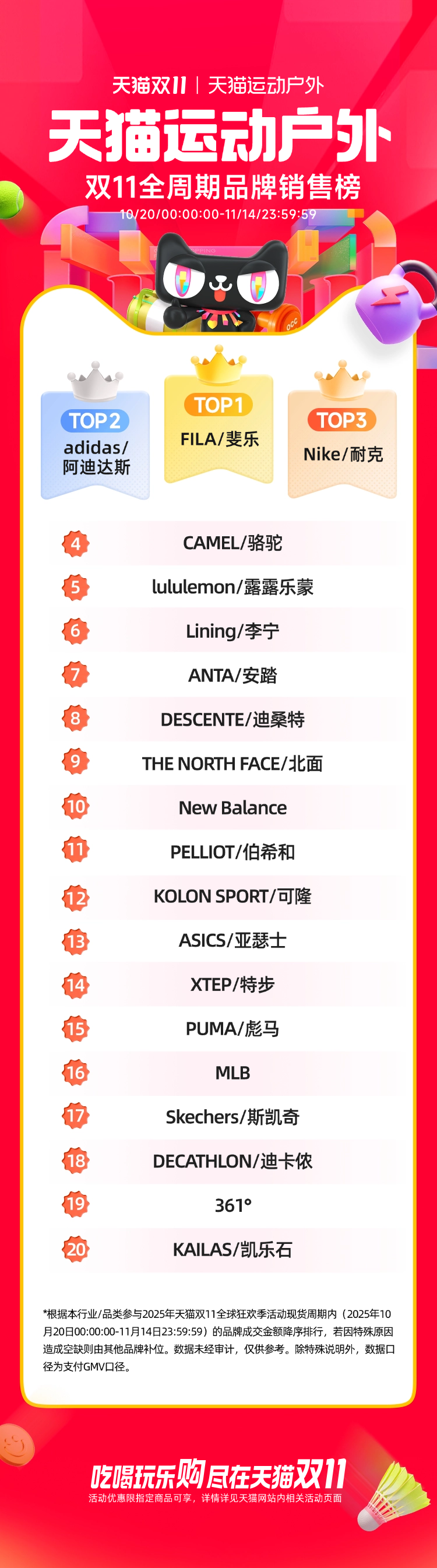
FILA把耐克“赶下”王座
2 1 Shi Ji Jing Ji Bao Dao· 2025-11-19 23:10
Core Insights - The sports market is undergoing significant reshuffling, with FILA ranking first in the Tmall Double Eleven sales, followed by Adidas and Nike, marking Nike's first drop from the top position in years [1] - The competitive landscape is intensifying, with domestic brands like FILA, Li Ning, and Anta gaining ground against established international brands [8] Group 1: Market Performance - FILA has shown strong performance in the sales rankings, with multiple products entering the top sales categories during the Double Eleven event [1] - Nike's revenue in the Greater China region has been declining, with a reported drop of 10% to $1.512 billion (approximately 10.775 billion RMB) for the latest fiscal quarter [7] - Despite the decline, Nike remains the largest sports brand in China, although its market share has decreased from 18.1% to 16.2% [7] Group 2: Strategic Adjustments - FILA has implemented a "ONE FILA" strategy under new CEO Jiang Yan, focusing on resource consolidation and increased investment in tennis and golf [3] - Nike is also recognizing the importance of localized operations, appointing local executives and establishing a creative center in Shanghai to enhance its market presence [4] - The competitive pressure is forcing both international and domestic brands to adapt their strategies to maintain market relevance [8] Group 3: Consumer Behavior and Market Trends - The decline in Nike's sales is attributed to a shift in consumer shopping behavior, with longer purchasing cycles and increased discounting in the local market [7] - Domestic brands are increasingly closing the product gap with international competitors, emphasizing the need for effective marketing strategies [8] - The overall market environment is challenging, with some domestic brands like Peak reporting significant losses in their direct sales segments [8]

安利股份(300218.SZ):目前公司与安踏有少量订单跨境交付
Ge Long Hui A P P· 2025-11-19 08:01
Core Viewpoint - The company is expanding its partnerships with major sports brands, indicating a strategic growth in its supply chain and product development capabilities [1] Group 1: Partnerships and Collaborations - The company will become a supplier for New Balance by 2025, with current collaboration in the product development phase [1] - The company is a strategic partner of Anta, co-establishing a technology research center for membrane technology [1] - The company upgraded its partnership status with Nike to a strategic partner starting January 2025 [1] Group 2: Order Fulfillment and Production - Currently, the company has a small volume of cross-border orders being delivered in collaboration with Anta [1] - Orders from Li Ning are primarily being produced and delivered domestically at this stage [1]

青木科技20251118
2025-11-19 01:47
Summary of Aoki Technology Conference Call Industry and Company Overview - Aoki Technology primarily operates in the large apparel agency business, focusing on platforms like Tmall and also engaging with Douyin. The market is expected to maintain a growth rate of around 15% in the coming years, despite limited overall market growth [2][3][4] - The company holds a 70% stake in the high-end female personal care brand Comando and the Italian oral beauty brand Icarus, with projected total revenue of 600 million yuan in 2025 [2][3] Core Business Insights - The large apparel agency business generates approximately 800 million yuan in annual revenue with a net profit margin of about 20%, attributed to a commission-based model that avoids inventory pressure and capital prepayment [2][3] - The self-owned brands, Comando and Icarus, are expected to contribute significantly to revenue, with Comando projected to generate around 400 million yuan and Icarus between 200-250 million yuan in 2025 [2][3] - The technology solutions and consumer operation services segment, which includes the Aoki Xiaobai and Aoki Woodpecker systems, generates about 100 million yuan in annual revenue, with a high net profit margin [2][4] Financial Projections - Aoki Technology's projected scale profit for 2025 is around 150 million yuan, potentially increasing to over 250 million yuan in 2026, with self-owned brand revenue expected to exceed 50% of total revenue [2][5] - The total revenue for Comando and Icarus is anticipated to reach 1.2 billion yuan by 2026, with ongoing efforts to incubate new self-owned brands [3][5] Investment Logic and Valuation - The expansion of the self-owned brand matrix is a key growth driver, with the potential for multiple brands to collectively reach 5 billion yuan in revenue, translating to annual profits of 300-400 million yuan based on a 10% operating profit margin [2][5] - The current valuation is considered undervalued at less than 30 times PE, with expectations to align closer to peers at around 50 times PE due to anticipated rapid growth [3][6] - The long-term outlook for the self-owned brand segment is promising, suggesting significant potential for market capitalization growth [6] Additional Insights - The company is actively incubating new self-owned brands, including Ti Xu (personal care) and a skincare brand, which are expected to contribute to future growth [4] - AI applications are expected to enhance marketing efficiency, positively impacting short-term performance [3][6] This summary encapsulates the key points from the conference call regarding Aoki Technology's business operations, financial projections, and investment potential.
智通港股沽空统计|11月19日
智通财经网· 2025-11-19 00:25
Core Insights - The article highlights the top short-selling stocks in the market, with AIA Group (81299), Li Ning (82331), and JD Group (89618) having the highest short-selling ratios at 100.00%, 100.00%, and 91.68% respectively [1][2] - Alibaba (09988), Xiaomi (01810), and Tencent (00700) lead in short-selling amounts, with figures of 3.531 billion, 1.787 billion, and 1.421 billion respectively [1][3] - China Mobile (80941), Shanghai Industrial Holdings (00807), and AIA Group (81299) have the highest deviation values, indicating significant differences from their historical short-selling averages [1][3] Short-Selling Ratios - AIA Group (81299) and Li Ning (82331) both have a short-selling ratio of 100.00%, while JD Group (89618) has a ratio of 91.68% [2] - Other notable companies with high short-selling ratios include Kuaishou (81024) at 90.75% and China Mobile (80941) at 90.20% [2] Short-Selling Amounts - Alibaba (09988) has the highest short-selling amount at 3.531 billion, followed by Xiaomi (01810) at 1.787 billion and Tencent (00700) at 1.421 billion [3] - Other companies with significant short-selling amounts include XPeng Motors (09868) at 1.012 billion and BYD (01211) at 1.001 billion [3] Deviation Values - China Mobile (80941) leads with a deviation value of 43.82%, indicating a significant increase in its short-selling ratio compared to its historical average [3] - Other companies with high deviation values include Shanghai Industrial Holdings (00807) at 40.85% and AIA Group (81299) at 36.63% [3]



11月港股消费观察:通胀交易回归
CMS· 2025-11-18 15:35
Investment Rating - The report maintains a "Recommended" rating for the industry [1] Core Views - The report highlights a return of inflation trading, with consumer goods showing a positive trend in performance [1][8] - The overall industry size is significant, with a total market capitalization of 18,186 billion and a circulating market capitalization of 16,721.2 billion [1] Summary by Sections Macroeconomic Analysis - Retail sales growth year-on-year is at 2.9%, with a slight recovery in October due to the holiday effect, showing a month-on-month increase of 0.16% [6] - The restaurant sector saw a year-on-year revenue increase of 3.8% in October, while jewelry sales surged by 37.6% [6][7] - Service retail sales grew by 5.3% year-on-year from January to October, indicating a gradual recovery in service consumption [7] Food and Beverage Sector - October inflation data exceeded expectations, with both CPI and PPI showing improvements, suggesting a potential recovery in profitability for the food and beverage sector [8] - Companies like Haidilao and Anjuke are expected to perform well due to improved demand and operational strategies [9][10] Textile and Apparel Sector - The textile manufacturing sector is experiencing stable overseas demand, with major brands like NIKE showing signs of recovery [12] - Recommendations include focusing on leading manufacturers with optimized order structures and production efficiency [12] Tobacco Sector - The report recommends companies like Smoore International and China Tobacco Hong Kong, highlighting their stable growth and market positioning [16] Home Appliances Sector - The report suggests focusing on leading white goods manufacturers like Midea Group, which has shown stable operational performance [17] Retail and E-commerce - The report notes a significant increase in e-commerce sales during the Double Eleven shopping festival, with a total sales growth of 14.2% [24] - Companies like JD.com are expected to maintain robust growth, with a projected non-GAAP net profit of 318 billion for 2025 [25] Pharmaceutical Sector - The report emphasizes the importance of innovation in the pharmaceutical industry, recommending companies like Innovent Biologics and 3SBio for their strong project pipelines [27] Agriculture Sector - The report indicates a rapid reduction in sow production capacity, suggesting a potential increase in pig prices in 2026 [28]
机制之争:双十一,FILA把耐克“赶下”王座
2 1 Shi Ji Jing Ji Bao Dao· 2025-11-18 12:42
Core Insights - The sports market is undergoing significant reshuffling, with FILA ranking first in Tmall's Double Eleven sales, followed by Adidas and Nike, marking Nike's first drop from the top position in years [1][4][10] Brand Performance - In the 2023 Double Eleven sales, the top three brands were Nike, FILA, and Anta, while in 2024, the rankings shifted to Nike, FILA, and Adidas, indicating a competitive landscape [1][10] - FILA's sales strategy includes a "customer service integration" project, enhancing the customer experience from pre-purchase to post-sale [4][5] - Nike's revenue in Greater China has been declining, with a 10% drop to $1.512 billion (approximately 10.775 billion RMB) for the latest fiscal quarter [10][11] Market Dynamics - The competition is intensifying, with domestic brands like Anta and Li Ning gaining market share, while overseas brands face declining premium pricing [10][11] - Nike's market share in China decreased from 18.1% to 16.2%, while Anta's increased from 9.8% to 10.5% [10][11] - The overall market is under pressure, with reports of losses in domestic sales for brands like Peak and Li Ning [11][12] Strategic Adjustments - FILA is focusing on strategic investments in tennis and golf, with significant sales growth in these categories during the Double Eleven period [6][13] - Nike is recognizing the importance of localized operations, appointing local executives and establishing creative centers in China to enhance market engagement [7][10] - The need for Nike to adapt its strategies in China is critical, especially after its drop to third place in sales rankings [14]


机制之争:双十一,FILA把耐克“赶下”王座丨小贺说
2 1 Shi Ji Jing Ji Bao Dao· 2025-11-18 12:36
Core Insights - The sports market is undergoing significant reshuffling, with FILA ranking first in the Tmall Double Eleven sales, marking Nike's first drop from the top position in recent years [1] - FILA's operational strategies and flexible mechanisms have contributed to its success, while Nike is facing challenges in maintaining its market position [4][6] Group 1: Market Performance - In the 2023 Double Eleven sales, FILA ranked first, followed by Adidas and Nike, which is a notable shift in market dynamics [1] - Nike's revenue in the Greater China region has been declining, with a reported drop of 10% to $1.512 billion (approximately 10.775 billion RMB) for the latest fiscal quarter ending August 31, 2025 [8] - Despite the decline, Nike remains the largest sports brand in China, with a market share of 16.2%, although it has decreased from 18.1% [8] Group 2: Company Strategies - FILA has implemented a "customer service integration" project to enhance its operational efficiency, allowing for a seamless customer experience from pre-purchase inquiries to post-sale support [2] - The new CEO of FILA, Jiang Yan, has introduced the "ONE FILA" strategy, focusing on resource consolidation and strategic investments in tennis and golf [4] - Nike is also recognizing the importance of localized operations, appointing Dong Wei as the new CEO for Greater China, indicating a shift towards empowering local leadership [5] Group 3: Competitive Landscape - The rise of domestic brands is evident, with local companies like Anta and Li Ning gaining market share, while overseas brands face declining premium pricing [9] - The overall market environment in China is challenging, with reports of losses in domestic sales for brands like Peak and Li Ning [10] - FILA's strategy of leveraging its parent company Anta's resources has allowed it to create a closed-loop system, enhancing its competitive edge [10]
斯凯奇200余家门店上线 “双11”后运动品牌加速入驻美团闪购
Zheng Quan Shi Bao Wang· 2025-11-18 11:59
Core Insights - The sportswear industry is experiencing a trend of "collective brand layout in instant retail" with brands like Skechers partnering with Meituan Flash Purchase to enhance their instant retail strategies [1][2] - The recent "Double 11" shopping festival showcased significant growth in instant retail, particularly in sportswear and home textiles, indicating a new growth point for the industry [1][2] Group 1: Industry Trends - Sportswear brands are increasingly adopting instant retail as a strategic component of their omnichannel operations, aligning with the high functionality and scene-specific characteristics of their products [2] - The collaboration between Skechers and Meituan Flash Purchase aims to cater to specific consumer needs such as commuting, business travel, and urgent sportswear requirements [2] Group 2: Performance Metrics - During the "Double 11" period, Meituan Flash Purchase reported record highs in transaction volume, number of orders, and average consumer spending, with over 800 brands and 400 categories seeing sales double year-on-year [1] - Skechers has expanded its delivery radius to 25 kilometers and introduced pre-order features during non-business hours to address urgent consumer needs [2] Group 3: Service Enhancements - Skechers' partnership with Meituan Flash Purchase ensures that all stores are brand-owned, providing official after-sales services to enhance customer satisfaction [2] - Meituan Flash Purchase is also working with leading brands to offer free return shipping services, addressing the high demand for returns in the apparel category [2]
中泰证券:家纺大单品驱动增长 低基数下服装行业缓慢复苏
智通财经网· 2025-11-18 06:43
Core Insights - The sportswear industry is experiencing significant demand differentiation due to a warm autumn and weak consumer spending, with running and outdoor categories maintaining high demand, and online channels outperforming offline ones [1][2] - The home textile industry shows a moderate recovery, with leading companies achieving growth through a big product strategy, particularly highlighted by Mercury Home Textile's successful launches of innovative products [1][3] - The apparel industry is slowly recovering from a low base, with men's wear remaining stable but under profit pressure, while women's wear shows signs of recovery, emphasizing the importance of cost optimization [1][4] Sportswear Industry - Demand differentiation is evident, with running and outdoor categories maintaining high demand, while online sales channels outperform offline [2] - Anta Sports shows low single-digit growth in main brand revenue, while other brands within its portfolio achieve 45-50% growth, effectively mitigating market pressures [2] - Li Ning's inventory turnover is at 5-6 months, with expectations for improvement by year-end [2] - Xtep International's main brand revenue shows low single-digit growth, but its sub-brand Saucony performs well with over 20% growth [2] - 361 Degrees reports 10% and 20% year-on-year growth in offline and e-commerce sales, respectively, and expands its superstore count to 93 [2] Home Textile Industry - The overall recovery is moderate, but leading companies leverage big product strategies for superior growth [3] - Mercury Home Textile's Q3 revenue growth accelerates by 20.19%, driven by innovative products like the "ice cream quilt" and "ergonomic pillow," which also boost gross margin by 4.2 percentage points to 44.74% [3] - Luolai Life benefits similarly, with a 9.90% year-on-year revenue increase and a gross margin improvement of 3.8 percentage points to 48.05% [3] - Mercury Home Textile and Luolai Life see significant increases in net profit attributable to shareholders, up 43.18% and 50.14%, respectively [3] - Fuanna is in a phase of channel adjustment and inventory reduction, with a 7.58% year-on-year revenue decline, but plans to launch new products in early 2026 [3] Apparel Industry - The apparel sector is slowly recovering from a low base, with men's wear stable but facing profit pressures [4] - Haier's revenue and profit show slight growth, supported by new business and overseas expansion [4] - Women's wear shows signs of recovery, with cost optimization being crucial [4] - Dizhu Fashion reports double-digit profit recovery in Q3, while other brands like Ge Li Si and Xin He show varying performance with expectations for improvement [4] - Semir sees revenue and profit growth in Q3, while Taiping Bird experiences a loss due to channel and cost structure adjustments [4] Investment Recommendations - For sportswear, focus on leading companies that can maintain market share in a competitive environment, such as Anta Sports, Li Ning, Xtep International, and 361 Degrees [5][6] - In the home textile sector, prioritize companies like Mercury Home Textile and Luolai Life that show significant growth potential through big product strategies and improved e-commerce efficiency [5] - In the apparel sector, consider brands like Haier and Semir that are managing to improve profitability and expand their market presence [6]
