力拓

Search documents
X @外汇交易员
外汇交易员· 2025-10-22 06:42
Potential Acquisition Targets - Chinalco may be interested in Rio Tinto's Simandou iron ore project in Guinea (75% owned by China) [1] - Chinalco previously attempted to acquire the Simandou iron ore project in 2016 but was unsuccessful [1] - Another potential swap deal could involve Rio Tinto's titanium business [1] - Chinalco may be interested in Rio Tinto's Oyu Tolgoi copper mine in Mongolia [1] Industry Dynamics - China is the world's largest producer and consumer of titanium dioxide [1] - Titanium dioxide is mainly used in paints, cosmetics, and military equipment [1]

国金交运:中国对美船舶收取特别港务费,关注油运干散及港口板块
Ge Long Hui· 2025-10-17 01:36
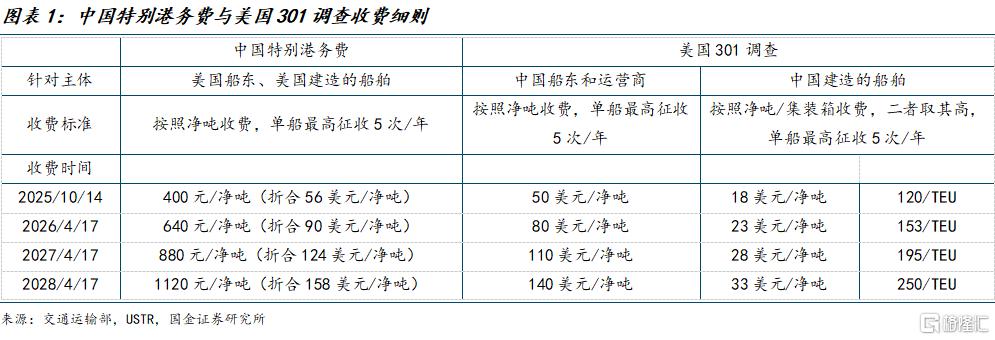
Investment Logic - China will impose a special port fee on U.S. vessels starting October 14, 2025, targeting U.S.-owned, operated, and flagged ships, as well as those built in the U.S. [1][7] - The fee will be collected by local maritime authorities, with a standard charge of 400 RMB (approximately 56 USD) per net ton, increasing annually [1][8]. Affected Capacity - The affected capacity includes U.S.-owned and flagged vessels, with container ships totaling 352,500 TEU (1.1% of global capacity), oil tankers at 20.418 million dwt (1.9%), and dry bulk carriers at 14.907 million dwt (2.1%) [2][12]. - The actual impact on U.S. capacity is reduced due to exemptions for Chinese-built vessels, resulting in effective percentages of 0.86% for container ships, 1.64% for oil tankers, and 0.95% for dry bulk carriers [13][14]. Economic Impact on Shipping Rates - The special port fee significantly affects oil and dry bulk shipping rates, with the fee accounting for approximately 89% of the current rate for VLCCs on the U.S. Gulf to Far East route and 123% on the Middle East to Far East route [25][26]. - For dry bulk carriers, the fee represents 76% of the rate for the Brazil to China route and 133% for the Australia to China route, indicating a loss of economic viability [28][29]. Short-term Effects on Shipping Companies - The imposition of the fee is expected to lead to a short-term supply shortage, driving up shipping rates as U.S. operators may cancel voyages or switch to transshipment routes [29][30]. - The efficiency loss from these changes will likely result in increased shipping costs and a reconfiguration of shipping routes, particularly affecting U.S. oil and dry bulk shipping to China [29][30]. Impact on Port Operations - The special port fee will not directly benefit port companies, as the fee is collected by maritime authorities rather than port operators [30]. - However, the reduction in U.S. shipping activity may lead to decreased throughput at affected ports, although this could be mitigated by other international operators filling the gap [30][33]. Investment Recommendations - Companies in the oil and dry bulk shipping sectors are recommended for investment due to potential rate increases stemming from supply disruptions [34]. - Ports with key transshipment hubs, particularly those oriented towards Southeast Asia, are also expected to benefit from shifts in trade flows [34].

人民币逼退美元!中国停购必和必拓后,全球矿业规矩要变了?
Sou Hu Cai Jing· 2025-10-14 11:58
Core Viewpoint - China's decision to stop purchasing BHP's iron ore priced in USD and switch to RMB has significant implications for the global mining industry, marking a shift in the balance of power in iron ore trade and signaling a move towards de-dollarization in commodity transactions [1][7][29]. Market Reaction - Following the announcement, BHP's stock fell by 1.8%, and iron ore futures experienced fluctuations exceeding 3%, highlighting the immediate impact of China's procurement policy change on the market [4][27]. China's Position in Iron Ore Trade - China, as the world's largest iron ore importer, consumes approximately 75% of globally shipped iron ore, making its purchasing decisions critical for the profitability of mining companies [4][6]. - Historically, China has been viewed as a "big spender" in iron ore trade, often at the mercy of international miners due to its reliance on imported high-grade iron ore [9][11]. Historical Context - China's steel industry has faced three main challenges: high demand for steel due to urbanization, internal competition among numerous small steel producers, and the oligopolistic control of iron ore supply by a few major companies [9][14][16]. - The average profit margin for Chinese steel companies from 2005 to 2020 was below 5%, while BHP and its peers maintained profit margins around 60%, illustrating the unfavorable pricing dynamics for Chinese steelmakers [14]. Strategic Moves by China - China has adopted a three-step strategy to break the monopoly of international miners: consolidating its domestic steel industry, securing alternative iron ore sources, and strategically engaging with individual mining companies [16][19][21]. - The establishment of the China Mineral Resources Group in 2022 allowed for unified negotiations with foreign suppliers, enhancing China's bargaining power [18]. Recent Developments - The commencement of production at the Simandou iron ore project in Guinea, which has significant reserves, provides China with a stable iron ore supply and strengthens its negotiating position [21]. - China's recent negotiations with BHP culminated in a decision to accept RMB for iron ore transactions, marking a pivotal moment in the shift away from USD dominance in commodity pricing [27][29]. Future Implications - The increasing use of RMB in commodity settlements is expected to lead to a more diversified and competitive global iron ore market, moving away from the previous USD-centric model [31]. - China's approach in the iron ore market serves as a potential template for other developing countries seeking to enhance their negotiating power and secure fairer trade terms [29][31].
美国防部拟斥资10亿美元囤积关键矿产以强化战略储备
智通财经网· 2025-10-14 01:14
Group 1 - The U.S. Department of Defense plans to procure up to $1 billion in critical minerals to enhance metal supply security and ensure the availability of materials needed for defense systems and advanced technologies [1] - This procurement marks one of the largest expansions of the U.S. strategic material reserves in years, with a focus on securing stable supplies of cobalt, antimony, tantalum, and scandium [1][2] - The Defense Logistics Agency (DLA) is managing a total asset value of $1.3 billion in strategic commodities, which can only be utilized during wartime or under presidential orders [2] Group 2 - The proposed procurement includes $500 million for cobalt, $245 million for antimony from U.S. Antimony Corporation, $100 million for tantalum, and approximately $45 million for scandium from Rio Tinto and APL Engineered Materials [1] - Recent years have seen significant price increases for various minerals, with germanium prices soaring and antimony trioxide prices nearly doubling year-on-year [2] - The DLA is also evaluating the potential procurement of rare earth elements, tungsten, bismuth, and indium, with intentions to purchase 222 tons of indium ingots, nearly equivalent to the total U.S. refined indium consumption for 2024 [3]
规模惊人!美国防部拟斥资10亿美元囤积关键矿产以强化战略储备
Zhi Tong Cai Jing· 2025-10-13 02:42
Core Insights - The U.S. Department of Defense plans to invest up to $1 billion in critical minerals to enhance metal supply security and ensure the availability of raw materials for defense systems and advanced technologies [1][2] - This initiative represents one of the largest expansions of the U.S. strategic material reserves in years, with a focus on securing stable supplies of cobalt, antimony, tantalum, and scandium [1][2] Group 1: Investment Details - Up to $500 million will be allocated for cobalt, $245 million for antimony from U.S. Antimony Corporation, $100 million for tantalum, and approximately $45 million for scandium from Rio Tinto and APL Engineered Materials [2] - The Defense Logistics Agency (DLA) manages a total asset value of $1.3 billion in strategic commodities, which are only utilized during wartime or under presidential orders [2] Group 2: Market Context - Prices for various minerals have surged recently, with germanium prices skyrocketing and antimony trioxide prices nearly doubling year-on-year [3] - The "One Big Beautiful Bill Act" allocates $7.5 billion for critical mineral projects, including $2 billion to strengthen defense reserves by early 2027 [3] Group 3: Supply Chain and Production - DLA is also evaluating the procurement of rare earth elements, tungsten, bismuth, and indium, with intentions to purchase 222 tons of indium ingots, nearly equivalent to the total U.S. refined indium consumption for 2024 [4] - U.S. Antimony Corporation sources materials from Canada, Mexico, Australia, Chad, Bolivia, and Peru, with projected revenues of $15 million in 2024 [3]
在美上市的铜矿企业股价盘前上涨
Xin Lang Cai Jing· 2025-10-09 09:24
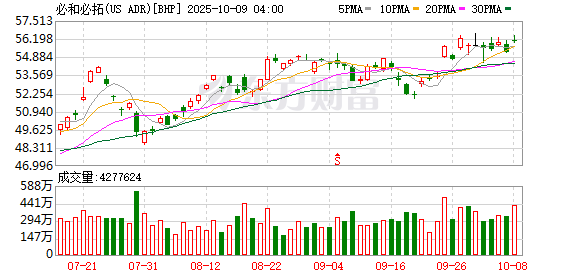
铜价触及逾16个月高位后,在美上市的铜矿企业股价盘前上涨。自由港麦克莫兰公司股价上涨3.1%, 南方铜业公司股价上涨2.1%,泰克资源公司股价上涨2.4%。必和必拓股价上涨1.4%,力拓股价上涨 0.7%。 来源:视频滚动新闻 ...
必和必拓美股盘前上涨1.4%,力拓上涨0.7%
Mei Ri Jing Ji Xin Wen· 2025-10-09 09:24
每经AI快讯,10月9日,必和必拓美股盘前上涨1.4%,力拓上涨0.7%。 ...
必和必拓美股盘前上涨1.4% 力拓上涨0.7%
Mei Ri Jing Ji Xin Wen· 2025-10-09 09:24
(文章来源:每日经济新闻) 每经AI快讯,10月9日,必和必拓美股盘前上涨1.4%,力拓上涨0.7%。 ...
中国停购澳大利亚铁矿石,理由很“硬气”
Sou Hu Cai Jing· 2025-10-07 16:39
Core Viewpoint - The article discusses how China, as the largest consumer of iron ore, is seeking to gain more bargaining power against Australian suppliers, particularly BHP and Rio Tinto, who dominate the market and have significant pricing power [1][4][5]. Group 1: China's Iron Ore Consumption and Import Dependency - China consumes approximately 75% of the global seaborne iron ore imports, with an import volume of 1.237 billion tons in 2024, accounting for 60.2% of the global total [2]. - The import dependency on Australia is high, with 720 million tons imported from BHP and Rio Tinto, representing 85% of Australia's iron ore exports [2]. Group 2: Bargaining Power Dynamics - Australia's significant control over pricing is evident, as China's reliance on Australian iron ore limits its negotiating power [4]. - In the 2019-2020 fiscal year, Australia's iron ore export revenue was $102 billion, with $84.9 billion (approximately 548.5 billion RMB) coming from China, highlighting China's limited influence on pricing [5]. Group 3: China's Strategic Response - China has initiated a halt in purchasing iron ore from BHP, demanding a shift from annual pricing to a quarterly pricing mechanism linked to the spot market, aiming to save approximately $20 billion annually [8][9]. - The move is also intended to challenge the dominance of the US dollar in trade settlements, as BHP insists on dollar transactions while other suppliers have begun accepting RMB [9]. Group 4: Alternative Supply Sources - Brazil has increased its iron ore exports to China, with a 20.7% year-on-year increase in the first two months of 2024, providing a reliable alternative supply [10]. - China has also secured mining rights in Guinea and has access to high-grade iron ore from Russia, which further strengthens its position [11][15]. Group 5: Implications for Australia - The Australian Prime Minister expressed concern over the potential impact of China's purchasing halt, emphasizing the importance of iron ore exports to both economies [16].