龙湖集团

Search documents
直线拉升!20cm涨停
中国基金报· 2025-09-25 03:18
Market Overview - On September 25, A-shares opened slightly lower, with the three major indices collectively in the red [1] - The Shanghai Composite Index decreased by 0.06%, the Shenzhen Component Index fell by 0.30%, and the ChiNext Index dropped by 0.45% [2] Sector Performance - The non-ferrous metals, media, electric equipment, and pharmaceutical sectors showed notable gains, with the nuclear fusion and copper industries being particularly active [2][4] - The nuclear fusion sector rose by 2.67%, while the copper industry increased by 2.63% [4] Copper Industry Insights - The copper industry index led the gains, with companies like Jingyi Co., Northern Copper, and Luoyang Molybdenum hitting the daily limit [8] - A recent landslide at Freeport McMoRan's Grasberg mine in Indonesia has raised global copper prices and sparked supply chain concerns, as this mine accounts for approximately 3% of global copper supply [9][10] Nuclear Fusion Sector Developments - The nuclear fusion concept stocks collectively surged, with companies like Hezhong Intelligent and Farsen hitting the daily limit, and others like Shanghai Electric and Baoli Electric also seeing significant increases [10][11] - China Fusion Energy Co., known as the "national team" for controllable nuclear fusion, is focusing on overall design, technology verification, and digital R&D [14] Company Specifics - On September 25, the stock of Upwind New Materials surged to a limit of 20%, reaching a price of 132.1 CNY per share, with a total market value of 53.3 billion CNY [15][16] - The company recently completed a share transfer, changing its controlling shareholder to Zhiyuan Hengyue, with plans for a tender offer to acquire an additional 37% of shares at a price of 7.78 CNY per share [18]







直线拉升!20cm涨停
Zhong Guo Ji Jin Bao· 2025-09-25 02:38
Market Overview - On September 25, A-shares opened slightly lower, with the three major indices showing a downward trend. The Shanghai Composite Index decreased by 0.06%, the Shenzhen Component Index fell by 0.30%, and the ChiNext Index dropped by 0.45% [2][4]. Industry Performance - The non-ferrous metals, media, electric equipment, and pharmaceutical sectors showed notable gains, with the nuclear fusion, copper industry, superconductors, and CRO concept stocks being particularly active. In contrast, semiconductor, memory, and photolithography sectors experienced declines [2][3]. Copper Industry Insights - The copper industry index led the gains, with stocks such as Jingyi Co., Northern Copper, and Luoyang Molybdenum hitting the daily limit. Other companies like Electric Alloy, Tongling Nonferrous Metals, and Jiangxi Copper also saw increases [4][5]. - A recent landslide at Freeport McMoRan's Grasberg mine in Indonesia has raised global copper prices and triggered supply chain concerns. The mine accounts for approximately 3% of global copper supply, and the incident is expected to impact global supply significantly in the fourth quarter [6]. Nuclear Fusion Sector - Nuclear fusion concept stocks experienced a strong rally, with companies like Hezhong Intelligent and Farsen hitting the daily limit, while others like Hahuan Huadong and Zhongzhou Special Materials rose over 10% [6][7]. - China Fusion Energy Co., known as the "national team" for controllable nuclear fusion, aims to focus on overall design, technology verification, and digital R&D, establishing a technology R&D platform and capital operation platform [10]. Company Specifics - On September 25, Upwind New Materials saw its stock price surge to 132.1 CNY, reaching a daily limit increase of 20%, with a total market value of 53.3 billion CNY [11][12]. - The company announced the completion of a share transfer, with Zhiyuan Hengyue and Zhiyuan Xinchuang holding a combined 29.99% stake, making Zhiyuan Hengyue the new controlling shareholder. An offer to acquire an additional 37% of shares at 7.78 CNY per share is also planned, requiring up to 1.161 billion CNY [13].




下半年房企优化增量质量,打造第二增长曲线
3 6 Ke· 2025-09-25 02:34
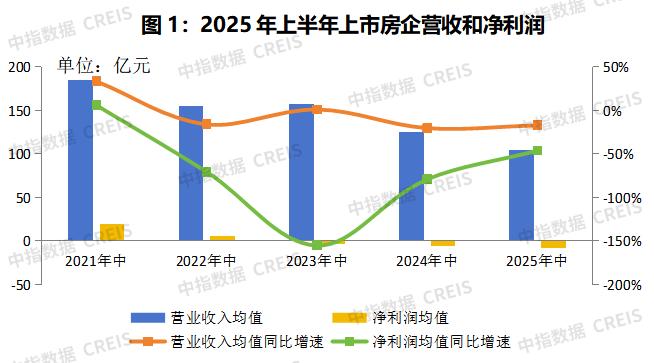
Core Insights - Leading real estate companies, such as China Resources Land and Longfor Group, demonstrate strong anti-cyclical resilience with diversified revenue structures, where light asset and operational service businesses contribute higher profits [1][6][9] - The overall performance in the first half of 2025 shows declining revenues and rising debt ratios, with the average net profit of the industry dropping to -830 million yuan, indicating a growing trend of losses among nearly 60% of listed real estate companies [1][4] Financial Performance - In the first half of 2025, the average revenue of listed real estate companies was 10.42 billion yuan, a year-on-year decrease of 16.9%, with the decline rate widening by 3.2 percentage points compared to the same period in 2024 [4] - The asset-liability ratio, excluding pre-receipts, reached 66.5%, up 0.9 percentage points year-on-year, while the net debt ratio surged to 171.8%, an increase of 55.8 percentage points [3] Strategic Focus for Second Half of 2025 - The primary strategies for leading real estate companies in the second half of 2025 include accelerating inventory clearance, optimizing the quality of new projects, and enhancing product iteration to build better homes [1][10] - Investment strategies emphasize targeted inventory clearance and maintaining cash flow balance while focusing on core cities and prime locations [12] - Product strategies involve responding to the "good house" policy by enhancing product iteration and ensuring high-quality service delivery [13] - Business strategies aim to establish new development models and create a second growth curve by expanding operational real estate and asset management businesses [14]


中指研究院:上半年房企负债率继续上升 打造第二增长曲线
智通财经网· 2025-09-25 00:00
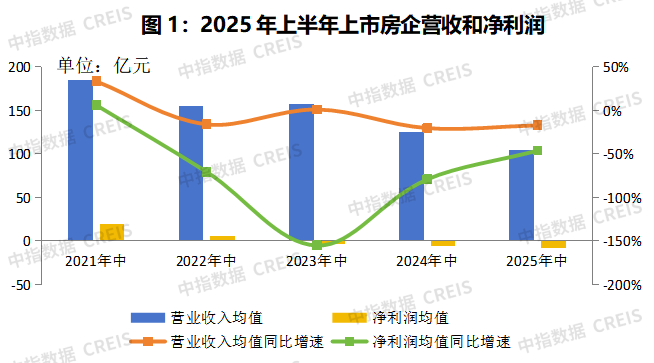
Core Viewpoint - The performance of listed real estate companies in China is expected to decline significantly in the first half of 2025, with continued losses and rising debt levels, indicating a challenging market environment [1][5]. Financial Performance - In the first half of 2025, the average revenue of listed real estate companies was 10.42 billion yuan, a year-on-year decrease of 16.9%, with the decline rate widening by 3.2 percentage points compared to the same period in 2024 [1]. - The average net profit of the industry fell to -830 million yuan, with approximately 60% of listed companies experiencing varying degrees of losses, indicating a growing trend of financial distress [1][5]. Debt and Liquidity - The asset-liability ratio of listed real estate companies, excluding pre-receivables, reached 66.5%, an increase of 0.9 percentage points year-on-year, while the net debt ratio surged to 171.8%, up by 55.8 percentage points [5]. - The cash-to-short-term-debt ratio dropped to 0.88, indicating that over half of the companies cannot cover their short-term debts with available cash, leading to increased liquidity pressure [5]. Company Strategies - Major real estate companies are focusing on accelerating inventory clearance, optimizing the quality of new projects, and enhancing product iteration to adapt to market conditions [1][12]. - Companies like China Resources Land and Longfor Group are demonstrating strong anti-cyclical resilience, with diversified revenue structures where non-development business contributes over 60% of profits [8][11]. Investment Strategy - In the second half of 2025, leading real estate firms will prioritize inventory clearance and ensure the safety, liquidity, and profitability of new projects, focusing on core cities and prime locations [14]. - Companies are adopting precise investment strategies to enhance resource quality and improve operational capabilities [14]. Product Strategy - Companies are responding to the "good housing" policy by enhancing product iteration and focusing on customer needs to improve product quality and service delivery [15]. Business Strategy - Firms are working to establish new development models and create second growth curves, with China Resources Land aiming to strengthen its operational real estate and asset management businesses [16]. - Longfor Group is advancing in multiple operational sectors, focusing on commercial, asset management, property management, and construction to maintain growth and competitive advantages [16].
中指研究院房企半年报透视:负债率继续上升,打造第二增长曲线
Zheng Quan Shi Bao Wang· 2025-09-24 23:46
Core Insights - The report from the China Index Academy indicates that in the first half of 2025, listed real estate companies will experience a significant decline in revenue, continued losses, and rising debt ratios, leading to a decrease in debt repayment capacity [1] Group 1: Industry Performance - Revenue for listed real estate companies is expected to decline significantly in the first half of 2025 [1] - Companies will continue to face losses, and their debt ratios will keep increasing [1] - The ability to repay debts is projected to decline further [1] Group 2: Leading Companies - Among leading real estate firms, China Resources Land and Longfor Group demonstrate strong cyclical resilience [1] - These companies have diversified revenue structures, with light asset and operational service businesses contributing higher profits [1] Group 3: Strategic Focus - In the second half of the year, leading real estate companies will focus on accelerating inventory clearance and optimizing the quality of new projects [1] - There will be an emphasis on product iteration and building quality homes [1] - Companies aim to create a second growth curve [1]
开源晨会-20250924
KAIYUAN SECURITIES· 2025-09-24 14:41
Group 1: Pharmaceutical Industry - The active pharmaceutical ingredient (API) industry has experienced a downturn over the past four years, with prices of various products, including sartans, heparins, and animal health products, reaching historical lows, leading to some leading companies operating at a loss [7][8][10] - In the first half of 2025, the API sector saw a decline in both revenue and net profit due to significant price drops in anti-infective products and increased R&D investments by some companies [7][10] - Domestic API companies are actively transitioning to innovative drug development, with several products in various clinical trial stages, indicating a shift towards higher-value offerings [7][10] Group 2: Real Estate Industry - The stabilization of housing prices is influenced by multiple factors, including monetary policy, supply-demand relationships, and economic expectations, rather than solely by population changes [3][12][15] - Analysis of housing price data from 70 cities shows that both new and second-hand housing prices have been in a downward trend since 2022, with a recent narrowing of year-on-year declines due to supportive policies [12][13] - Recommendations for investment focus on strong credit real estate companies with good fundamentals and leading product capabilities, as well as those benefiting from dual-driven residential and commercial real estate strategies [15] Group 3: IT Services Industry - The company is a leading player in the domestic IT services sector and a key partner of Huawei, with over 40% of its revenue derived from this partnership [4][17][20] - The company's cloud intelligence business is experiencing significant growth, and it is expected to benefit from the development of the HarmonyOS ecosystem and AI technologies [4][17][20] - Profit forecasts for 2025-2027 have been adjusted, with expected net profits of 564 million, 628 million, and 708 million yuan respectively, reflecting a strategic focus on AI and cloud services [4][17][20] Group 4: Alibaba Group - Alibaba is actively advancing its AI infrastructure and plans to increase investments, which is expected to accelerate growth in its cloud business [5][21][22] - The demand for AI infrastructure is exceeding expectations, with plans to invest 380 billion yuan in building AI infrastructure, significantly increasing the energy consumption scale of its global data centers by 10 times by 2032 [5][21][22] - The company aims to enhance its market position through comprehensive AI-driven strategies, including improvements in its e-commerce platform and cloud services [21][22][23]
重庆市“四企”联动协同发展联盟正式启动
Zhong Guo Xin Wen Wang· 2025-09-24 10:07
Core Insights - The Chongqing International Exchange's 2025 Investor Conference and the launch of the "Four Enterprises" collaborative development alliance took place, aimed at enhancing high-quality development in Chongqing [1] - The "Four Enterprises" refers to state-owned enterprises, central enterprises, private enterprises, and foreign enterprises, representing a significant reform initiative in Chongqing's state-owned asset management [1] Group 1: Alliance Formation - The alliance has over 120 initial member units, with a first council consisting of 39 members, including key companies like Chongqing International Investment Consulting Group and China Chang'an Automobile Group [1] - The alliance aims to empower member units through project planning, industrial upgrading, financial support, green initiatives, policy support, data governance, and innovation [1] Group 2: Investment Projects - A total of 527 key projects were selected for investment, with a total investment amount of 256.6 billion yuan and a proposed investment attraction of 151.3 billion yuan [2] - The projects span six major categories, including commercial comprehensive projects, cultural tourism and consumption projects, industrial development projects, urban renewal projects, public service projects, and financial and capital cooperation projects [2] Group 3: Collaborative Development - The conference established a regular platform for project co-investment, resource sharing, and collaborative development, promoting a new integration development model [2] - Eleven projects were signed during the conference, with a total signing amount of nearly 1.5 billion yuan, covering various fields such as fund establishment, equity investment, and cross-regional cooperation [2]
行业深度报告:房价止跌回稳系列三:鉴往知来,人口不是影响房价唯一因素
KAIYUAN SECURITIES· 2025-09-24 09:50
Investment Rating - The investment rating for the real estate industry is "Positive" (maintained) [1] Core Insights - The report indicates that new housing transaction areas have shown a month-on-month increase, while real estate development investment has decreased year-on-year from January to August 2025 [3] - The report highlights that the decline in housing prices has been consistent since 2022, with a significant drop in both new and second-hand housing prices across 70 cities, although the rate of decline has started to narrow due to supportive policies [5][16] - It emphasizes that the relationship between population growth and housing prices is not straightforward, as effective housing demand driven by economic development and income growth is crucial for influencing prices [5][25] Summary by Sections Industry Overview - The real estate market has entered a downward trend since 2022, with new and second-hand housing prices experiencing a decline for over 40 months [5][16] - As of August 2025, the new housing price index across 70 cities has decreased by 3.0% year-on-year, while the second-hand housing price index has dropped by 5.5% [16][20] Population Impact - The report concludes that population factors are long-term variables with limited mid-term impact on housing prices, as the marginal changes in housing prices are influenced more by monetary policy, supply-demand relationships, and economic expectations [25][39] - A regression analysis across several developed countries shows that housing price indices do not have a significant correlation with population growth rates [40][42] International Experience - The report draws parallels with international experiences, noting that stable fiscal and monetary policies are essential for stabilizing housing prices after declines [6][46] - It cites examples from the U.S., Japan, and South Korea, where coordinated fiscal and monetary policies have successfully supported housing market recovery after significant downturns [46][49] Investment Recommendations - The report recommends focusing on real estate companies with strong credit ratings and solid fundamentals in urban areas, such as China Overseas Development and Poly Developments [7] - It also suggests that companies excelling in both residential and commercial real estate, as well as those providing high-quality property management services, are well-positioned for growth [7]


开源证券-房地产行业深度报告:房价止跌回稳系列三,鉴往知来,人口不是影响房价唯一因素-250924
Xin Lang Cai Jing· 2025-09-24 09:49
Group 1 - The core viewpoint is that the impact of mid-term population changes on housing prices in developed countries/regions is limited, as there is no significant positive correlation between housing price indices and population growth rates or numbers [1] - From 2022, housing prices in 70 cities have entered a downward trend, with a widening decline expected in Q3 2024, although the year-on-year decline has narrowed since Q4 due to supportive policies [1] - The current adjustment cycle in the housing market has seen both new and second-hand housing price indices decline for over 40 months [1] Group 2 - Historical data shows that housing prices in developed countries/regions have experienced fluctuations since the 1980s, with price corrections often exceeding those in China, but eventually stabilizing [2] - Key factors for stabilizing and recovering housing prices include coordinated fiscal and monetary policies, such as large-scale quantitative easing, interest rate cuts, and fiscal subsidies [2] - A stable policy outlook, low interest rate environment, and improved supply-demand structure are crucial for halting the decline and stabilizing the real estate market [2] Group 3 - The stabilization of housing prices is influenced by multiple factors, including monetary policy, supply-demand relationships, and economic expectations, rather than solely by population dynamics [3] - Recommended investment targets include strong credit property companies with good urban fundamentals and leading product capabilities, as well as firms that can drive both residential and commercial real estate [3] - The increasing penetration rate of second-hand housing indicates a promising outlook for the real estate after-service sector [3]

克而瑞地产:2025年上半年房企毛利率修复至10.87% 净利润维持亏损
Zhi Tong Cai Jing· 2025-09-24 09:33
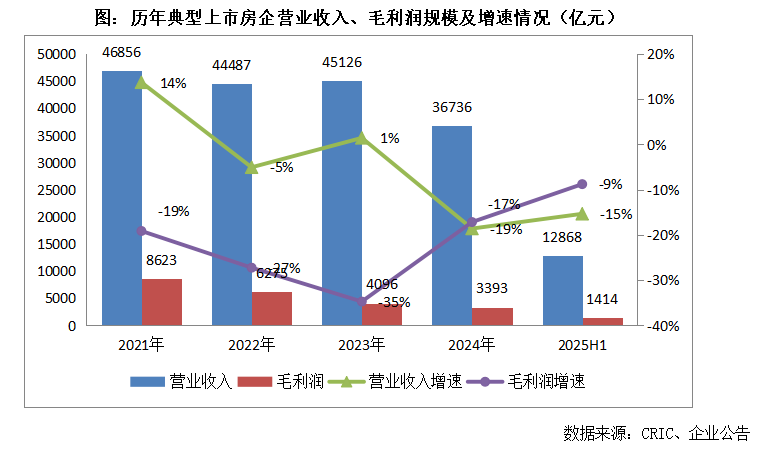
Core Viewpoint - The real estate industry is experiencing a significant decline in both revenue and profitability, with major listed companies reporting substantial losses and a challenging outlook for the near future [1][2][4][7]. Revenue and Profitability - In the first half of 2025, typical listed real estate companies achieved total revenue of 12,868 billion yuan, a year-on-year decrease of 15%, while operating costs were 11,454 billion yuan, down 16% [1]. - The gross profit for these companies was 1,414 billion yuan, reflecting a 9% decline compared to the previous year [1]. - The net profit loss for the industry expanded to 2,762 billion yuan in 2023, further increasing to 3,397 billion yuan in 2024, and reaching 902 billion yuan in the first half of 2025 [2]. Profitability Ratios - The overall gross margin for the industry in the first half of 2025 was 10.87%, an increase of 1.8 percentage points from the entire year of 2024, while the net margin was -7.45% [4]. - Excluding companies that have faced financial distress, the gross margin for 27 stable firms was 15.09%, up 2 percentage points from 2024, with a net margin of 1.71%, indicating a recovery from previous losses [4]. Factors Affecting Profitability - The decline in profitability is attributed to high land acquisition costs, increased sales pressure, and asset impairment provisions, which have negatively impacted current profit performance [4][7]. - Companies are resorting to discount promotions to boost sales, leading to a situation where revenue increases do not translate into profit growth [4]. Industry Outlook - The industry is at a turning point, with a shift in policy focus from deleveraging to risk prevention, and a change in demand dynamics from broad increases to differentiation [7]. - Major companies like Longfor and Vanke express cautious optimism, highlighting the ongoing demand for quality housing in core urban areas despite recent price declines [7][8]. Strategic Planning of Key Companies - China Resources Land plans to maintain an annual opening pace of around six shopping centers, with a focus on public REITs to enhance asset value [9]. - China Merchants Shekou aims to optimize asset structure and enhance operational capabilities through a new asset management model [9]. - Longfor Group anticipates a 10% growth in its commercial sector and plans to open approximately ten new projects annually in the coming years [9]. - New City Holdings is focused on enhancing its commercial operations and leveraging financial policies to improve its capital structure [9].