泸州老窖

Search documents
观酒|湾区白酒半年图谱:名酒价格频频失守,行业陷深度博弈
Nan Fang Du Shi Bao· 2025-12-25 05:56
Core Insights - The Chinese liquor industry is undergoing significant transformation in 2025, facing challenges such as high channel inventory and weak terminal sales, while also experiencing new opportunities driven by changing policies, consumption patterns, and scenarios [2][3] - The market is seeing a shift towards product innovation targeting younger consumers, with low-alcohol beverages and fruit-flavored wines becoming popular among Generation Z [2] - The industry is also accelerating its international expansion, moving from product export to cultural export, as domestic growth slows [2] Price Trends - The retail prices of liquor in the Guangdong-Hong Kong-Macao Greater Bay Area have shown a clear trend of "overall decline, weak peak seasons, and increasing differentiation" [4][6] - Over half of the monitored products in the Bay Area have experienced price declines, including high-end brands like Moutai and Wuliangye, indicating a significant pressure on the price points [6][10] - The price of high-end products has collectively "cooled down," with many products in the 1,000 yuan price range facing substantial pressure, leading to a significant gap between listed and actual transaction prices [6][10] Regional Analysis - In Guangzhou, the liquor market has continued to show price declines and frequent fluctuations, reflecting a deepening adjustment trend [8][9] - Shenzhen's liquor prices have shown stability in offline channels, acting as a "price ballast," while online channels have seen significant price drops [12][15] - In Foshan, the price trends are characterized by a "two-tier" differentiation, with stable products maintaining their prices while others experience significant volatility [16][17] - Dongguan's liquor market has shown structural differentiation in price trends, with high-end products under pressure and mid-range products adopting flexible pricing strategies [19][21] Market Dynamics - The collective price adjustments in the Bay Area are driven by a combination of macroeconomic pressures, industry cycles, and channel transformations [22][23] - The current market pressure stems from a cooling demand for consumption, particularly in business and banquet settings, alongside a shift in consumer preferences [22] - The evolution of channels, particularly the rise of instant retail platforms, has increased price transparency and intensified competition among channels [23] Future Outlook - The market is expected to maintain a "low-price" trend in the short term, with the upcoming Spring Festival being a focal point for potential sales recovery [24] - However, significant price rebounds are unlikely until consumer confidence is restored and channel inventories are effectively reduced [24] - The industry is likely to see a shift from price wars to competition based on brand strength, product innovation, and refined channel management [24]





白酒板块午后直线拉升!水井坊涨停,贵州茅台涨1%
Mei Ri Jing Ji Xin Wen· 2025-12-25 05:42
Group 1 - The core viewpoint of the news highlights a significant rise in the liquor sector, particularly after Beijing's announcement to further relax housing purchase restrictions, which is expected to stimulate a cyclical recovery in the economy [1] - As of December 25, 2025, the food and beverage industry has experienced a decline of over 7% year-to-date, ranking it as the worst-performing sector among 31 Shenwan primary industries, indicating a potential for the fifth consecutive year of negative returns if the decline is not mitigated in the remaining trading days [1] - Looking ahead to 2026, many institutions are optimistic about a turnaround in the food and beverage sector, particularly in liquor and restaurant supply chains, following a five-year adjustment period from 2021 to 2025 [1] Group 2 - The food and beverage ETF (515170.SH) is based on the CSI sub-index for the food and beverage industry, focusing on leading liquor companies such as Kweichow Moutai, Wuliangye, and Luzhou Laojiao, which together account for nearly 60% of the index weight [2] - The ETF also includes leading consumer food companies, providing a diversified investment opportunity for individual investors to capture potential recovery in the industry [2] - The ETF and its linked funds are considered effective tools for investors looking to engage with the sector at a low capital threshold while diversifying their exposure [2]
华源证券:食品饮料板块复苏分化 关注ROA企稳与结构性景气赛道
智通财经网· 2025-12-25 03:57
Core Viewpoint - The report from Huayuan Securities indicates a recovery sequence in the food and beverage industry, with soft drinks and snacks leading the recovery, followed by the catering supply chain, condiments, dairy products, beer, and finally, liquor [1][2]. Group 1: Recovery Sequence Analysis - The recovery rhythm of different consumption sectors shows both differences and commonalities, driven by industry supply-demand dynamics and supply chain structures [2]. - The commonality lies in the prevailing competition in the existing market, where companies focus on increasing sales to digest capacity and enhance operational efficiency [2]. - ROA (Return on Assets) is identified as a leading indicator for the operational recovery of consumer enterprises, with a detailed analysis of the stages of enterprise and channel adjustments [2]. Group 2: Historical Context and Insights - An analysis of Japan's consumption differentiation in the 1990s reveals that industries that can capture structural opportunities typically meet two conditions: addressing demand pain points and having low penetration rates [3]. - The rapid development of cost-effective options and health-oriented niche categories in Japan during that period illustrates the potential for growth in low-penetration sectors [3]. Group 3: Investment Strategy - From a pricing perspective, rising CPI may lead to valuation recovery in traditional industries with higher penetration rates, such as liquor, beer, and dairy products, which are expected to attract incremental capital [4]. - Recommendations include focusing on leading companies in these sectors, such as Kweichow Moutai, Luzhou Laojiao, and Yili Group [4]. - From a volume perspective, companies with high supply chain efficiency in cost-effective consumption are likely to see volume growth, with specific recommendations for companies in the catering supply chain and soft drinks [4].
中国银河证券:头部酒企定调来年战略 传统消费有望迎来底部改善
Zhi Tong Cai Jing· 2025-12-25 02:55
Core Viewpoint - The food and beverage index in December experienced a pullback, primarily due to the timing of the Mid-Autumn Festival affecting November sales data and the later stocking period for the 2026 Spring Festival, which may pressure Q4 revenue growth [1] Group 1: Industry Insights - Major liquor companies are adjusting their strategies for 2026, focusing on maintaining price stability and channel profit margins amid ongoing industry downturn pressures [1] - Companies are developing high-margin products and increasing marketing investments to boost distributor engagement [1] - Long-term transformations include targeting new consumer demographics and developing products aligned with new consumption trends, as well as enhancing relationships with e-commerce platforms and instant retail channels [1] Group 2: Price Tracking - As of December 24, 2025, the price of Feitian Moutai increased by 20 yuan compared to November, while prices for Wuliangye and Luzhou Laojiao remained stable or slightly decreased year-on-year [2] - Packaging material prices showed a mixed trend, with glass prices down 26.4% year-on-year, while aluminum and carton prices increased [2] - Raw material prices for sugar, flour, and pork saw significant year-on-year declines, while quail eggs and soybeans experienced price increases [2] Group 3: Market Performance - The food and beverage sector declined by 3.1% as of December 23, 2025, underperforming the overall A-share index by 4.9%, ranking 28th among 31 sub-industries [3] - Half of the sub-sectors saw gains, with snacks, seasoning and fermentation products, and pre-processed foods leading the increases at 3.6%, 3.0%, and 2.6% respectively [3]

独家 | 茅台新一轮“马年生肖酒”明年2月中旬开售
Xin Lang Cai Jing· 2025-12-25 01:50
Core Viewpoint - Moutai has confirmed the production of a new round of zodiac Moutai, starting with the "Bingwu Year of the Horse Zodiac Moutai," set to be released in mid-January and available for sale in mid-February [1][7]. Group 1: Zodiac Moutai Production - The first zodiac liquor cycle has concluded, with the market value of previous zodiac Moutai recognized [1][7]. - The current market price for the Year of the Snake Moutai is 2390 yuan per bottle, while the Year of the Horse Moutai is priced at 14,400 yuan per bottle due to its limited production [1][7]. Group 2: Price Trends - Recent reports indicate a significant price increase for both Flying Moutai and Premium Moutai, attributed to new production control policies and the upcoming Spring Festival [8][9]. - The price of Flying Moutai has risen from a low of 1816 yuan per bottle to 1825 yuan per bottle [9]. - Premium Moutai has seen a more substantial increase, climbing from 2281 yuan per bottle to 2366 yuan per bottle, marking an almost 4% rise over five days [2][9].
酒价内参12月25日价格发布 飞天茅台大涨9元
Xin Lang Cai Jing· 2025-12-25 01:16
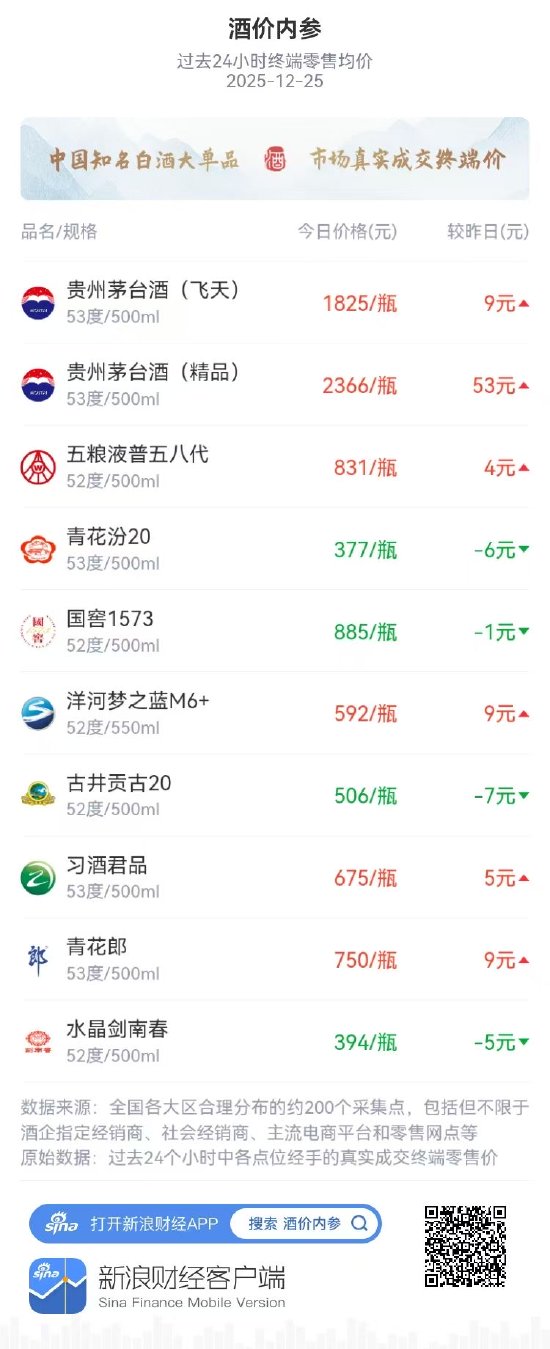
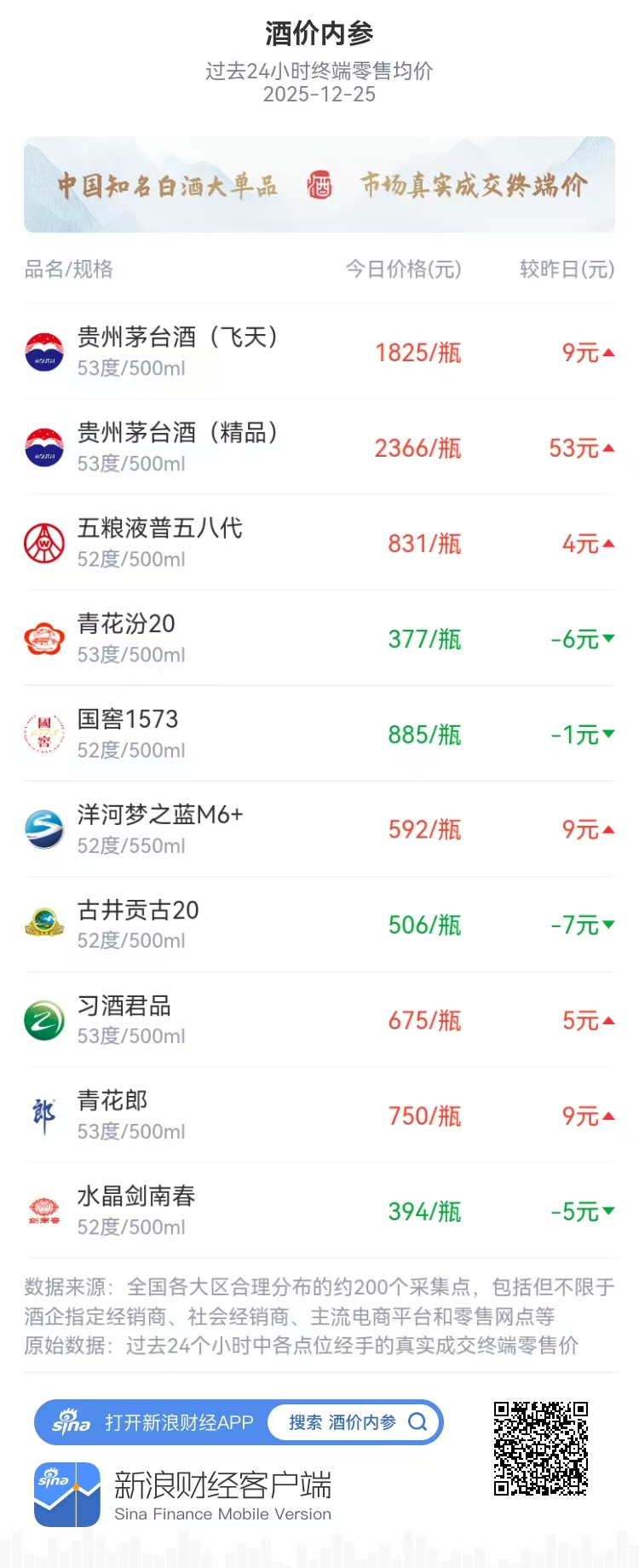
Core Viewpoint - The Chinese liquor market is experiencing a significant price increase for top products, with the average retail price of the top ten liquor items rising sharply, indicating strong market confidence and signaling the onset of the year-end peak season [1][8]. Price Trends - The total price for a package of the top ten liquor items reached 9,201 yuan, an increase of 70 yuan from the previous day, marking the highest total price since November 26 [1][8]. - The price of Guizhou Moutai's premium product surged by 53 yuan per bottle, while the price of Moutai Feitian increased by 9 yuan per bottle, highlighting Moutai's strong position in high-end gifting and banquet scenarios [2][9]. - Other notable price increases include: - Qinghua Lang: +9 yuan/bottle - Yanghe Dream Blue M6+: +9 yuan/bottle - Xijiu Junpin: +5 yuan/bottle - Wuliangye Pu 58th generation: +4 yuan/bottle - A few products experienced price declines, such as: - Gu Qingong 20: -7 yuan/bottle - Shuijing Jian Nan Chun: -5 yuan/bottle - Qinghua Fen 20: -6 yuan/bottle - Guojiao 1573: -1 yuan/bottle [2][9][6]. Market Sentiment - The market is currently buoyed by the dual influence of the festive atmosphere and expectations of a strong sales season, leading to heightened trading activity and positive market sentiment [2][9]. - Distributors have noted that the recent price increases are primarily for non-standard products, with significant hikes in the prices of aged and premium Moutai products, reflecting a recovery in distributor confidence due to reduced quotas [3][10]. - Some distributors express uncertainty about future market trends, indicating that daily price fluctuations complicate predictions, with many suggesting to wait for the upcoming distributor conference for clearer insights [3][10]. Data Collection Methodology - The "Liquor Price Reference" collects data from approximately 200 sampling points across various regions, including designated distributors, social distributors, major e-commerce platforms, and retail outlets, aiming to provide objective and traceable market price data [2][9].
酒价内参12月25日价格发布 贵州茅台全线大涨精品茅台暴涨53元
Xin Lang Cai Jing· 2025-12-25 01:07
Core Insights - The Chinese liquor market has seen a significant increase in the retail prices of its top ten products, with a total price of 9,201 yuan, marking a rise of 70 yuan from the previous day, the highest since November 26 [1] - The market sentiment is buoyed by the festive atmosphere and expectations of a strong sales season, leading to active trading [1] - Moutai products are at the forefront of this price surge, with Moutai's premium product increasing by 53 yuan per bottle and the regular Moutai rising by 9 yuan per bottle, indicating its strong market position and pricing power [1] Price Movements - The retail price for Moutai (Feitian) is now 1,825 yuan per bottle, up by 9 yuan [3] - The premium Moutai is priced at 2,366 yuan per bottle, an increase of 53 yuan [3] - Other notable price increases include: - Wuliangye (Pu 58th generation) at 831 yuan, up by 4 yuan [3] - Qinghua Lang at 750 yuan, up by 9 yuan [4] - Yanghe Dream Blue M6+ at 592 yuan, up by 9 yuan [4] - Xijiu Junpin at 675 yuan, up by 5 yuan [4] - Some products experienced price declines, such as: - Gujing Gonggu 20 down by 7 yuan to 506 yuan [4] - Shuijing Jian Nan Chun down by 5 yuan to 394 yuan [4] - Qinghua Fen 20 down by 6 yuan [4] - Guojiao 1573 down by 1 yuan to 885 yuan [3]
酒企打响“马年”发令枪:生肖酒市场的喜与忧
Xin Lang Cai Jing· 2025-12-24 16:48
Core Viewpoint - The Chinese liquor industry is experiencing a shift in the zodiac liquor market for the Year of the Horse in 2026, with a notable decrease in enthusiasm compared to previous years, indicating a more rational approach from companies amidst industry adjustments and changing consumer perceptions [5][6]. Group 1: Market Dynamics - Major liquor companies, including Wuliangye, Yanghe, and Luzhou Laojiao, have launched zodiac liquor products for the Year of the Horse, but the market appears less vibrant than in previous years [3][4]. - The number of companies participating in the zodiac liquor market is expected to decrease by at least 30% compared to previous years, as the market becomes dominated by leading brands, raising entry barriers [6][9]. - The market is transitioning from a speculative investment focus to a cultural consumption perspective, driven by changing consumer attitudes and a need for differentiation in product offerings [7][8]. Group 2: Consumer Behavior - Consumers are increasingly prioritizing taste and gifting scenarios over investment potential, indicating a shift back to the core values of consumption [8][9]. - The demand for unique and culturally rich products is rising, as consumers show signs of fatigue towards homogenized designs and offerings in the zodiac liquor market [9][10]. Group 3: Challenges and Opportunities - The zodiac liquor market faces challenges such as product homogenization, supply-demand imbalances, and the risk of value bubbles, necessitating deeper cultural engagement and innovation from companies [9][10]. - Companies are encouraged to develop strong cultural narratives and product matrices to establish independent value systems and consumer bases, moving away from reliance on leading brands like Moutai and Wuliangye [10][11].


生肖酒“降温”
Bei Jing Shang Bao· 2025-12-24 16:03
Core Viewpoint - The domestic liquor industry is actively launching zodiac-themed products for the upcoming Year of the Horse in 2026, but the market appears less enthusiastic compared to previous years, indicating a shift in consumer sentiment and market dynamics [1][4][6]. Group 1: Market Activity - Major liquor companies such as Wuliangye, Yanghe, and Luzhou Laojiao have already released their zodiac-themed products for 2026, with various pricing strategies and limited editions [3][4]. - Specific product launches include Tianyoude's limited edition of 1,000 bottles, Luzhou Laojiao's offerings priced at 888 yuan, and Wuliangye's zodiac liquor debuting on JD.com [3][4]. Group 2: Market Trends - The zodiac liquor market is experiencing a "cooling down" phase, contrasting sharply with the previous years' frenzy of new product launches and market excitement [4][6]. - A significant reduction in the number of companies participating in the zodiac liquor market is anticipated, with estimates suggesting a decrease of at least 30% compared to previous years [4][5]. Group 3: Consumer Behavior - The previous investment and collectible appeal of zodiac liquors is diminishing, as consumers are now prioritizing taste and gifting scenarios over speculative value [6][7]. - The shift in consumer demand is pushing the zodiac liquor market to refocus on cultural and emotional values rather than purely investment-driven motives [7][8]. Group 4: Challenges and Opportunities - The zodiac liquor market faces challenges such as product homogenization, supply-demand imbalances, and the risk of value bubbles [8][9]. - Companies need to innovate beyond simple design replication and engage in deeper cultural storytelling and regional integration to differentiate their products [8][9]. Group 5: Future Directions - The future success of zodiac liquors will depend on companies' abilities to develop long-term capabilities, including cultural narrative, direct consumer engagement, pricing strategies, and product lifecycle management [9][10]. - Emphasizing cultural significance and scarcity will be crucial for achieving market success in the evolving landscape of the zodiac liquor market [10].
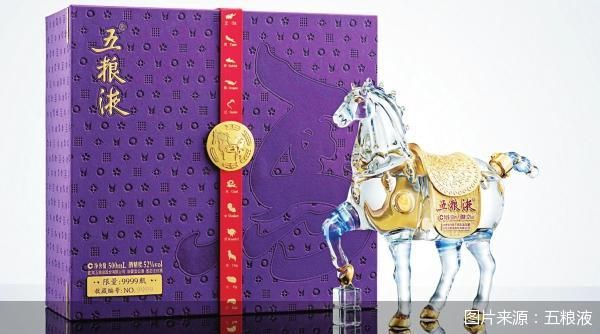
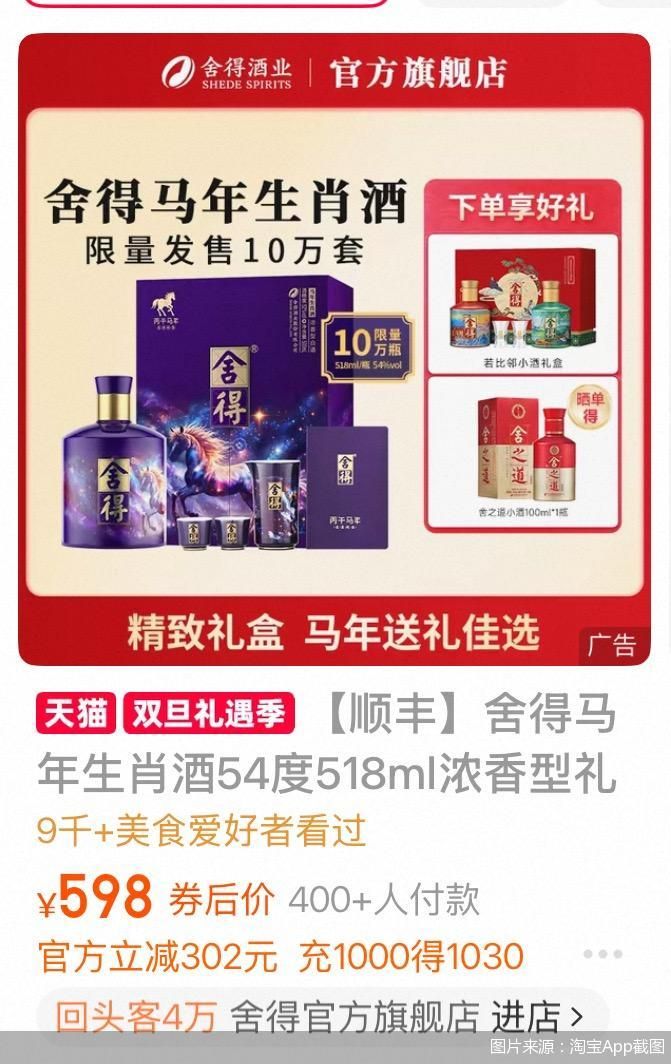
酒企打响“马年”发令枪 生肖酒市场的喜与忧
Bei Jing Shang Bao· 2025-12-24 13:21
Core Viewpoint - The Chinese liquor industry is experiencing a "cooling" phase in the zodiac liquor market for the upcoming Year of the Horse in 2026, contrasting with previous years' fervor, as companies like Wuliangye, Yanghe, and Luzhou Laojiao release new products amid a more rational consumer sentiment and industry adjustments [1][4][6]. Group 1: Market Dynamics - Major liquor companies, including Wuliangye, Yanghe, and Luzhou Laojiao, have launched zodiac liquor products for the Year of the Horse, with various pricing strategies and limited editions [2][5]. - The number of companies participating in the zodiac liquor market is expected to decrease by at least 30% compared to previous years, as the market becomes dominated by leading brands, raising entry barriers [5][9]. - The market is witnessing a shift from speculative investment to cultural consumption, as consumers prioritize taste and gifting over mere investment value [7][8]. Group 2: Consumer Behavior and Trends - Consumers are increasingly focused on the drinking experience and gifting scenarios, indicating a need for zodiac liquors to enhance their core drinking value alongside cultural attributes [7][9]. - The current market is characterized by homogenization in product design and packaging, leading to consumer fatigue and a decline in perceived uniqueness [8][9]. - The future success of zodiac liquors will depend on the ability of companies to innovate culturally and establish independent value systems for their products [9][10].