THK

Search documents
中国自动化与机械行业周评:工程机械及 AI PCB 设备数据向好-China Automation and Machinery Weekly Highlights Positive Data Points for Construction Machinery and AI PCB Equipment
2026-02-10 03:24
Flash | 09 Feb 2026 01:12:42 ET │ 11 pages China Automation and Machinery Weekly Highlights: Positive Data Points for Construction Machinery and AI PCB Equipment CITI'S TAKE Construction machinery: According to CCMA (China Construction Machinery Association), China domestic excavator shipment/export volume increased by 61%/40% YoY in Jan-26, which we believe could be due to the CNY-led low base in Jan-25. China's tower crane leasing rate index, published by Pangyuan, declined by 6% WoW last week as we are a ...
【环球财经】日经225指数微涨0.03%
Xin Hua Cai Jing· 2026-01-29 07:30
从板块来看,东京证券交易所33个行业板块多数上涨,石油及煤炭制品、运输机械、矿业等板块涨幅靠 前;服务业、零售业、其他制品等板块下跌。 (文章来源:新华财经) 新华财经东京1月29日电 日本东京股市两大股指29日低开高走,小幅收涨。日经225种股票平均价格指 数收盘微涨0.03%,东京证券交易所股票价格指数上涨0.28%。 当天早盘,受投资者忧虑美国联邦政府部分机构或再陷"停摆"等多重因素影响,东京股市两大股指小幅 低开。早盘前段,由于优衣库母公司迅销集团等大盘股低迷不振拖累大盘,日经股指一度下跌300多 点。其后半导体设备制造商爱德万测试及大型机械部件制造商THK等绩优股获投资者积极买入,对大 盘起到拉升作用。东证股指前低后高,午盘后段逐渐企稳上涨。 至收盘时,日经指数涨16.89点,收于53375.60点;东证指数涨9.81点,收于3545.30点。 ...
中国收紧对日两用物项出口管制,媒体称稀土或面临实质限制风险_ China tightens controls on export of dual-use items to Japan, media reports on risk of facto restrictions on rare earth
2026-01-07 03:05
Summary of Conference Call Notes on Japan Industrials Industry Overview - The conference call discusses the Japan Industrials sector, particularly focusing on the implications of China's recent export control measures on dual-use items to Japan [1][2]. Key Points and Arguments 1. **Export Control Announcement**: On January 6, China's Ministry of Commerce announced strengthened export controls on dual-use items to Japan, citing national security and international obligations [1]. 2. **Prohibition Details**: The export of dual-use items to Japanese military users for military purposes is strictly prohibited. Violators will face legal consequences [2]. 3. **Rare Earths Inclusion**: Media reports suggest that rare earths may be included in these export controls, which could have significant implications for Japan's industrial sectors [2]. 4. **Historical Context**: The focus on rare earths is heightened due to China's previous actions in April 2025, when it added several rare earths to its dual-use item export control list [2]. 5. **Ambiguity in Applications**: There are gray areas in distinguishing between military and civilian applications of these items, leading to potential supply disruptions [6]. 6. **End-Use Certification Challenges**: The high bar for end-use certification complicates the situation, as items with both military and civilian applications may fail to pass review [7]. 7. **Industrial Impact**: The potential for widespread industrial impact, especially in Japan's precision and manufacturing sectors, necessitates close monitoring of future developments [7]. 8. **Historical Reactions**: Past issues related to rare earths have caused short-term shocks but also spurred the development of alternative materials in some fields [8]. Additional Important Content - **Analyst Disclosures**: Analysts from Goldman Sachs may have conflicts of interest due to their business relationships with companies covered in the report [3]. - **Valuation Comparisons**: The document includes a valuation comparison table for various companies within the Japan Industrials sector, detailing metrics such as price targets, P/E ratios, and expected returns [9][11]. - **Contact Information**: Contact details for analysts covering the sector are provided for further inquiries [4]. This summary encapsulates the critical insights and implications of the recent developments in the Japan Industrials sector, particularly concerning China's export controls and their potential impact on the industry.
行业聚焦:全球精密运动系统行业头部企业市场份额及排名情况(附厂商名单)
QYResearch· 2025-11-25 02:49
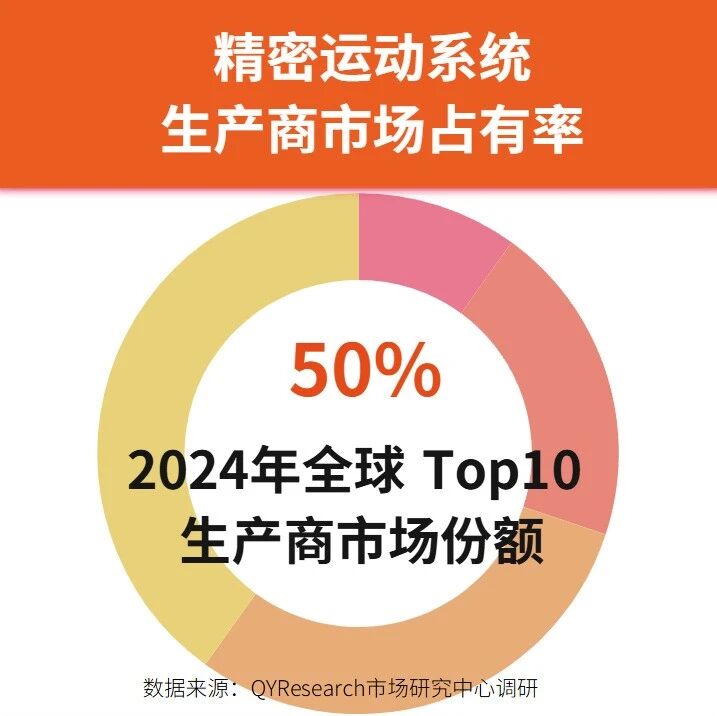
Core Insights - The global precision motion systems market is projected to reach $1.99 billion by 2031, with a compound annual growth rate (CAGR) of 8.77% in the coming years [5] - The industry is characterized by a dual structure of "oligopoly stability + accelerated local differentiation," with top manufacturers holding significant market shares [9] Market Size and Trends - The precision motion systems market is expected to grow significantly, driven by advancements in semiconductor manufacturing and optical device production [5][13] - The market is shifting from single-axis standard products to multi-axis collaborative and intelligent control systems [13] Competitive Landscape - The top three manufacturers account for approximately 26% of the market share, while the top ten account for about 50%, indicating high market concentration and significant entry barriers [9] - Major players like MKS (Newport), Physik Instrumente (PI), and THK dominate the high-end market through vertical integration and comprehensive system solutions [9] Product Segmentation - Precision motion platforms can be categorized into linear, rotary, and composite platforms, with linear platforms representing over 60% of total demand [11] - The demand for high precision and high rigidity in semiconductor wafer transport and optical measurement drives the market for linear platforms [11] Application Structure - The semiconductor and flat panel display sectors are the largest downstream applications, accounting for about 40% of the market [13] - The demand for precision motion systems is evolving towards more complex applications, including multi-axis coordination and intelligent control systems [13] Supply Chain Analysis - Key upstream components include linear motors, rotary motors, and air bearings, which are crucial for determining the precision and stability of motion platforms [19] - Major suppliers like THK and NSK dominate the high-precision linear guide and ball screw markets, while domestic companies are making strides in mid-to-high-end segments [19] Industry Development Trends - The precision motion systems industry is witnessing a trend towards sub-micron precision and the acceleration of breakthroughs in nano-level precision [23] - Modularization and customization are becoming prevalent, allowing for faster delivery and integration while meeting stringent requirements in high-end applications [24] Driving Factors - Long-term demand from the semiconductor and precision optics sectors is driving the need for high-end platforms capable of nano-level positioning [28] - The expansion of laser processing applications and the increasing demand for high bandwidth are pushing advancements in precision motion technology [28]

Optimus人形机器人量产在即,热管理巨头加速布局
DT新材料· 2025-09-28 16:03
Core Viewpoint - Elon Musk emphasized that Tesla is fully committed to scaling the Optimus project, defining it as the most important product in the company's history, with expectations that it will account for 80% of the company's future value [2][6]. Group 1: Production Timeline and Goals - Tesla aims for internal limited production and testing of thousands of Optimus units by 2025, ramping up to 50,000-100,000 units for external sales in 2026, and targeting an annual production of 1 million units within five years [2]. - The current supply chain for Optimus is based on the design of Optimus V2, with actuators and sensors each accounting for approximately 30% of material costs [4]. Group 2: Supply Chain and Component Suppliers - The supply chain for Optimus includes Tier 1 suppliers such as Sanhua Intelligent Controls and Top Group for actuators, and Mingzhi Electric and Zhaowei Electromechanical for dexterous hands [7]. - Key component suppliers include Shuanghuan Transmission and Lide Harmony for reducers, Best for lead screws, and Rongtai Health for insulation parts [7]. - International Tier 1 suppliers include Amphenol for cables, TE Connectivity for six-dimensional torque sensors, and THK for lead screws [8]. Group 3: Challenges and Development Needs - Current challenges for Optimus include hardware issues such as overload and overheating of joint motors, insufficient dexterity and load capacity of dexterous hands, and the lifespan of transmission components [10]. - There is a need for improved compatibility between hardware and software, particularly in complex dynamic environments and multi-task coordination [10]. Group 4: Thermal Management Solutions - The thermal management system for Optimus V3 is similar to that of electric vehicles, focusing on the management of key components like batteries and motors [11]. - Sanhua Intelligent Controls is developing liquid cooling modules for Optimus, leveraging its experience in electric vehicle thermal management to address overheating issues in robotic joints [13]. - Sanhua plans to deliver approximately 2,000 actuators to Tesla by Q3 2025, with an annual order forecast of 5,000-10,000 units [13]. Group 5: Industry Trends and Future Outlook - Domestic suppliers are increasing investments to meet the demand for high-performance, miniaturized thermal management components for robots [14]. - The year 2025 is anticipated to be a pivotal year for humanoid robot mass production, with 2026 expected to be a critical turning point for the industry landscape [14]. - The upcoming iTherM 2025 conference will address advanced thermal management technologies and materials relevant to humanoid robots [15].



灵巧手:赛道蓝海可期,各类新技术百花齐放
2025-09-09 14:53
Summary of Key Points from the Conference Call Industry Overview - The conference call discusses the humanoid robot industry, focusing on the development and technology of dexterous hands, which are crucial for precise operations in humanoid robots [1][2][3]. Core Technologies and Trends - **Drive Modules**: The main drive technologies include hydraulic, motor, pneumatic, and shape memory alloy drives. Motor drives are favored due to their cost-effectiveness and technical advantages, with hollow cup motors being seen as the ideal choice for the future due to their efficiency and low noise [1][3][4]. - **Reduction Modules**: These modules increase motor torque and include harmonic reducers, planetary reducers, and RV reducers. Harmonic reducers are considered the mainstream choice due to their compact size and high load capacity, while Japanese manufacturers currently dominate the market [5]. - **Sensor Modules**: These are critical for assessing the usability of humanoid robots, affecting operational flexibility, load efficiency, and interaction safety. The international market is led by Japanese and European manufacturers, but domestic companies are gradually improving their capabilities [6][7]. Market Dynamics - The market for various components is projected to grow significantly over the next three years, with expected market sizes of 13.1 billion, 2.5 billion, 2.5 billion, and 16.3 billion for drive modules, reduction modules, transmission modules, and sensor modules, respectively. The overall compound annual growth rate (CAGR) is anticipated to reach 110% [3][13]. - **Hollow Cup Motors**: European suppliers currently lead in this segment, but domestic companies like Mingzhi Electric and Dingzhi Technology are emerging with competitive advantages in cost and efficiency [8]. - **Tactile Sensors**: The dominant technology is resistive sensors due to their maturity, low cost, and high sensitivity. The six-dimensional torque sensor market is primarily led by overseas companies, but domestic firms are beginning to emerge [9][10]. Competitive Landscape - The dexterous hand industry is still in its early stages, with three main player categories: self-research entities, new entrants, and component extension players. Each category has opportunities for growth and differentiation [14]. - Tesla's humanoid robot is expected to lead the market with large-scale production planned for 2025, which could significantly impact the industry and create opportunities for domestic suppliers [15]. Investment Opportunities - Companies such as Longsheng Technology, Qiangjing Technology, Wuzhou Xinchun, Nanshan Zhishang, Hengshuai Co., and Guangyang Co. are highlighted as potential investment targets due to their strengths in specific segments of the humanoid robot supply chain [15]. Additional Insights - The industry is witnessing trends such as increased dexterity in dexterous hands, expansion of micro-screw applications, the emergence of electronic skin technologies, and the promising application of PEEK materials in lightweight humanoid robots [11][12].
丝杠行业深度
2025-08-12 15:05
Summary of the Screw Rod Industry Conference Call Industry Overview - The screw rod market is experiencing exponential growth driven by the development of humanoid robots and embodied intelligence, with domestic manufacturers like Zhaowei Electromechanical and Yingshi adopting micro screw rod solutions, significantly increasing demand, especially in the micro screw rod sector [2][3][14] Market Size and Segmentation - The Chinese four-cylinder market (excluding humanoid robots) is approximately 3 billion yuan, with the ball screw rod segment holding the highest share (1.663 billion yuan), while trapezoidal screw rods have the largest sales volume but lower value (1.064 billion yuan), and planetary roller screw rods have the smallest share (118 million yuan). The market is expected to maintain double-digit growth over the next 5-10 years, further propelled by humanoid robots [2][7] Market Dynamics - The ball screw rod market is dominated by Taiwanese, Japanese, and European and American companies, with NSK, THK, and Schaeffler accounting for 94% of the global market share. The domestic high-end ball screw rod localization rate is only 30%, indicating significant room for improvement for local companies [2][9][21] Technological Developments - Planetary roller screw rods are widely adopted in humanoid robot projects by companies like Tesla, Xiaopeng, and Xiaomi due to their high load capacity and self-locking features, particularly suitable for joints requiring high axial force [2][11][12] Design Innovations - Tesla's humanoid robot hand design may shift from a worm gear scheme to a motor with a reducer combined with C-shaped steel and tendon ropes to improve transmission efficiency, indicating a trend towards increased demand for micro C-shaped steel, with a single hand potentially requiring 17 micro screw rods [2][13] Industry Challenges and Improvements - The screw rod processing industry faces challenges such as internal thread grinding precision and efficiency. The industry is actively exploring new processing methods to enhance efficiency and reduce costs, including the use of lightweight materials like PEEK [4][15][19] Future Market Potential - The application of micro screw rods in robots is expected to grow significantly, with projections indicating that if humanoid robot production reaches 1 million units annually, the market for micro screw rods could reach 28 billion yuan. If production reaches 3 million units, the market potential could exceed 50 billion yuan [14][24] Key Players and Developments - Major domestic players in the screw rod industry include Hengli Hydraulic, Shuanglin Co., Huichuan Technology, Best, Beite Technology, and Wuzhou Xinchun, all actively expanding their screw rod and related businesses [22][24] Conclusion - The screw rod industry is poised for significant growth driven by advancements in humanoid robotics and increasing demand for high-performance screw rod solutions. The market dynamics indicate a shift towards domestic production and innovation, with substantial opportunities for local manufacturers to capture market share in high-end applications [2][21][24]
投资者陈述_日本股票策略-Investor Presentation_ Japan Summer School_ Japan Equity Strategy
2025-08-08 05:02
Summary of Key Points from the Conference Call Industry Overview - **Industry**: Japanese Equities - **Key Themes**: The presentation discusses macroeconomic and microeconomic forces driving Japanese equities, including nominal growth, U.S. tariffs, political changes, corporate governance reforms, and industrial competitiveness in a multipolar world [1][5][6]. Core Insights 1. **Strong Nominal GDP Growth**: - Japan's nominal GDP is projected to grow significantly, with forecasts indicating a rise from 480 trillion yen in 1995 to 3,400 trillion yen by 2027 [9]. - Morgan Stanley's TOPIX forecast is set at 2,900 points as of June 2026, with a base case EPS growth of 185 million yen for December 2025 [10][12]. 2. **Impact of U.S. Tariffs**: - The U.S. tariffs and investment packages are influencing Japanese stocks, with a focus on the cumulative excess return on TOPIX for stocks sensitive to tariffs [27][30]. - Stock price gains post-U.S.-Japan tariff agreements have shown weak performance support, indicating potential volatility in the market [30][35]. 3. **Political Landscape Changes**: - The focus of uncertainty is shifting from external pressures, such as tariffs, to internal political dynamics, including public opinion on leadership and fiscal policies [47][51]. - The government fiscal balance is improving, which may influence future investment strategies [54]. 4. **Corporate Governance Reforms**: - Ongoing reforms are expected to enhance shareholder returns and capital efficiency, contributing positively to the market outlook [7][20]. 5. **Sector Preferences**: - A barbell strategy is recommended, focusing on export-oriented manufacturing and domestic demand-oriented non-manufacturing sectors [20]. - Specific sectors such as pharmaceuticals, IT services, and construction materials are highlighted for their growth potential [20][22]. Additional Important Insights - **Focus List Performance**: The focus list of stocks reflects a cautious view on large external demand stocks while being bullish on domestic demand growth stocks [22][23]. - **Market Dynamics**: The analysis includes cumulative fund flows, indicating a trend of net purchases in cash equities by overseas investors, suggesting a positive sentiment towards Japanese equities [42][46]. - **Infrastructure Investment**: Upcoming government spending on infrastructure is anticipated, which may further stimulate economic growth and investment opportunities [61]. This summary encapsulates the critical insights and data points discussed in the conference call, providing a comprehensive overview of the current state and future outlook of the Japanese equity market.
日本股票策略:短期波动 -为选择性动量反转做好准备-Japan Equity Strategy_ Sho-Time_ Brace for Selective Momentum Reversal
2025-08-05 03:15
Summary of Key Points from the Conference Call Industry Overview - The report focuses on the **Japanese equity market**, particularly the **TOPIX 500** index and its performance in relation to earnings and market dynamics [1][11][12]. Core Insights and Arguments - **Contrarian Bias in Stock Reactions**: Share price reactions to 1Q earnings have shown a strong contrarian bias, with high-momentum stocks facing potential profit-taking despite solid earnings support [1][11][27]. - **Profit-Taking Opportunities**: Temporary selling in high-momentum names is viewed as an opportunity to buy on dips as the market heads into 2Q results [1][11][32]. - **Earnings Support Lacking**: The post-tariff-agreement rally lacks strong earnings support, with recent gains driven more by P/E expansion than by earnings strength [11][12]. - **Focus on Domestic Politics**: The focus of uncertainty is shifting from external pressures, such as tariffs, to internal pressures related to domestic politics, which could impact fiscal stimulus expectations [11][40][43]. - **Banking Sector Outlook**: The report maintains a long position in banks, anticipating that proactive fiscal stimulus could positively affect the banking sector [11][44]. Important but Overlooked Content - **Market Liquidity Concerns**: August is typically marked by lower market liquidity, raising caution against potential profit-taking by foreign investors, which could increase volatility [11][19]. - **Historical Patterns**: Historically, stocks with high run rates tend to rise until Q2 results are released, but a contrarian pattern emerges when considering Q1 earnings reactions [27][30]. - **Sector-Specific Risks**: Auto stocks are highlighted as particularly vulnerable due to ongoing tariff uncertainties, which could constrain EPS growth [11][14]. - **Dividend Yield Factor**: The effectiveness of the dividend yield factor has increased, suggesting a shift in focus for investors amid rising volatility [11][19][21]. Data and Exhibits - **Exhibit 1**: Shows the TOPIX 500 revision and YoY stock price comparison, indicating that stock increases following the Japan-US tariff agreement lack strong earnings support [3][16]. - **Exhibit 2**: Illustrates stock reactions to recurring profit achievement rates, emphasizing the need to watch for profit-taking in high-momentum names [5][36]. - **Exhibit 13 and 14**: Lists high-momentum stocks with elevated valuations and limited earnings support, as well as those with strong earnings backing price gains, respectively [37][38]. This summary encapsulates the key insights and data points from the conference call, providing a comprehensive overview of the current state and outlook of the Japanese equity market.
揭秘2025中国工博会机器人展,展品亮点抢“鲜”看!
半导体芯闻· 2025-07-21 10:44
Core Viewpoint - The 2025 China Industrial Expo Robot Exhibition, themed "Embodied Industry, Intelligent Future," will showcase over 500 renowned global companies and highlight cutting-edge robotic technologies and applications in a vast space of 56,000 square meters [2]. Group 1: Collaborative Robots - ABB's PoWa is a compact collaborative robot designed for speed and efficiency, achieving industrial-grade speeds of up to 5.8 m/s, making it ideal for small and medium enterprises with its no-code programming and plug-and-play capabilities [4]. - JAKA Lumi is an embodied intelligent platform designed for lightweight scenarios, featuring a 12-degree-of-freedom collaborative motion system that enhances production efficiency and product quality in tight spaces [7]. - GBT-C12A from Jiebo is a collaborative robot with a repeat positioning accuracy of 0.03mm, suitable for high hygiene and precision requirements in food processing environments [10]. Group 2: Industrial Robots - FANUC's ROBODRILL DC series is a high-efficiency machining center that enhances processing speed and quality through structural optimization and AI algorithms [19]. - Yaskawa's MOTOMAN-ME1000 is a heavy-duty SCARA robot capable of handling loads up to 1 ton, specifically designed for electric vehicle battery assembly [22]. - KUKA's KR IONTEC ultra is optimized for battery handling and lightweight spot welding, offering high dynamics and precision in compact spaces [25]. Group 3: Humanoid Robots - The Doco humanoid robot from Siasun integrates intelligent interaction and autonomous operation, capable of performing complex assembly tasks and providing services in commercial settings [48][49]. - Kepler's K2 "Bumblebee" humanoid robot combines cloud-based models with physical capabilities, enabling it to autonomously complete tasks in logistics and hazardous environments [52]. - DexForce W1 is a humanoid robot designed for precise operations in complex environments, featuring 34 actuators for flexibility and real-time environmental sensing [56]. Group 4: Intelligent Perception - Mech-GPT from Mechamand is an intelligent system that combines perception, decision-making, and execution capabilities, enhancing robots' ability to understand and interact with their environment [58][60]. Group 5: Logistics Innovations - Jiateng's single-arm unmanned forklift is designed for low-profile material handling, improving logistics efficiency in warehouses [80]. - Sainade's iLoabot series includes intelligent robots capable of autonomous loading and unloading, with advanced navigation and operational capabilities [83]. Group 6: Industry Applications - Songchuan's AIS-200 mechanical arm box-opening machine offers high cost-effectiveness and compatibility across various industries, streamlining the box-opening process [87].