
Wedbush

Search documents
AI焦虑搅动市场,用数据辨清调整虚实
Sou Hu Cai Jing· 2026-02-17 15:27
近期不少投资者被AI搅得心慌,一会儿怕软件股被颠覆,一会儿又想追风口。但机构研报给出了明确信号:高盛指出过去三个月软件 类股两年期前瞻性盈利预期已上调5%,即便处于AI担忧核心的板块,2026年每股盈利预期仍在上修,且四季度业绩实现两位数增长; Wedbush分析师也直言,当下对软件股的悲观情绪并不理智,AI的真实应用正加速落地。 但现实中,多数投资者炒股全靠感觉:看形态就抄底,见调整就离场,常常踩空或被套。其实,行情的核心是交易意愿,尤其是机构 的交易活跃程度——用量化大数据还原真实交易状态,就能跳出"靠感觉"的误区,辨清行情虚实。 一、靠走势判高低,全是马后炮 同样,量化数据显示,除了首次反弹有机构交易活跃信号,后续所有反弹都没有相关数据,机构交易活跃度未显现,反弹不具备持续 性,盲目入场只会陷入被动。二、上涨遇波动,别慌看数据 上涨途中的波动最磨人,尤其是大阴线出现,很多人会忍不住离场,错失后续行情。 但判断波动要不要慌,关键看机构的交易状态。 只要机构交易活跃度未下降,波动只是短期整理,行情仍有延续性。 看图3: 多数人炒股总在找高低点,看双底就觉得是入场时机,见跌多了就想捡漏,结果往往陷入被动。 这 ...


Wedbush Notes Underperformance As Lyft Stock Dives
Benzinga· 2026-02-11 20:49
Core Insights - Lyft's stock performance has weakened significantly, with shares down 16.85% to $14.01 following disappointing earnings results [5] Group 1: Financial Performance - Lyft reported fourth-quarter bookings growth of 18.6% year-over-year, reaching $5.1 billion, but this was below expectations [2] - Total rides grew 11.4%, falling short of Street estimates of 17.3% and below management's mid-to-high-teens growth outlook [2] - Revenue for the quarter was $1.6 billion, up just 2.7% year-over-year, and approximately 9% below estimates, impacted by a one-time legal, tax, and regulatory charge [2] Group 2: Analyst Reactions - Following the earnings report, Wedbush lowered its price target for Lyft from $16 to $13 and maintained an Underperform rating, citing weaker ride growth and modest guidance [3] - Concerns were raised about Lyft's long-term ability to meet its targets, with indications that Lyft may have lost U.S. mobility market share to Uber, which saw a 22% year-over-year growth in consolidated trips [3] Group 3: Future Guidance - Lyft's guidance for the first quarter indicated gross bookings growth of 16.8% to 20.1%, which is roughly in line with expectations [4] - Adjusted EBITDA is projected to be between $120 million and $140 million, below the Street's $140 million midpoint [4] - Management indicated that ride growth will lag behind bookings growth as the company shifts towards higher-priced offerings [4] Group 4: Broader Concerns - Longer-term risks highlighted include Lyft's exposure to autonomous vehicle disruption and a relatively undiversified business model [5] - There are concerns that the market may be underestimating the potential negative impact of autonomous vehicle adoption on Lyft's valuation [5]


小摩加入力挺美股软件股行列:AI冲击担忧被夸大 历史性下跌过后有望反弹
智通财经网· 2026-02-10 13:47
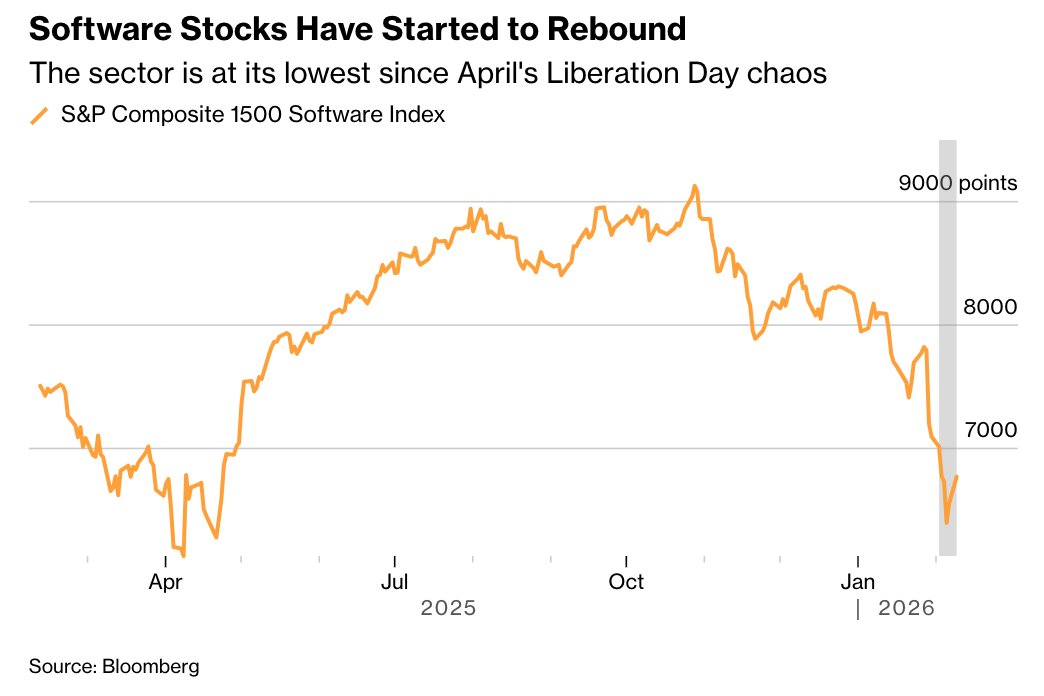
Core Viewpoint - Software stocks are expected to rebound from historic lows as the market has overly pessimistic expectations regarding AI's short-term disruption of the software industry, according to JPMorgan strategists [1][5]. Group 1: Market Sentiment and Stock Performance - The software sector has fallen to its lowest level since the market turmoil in April last year [4]. - Concerns over new AI tools potentially disrupting traditional Software as a Service (SaaS) business models have led to sustained pressure on U.S. software stocks [1][5]. - The recent sell-off did not differentiate between companies with AI partnerships or proprietary data assets, affecting nearly all related software companies equally [1]. Group 2: Company Resilience and Long-term Outlook - Companies like Microsoft and CrowdStrike are highlighted as resilient players in the AI space, likely to benefit from AI-enhanced workflow efficiencies [5]. - The high switching costs and long-term contracts in enterprise software provide a buffer against short-term disruptions [5]. - The long-term fate of traditional software companies in the face of AI remains uncertain, but current market pessimism appears to be an overreaction [5]. Group 3: Analyst Perspectives - Analysts from Morgan Stanley believe that U.S. tech stocks still have room for further gains, and the decline in software stocks has created an attractive entry point [5]. - Wedbush analysts argue that the market's reaction to AI risks is excessive, suggesting that the current sell-off implies an extreme assumption of widespread AI disruption, which is not feasible [6]. - The caution of enterprise clients regarding AI migration is emphasized, as many are reluctant to expose core data to immature new platforms [6]. Group 4: AI Integration and Market Dynamics - The narrative that AI will replace entire enterprise software stacks is overly simplistic; the value density of enterprise software lies in proprietary data and compliance structures [8][9]. - AI is more likely to integrate as embedded tools within existing software platforms rather than completely replacing them [6][9]. - The current sell-off reflects a market response to the question of how much profit pools in SaaS will be redistributed due to AI [10]. Group 5: Future Indicators and Investment Strategy - The rebound in software stocks may depend on two hard indicators: the speed of real deployment and payment expansion by enterprises, and the elasticity of SaaS companies' AI-related product revenues [10]. - Companies with strong data assets and solid fundamentals, such as Microsoft, MongoDB, Snowflake, Palantir, and SAP, are likely to experience a robust rebound post-panic [10].



Dan Ives: Software will be the heart and lungs of the AI revolution
Youtube· 2026-02-09 22:03
Core Viewpoint - The software sector is expected to play a crucial role in the AI revolution, despite current skepticism surrounding certain companies like Salesforce and ServiceNow [2][4]. Company Analysis - Salesforce's current price-to-earnings (PE) ratio is approximately 15, while ServiceNow's forward PE is nearly 25, indicating a significant discrepancy in valuation [5][8]. - There is potential for 20-30% incremental revenue growth for both Salesforce and ServiceNow, which is not currently reflected in their valuations [6][8]. - Salesforce is viewed as particularly dislocated in terms of its market opportunity, suggesting it may be undervalued compared to its potential [8]. Market Sentiment - The sentiment around software companies is mixed, with some being perceived as structurally broken while others, like Salesforce and ServiceNow, are expected to recover as AI use cases develop [3][7]. - Conversations with numerous CTOs and IT managers indicate a strong belief in the ongoing relevance and potential of Salesforce and ServiceNow, despite current market pressures [9][10]. Competitive Landscape - Microsoft is seen as integral to the success of the AI revolution due to its deep integration in enterprise solutions, particularly through Azure [11]. - Concerns have been raised about Microsoft's capital expenditure and its ability to keep pace with competitors like Google and Amazon, which may impact its free cash flow in the near term [12][13].


沃什提名引发投资者重估美元前景,成金银价格暴跌导火索,恐波及更多市场
Di Yi Cai Jing· 2026-02-02 07:05
Group 1 - The core viewpoint of the articles indicates that the recent nomination of Kevin Warsh as the next Federal Reserve Chairman has triggered a significant reevaluation of the dollar and dollar-denominated assets, leading to a sharp decline in gold and silver prices, marking the largest single-day drop since the early 1980s, with a total market value evaporation of $7.4 trillion [1][5][6] - The precious metals market is experiencing a de-leveraging effect, which is expected to impact other markets and increase the volatility of gold and silver prices [1][6][9] - The dollar index has risen by 0.8% since the announcement, reversing a previous decline of 2.1% in January, indicating a shift in market sentiment towards the dollar [5][6] Group 2 - Analysts warn that the recent surge in gold and silver prices, driven by strong demand from individual investors and a crowded long position, may lead to a significant price correction in the short term [6][8] - The CME Group has raised margin requirements for gold and silver futures, which may force high-leverage investors to exit the market, further reducing liquidity and exacerbating price volatility [8][9] - The recent price drop in gold and silver is seen as a typical correction following an extraordinary rise, with profit-taking and the strengthening dollar contributing to the bursting of this crowded trade bubble [9][10] Group 3 - The investment community is concerned about the spillover effects of the gold and silver price declines, which are causing a broader sell-off in other asset classes, including equities and cryptocurrencies [10] - The historical context of gold's price surge is highlighted, with comparisons to past economic crises, suggesting that the current market conditions may indicate a speculative bubble [10]

告别美联储看跌期权!Wedbush警告:沃什执掌下流动性红利将终结,未来数月美股或面临动荡
Sou Hu Cai Jing· 2026-02-02 03:51
Core Viewpoint - The report from Wedbush indicates that the U.S. stock market may face a period of volatility in the coming months as investors prepare for potential policy reforms under Kevin Warsh's leadership at the Federal Reserve [1]. Group 1: Market Outlook - Wedbush analysts expect market volatility to persist until Warsh officially takes office in May, as investors reassess their positions in light of a significant policy shift away from the framework established during Jerome Powell's tenure [1][2]. - The transition period is anticipated to be bumpy, with Wedbush suggesting that the downside risk in the stock market outweighs the upside risk as investors shift focus to companies with sustainable growth [2]. Group 2: Policy Changes - Under Warsh, the Federal Reserve is expected to shift its focus from interest rates to the size of the central bank's balance sheet, utilizing monetary supply as the primary tool against inflation through quantitative tightening [1][2]. - This change is seen as the end of the "Fed put," which refers to the market's assumption that the central bank would intervene to support asset prices in non-crisis situations [1]. Group 3: Warsh's Background and Views - Warsh, nominated by Trump, has a history of skepticism towards large-scale asset purchases and previously resigned from the Fed in 2011 due to his opposition to the second round of quantitative easing [2][4]. - His nomination signifies a potential ideological shift in U.S. monetary policy, emphasizing inflation control and policy independence, contrasting with Powell's consensus-driven approach [5]. Group 4: Market Implications - Warsh's hawkish stance and support for balance sheet reduction may negatively impact risk assets reliant on excess liquidity while benefiting U.S. Treasuries and the dollar, putting pressure on gold and silver [1][4]. - Analysts believe that while Warsh may implement 2-3 rate cuts this year to align with government expectations, he will also prioritize inflation control, indicating a more stringent approach compared to Powell [5].
告别美联储看跌期权!Wedbush警告:沃什执掌下流动性红利将终结 未来数月美股或面临动荡
智通财经网· 2026-02-02 03:27
智通财经APP获悉,投行Wedbush在一份策略报告中表示,随着投资者为凯文·沃什领导下的美联储可能 进行的政策全面改革做好准备,未来几个月美国股市可能面临一段震荡期。 在2月1日发布、题为《告别美联储看跌期权》的报告中,Wedbush分析师萨姆·巴沙姆指出,美国特朗普 选择沃什出任下一任美联储主席,短期内很可能令市场不安,直到今年晚些时候政策前景逐步明朗。该 机构预计,在沃什于5月正式上任之前,市场波动性仍将持续,因为投资者开始计入其所认为的、与鲍 威尔时代政策框架的决定性决裂。 据悉,沃什的立场相对偏鹰派,且更倾向于维护美联储的独立性,这一预期弱化了市场对美联储宽松货 币政策的预期。此外,沃什是美联储缩表的坚定支持者。在过去一年的多次演讲中,沃什反复表示,美 联储多年来激进的债券购买计划已经走得太远,并可能将其拖入财政政策的混乱政治泥潭。有市场参与 者警告称,沃什倾向于以加速缩减资产负债表为代价换取降息,这将成为不利于股债市场流动性扩张的 独特政策组合。 该机构预计,过渡期将会颠簸不平。从现在到5月,如果负面动能累积,Wedbush认为股市"下行风险大 于上行风险",因为投资者将重新评估高贝塔敞口,并转向 ...
Google, Amazon, Microsoft, and Meta earnings set the stage for Nvidia
Yahoo Finance· 2026-01-27 14:17
Core Viewpoint - Wall Street is focused on understanding the current expansion of AI infrastructure and the associated costs, with major companies like Microsoft, Meta, Amazon, and Alphabet set to provide insights that will influence investor sentiment and expectations for AI-related capital expenditures [1][4][22] Group 1: Company Insights - Microsoft will discuss Azure and enterprise demand, with expectations for strong AI revenue growth, while also needing to reassure investors about the sustainability of its spending [5][7][13] - Meta's simpler business model relies on advertising revenue, and analysts expect it to deliver modest results while assessing the impact of AI spending on its ad performance [8][10] - Amazon is expected to frame its AI investments as a response to growing demand, with AWS positioned as a key growth engine, while also managing operational efficiency [14] - Alphabet's strategy involves leveraging its comprehensive AI tech stack, but it faces scrutiny regarding the speed of monetization from its AI investments [15][16] Group 2: Market Dynamics - The upcoming earnings calls will serve as a stress test for the AI supply chain, with the language used by these companies indicating their confidence in ongoing AI demand and spending [4][12][22] - Investors are keen to see whether companies will maintain a bullish outlook on AI infrastructure or shift towards more cautious language regarding spending and capacity [19][21] - The narrative built from these earnings reports will significantly influence Nvidia's market position, as it is closely tied to the demand signals from these major players [18][22]



Citigroup CEO Jane Fraser Doesn't Expect 'Sell America' Sentiment to Last in Markets
Investopedia· 2026-01-20 22:50
Core Viewpoint - The current move away from American assets is not expected to be long-lasting, according to Citigroup CEO Jane Fraser [1][7]. Market Reactions - U.S. stocks experienced a significant decline, the dollar weakened, and bond prices fell, leading to a sharp increase in Treasury yields, while investors shifted towards gold and silver following the announcement of tariffs related to Greenland [2][3]. Investor Sentiment - Fraser expressed confidence that momentum will return to favor American assets, emphasizing the resilience of American entrepreneurs and consumers despite geopolitical challenges [3][4]. - Corporate leaders are optimistic about a resolution to the current uncertainties, and companies have adapted to manage trade disruptions effectively [4][6]. Economic Outlook - The U.S. economy is positioned strongly, with robust consumer spending during the holidays and potential increases in spending due to tax code changes. Companies may also benefit from deregulation and investments in AI [5][6].


Goldman Sachs revamps Microsoft stock price target before earnings
Yahoo Finance· 2026-01-17 19:17
Core Viewpoint - Goldman Sachs has issued a buy rating for Microsoft (MSFT) with a price target of $655, indicating a potential upside of nearly 37% from current prices [1] Group 1: Stock Performance - Microsoft has achieved a remarkable 91% gain over the past three years, outperforming the broader market [2] - In the previous year, the stock's performance was muted, with only a 7% increase, attributed to AI fatigue despite its first-mover advantage [2] - Currently, the stock is trading at over 28-times non-GAAP forward earnings, which is 12% lower than its five-year average [2] Group 2: Analyst Perspectives - Goldman Sachs holds the most bullish price target among major analysts, with others like Morgan Stanley at $650, Barclays at $610, J.P. Morgan at $575, and Wedbush at $625 [3][7] Group 3: AI Strategy and Long-term Value - Goldman Sachs believes the market is underestimating the long-term value of Microsoft's AI initiatives, particularly its Copilot tools and AI agent-based workflows [4][5] - The firm argues that Microsoft's approach is transitioning from experimentation to practical, repeatable use cases [6] - Microsoft's Copilot apps have gained significant traction, boasting 100 million monthly active users and being utilized by over 90% of Fortune 500 companies [8][9] Group 4: Financial Projections - Goldman Sachs projects that Microsoft could achieve over $35 in earnings per share by fiscal 2030, indicating more than 20% EPS growth, surpassing the mid-teens growth expected from other mega-cap companies [10] Group 5: Market Dynamics - The market for agent-based AI is expected to grow significantly, with Gartner predicting that 40% of enterprise applications will include task-specific AI agents by the end of 2026 [13] - Microsoft's Azure business has surpassed $75 billion in sales in fiscal 2025, with continued growth anticipated [18]